

It’s the final week of the quarter. The pressure’s on, deals are slipping, and leadership is asking that one question that sends chills down the sales floor: “Is this number real?”
Here’s the uncomfortable truth: 93% of sales leaders can’t forecast revenue within a 5% margin of error—even with just two weeks left in the quarter.
For most sales professionals, forecasting feels like tedious admin work. A number you submit for your manager’s dashboard. But this perspective misses something critical: forecast accuracy isn’t just a reporting metric—it’s one of the most powerful, learnable skills that separates top performers from everyone else.
This guide transforms forecasting from a chore into your strategic weapon. You’ll learn what “good” actually looks like, understand the key metrics that matter, diagnose what’s killing your accuracy, and discover a concrete playbook to take control of your numbers—and your commission check.
What is a Good Level of Forecast Accuracy?
At its core, forecast accuracy measures how closely your predicted sales value matches what actually closes. It’s the ultimate test of predictability and the foundation of smart business strategy.
But what counts as “good” in the real world?
The Gold Standard
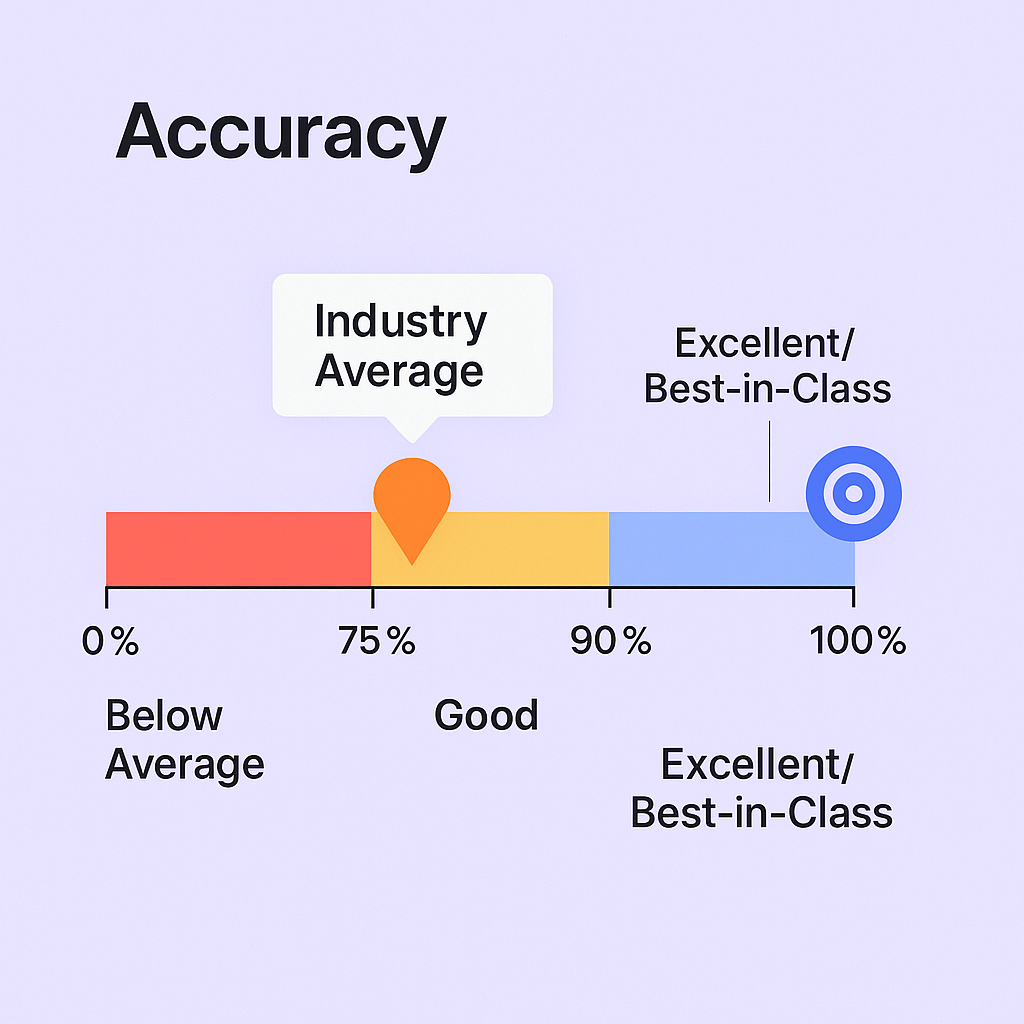
Industry benchmarks give us clear targets. According to Forrester research, sales projections within a 5% margin are “excellent,” while 10% margin earns a “good” rating. Best-in-class sales organizations consistently hit 90-95% forecast accuracy—a level of precision that allows confident planning and resource allocation.
The Reality Check: A Confidence Crisis
Despite these clear benchmarks, most organizations fall dramatically short. The data reveals a massive gap between standard and reality:
Only 20% of sales organizations achieve forecasts within the “excellent” 5% range. Even more concerning, 43% miss their projections by 10% or more. Some reports paint an even bleaker picture: 80% of organizations fail to achieve forecast accuracy greater than 75%.
This poor performance breeds skepticism. Less than 50% of sales leaders and sellers have high confidence in their company’s forecasting accuracy. A January 2024 poll found that fewer than 20% of sales leaders would rate their organization’s forecast as “predictable.”
Your forecast accuracy functions as internal currency. High accuracy buys autonomy, trust, and preferential access to limited resources required to win. A history of precision signals to leadership that investing a solution engineer’s time or legal’s attention in your deal is sound business. In contrast, low accuracy incurs a “tax” in the form of micromanagement, skepticism, and friction in securing those same resources.
What Factors Affect Your Attainable Forecast Accuracy
Before you can fix your forecast, you must diagnose what’s breaking it. Inaccuracy rarely results from a single mistake—it’s typically the outcome of several underlying issues in process and judgment.
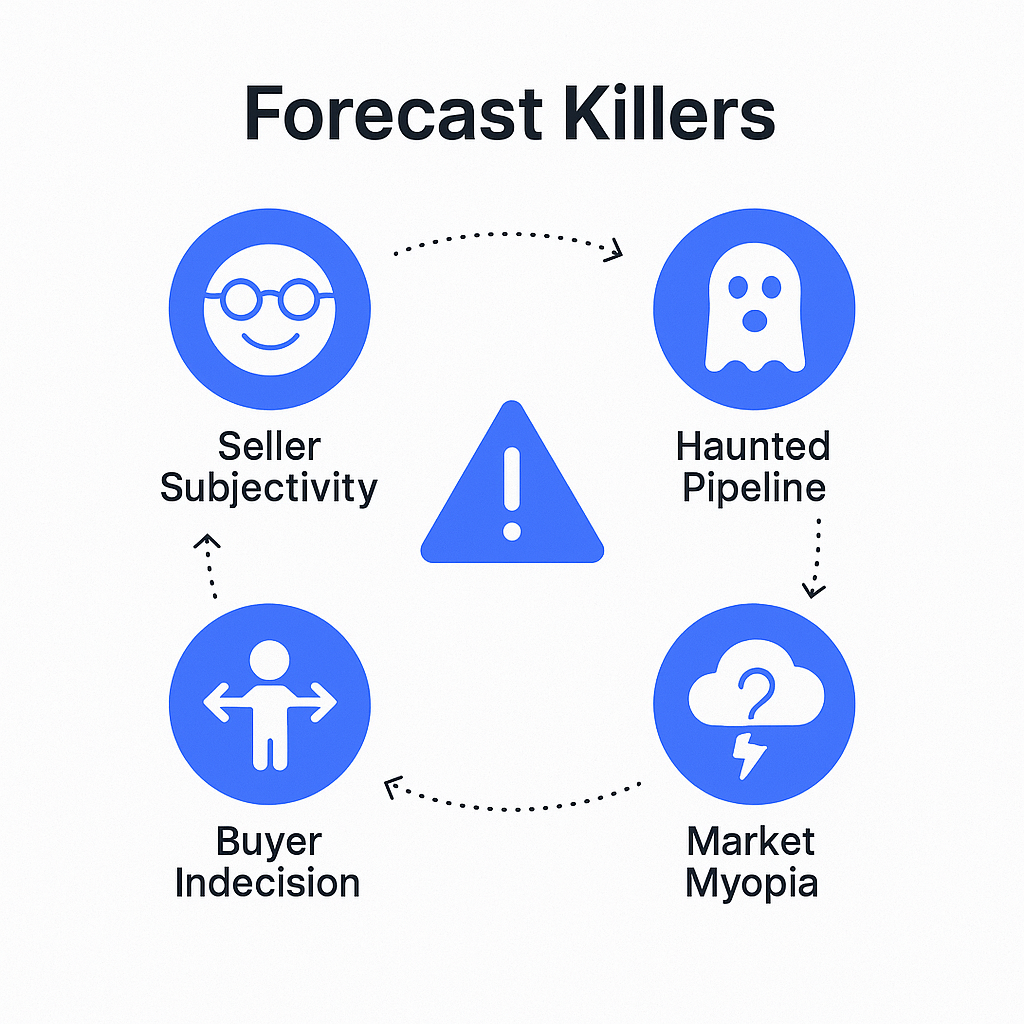
These five “forecast killers” are the most common culprits:
Seller Subjectivity (The “Happy Ears” Epidemic)
This is the classic challenge of relying on gut feelings and optimistic interpretations rather than objective, verifiable data from sales data. Sales professionals, naturally optimistic, fall into the trap of hearing what they want from prospects. This is especially prevalent with sparse pipelines and emotional investment in few deals.
The key to combating this: shift focus from what the buyer says to what the buyer does. Customer words are subjective; customer actions are demand data.
The Haunted Pipeline (Garbage In, Garbage Out)
Nothing undermines forecast accuracy faster than a CRM cluttered with phantom opportunities. These deals pad the pipeline, creating false security, but aren’t real. They appear in three forms:
- “Ghost Deals”: Opportunities without specific deal amounts
- “Timeless Wonders”: Deals missing projected close dates
- “Walking Dead Deals”: Stale opportunities that constantly slip quarters
Research shows deals with no activity for 30+ days are 80% less likely to close—yet they often remain in active forecasts.
Undefined Deal Stages (The “Feels Like” Problem)
A primary cause of inaccuracy is advancing deals based on subjective feelings (“it feels like we’re in the proposal stage”) rather than objective, buyer-centric milestones. A robust sales process must have clearly defined entry and exit criteria for each stage based on concrete actions taken by the customer, not just the seller.
For example, deals shouldn’t move to “proposal review” simply because you sent the proposal, but only after the buyer confirms receipt and schedules a formal review session.
Market Myopia (Ignoring the Headwinds)
Even the most rigorously managed sales process can be derailed by external forces. Sales professionals who operate in a vacuum, ignoring broader market conditions, set themselves up for failure. Factors like economic downturns, inflation, new competitive launches, or regulatory changes can all impact buyer ability and willingness to purchase.
Buyer Indecision (The “JOLT Effect”)
Often, deals don’t die with a definitive “no.” They wither in customer indecision. Research published in “The JOLT Effect” found markers of customer indecision in 90% of analyzed sales calls. Sales professionals who misinterpret stalling as continued progress—believing the customer is “still thinking about it”—will have wildly inaccurate forecasts.
The Causal Chain
These five killers aren’t isolated—they often form a debilitating sequence. It begins with lack of a defined, objective sales process (Killer #3). Without clear criteria, you’re forced to rely on seller subjectivity (Killer #1). This directly results in a haunted pipeline (Killer #2) filled with poorly qualified deals lacking concrete amounts, close dates, or verified buyer commitment.
When this fragile pipeline inevitably gets struck by external shocks—market headwinds (Killer #4) or key stakeholder cold feet from buyer indecision (Killer #5)—the forecast collapses. Operating on subjectivity, you’re already emotionally invested and more likely to interpret red flags as minor delays rather than existential threats.
This demonstrates that fixing forecast accuracy requires starting at the root: defining the process to enforce objectivity, which in turn cleans the pipeline and makes it more resilient to unavoidable real-world shocks.
How to Assess Forecast Quality
Before improvement begins, you must know your starting point. This requires conducting a personal audit within your CRM.
Look back at the past four quarters. Compare your “forecast submission” value at various points (week 4, week 8, week 12) to the final “closed won” actuals for each period.
This exercise allows you to calculate your personal accuracy metrics and identify any consistent bias patterns—providing a clear, data-backed understanding of your historical performance. This baseline becomes your starting point and measures your progress over time.
Without this self-audit, you’re flying blind. You might think you’re accurate when you’re consistently off by 15%, or believe you’re conservative when you’re actually inflating numbers. The data doesn’t lie, and it gives you an objective foundation to build improvement strategies.
How the Main Forecast Accuracy Metrics Work
To improve forecast accuracy, you must first understand how it’s measured. While becoming a data scientist isn’t required, grasping key metrics is non-negotiable for any sales professional wanting to take control of their performance.
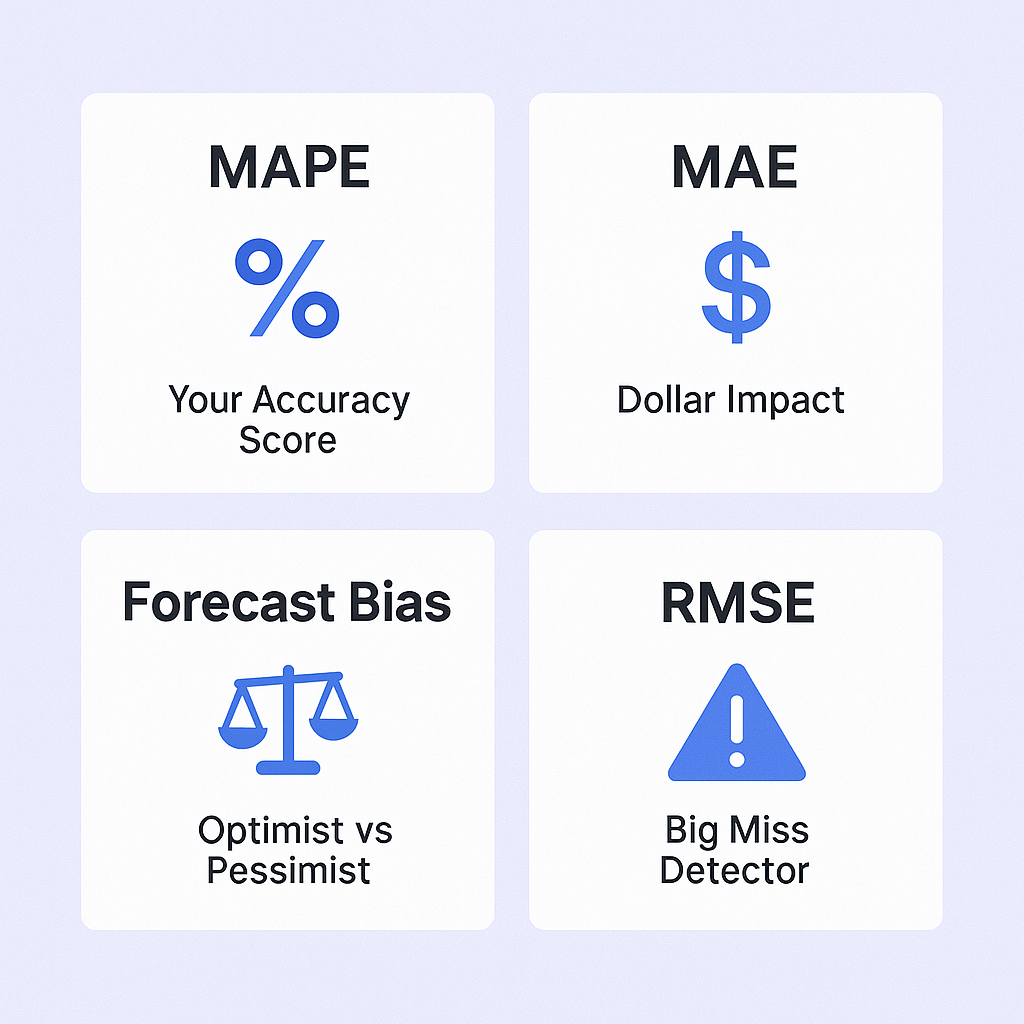
These metrics provide objective feedback needed to diagnose issues and track improvement:
MAPE (Mean Absolute Percentage Error)
Think of this as your long-term accuracy “batting average.” MAPE measures the average percentage difference between forecasted and actual values, making it excellent for tracking personal improvement over time or comparing accuracy against peers, regardless of deal size or quota.
For example, if you forecast $100,000 and close $90,000, the absolute error is $10,000, and the percentage error for that forecast is 11.1%. MAPE is the average of these percentage errors across all your forecasts in a given period.
MAE (Mean Absolute Error)
This metric represents the average dollar value of a miss. Unlike MAPE, which is a percentage, MAE quantifies the raw financial impact of an inaccurate forecast in the same units as the sale (dollars). It answers: “On average, by how many dollars was my forecast off?”
For instance, if you miss one forecast by $10,000 and another by $20,000, your MAE is $15,000.
Forecast Bias
This diagnostic metric reveals whether you’re a chronic optimist or pessimist. It measures the consistent tendency to either over-forecast (positive bias, often due to “happy ears”) or under-forecast (negative bias, aka “sandbagging”). A persistent bias—whether positive or negative—signals a systemic flaw in judgment or process that needs addressing.
RMSE (Root Mean Squared Error)
This metric acts as a “big miss” penalty. By squaring the differences between forecast and actual values, RMSE gives disproportionately more weight to large forecast errors. It’s particularly useful for understanding if your forecast is generally stable with minor deviations or prone to occasional massive mistakes that severely impact the business.
Quick-Reference Guide
Metric | What It Measures | Ask Yourself This | Why It Matters |
MAPE | Average percentage your forecast is off | “Over the last year, what was my average percentage error?” | Your credibility score over time. High MAPE tells your manager your pipeline is unpredictable |
MAE | Average dollar amount of your forecast error | “On average, how many dollars away from actual is my forecast?” | Quantifies real financial impact of your misses and helps in risk assessment |
Forecast Bias | Consistent tendency to over- or under-forecast | “Am I consistently wearing ‘happy ears’ or sandbagging deals?” | Reveals systemic flaws in judgment or qualification process needing correction |
RMSE | Standard deviation of forecast errors, penalizing large misses | “Is my forecast generally close, or do I make occasional massive errors?” | High RMSE indicates high volatility and risk, even if average error (MAE) is low |
How to Monitor Forecast Accuracy
Taking control of forecast accuracy requires discipline and a structured approach. This practical, five-step playbook provides a clear path to transform your forecasting from guesswork into a reliable game plan.
Step 1: Establish Your Baseline (Self-Audit)
Before improvement can begin, know your starting point. Conduct a personal audit within your CRM. Look at the past four quarters and compare “forecast submission” values at various points (week 4, 8, 12) to final “closed won” actuals.
This allows you to calculate your personal MAPE and identify any consistent forecast bias, providing clear, data-backed understanding of historical performance.
Step 2: Conduct a Ruthless Weekly Pipeline Review
This is about disciplined CRM hygiene. Every week, review every single deal in your forecast against this simple checklist:
- Does every opportunity have complete critical fields, including realistic amount and close date?
- Does every deal have a clearly defined, owner-assigned next step with a specific date?
- Has any deal been inactive for 30+ days? If so, immediately re-qualify or move out of active forecast
- Does the current deal stage reflect an objective, verifiable buyer action (e.g., “Have they provided feedback on the proposal?” or “Is budget allocated?”) rather than just seller action?
Step 3: Become a Sales Cycle Expert
Every sales professional must know their average sales cycle length. This number becomes a critical health metric for every pipeline deal.
An opportunity sitting in your pipeline significantly longer than average is a major red flag. It’s likely a “Walking Dead Deal” bloating your forecast that should be critically re-evaluated or removed.
Step 4: Reframe Your 1:1s (From Reporting to Strategizing)
Proactively change the nature of your weekly 1:1 meetings with your manager. Instead of simply reporting numbers, come prepared for a strategic coaching session about deal health.
Move beyond superficial questions. Shift the conversation from “Do you have executive sign-off?” to more powerful, verifiable questions like “Do all executive stakeholders know they’re in an active buying process?”
This approach transforms 1:1s from simple inspections into collaborative sessions that actively improve deal strategy and forecast accuracy.
Step 5: Commit with Confidence (and Discipline)
Use forecast categories with strict discipline. A common framework includes “Commit,” “Best Case,” and “Pipeline.”
Commit: These are deals you’d bet your job on. There’s overwhelming, objective evidence they’ll close within the quarter. All approvals are secured, and contracts are in final stages.
Best Case: These are well-qualified deals where you’re confident, but one or two critical milestones still need clearing (e.g., final legal review, executive sign-off).
This disciplined use of categories requires honesty with yourself and your managers. Some organizations encourage this honesty by incentivizing results that fall within a specific percentage of the salesperson’s committed forecast.
The Future: Your AI-Powered Co-Pilot
The evolution of sales technology is shifting CRMs from passive record systems to active intelligence partners. Artificial intelligence and accuracy machine learning are at the forefront, offering powerful tools to enhance forecasting capabilities.
