
🎉Find Prospects and Send Cold Emails & LinkedIn Outbound | All in One Place

SDR Compensation Statistics 2025: Salary & Pay Guide

Table of Contents

SDR Compensation Statistics 2025

  • Median base salary for BDRs is $55,000, with median OTE at $83,000 across national benchmarks
  • Top BDR performers can earn $130,000+ through consistent quota overachievement and accelerators
  • Entry-level BDRs (0-1 year) earn $70,000-$75,000 OTE with 70/30 base/variable pay mix
  • Mid-level BDRs (1-3 years) earn $80,000-$90,000 OTE with 65/35 base/variable pay mix
  • Senior BDRs (3-5+ years) earn $90,000-$100,000+ OTE with 60/40 base/variable pay mix
  • Pipeline generation roles typically have 68% base / 32% variable compensation split structure
  • Revenue-closing roles shift toward 44% base / 56% variable compensation, increasing risk and reward
  • Average quota attainment rate is only 54%, meaning most BDRs don’t hit full number every month
  • Promotion timeline has increased 28% post-pandemic, from 12 months to now 15-16 months on average
  • Staying in BDR role beyond 3-5 years leads to wage stagnation with minimal salary growth
  • Seattle leads compensation with median OTE of $160,149 and average base of $73,598
  • Remote BDR roles show average salary of $66,616, competitively above some major cities like Austin
  • Healthy Quota-to-OTE ratio ranges from 4:1 to 6:1, revealing how much revenue you must generate per dollar earned
  • Companies with strong compensation programs experience 50% higher employee retention rates than those with weak programs
  • Unrealistic sales targets rank as the top reason sales professionals want to leave their jobs

What’s your actual market value as a sales development representative in 2025?

It’s the question that keeps you up at night before a job interview. The one that runs through your head when you’re debating whether to ask for more money. And honestly, with so much conflicting salary data floating around online, finding a straight answer feels impossible.

Here’s the thing: understanding your compensation isn’t just about knowing a number. It’s about walking into negotiations with confidence, planning your financial future, and mapping out a career path that actually makes sense for you.

This guide cuts through the noise. We’ve pulled together the latest 2025 industry data, real benchmarks, and actual compensation structures to give you the complete picture. Whether you’re considering your first sales development role or negotiating your third, this is your roadmap.

Let’s get into it.

The 2025 Baseline: What Sales Professionals Actually Earn

First things first: what are we really talking about when it comes to pay?

The median base salary for sales development representatives in 2025 sits at $60,000. That’s your guaranteed income before any commissions or bonuses kick in.

When you factor in variable pay, the median on-target earnings (OTE) hit $85,000. This is what you’d make if you hit 100% of your quota.

But here’s where it gets real: only 55% of reps actually hit their quota

🎯 Struggling to Hit Your Quota?

Our LinkedIn campaigns deliver 3x more qualified meetings than cold calling or email outreach.

Let’s be honest about what that means. Almost half of all people in this role don’t reach their full earning potential. The gap between what’s advertised and what you actually take home can be significant.

Metric

2025 Benchmark

Median Base Salary

$60,000

Median OTE

$85,000

Average Quota Attainment

~55%

This isn’t meant to discourage you. It’s meant to set realistic expectations. The reps who consistently overperform are the ones who maximize their income. If you’re strategic about skill development and process, you can be in that top half.

The good news? Companies continue investing heavily in pipeline generation. Base salary floors remain stable even during economic uncertainty. This role is fundamental to revenue growth, and organizations know they need to pay competitively to get the right people.

How Your Paycheck Actually Works

Your compensation structure isn’t random. It’s designed to keep you fed while incentivizing the activities that drive results.

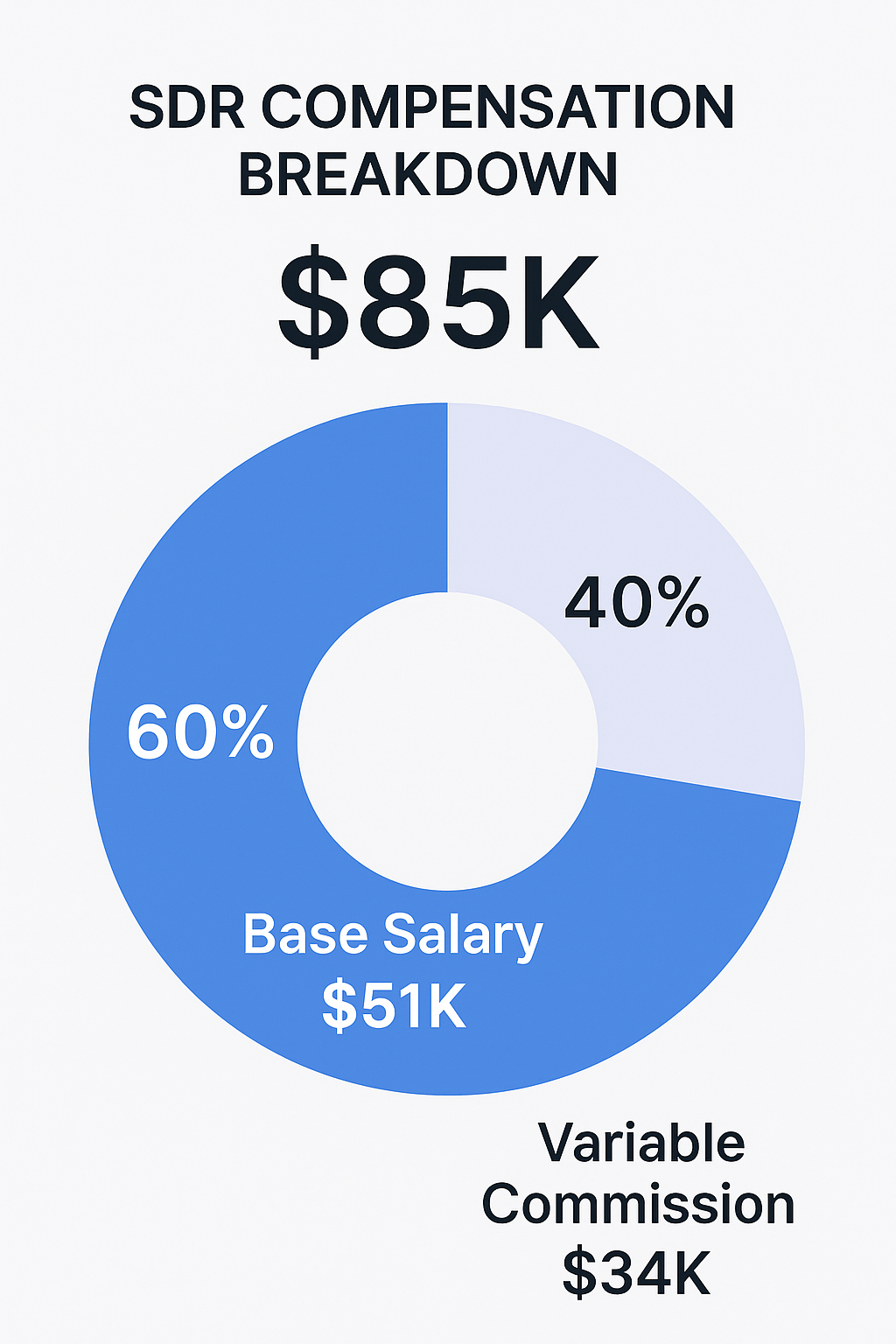
The most common split is 60% base salary and 40% variable commission out of your total OTE. This means if you’re looking at an $85,000 OTE role, roughly $51,000 is base and $34,000 is commission-based.


But this isn’t universal.

Early-stage startups often run a 70/30 split, giving you more base salary security. Why? Because they’re still figuring things out. Sales cycles are unpredictable, processes aren’t locked in, and they don’t want you stressed about rent while they’re finding product-market fit.

Established mid-market companies usually stick with the 60/40 split. They’ve got proven playbooks, predictable sales motions, and confidence in their conversion rates.

Enterprise sales environments sometimes push the base even higher—over 70%—because those deals take forever to close. You can’t be waiting six months for a commission check when you contributed to a deal that’s still in legal review.

Here’s something critical: pure commission-only structures don’t work for this role. The industry figured this out the hard way. Sales development sits at the top of the funnel. You don’t control whether deals actually close. Putting 100% of the financial risk on someone who doesn’t own revenue is just bad business. It burns people out fast and destroys team quality.

A solid base salary isn’t just about stability. It signals that the company values the role as a professional career step, not a revolving door position.

Where the Real Money Lives: Commission Breakdowns

Your base keeps the lights on. Your variable pay is where you actually accelerate your earnings.

Commission structures aren’t one-size-fits-all. Here’s how companies typically pay out:

Meeting-Based Plans You get paid a flat fee per meeting booked. Simple. Clean. Common in high-volume environments with shorter sales cycles. Think $50 per meeting as a baseline. Book 20 meetings in a month? That’s an extra $1,000.

💰 Want Higher-Quality Meetings?

LinkedIn targeting puts you in front of decision-makers ready to buy, maximizing your commission potential.

Quality-Driven Plans Companies got tired of low-quality meetings wasting everyone’s time. So they evolved. Now many pay based on qualified leads that meet specific criteria. These are your SQLs (Sales Qualified Leads) or SAOs (Sales Accepted Opportunities). The payout is higher—around $100 per qualified lead—because you’re being rewarded for better targeting.

Revenue-Aligned Plans The most direct connection to business outcomes. You earn 1-5% of the closed deal value for opportunities you source. This creates ultimate alignment, but there’s a catch: you might wait months between sourcing a lead and getting paid. This works better in faster sales cycles or high-velocity environments.

Hybrid Models The most mature approach blends everything. A typical hybrid might look like:

  • 40% from meetings booked
  • 30% from opportunities created
  • 30% from influenced pipeline value

This recognizes that your contribution is multifaceted. You’re rewarded for consistent activity and quality outcomes.

Commission Model

How It Works

What It Rewards

Best For

Pay-per-Meeting

$50/meeting booked

Volume & activity

High-velocity teams

Quality-Driven

$100/qualified lead

Better targeting

Complex sales

Revenue-Aligned

1-5% of deal value

Business impact

Shorter cycles

Hybrid

40/30/30 split

Activity + quality

Mature orgs

Most plans also include accelerators. Hit 120% of quota? Your per-meeting rate might jump from $50 to $75. These are designed to reward overperformance.

SPIFFs (Sales Performance Incentive Funds) are short-term bonuses. Think $200 for the highest conversion rate this week or a $500 bonus for booking 5 enterprise meetings this month. They keep things interesting.

Geography Changes Everything

Where you work dramatically impacts what you earn.

San Francisco leads the pack with OTEs regularly hitting $100,000+. The cost of living demands it. Tech companies compete aggressively for talent, and they pay up.
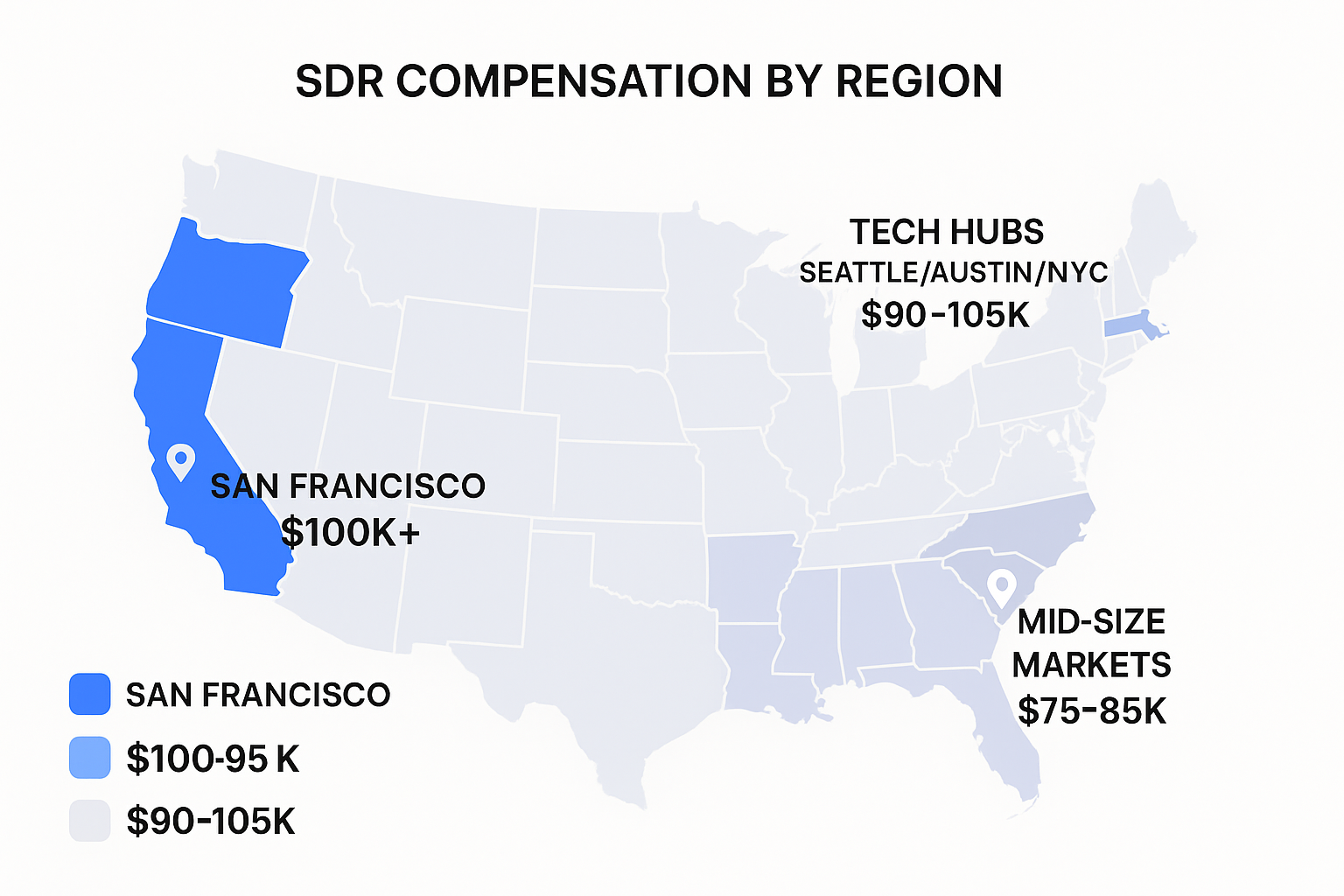
 

Major tech hubs (Seattle, Austin, Boston, New York) typically offer $90-105K OTE ranges. These markets have density of B2B tech companies and strong sales cultures.

Mid-size markets sit in the $75-85K OTE range. Lower cost of living, less intense competition for talent, but still solid compensation packages.

Here’s the shift: remote work changed the game. You can now work for a San Francisco company while living in a lower-cost market. Some companies adjust compensation based on your location. Others pay market rate regardless of where you live. Always clarify the policy during negotiations.

The gap between the highest and lowest markets can be $30,000+ in OTE. Geography matters.

Experience Levels the Playing Field

Your tenure impacts your earning power significantly.

Entry-level (0-1 year): Expect $70-80K OTE. You’re learning the ropes, building skills, proving you can execute.

🚀 Accelerate Your Career Path

Master LinkedIn outbound to consistently overperform, earn accelerators, and fast-track your promotion to AE.

Intermediate (1-2 years): Earning range moves to $80-95K OTE. You’ve demonstrated competence, understand the sales cycle, and can work independently.

Senior (3+ years): Top performers pull $90-105K+ OTE. At this stage, you’re either specializing (Enterprise SDRs) or you’re ready to transition into closing roles.

Company size also plays a role. Startups might offer lower base salaries but higher upside through equity. Mid-market companies provide stability and clear paths to promotion. Enterprises pay top dollar for specialized roles.

Enterprise SDR positions command premium pay—often 10-20% higher than standard roles—because they require deeper industry knowledge, sophisticated research skills, and the ability to navigate complex buying committees.

The Fast Track to Six Figures

Here’s what most people miss about sales development: it’s not meant to be a career destination. It’s a launchpad.

The typical career progression looks like this:
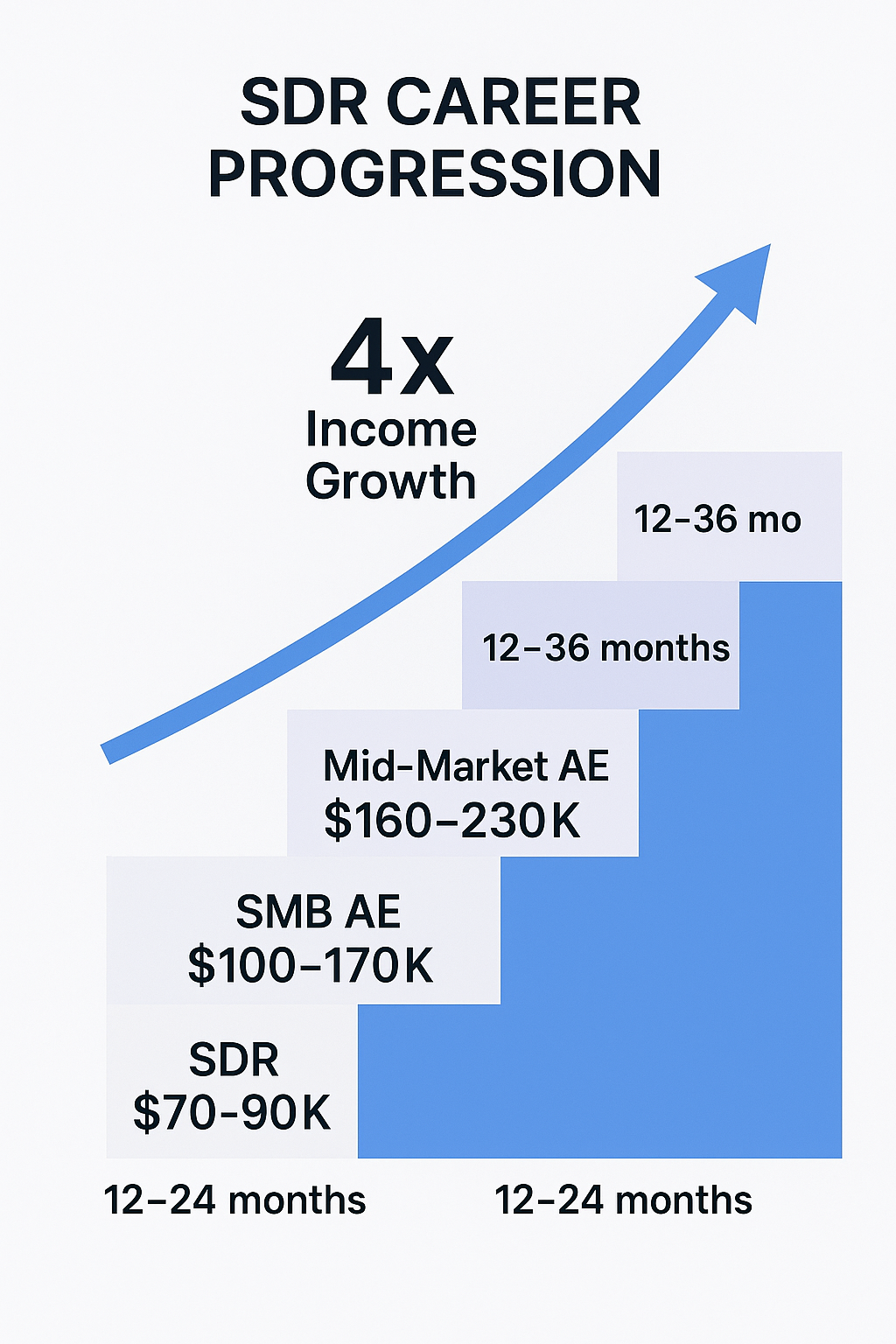


Sales Development Representative

  • Timeline: 12-24 months
  • OTE: $70-90K
  • Focus: Pipeline generation, qualification, meeting setting

SMB Account Executive

  • Timeline: 18-24 months
  • OTE: $100-170K
  • Focus: Closing small to mid-size deals

Mid-Market Account Executive

  • Timeline: 18-24 months
  • OTE: $160-230K
  • Focus: Complex deals, longer cycles, bigger contracts

Enterprise Account Executive

  • Timeline: Ongoing career role
  • OTE: $250-350K+
  • Focus: Strategic accounts, C-level relationships, major deals

Role

Time in Role

OTE Range

Sales Development Representative

12-24 months

$70-90K

SMB Account Executive

18-24 months

$100-170K

Mid-Market Account Executive

18-24 months

$160-230K

Enterprise Account Executive

Ongoing

$250-350K+

Do the math: you can 4x your income in 4-6 years. That’s faster wealth accumulation than most careers that don’t require an advanced degree.

Here’s the reality though: most people switch companies to get promoted. Internal promotion tracks are often slow or unclear. Only 9% of reps make the full progression at a single company. Each job switch adds about 8 months to the timeline, but it’s often necessary to secure the next level of responsibility and pay.

Be strategic about when you move. Stay long enough to prove results, but don’t stay so long you’re leaving money on the table.

What’s Coming: 2025 Trends

The role is evolving fast. Here’s what’s changing your compensation in real-time:

AI Is Handling Routine Work Automation tools now handle basic lead research, initial email sequences, and follow-up reminders. As AI takes over high-volume grunt work, compensation is shifting to reward higher-value activities: strategic engagement, personalized outreach to key accounts, and sophisticated multi-touch campaigns.

📈 AI-Powered LinkedIn Campaigns

While automation handles grunt work, our targeting and personalization strategies book meetings that close deals

7-day Free Trial |No Credit Card Needed.

The future splits into two paths:

  • AI-Powered Operators who master sales tech and manage outreach with extreme efficiency
  • Strategic Account Specialists who focus on deep research, complex buying committees, and high-value target accounts

Both paths pay well. You just need to pick your lane and develop those specific skills.

Faster Payouts = Better Retention Progressive companies switched from quarterly to monthly commission payouts. The result? 19% reduction in turnover and 12% increase in quota attainment. Getting paid more frequently keeps motivation high and provides immediate feedback on performance.

Team-Based Incentives Work Some companies now tie 5-10% of variable pay to team goals. This approach increases collaboration and reduces the isolation of individual quotas. Early data shows 31% more pipeline generated per rep in teams with shared incentives.

Skills-Based Bonuses Forward-thinking orgs reward learning. Complete a sales certification? Bonus. Master advanced objection handling? Bonus. These micro-incentives drive continuous improvement while signaling that the company invests in your development.

Enterprise SDR Specialization As companies focus on bigger deals, specialized Enterprise SDR roles are emerging. These positions require advanced industry knowledge and command premium compensation to reflect their strategic importance.

The generic, one-size-fits-all version of this role is fading. The future belongs to specialists who choose their path deliberately.

Conclusion

The data paints a clear picture: sales development is a challenging but highly lucrative entry point into a sales career.

The 2025 baseline is solid: $60,000 median base salary and $85,000 median OTE. But with just over half of reps hitting quota, remember that potential only becomes reality through consistent, high-quality performance.

The industry is evolving. Companies are moving away from pure activity metrics toward rewarding real business impact. Commission structures increasingly blend volume with quality, recognizing that not all meetings are created equal.

Your career path from this role is one of the fastest wealth-building tracks available. From $85K to $300K+ in 4-6 years is realistic if you’re strategic about skill development and advancement timing.

As technology reshapes sales, adapt with it. Master the tools. Develop deep expertise. Choose your specialization deliberately.

Use these benchmarks to negotiate confidently, evaluate opportunities critically, and plan your career strategically. Your earning potential in sales is massive. But it starts with understanding your true market value.

And remember: the best cold email statistics show that outreach effectiveness directly impacts your commission checks. The better you are at initiating conversations, the more money you make.

Now go get what you’re worth.

FAQs

What's the average SDR salary in 2025?

The median base salary for sales development representatives is $60,000, with median on-target earnings of $85,000 when including commission. However, actual earnings vary based on quota attainment, with only 55% of reps hitting their full OTE.

How do SDR commission structures really work?

Most companies use a 60/40 split (60% base, 40% variable). Commission models include pay-per-meeting ($50/meeting), quality-driven ($100/qualified lead), revenue-aligned (1-5% of deals), or hybrid approaches. Top performers benefit from accelerators that increase payout rates after exceeding quota thresholds.

Can you make six figures in sales development?

Yes, but typically in high-cost markets like San Francisco or as a specialized Enterprise SDR. Standard roles range $70-105K OTE depending on experience and location. The bigger opportunity is the progression to account executive roles, where six-figure earnings become standard within 2-3 years.

How long should I stay in a sales development role?

Plan for 12-24 months. This gives you enough time to master the skills, prove results, and position yourself for promotion. Most people move into closing roles after this period, often switching companies to accelerate advancement. Staying too long can limit your earning potential.

What's the difference between base salary and OTE?

Base salary is your guaranteed income regardless of performance. OTE (On-Target Earnings) is your total potential compensation if you hit 100% of quota, combining base plus commission. For example, a $60K base with $25K variable equals $85K OTE. Your actual take-home depends on quota achievement.

Ready to Hit Quota Consistently?

Our LinkedIn outbound engine books qualified meetings that actually convert into revenue.

Segmentation That Actually Converts

LinkedIn outbound targets precise demographics with strategic campaign design and scaling methods

How to Build a High-Converting B2B Sales Funnel from Scratch on LinkedIn ​