- blog
- Statistics
- Email Spam Statistics 2025: Shocking Numbers Every Marketer Needs
Table of Contents
Email Spam Statistics
- 46.8% of all email traffic was spam by December 2024 – nearly half of all emails sent globally are unwanted
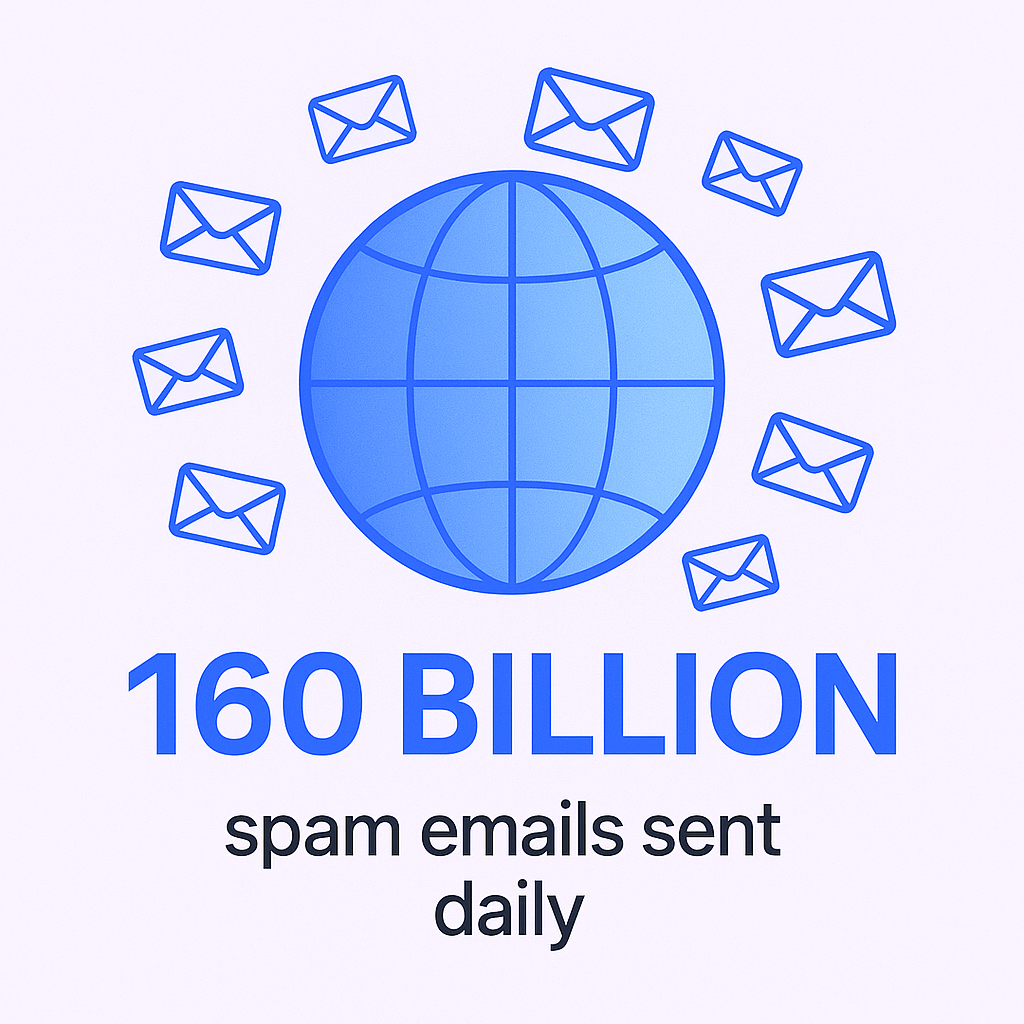
- 160 billion spam emails are sent daily in 2023 – translating to an unfathomable volume of junk mail
- 333.2 billion emails sent and received daily in 2022, projected to reach 376.4 billion by 2025 – showing the massive scale of email communication
- Average person receives approximately 1,825 spam emails per year – that’s about 5 spam emails hitting inboxes every single day
- 96.8% of individuals have received spam – making it an almost universal experience
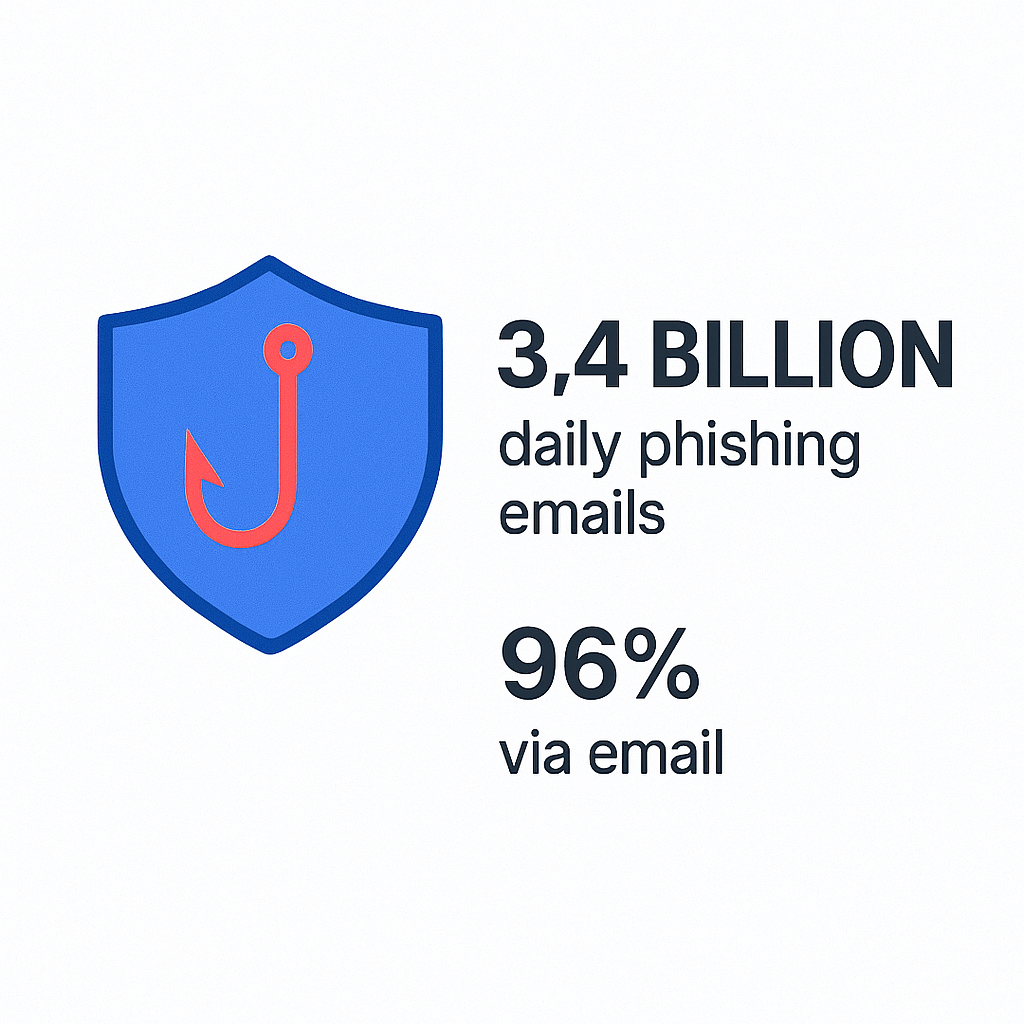
- 3.4 billion phishing emails are sent daily – over a trillion phishing emails per year
- 96% of phishing attacks are carried out through email – making it the primary vector for cybercrime
- 150% yearly increase in phishing attacks since 2019, reaching approximately 4.7 million attacks in 2022
- China and the U.S. each generate approximately 7.8 billion spam emails daily – tied for highest volume in 2024
- Marketing and advertising emails constitute 36% of all spam – the largest spam category
- 80% of phishing websites now feature HTTPS – making them appear more legitimate and harder to detect
- $16.6 billion in losses reported to FBI in 2024 for online scams and internet crimes – a record amount
- 21% of U.S. adults (1 in 5) have lost money due to an online scam with 30% reporting significant financial impact
- Average click rate for phishing campaigns is 17.8%, but targeted spear phishing with phone calls achieves 53.2% – three times more successful
- Spam costs businesses an estimated $20.5 billion per year with the average employee losing 2 days annually sorting through spam ($1,934 per employee in lost productivity)
If you think email spam is getting better, think again. While you’re reading this sentence, approximately 1.8 million spam emails have already been sent globally. That’s not a typo – that’s reality in 2025.
The digital battlefield of your inbox is more intense than ever, and if you’re running email campaigns, sending cold outreach, or simply trying to ensure your legitimate emails reach their destination, understanding these email spam statistics isn’t just helpful – it’s critical for your success.
Here’s what the numbers reveal about the state of email spam today, and more importantly, what you need to do about it.
The Numbers Don’t Lie: Key Email Spam Statistics
Let’s start with the reality check that’ll make your jaw drop.
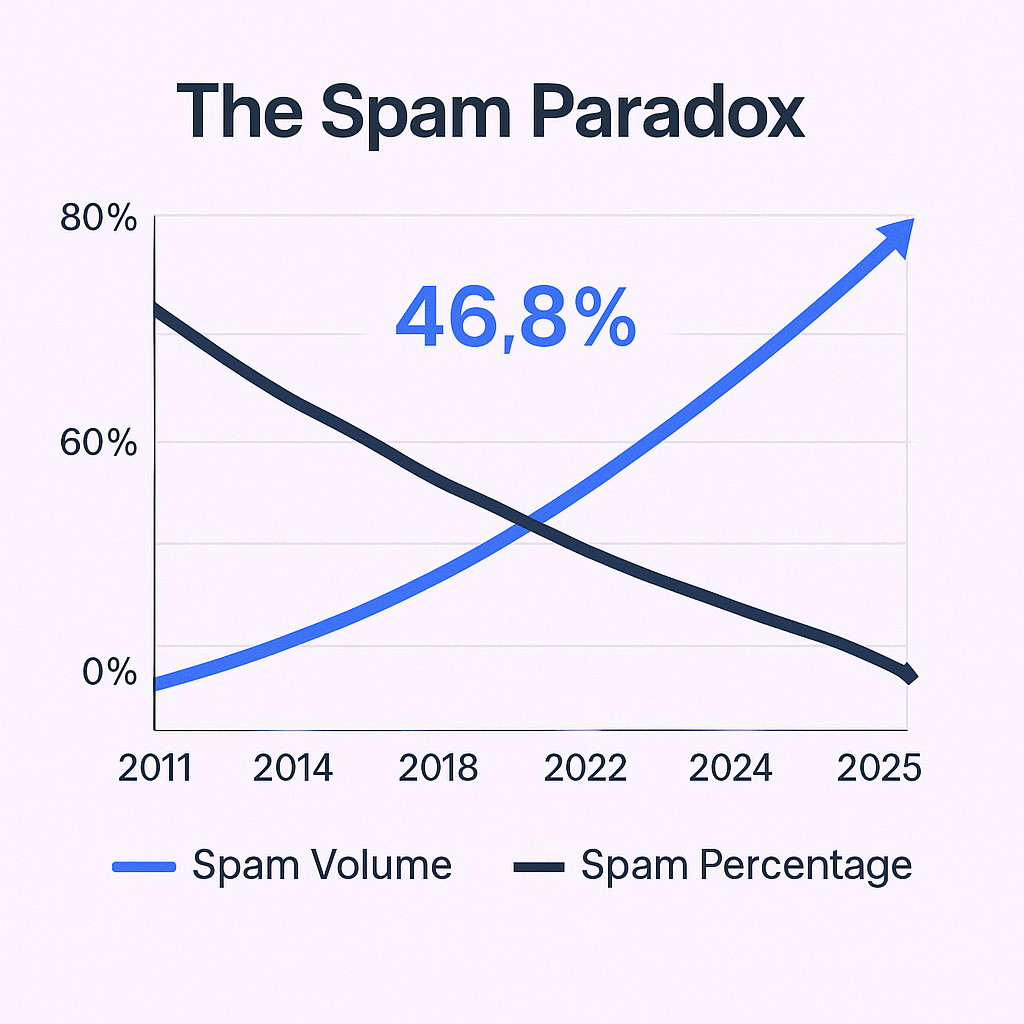
333.2 billion emails were sent and received globally each day in 2022, with projections showing this will reach 376.4 billion emails per day by 2025. Within this massive volume, spam accounted for 45.6% of all email traffic in 2023, climbing to 46.8% by December 2024.

When you do the math, that translates to an estimated 160 billion spam emails sent daily in 2023 alone. For the average person, this means receiving approximately 1,825 spam emails per year – that’s about 5 unwanted emails hitting inboxes every single day.
But here’s where it gets interesting: while the percentage of spam has actually decreased from a peak of 80.26% in 2011, the absolute number of spam emails continues to climb relentlessly.
Â

Â
Why Spam Numbers Keep Rising (Even as Percentages Drop)
This seems contradictory at first – how can spam percentages drop while total spam increases? The answer reveals a critical insight about modern email infrastructure.
The decrease in spam percentage indicates that email filters have become significantly more effective at identifying and blocking unwanted messages. However, the increase in absolute numbers shows that spammers are scaling their operations faster than the growth in legitimate email traffic.
This creates an ongoing technological arms race where your legitimate emails often get caught in increasingly sophisticated crossfire between spammers and security systems.
Most People Have Received Scam or Phishing Messages
The reach of malicious emails is staggering. 96.8% of individuals have received spam, making it an almost universal experience. More concerning, 3.4 billion phishing emails are sent daily, accumulating to over a trillion phishing emails per year.
Â

Â
Â
🚀 160B Daily Spam Emails?
LinkedIn outbound cuts through noise with targeted campaigns, custom messaging, and measurable scaling systems.
Phishing represents the single most common form of cybercrime, with 96% of phishing attacks carried out through email. The Anti-Phishing Working Group observed a dramatic escalation, with more than 150% yearly increase since 2019, reaching approximately 4.7 million attacks in 2022.
These aren’t just annoying messages – they’re sophisticated psychological weapons designed to exploit human trust and emotion.
Countries with the Worst Spam Issues
Spam generation isn’t evenly distributed across the globe. In 2024, China and the United States were tied for the highest volume of spam emails, each generating approximately 7.8 billion daily. India and Japan followed closely with 7.6 billion spam emails each.
Other significant contributors include:
- Russia: 8.09 billion daily
- Brazil: 8.03 billion daily
- Germany: 7.9 billion daily
- Czech Republic: 7.83 billion daily
China also leads in spam-emitting IP addresses with 771,021, while the U.S. follows with 677,067. This global distribution means that maintaining good sender reputation requires understanding international email security standards.
The Most Common Topics of Spam Emails
Understanding what spammers talk about helps you avoid accidentally triggering their patterns in your legitimate emails.
Marketing and advertising emails constitute the largest portion at 36% of all spam. Adult content accounts for 31.7%, while financial spam makes up 26.5%.
The most frequent specific topics include:
- Prizes and giveaways
- Job opportunities
- Banking notifications
- Password/account updates
- Software downloads
- Cryptocurrency offers
Phishing emails use particularly dangerous subject lines like ‘Request,’ ‘Follow up,’ ‘Urgent/Important,’ ‘Are you available?,’ ‘Payment Status,’ and ‘Invoice Due.’ These leverage familiarity and financial urgency to prompt quick, unthinking responses.
Approximately 80% of phishing websites in 2024 now feature HTTPS, making them appear more legitimate and complicating detection for users.
Spam Text and Call Statistics
Email isn’t the only battlefield. U.S. consumers lost a reported $470 million to scams that originated with fraudulent text messages in 2024, representing a 26% increase from $373 million in 2023.
On the voice front, consumers received approximately 52.8 billion robocalls in 2024, while 6.3 billion were specifically identified as scam calls.
A growing threat is AI-generated voice clones. In 2024, 49% of U.S. businesses reported experiencing fraud involving audio and video deepfakes, with an average loss of nearly $450,000 per incident.
The Success Rate of Online Spam
Despite widespread awareness, scams remain remarkably effective. A record $16.6 billion in losses was reported to the FBI in 2024 for online scams and internet crimes.
One-in-five U.S. adults (21%) have lost money due to an online scam or attack, with 30% reporting that it hurt their personal finances significantly.
The average click rate for phishing campaigns was 17.8% in 2021, but targeted spear phishing campaigns that incorporate phone calls achieve an average click rate of 53.2% – making them three times more successful than email-only campaigns.
Industries Most Targeted by Phishing Scams
Cybercriminals strategically target industries where data is most valuable. The top vulnerable industries include:
- Healthcare & Pharmaceuticals: 41.9%
- Insurance: 39.2%
- Retail & Wholesale: 36.5%
Financial institutions consistently remain prime targets, accounting for 27.7% of phishing attacks in Q4 2022, while Software-as-a-Service providers represent 17.7% of attacks.
The healthcare sector experienced a staggering 180% increase in ransomware and database leak incidents compared to 2023. Small businesses with less than 100 employees experience 350% more phishing and social engineering attacks than larger enterprises.
AI and Spam: The Evolving Battleground
Artificial Intelligence is rapidly transforming both spam generation and detection, creating an increasingly sophisticated technological arms race.
AI in Spam Generation
The emergence of generative AI has led to “AI slop” – low-quality content produced at overwhelming volumes. While a 2024 analysis found that only 0.7-4.7% of malicious phishing emails were crafted by AI, the potential for dramatic increases in sophistication and volume represents a significant future threat.
AI in Spam Detection
Fortunately, AI also powers the defense. Natural Language Processing (NLP) serves as a crucial component of modern spam emails NLP detection systems. AI-powered filters analyze patterns, apply email spam NLP to scrutinize content, conduct behavioral analysis, and continuously learn from new data.
Platforms utilizing AI-enhanced detection have seen a 25% increase in identifying phishing emails, particularly those designed to evade keyword-based rules. AI systems can monitor email traffic NLP in real-time, observing bounce rates, complaint rates, and delivery speeds.
AI in Email Marketing
Email marketing NLP technologies are transforming legitimate outreach strategies. 47% of marketers use AI in their email campaigns, with 49% utilizing it to generate email content. While 63% of marketers trust AI to generate emails but prefer to double-check results, almost 30% fully rely on AI-generated emails.
This integration allows for more efficient data content marketing strategies, leading to higher open rates and improved conversion rates.
People’s Thoughts on Spam and How It Affects Them
The constant barrage of spam profoundly impacts how individuals perceive and interact with email. 52% of internet users consider spam a major problem, and as early as 2005, 53% of users reported that spam made them lose confidence in email as a communication tool.
28% of unsubscribes are attributed to emails feeling too spammy, while 52.7% of consumers report feeling frustrated, losing trust, or unsubscribing if a brand’s emails consistently land in their spam folder.
When faced with spam, most people handle it by deleting it (40.8%), ignoring it (23.1%), or marking it as spam (19.9%). Only 7.9% open it, 7.2% unsubscribe, and a mere 1% file a complaint.
Business Impact
For businesses, spam costs an estimated $20.5 billion per year. The average employee loses two days per year sorting through spam, equating to an annual productivity waste of approximately $1,934 per employee.

 📊 Stop Losing $20B to Spam
LinkedIn outbound generates qualified leads without deliverability headaches or wasted productivity.
52% of businesses now identify reducing spam as their number one email-related goal, with projections suggesting spam volume could cost businesses up to $198 billion annually within four years.
Survey Methodology
These statistics compile data from reputable sources including DeBounce, Mailmodo, EmailToolTester, StationX, AgainstData, APWG, McAfee, IBM, Pew Research, FTC, YouMail, and KnowBe4.
The Anti-Phishing Working Group (APWG) observes millions of phishing attacks annually, the Federal Trade Commission compiles consumer fraud reports, and YouMail’s Robocall Index extrapolates data from millions of active users. This multi-source approach ensures comprehensive insights into email and online spam landscapes.
What This Means for Your Email Strategy
Understanding these email spam statistics reveals a critical truth: the fight for inbox attention has never been more competitive or sophisticated. Whether you’re running cold outreach campaigns, managing customer communications, or building content marketing design strategies, these numbers directly impact your success rate.
The key takeaways for navigating this landscape:
 🎯 Skip Email Spam Entirely
LinkedIn outbound reaches decision-makers directly with targeting precision email can never match.
Reputation is everything. With billions of spam emails sent daily and increasingly sophisticated filters, maintaining pristine sender reputation through proper authentication, list hygiene, and gradual sending practices isn’t optional – it’s survival.
💼 LinkedIn Outbound Beats Email Deliverability
No spam folders, no filters—just personalized conversations with prospects who actually engage.
7-day Free Trial |No Credit Card Needed.
Personalization beats automation. As AI-generated spam becomes more sophisticated, genuine personalization and value-driven content become your competitive advantages in reaching real humans.
Trust must be earned faster. With recipients receiving thousands of unwanted emails yearly, your legitimate messages have seconds to establish credibility and demonstrate value.
Technology is your ally. Leveraging email users NLP insights and email traffic NLP monitoring can help optimize your delivery and engagement rates while staying ahead of evolving spam detection systems.
The statistics paint a clear picture: email spam isn’t going away, but understanding its patterns, psychology, and technological defenses gives you the knowledge to navigate successfully through the noise and reach your intended audience.
Remember, every legitimate email that lands in an inbox instead of a spam folder represents a victory in this ongoing digital battle – and with the right knowledge and tools, that victory can be yours.
FAQs
What percentage of emails are spam in 2024?
How many spam emails are sent per day globally?
Which countries send the most spam emails?
What are the most common types of spam emails?
How effective are phishing attacks?
Tired of Fighting Spam Filters?
LinkedIn outbound bypasses email chaos with direct decision-maker conversations and 5x better response rates.
Segmentation That Actually Converts
LinkedIn outbound targets precise demographics with strategic campaign design and scaling methods