
🎉Find Prospects and Send Cold Emails & LinkedIn Outbound | All in One Place

AI Chatbot Statistics 2025: The Complete Data Guide That Could Transform Your Business

Table of Contents

AI Chatbot Statistics 2025

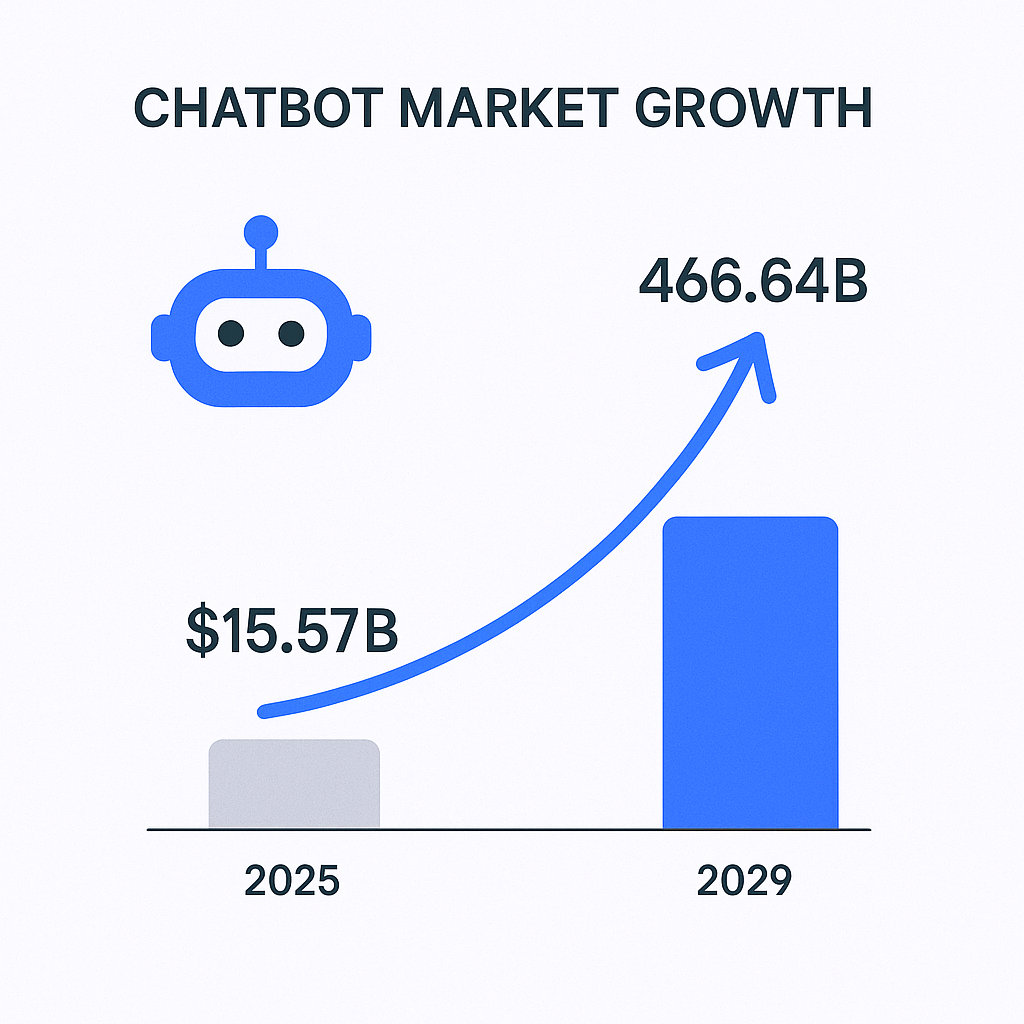
  • Global chatbot market projected to hit $15.57 billion in 2025 – with explosive growth of 23-30% annually
  • By 2029, market will reach $46.64 billion – nearly tripling in just four years
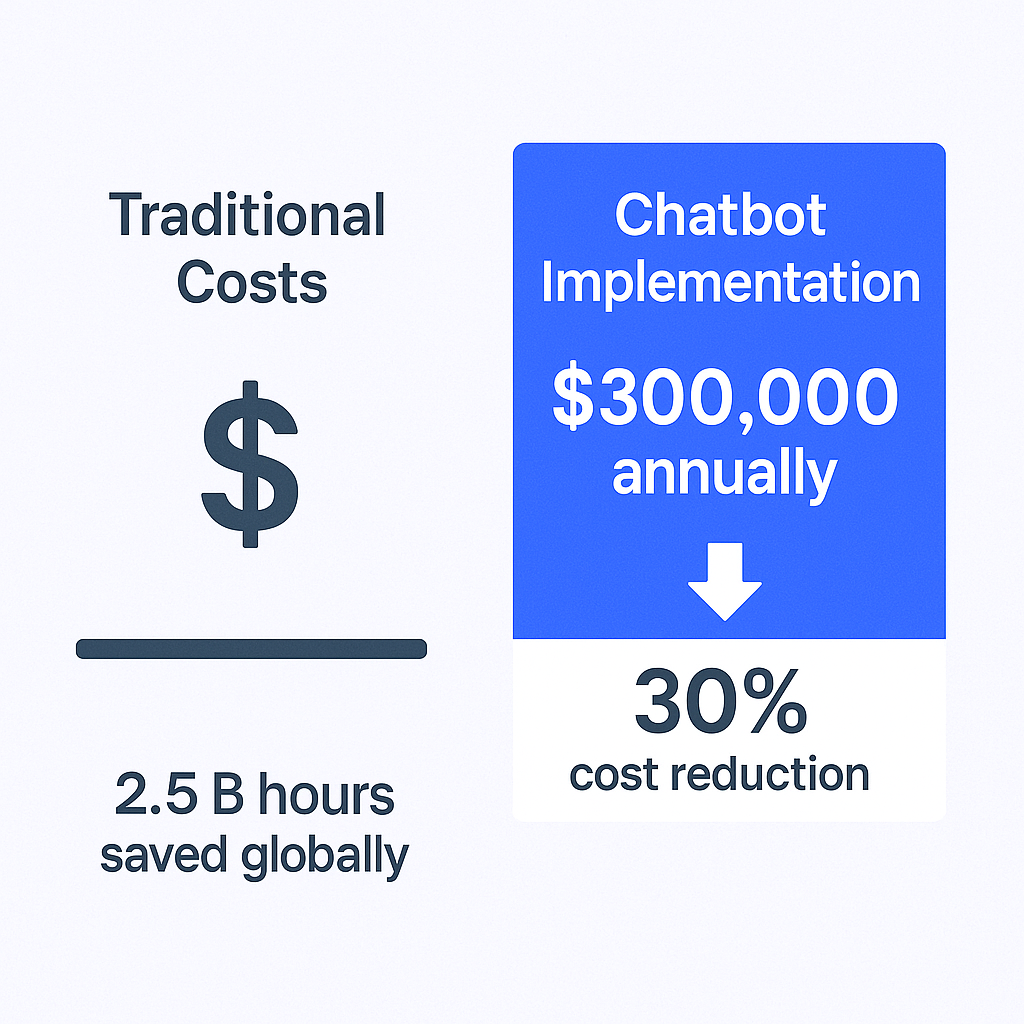
  • Companies using chatbots save an average of $300,000 annually – massive cost reduction through automation
  • AI chatbots automate 2.5 billion labor hours every year globally – representing enormous productivity gains
  • Businesses report 67% average increase in sales after implementing chatbots – significant revenue impact
  • 26% of all sales now originate from chatbot interactions – more than one-quarter of total sales
  • 88% of people have had at least one conversation with a chatbot in the past year – showing widespread consumer adoption
  • 62% of consumers prefer getting quick answers from chatbots rather than waiting for human agents – customers are actively choosing automation
  • 987 million people are active users of AI chatbots today – nearly a billion global users
  • 58% of B2B companies have implemented chatbots on their websites – B2B adoption outpacing B2C
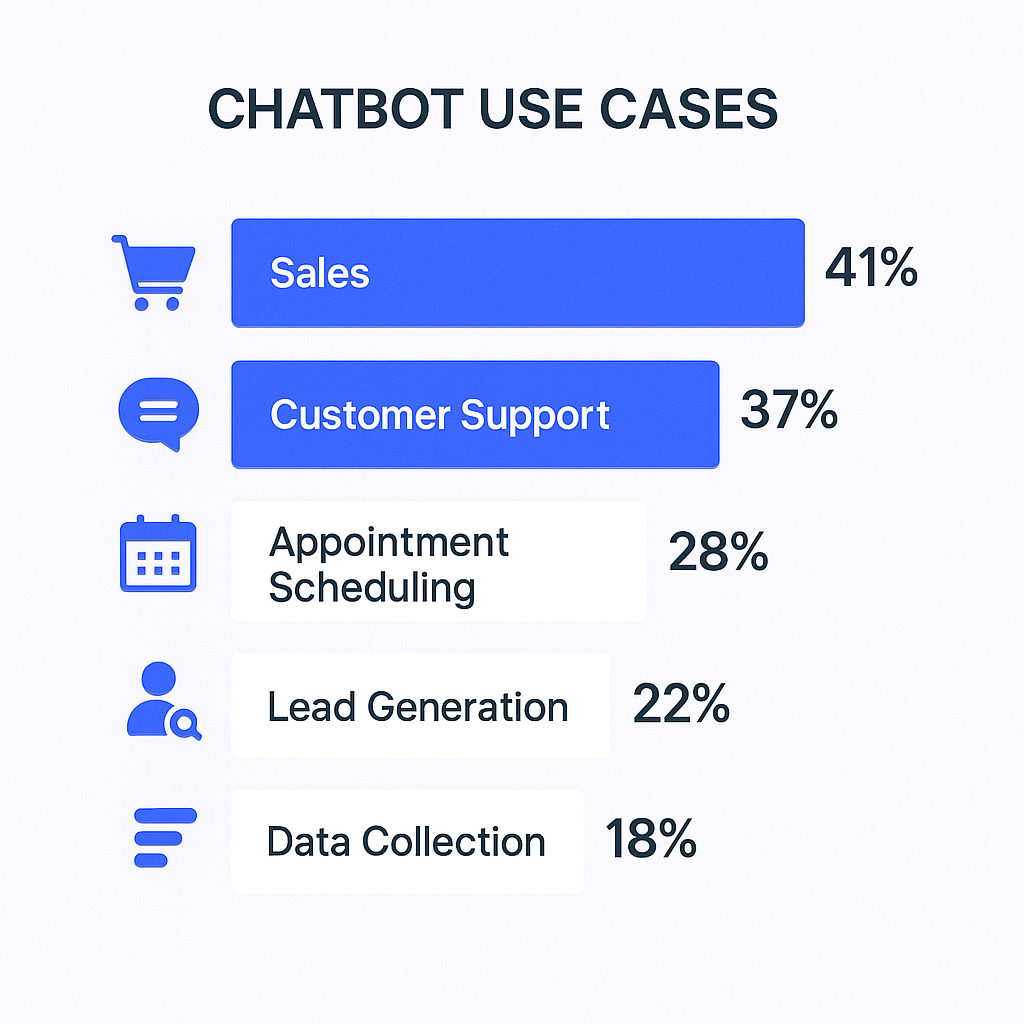
  • 41% of businesses use chatbots primarily for sales functions – not customer service, making sales the #1 use case
  • High-performing organizations are 2.1 times more likely to use AI chatbots – than underperforming competitors
  • ChatGPT alone receives over 1 billion monthly visits – showing massive consumer engagement with AI
  • Customer service cost reduction of 30% on average – while improving response times from hours to seconds
  • Responding to a lead within 5 minutes increases conversion probability by 21 times – chatbots make this level of responsiveness possible 24/7

You’re sitting in another meeting about “digital transformation” and wondering what’s actually worth investing in. Between all the buzzwords and vendor pitches, it’s tough to know what will actually move the needle for your business.

Here’s the reality: while everyone’s talking about AI, AI chatbots are quietly revolutionizing how businesses operate. They’re not just handling customer service anymore—they’re automating sales processes, qualifying leads, and saving companies hundreds of thousands of dollars annually.

This isn’t hype. It’s backed by hard data from real businesses seeing real results.

Whether you’re trying to reduce operational costs, improve response times, or scale your operations without hiring more staff, the chatbot statistics we’ll cover show exactly why this technology has moved from “nice to have” to business critical.

Top Chatbot Stats (The Essential Numbers You Need to Know)

Let’s cut straight to the numbers that matter most for business decision-makers:

Market Growth That Can’t Be Ignored:

  • The global chatbot market is projected to hit $15.57 billion in 2025, growing at a staggering 23-30% annually
  • By 2029, analysts predict the market will reach $46.64 billion
 

📊 Target Companies Spending on AI

Connect with decision-makers actively budgeting for automation through targeted LinkedIn outreach

Massive Business Impact:

  • Companies using chatbots save an average of $300,000 annually
  • AI chatbots automate 2.5 billion labor hours every year globally
  • Businesses report a 67% average increase in sales after implementing chatbots
  • 26% of all sales now originate from chatbot interactions

Customer Acceptance:

  • 88% of people have had at least one conversation with a chatbot in the past year
  • 62% of consumers prefer getting quick answers from chatbots rather than waiting for human agents
  • 987 million people are active users of AI chatbots today

Business Adoption:

  • 58% of B2B companies have implemented chatbots on their websites
  • The number one use case for chatbots isn’t customer service—it’s sales (41%)
  • High-performing organizations are 2.1 times more likely to use ai chatbots than underperforming ones

The bottom line? This isn’t emerging technology anymore. It’s mainstream business infrastructure.

Chatbot Market Size Statistics: Understanding the Explosive Growth

The chatbot market size tells a compelling story about where business is heading. In 2025, the market value ranges from $10.32 billion to $15.57 billion depending on the research firm, but every projection points in the same direction: explosive growth.

What makes these numbers particularly striking is the consistency of the growth trajectory. The ai chatbot market is expanding at a compound annual growth rate (CAGR) of 23% to 30%, which means it’s doubling roughly every 3-4 years.

To put this in perspective, when a market grows this fast, it’s not just adding features—it’s fundamentally changing how business gets done. Compare this to email marketing software (growing at about 13% CAGR) or traditional CRM systems (growing at 12% CAGR), and you can see why chatbots represent such a significant opportunity.

Future Projections Paint an Even Bigger Picture:

  • 2029 Market Value: $29.5 billion to $46.64 billion
  • Investment Flow: Venture capital funding for chatbot companies increased 67% in 2024
  • Enterprise Adoption: 73% of Fortune 500 companies plan to increase chatbot investment in 2025

This growth is driven by businesses discovering that artificial intelligence ai tools don’t just cut costs—they actually improve customer experiences and drive revenue growth.

Chatbot Usage & Adoption Statistics: Who’s Really Using This Technology

The adoption data reveals something fascinating: this isn’t just a tech company trend. Businesses across every industry are implementing ai customer service solutions, and the results are driving widespread adoption.

Business Adoption Breakdown:

  • 58% of B2B companies have chatbots on their websites (outpacing B2C adoption)
  • 41% of businesses use chatbots primarily for sales functions
  • 37% focus on customer support
  • 22% use them for lead generation

User Engagement Numbers:

  • 88% of people have interacted with a chatbot in the past year
  • Over 987 million people are active chatbot users globally
  • 62% of consumers prefer chatbot responses over waiting for human agents
  • ChatGPT alone receives over 1 billion monthly visits

Geographic Distribution:

  • North America holds the largest market share at 30%+ of total revenue
  • United States accounts for 36% of global chatbot users
  • Asia-Pacific is the fastest-growing region with 24%+ CAGR
  • Europe shows strong adoption in customer service applications

What’s particularly interesting is the performance correlation. High-performing service organizations are 2.1 times more likely to be using ai chatbots than their underperforming competitors. This suggests that chatbot adoption isn’t just following success—it’s helping drive it.
 

💼 Target High-Growth Organizations

Reach companies 2.1x more likely to adopt AI with our targeting, campaign design, and scaling methods

The user acceptance rate also tells an important story. When 88% of people have used chatbots and 62% prefer them for quick responses, it means your customers aren’t just okay with this technology—they’re expecting it.

Most Popular Chatbot Use Cases: Where Businesses Get the Biggest Impact

Understanding how successful companies deploy chatbots can help you identify the highest-impact opportunities for your business. The data shows that the most successful implementations focus on these core areas:

Sales and Lead Generation (41% of implementations): This is where businesses see the most dramatic ROI. AI chatbots can qualify leads 24/7, ask the right questions to identify serious prospects, and route hot leads directly to sales teams. Companies using chatbots for sales report a 67% average increase in sales and see 26% of total sales originating from chatbot interactions.

The key to success here is speed. Research shows that responding to a lead within 5 minutes increases conversion probability by 21 times. Chatbots make this level of responsiveness possible without requiring round-the-clock staffing.

Customer Support and Service (37% of implementations): This is the traditional chatbot use case, but it’s evolved far beyond simple FAQ responses. Modern ai customer service chatbots can handle complex troubleshooting, process returns, schedule appointments, and escalate issues to humans when needed.

Businesses using chatbots for customer support typically see 30% cost savings while improving response times from hours to seconds.

Appointment Scheduling and Booking (28% of implementations): For service-based businesses, this is often the highest-value use case. Chatbots can check availability, book appointments, send reminders, and handle rescheduling—all without human intervention.

Internal Process Automation (22% of implementations): Smart companies are using chatbots internally to handle HR questions, IT support requests, and workflow management. This ai automate repetitive tasks approach frees up employees to focus on higher-value work.

Data Collection and Market Research (18% of implementations): Chatbots excel at gathering customer feedback, conducting surveys, and collecting valuable data that would be expensive to obtain through traditional research methods.

The most successful deployments often combine multiple use cases. For example, a chatbot might start by qualifying a lead, then schedule a demo, and finally collect feedback after the sales call.

Chatbot Cost Statistics: Investment vs. Return Analysis

When evaluating any business technology, the critical question is always ROI. The chatbot statistics around costs and returns make a compelling case for investment.

Implementation Costs:

  • Small to mid-sized businesses: $30-$150 per month for subscription-based platforms
  • Mid-market solutions: $800-$1,500 per month
  • Enterprise implementations: $5,000-$20,000+ per month (including custom development)

Cost Savings and ROI:

  • Average annual savings: $300,000 per company
  • Labor hours saved globally: 2.5 billion hours annually
  • Customer service cost reduction: 30% average decrease
  • Response time improvement: From hours to seconds (instant responses)
 

Revenue Impact:

  • Sales increase: 67% average improvement
  • Lead quality improvement: 55% increase in high-quality leads
  • Conversion rate improvement: Studies show closing ratios can improve from 11% to 40%
  • Sales attribution: 26% of sales now originate from chatbot interactions

🎯 Target Companies With Budget

Connect with businesses saving $300K annually who have resources for your solution

Operational Efficiency Gains: When you factor in the time savings, the ROI becomes even more compelling. If chatbots save businesses 2.5 billion hours annually, and the average knowledge worker costs $50-75 per hour, you’re looking at massive productivity gains.

For sales teams specifically, chatbots can save 8-10 hours per week that would otherwise be spent on research and qualification. That’s essentially getting an extra day of selling time every week.

The key insight here is that chatbots don’t just reduce costs—they redeploy those costs toward higher-value activities. Every hour a chatbot handles routine inquiries is an hour your team can spend on strategic projects, relationship building, or closing deals.

Chatbot Statistics By Region: Global Adoption Patterns

Understanding regional adoption patterns helps identify market opportunities and benchmark your progress against similar markets.

North America – The Mature Market:

  • Market share: 30%+ of global revenue
  • Adoption rate: Highest globally, with 58% of B2B companies using chatbots
  • Primary use cases: Sales automation, customer service, lead generation
  • Growth rate: Steady 20-25% annual growth
  • Key insight: High customer acceptance (62% prefer chatbots for quick responses)

Asia-Pacific – The Growth Engine:

  • Market share: 25% of global revenue but growing fastest
  • Growth rate: 24%+ CAGR (fastest globally)
  • Adoption drivers: Mobile-first markets, tech-savvy populations
  • Primary use cases: E-commerce, customer support, natural language processing applications
  • Key insight: Strong government support for AI initiatives driving business adoption

🗺️ Geographic Precision Targeting Works

Reach North American buyers or Asia-Pacific growth markets with complete LinkedIn campaign strategies

7-day Free Trial |No Credit Card Needed.

Europe – The Compliance-Conscious Market:

  • Market share: 20% of global revenue
  • Adoption rate: Moderate but accelerating post-GDPR clarity
  • Primary focus: Privacy-compliant customer service, B2B applications
  • Growth rate: 18-22% CAGR
  • Key insight: Quality over quantity approach with sophisticated implementations

Latin America and Other Regions:

  • Market share: 25% combined
  • Growth drivers: Cost savings focus, improving digital infrastructure
  • Primary use cases: Basic customer service, payment processing
  • Key insight: Rapid adoption once infrastructure improves

Global Trends Affecting All Regions:

  • Mobile-first adoption: 70% of chatbot interactions happen on mobile devices
  • Multilingual capabilities: Growing demand for natural language processing in local languages
  • Integration requirements: Businesses want chatbots that work with existing CRM and marketing tools

The regional data suggests that while North America leads in adoption, the biggest opportunities for growth are in Asia-Pacific and emerging markets where digital transformation is accelerating.

Advanced Chatbot Capabilities: What’s Driving the Growth

The explosion in chatbot market growth isn’t just about basic FAQ bots. Advanced capabilities powered by artificial intelligence ai are enabling sophisticated business applications that weren’t possible even two years ago.

Natural Language Processing Breakthroughs: Modern chatbots can understand context, handle complex queries, and maintain conversation flow across multiple topics. Natural language processing improvements mean chatbots can now handle 80-90% of routine customer inquiries without human intervention.

Integration Capabilities: Today’s chatbots integrate seamlessly with CRM systems, email marketing platforms, scheduling tools, and payment processors. This integration capability is what enables the 67% sales increase that businesses report—chatbots aren’t just collecting information, they’re triggering complete workflows.

Predictive Analytics: Advanced chatbots can predict customer needs, identify upsell opportunities, and flag at-risk customers based on conversation patterns and historical data.

Omnichannel Presence: Modern ai chatbots work across websites, social media, messaging apps, and even phone systems, providing consistent experiences regardless of how customers choose to engage.

These advanced capabilities explain why 58% of B2B companies have adopted chatbots and why 41% focus on sales applications. The technology has evolved from simple customer service tools to sophisticated business automation platforms.

Future Predictions: What the Data Tells Us About Tomorrow

The chatbot statistics point to several clear trends that will shape business strategy in the coming years:

Market Growth Will Accelerate: With projections showing growth to $46.64 billion by 2029, we’re still in the early stages of adoption. The 23-30% CAGR suggests this technology will become as common as email or CRM systems.

AI Integration Will Deepen: As artificial intelligence ai capabilities improve, chatbots will handle increasingly complex tasks. We’re moving from reactive customer service to proactive business intelligence and automation.

Customer Expectations Will Rise: With 88% of people already using chatbots and 62% preferring them for quick responses, businesses without chatbot capabilities will increasingly appear outdated to customers.

Sales Applications Will Dominate: The fact that 41% of businesses use chatbots for sales (versus 37% for customer service) suggests the biggest opportunity lies in revenue generation, not just cost savings.

Integration Ecosystems Will Expand: Businesses will expect chatbots to work seamlessly with every tool in their tech stack, from ai automate repetitive tasks to complex workflow management.

Competitive Differentiation: As chatbot adoption becomes standard, competitive advantage will come from implementation sophistication, not just having a chatbot at all.

Conclusion: Your Next Move in the AI Revolution

The ai chatbot statistics paint a clear picture: this technology has moved from experimental to essential. With $15.57 billion in market value, 2.5 billion hours of annual labor savings, and 67% sales increases for adopting businesses, the question isn’t whether to implement chatbots—it’s how quickly you can get started.

The most compelling statistic might be the simplest one: 58% of B2B companies already have chatbots. If you’re not among them, you’re increasingly in the minority.

But here’s what the data also shows: successful chatbot implementation isn’t about the technology itself—it’s about understanding your specific use case and measuring the right metrics. Whether you’re focused on sales automation, customer support, or lead generation, the businesses seeing $300,000 in annual savings are those that aligned their chatbot strategy with their core business objectives.

The chatbot market growth trajectory of 23-30% annually means this opportunity window won’t stay open forever. Early adopters are already gaining competitive advantages through improved response times, higher conversion rates, and operational efficiency.

Your customers are ready (88% have used chatbots), the technology is proven (26% of sales originate from chatbots), and the ROI is measurable (average $300,000 annual savings). The only question is: what will you automate first?

Ready to join the 58% of B2B companies leveraging automation? Start with email outreach—the foundation of all automated sales processes. Get verified email addresses, warm up your domains, and build automated campaigns that work 24/7.

FAQs

Is LinkedIn Premium guaranteed to get me a job?

No, LinkedIn Premium is not a guarantee. It's a powerful tool that can significantly enhance your job search by providing advanced features and insights, but success still depends on factors like your profile strength, experience, industry, and how effectively you utilize the premium tools.

What are the main benefits of LinkedIn Premium for job seekers?

The main benefits LinkedIn Premium offers include direct messaging via InMail, seeing all profile visitors, access to advanced search filters LinkedIn, "Featured Applicant" status, applicant and salary insights, and unlimited access to LinkedIn Learning courses.

How does LinkedIn Premium help me stand out to recruiters?

LinkedIn Premium Career helps you stand out by allowing "Featured Applicant" applications and marking jobs as "Top Choice," making you 43% more likely to receive recruiter responses. InMails to hiring managers help bypass traditional application channels.

Can I try LinkedIn Premium for free?

Yes, eligible LinkedIn members can typically try LinkedIn Premium with a 30-day trial. This allows feature exploration before committing to a LinkedIn Premium subscription.

Is the "Who's Viewed Your Profile" feature truly useful?

Yes, seeing who has viewed your profile acts as a warm lead indicator. Proactively reaching out to these individuals can significantly increase engagement chances, as prospects are 86% more likely to accept an InMail if you view their profile first.

What is the "agreement privacy policy" related to LinkedIn Premium?

The agreement privacy policy refers to LinkedIn's privacy policy governing data collection, use, and sharing. Premium features like anonymous browsing interact with privacy settings, though LinkedIn still tracks anonymous visits. Users should review LinkedIn's official privacy policy for comprehensive details.

Target AI-Ready Decision Makers

Reach executives investing in chatbots through precision LinkedIn outbound campaigns

Segmentation That Actually Converts

LinkedIn outbound targets precise demographics with strategic campaign design and scaling methods

How to Build a High-Converting B2B Sales Funnel from Scratch on LinkedIn ​