

- blog
- Statistics
- Email Client Statistics 2025: 13 Stats That Will Transform Your Strategy
Email Client Statistics 2025: 13 Essential Statistics Every Marketer Needs to Know
Table of Contents
Email Client Statistics
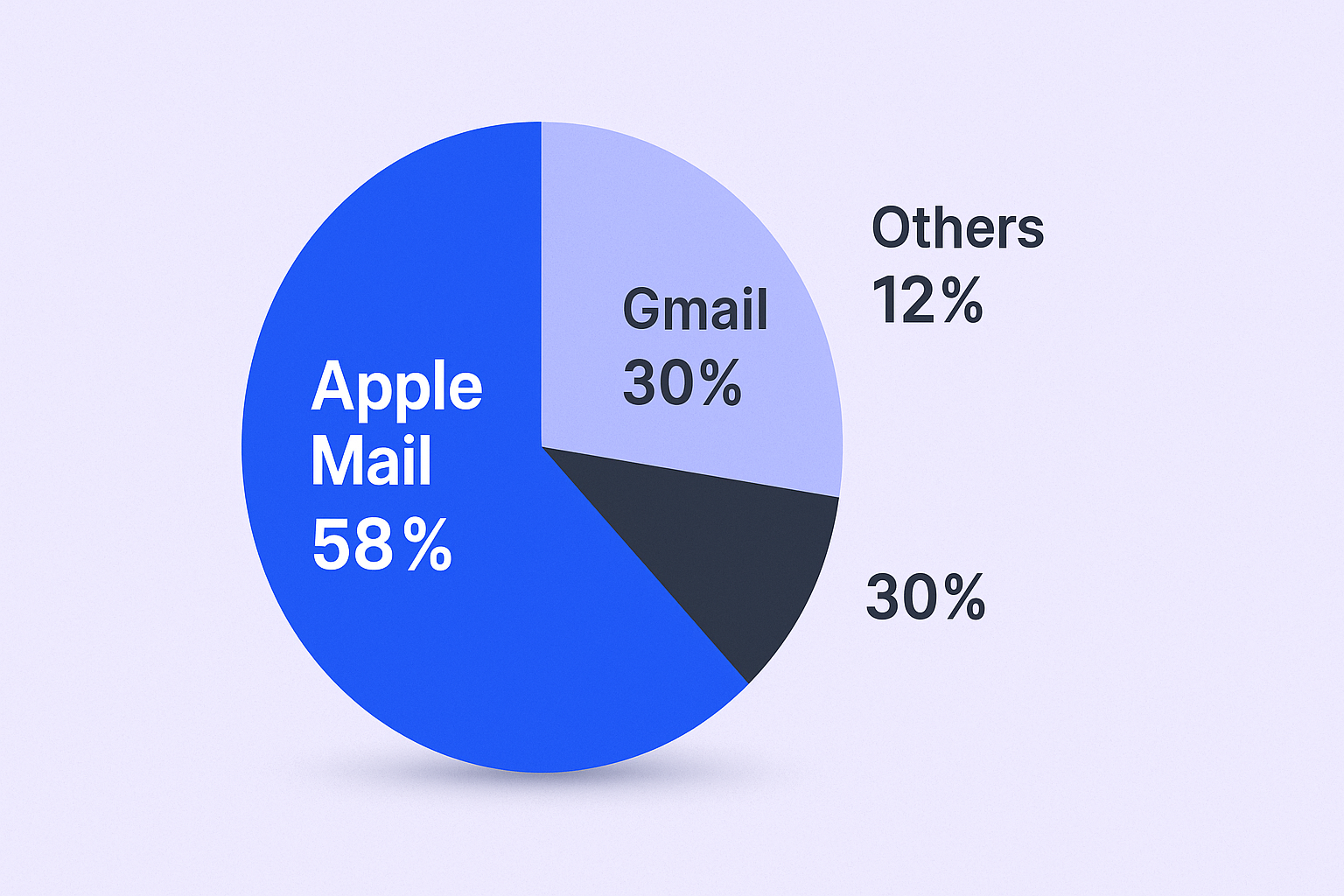
- Apple Mail commands 58% of the email client market share – making it the undisputed king of email clients, leading the global market
- Gmail captures 29-32% market share – establishing itself as the clear runner-up, with over 2.5 billion users
- Apple and Gmail combined control nearly 90% of the market – meaning email success literally depends on performance in these two platforms
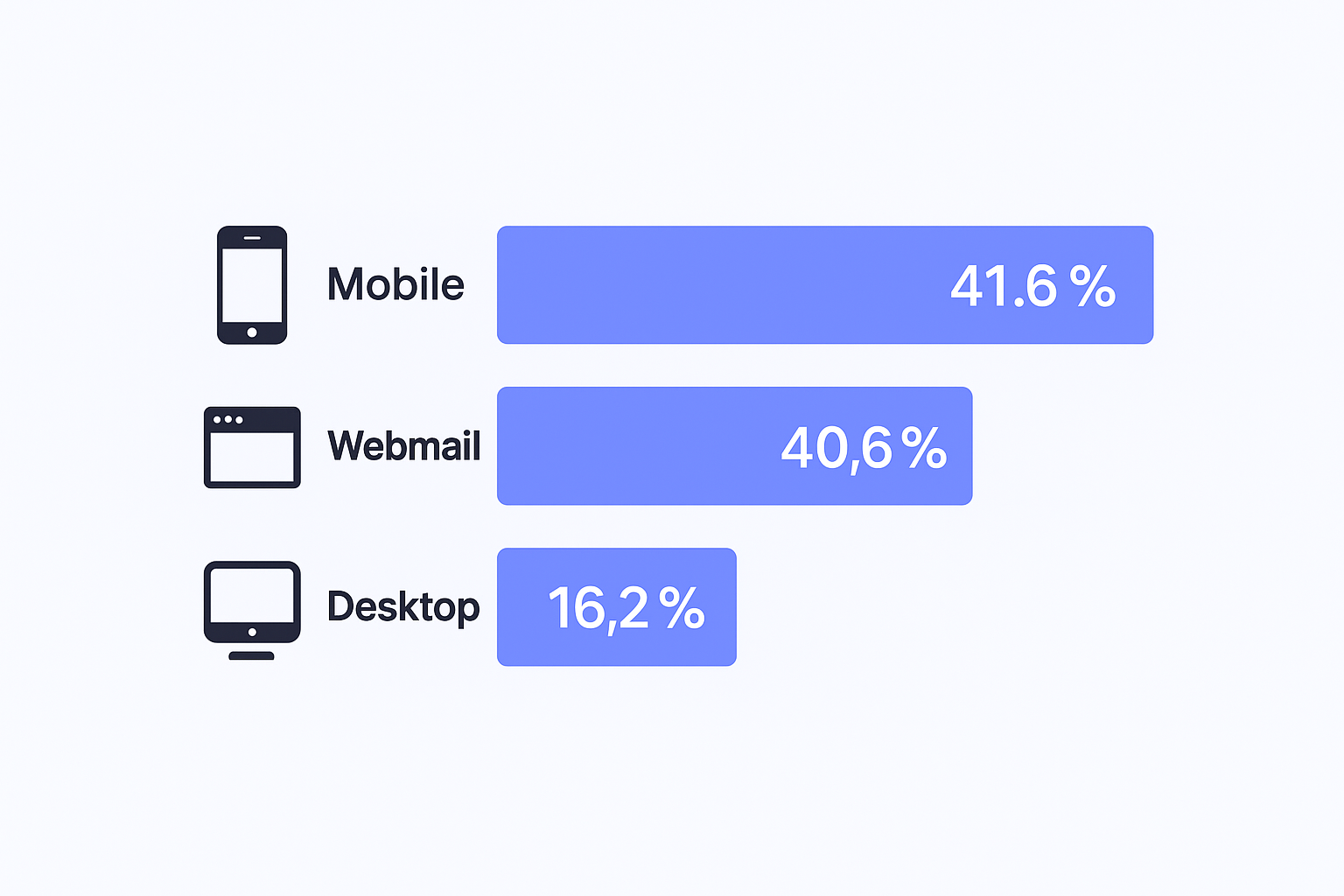
- Mobile clients account for 41.6% of all email opens – with webmail close behind at 40.6%, while desktop email clients lag at just 16.2%
- iPhone dominates mobile with an incredible 90.5% market share – meaning when someone opens an email on their phone, it’s almost guaranteed to be on an iPhone
- 84% of Gmail users access their email via mobile devices – with just 15.92% preferring to access Gmail on desktop
- Apple’s Mail Privacy Protection accounts for over 56% of tracked “opens” – though this reflects MPP’s automatic pre-fetching rather than genuine user engagement
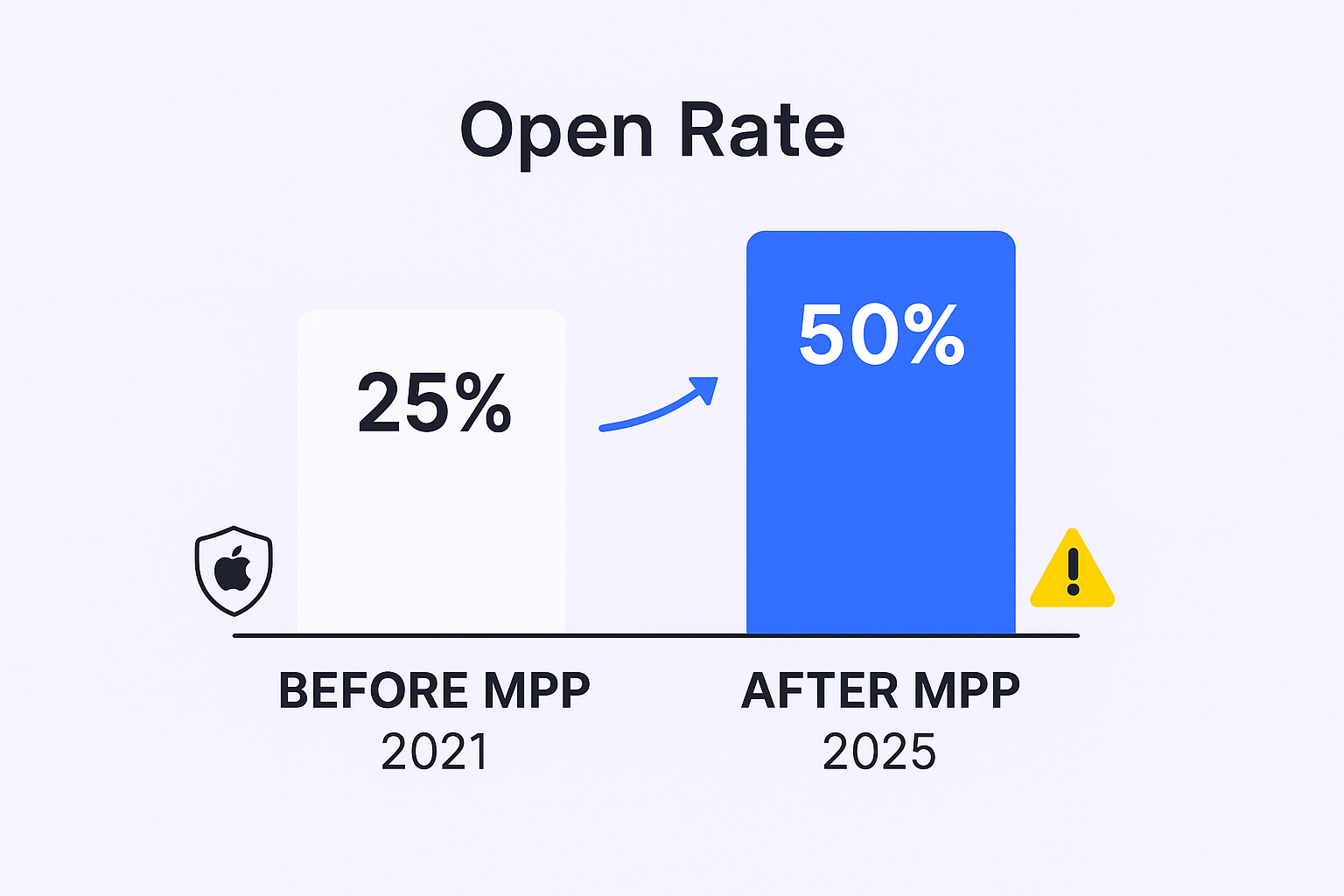
- Email open rates have nearly doubled since MPP’s introduction – though this inflation doesn’t indicate increased reader interest
- Microsoft Outlook maintains 4.4% market share – with presence increasing significantly in enterprise environments running Microsoft ecosystems
- Gmail dominates webmail with 85.8% share – commanding the vast majority of browser-based email access
- Click-through rates average 1.4-2.62% across industries – becoming the new gold standard for measuring genuine engagement
- Cold email reply rates average 5.1% – but persistent follow-up sequences of 4-7 emails can triple this response rate
- Personalized emails see 17% reply rates vs 7% for generic messages – a more than 2x improvement in performance
- Multi-touch sequences (4-7 emails) consistently outperform single sends by 3x – showing the importance of follow-up campaigns
- iPhone users account for 90% of mobile opens – meaning every email design decision should prioritize the iPhone experience
Picture this: You’ve just crafted the perfect email campaign. The subject line is compelling, your content is personalized, and your call-to-action is crystal clear. You hit send to thousands of subscribers… and then watch your open rates plummet.
Sound familiar?
Here’s what most marketers miss: where your email gets read matters just as much as what you write. Your beautifully designed desktop email might look like a jumbled mess on the iPhone where 90% of mobile opens actually happen.
Understanding email client statistics isn’t just nice-to-have data anymore—it’s the secret weapon that separates high-performing campaigns from inbox clutter. These insights reveal exactly how your audience consumes emails, which devices they prefer, and why your current strategy might be failing.
Ready to discover what the data reveals about the modern inbox? Let’s dive into the numbers that will transform how you think about email marketing.
How do we collect this data?
Before diving into the statistics, it’s crucial to understand how email client market share data gets collected—especially since a major privacy update changed everything in 2021.
The Science Behind Email Tracking
For decades, tracking email engagement relied on a simple but clever technology: the tracking pixel. Here’s how this invisible data collection works:
The Tracking Process:
- The Invisible Messenger: When you send an email through any marketing platform, it embeds a tiny, invisible 1×1 pixel image within your message.
- The “Ping” Home: When someone opens your email, their email client (like Gmail or Apple Mail) downloads the images in the message, including this tracking pixel.
- The Data Collection: This download request sends a “user agent” string back to the sender’s server, revealing which email client was used, device type, and sometimes location data.
This mechanism powered email analytics for years, giving us reliable email client statistics and market share data.
Apple’s Privacy Revolution Changes Everything
In 2021, Apple introduced Mail Privacy Protection (MPP) with iOS 15, fundamentally disrupting this tracking system. MPP pre-loads all email images through Apple’s proxy servers, regardless of whether users actually open the message.
📊 Tired of Phantom Email Opens?
LinkedIn outbound gives you real engagement data—no privacy walls blocking your targeting and performance insights.
The Impact is Massive:
- Phantom Opens: Every email delivered to Apple Mail users with MPP enabled registers as “opened”—even if never viewed
- Inflated Metrics: Average open rates have nearly doubled for some marketers, but don’t reflect real engagement
- Hidden User Data: Apple’s proxy servers mask users’ true IP addresses and device information
This privacy shift forces us to interpret email client statistics differently. The numbers we see today blend real opens with Apple’s automated pre-loading, making the data more complex but still valuable for strategic decisions.
13 Email client statistics to know
Now let’s explore the data that defines today’s email landscape. These email client statistics will reshape how you approach your campaigns, from design choices to timing strategies.
The Dominant Players: Apple and Gmail Rule Everything
- Apple Mail commands a staggering 58% of the email client market share
Apple Mail leads the global email client market with approximately 56-58% market share, making it the undisputed king of email clients. This dominance stems from being pre-installed on every iPhone, iPad, and Mac—creating a massive default user base.
- Gmail captures 29-32% market share as the strong second
Gmail holds between 25.89% and 32% of the email client market, establishing itself as the clear runner-up. While Gmail is incredibly popular as an email provider with over 2.5 billion users, its client market share remains secondary to Apple’s ecosystem integration.
Â

Â
Key Insight: These two platforms control nearly 90% of the market. Your email success literally depends on how well your messages perform in Apple Mail and Gmail environments.
Mobile Dominance: Your Desktop Preview Doesn’t Matter
- Mobile clients account for 41.6% of all email opens
Mobile email opens made up 41.6% of all email opens, with webmail (like Gmail.com accessed through browsers) close behind at 40.6%. Traditional desktop email clients lag far behind at just 16.2%.
Â

Â
- iPhone dominates mobile with an incredible 90.5% market share
Within mobile email reading, the iPhone holds a massive 90.5% share. This means when someone opens your email on their phone, it’s almost guaranteed to be on an iPhone using Apple Mail.
- 84% of Gmail users access their email via mobile devices
84.08% of Gmail users access their emails through their mobile devices, while just 15.92% prefer to access their Gmail on a desktop. Even Gmail, primarily accessed through web browsers, sees overwhelming mobile usage.
Assume every email you send will be opened first on an iPhone. If your email isn’t optimized for a small, vertical screen, it’s optimized for the trash bin
The Privacy Revolution’s Impact
- Apple’s Mail Privacy Protection accounts for over 56% of tracked “opens”
Apple’s devices using client Mail Privacy Protection (MPP) were the most popular on the global market – making up a share of 55 percent opens during the year. This massive percentage reflects MPP’s automatic pre-fetching rather than genuine user engagement.
Â

Â
- Email open rates have nearly doubled since MPP’s introduction
Some marketers report seeing their open rates nearly double compared to pre-MPP levels, though this inflation doesn’t indicate increased reader interest—it’s Apple’s servers “opening” emails automatically.

🎯 Beyond Unreliable Email Metrics
Our LinkedIn outbound engine delivers verified engagement through complete targeting, campaign design, and intelligent scaling methods.
The Supporting Cast: Other Email Clients
- Microsoft Outlook maintains 4.4% market share
Outlook holds a 4% market share and is popular for its use in both personal and business contexts. While modest globally, Outlook’s presence increases significantly in enterprise environments running Microsoft ecosystems.
- Yahoo Mail captures 2.5-3% of the market
Yahoo! Mail captures about 2.5% of the email market share, maintaining its loyal user base despite being overshadowed by the major players.
- Gmail dominates webmail with 85.8% share
When users open emails in web browsers, Gmail commands 85.8% of all webmail opens. This shows Gmail’s strength in browser-based email access.
New Success Metrics in the Post-MPP World
- Click-through rates average 1.4-2.62% across industries
The average email click-through rate across all industries is between 1.4% and 2.62%. With open rates being unreliable, clicks have become the new gold standard for measuring genuine engagement.
- Cold email reply rates average 5.1%
The average cold email reply rate is around 5.1%. However, persistent follow-up sequences of 4-7 emails can triple this response rate compared to single-touch campaigns.
- Personalized emails see 17% reply rates vs 7% for generic messages
Campaigns with advanced personalization see an average reply rate of 17%, compared to just 7% for non-personalized emails—a more than 2x improvement in performance.
💬 Want 17% Reply Rates Consistently?
LinkedIn outbound combines hyper-personalization with professional context to maximize response rates and book qualified meetings.
Geographic and Demographic Nuances
While these global statistics paint the big picture, it’s worth noting that email client popularity varies significantly by region and age group:
- Apple dominates in the US, Canada, Australia, and New Zealand, but its share is closer to 25-35% in these markets (without MPP inflation)
- Gmail leads in most European, South American, African, and many Asian countries
- Outlook commands 25-30% share in countries like Spain, Italy, Sweden, and India
- Local providers like Web.de and GMX capture significant market share in Germany (30% and 25% respectively)
- Younger users (under 35) prefer Gmail and Apple Mail, while older demographics use Outlook, Yahoo, and ISP-provided email services
Optimizing for the Two-Client Reality
These email client statistics reveal a clear strategic imperative: optimize for Apple Mail and Gmail, and you’ll reach 90% of your audience effectively.
Apple Mail Optimization Checklist
Since Apple Mail dominates, especially on mobile, your emails must excel in this environment:
Mobile-First Design:
- Keep subject lines under 40 characters to avoid truncation on iPhone screens
- Write compelling preview text (under 10 words) – it acts as your second subject line
- Use single-sentence paragraphs for easy thumb-scrolling
- Employ strategic bolding to guide mobile readers’ eyes
- Ensure links are well-spaced to prevent “fat-finger” mis-taps
Technical Considerations:
- Test how your emails render with images disabled (some users have this setting)
- Remember that Mail Privacy Protection makes traditional open tracking unreliable
- Focus on click-through rates and replies as engagement metrics instead
Gmail Optimization Strategy
For Gmail’s massive user base, different tactics work best:
Beat the Algorithm:
- Write like a human, not a marketing department, to avoid the Promotions tab
- Minimize HTML formatting and limit yourself to 1-2 links per email
- Craft compelling first lines since Gmail shows “snippets” next to subject lines
- Avoid spam trigger words that might hurt deliverability
Mobile Gmail Specifics:
- Remember that 84% of Gmail users access via mobile, so mobile optimization remains crucial
- Test your emails across both the Gmail app and mobile browser versions
Post-MPP Follow-up Strategy
Apple’s privacy changes demand a complete overhaul of traditional email sequences:
Â
Abandon Open-Based Triggers:
- Disable any automated sequences that trigger follow-ups based on email “opens”
- These triggers are now fundamentally broken due to phantom opens
Embrace Click-Based Automation:
- Set up sequences triggered by link clicks—these represent genuine interest
- Create targeted follow-ups based on which specific links recipients clicked
Default to Time-Based Sequences:
- Use proven cadences like: Day 1 (Initial Email), Day 3 (Follow-up 1), Day 7 (Follow-up 2), Day 12 (Follow-up 3)
- Each touchpoint should provide new value, not just “bump” previous messages
- Remember: 4-7 email sequences generate 3x more replies than shorter campaigns
Multi-Channel Approach:
- If you see no email engagement after several attempts, incorporate LinkedIn connections, social media comments, or phone calls
- Diversify beyond email to reach prospects through their preferred channels
🚀 Scaling Beyond Email Limitations?
LinkedIn outbound eliminates guesswork with data-driven targeting, multi-touch campaigns, and proven scaling frameworks.
7-day Free Trial |No Credit Card Needed.
Your New Email Success Framework
These email client statistics point to a fundamental shift in how successful email marketing works in 2025. Here’s your action plan:
New KPI Dashboard
Primary Metric: Positive Reply Rate Track responses that express interest, ask questions, or agree to meetings—not just total replies.
Secondary Metric: Click-Through Rate With a target above 2%, clicks represent deliberate engagement in our post-open-rate world.
Foundation Metric: Deliverability Rate Keep bounce rates below 5% and spam complaints near zero to maintain inbox access.
Design for Mobile Reality
The iPhone-First Rule: Every email design decision should prioritize the iPhone experience since it dominates mobile opens at 90.5%.
Essential Mobile Optimizations:
- Subject lines: 4-7 words maximum
- Preview text: Under 10 words of compelling copy
- Body content: Short, scannable paragraphs
- Links: Well-spaced and thumb-friendly
- Images: Optimized for vertical screens
Focus on Real Engagement
Beyond Opens: With Mail Privacy Protection creating phantom opens, success comes from deliberate actions: clicks, replies, and conversions.
Personalization Pays: The 17% vs 7% reply rate difference between personalized and generic emails isn’t just significant—it’s campaign-defining.
Persistence Wins: Multi-touch sequences (4-7 emails) consistently outperform single sends by 3x, but each message must provide unique value.
Understanding email client statistics transforms your approach from guesswork to strategic precision. You now know that Apple Mail and Gmail control 90% of your audience’s inbox experience, mobile optimization isn’t optional—it’s mandatory, and traditional success metrics need complete overhaul.
The data is clear: successful email marketing in 2025 means designing for mobile, optimizing for the “Big Two” clients, and measuring engagement through clicks and replies rather than unreliable opens.
Start implementing these insights today, and watch your email performance align with how people actually read emails in the real world.
FAQs
What is the most popular email client in 2025?
How has Apple's Mail Privacy Protection affected email statistics?
What percentage of emails are opened on mobile devices?
What's a good email click-through rate in 2025?
How much market share does Gmail have?
Struggling With Email Open Rates?
LinkedIn outbound eliminates privacy walls and delivers 3x higher response rates with precise targeting.
Segmentation That Actually Converts
LinkedIn outbound targets precise demographics with strategic campaign design and scaling methods