

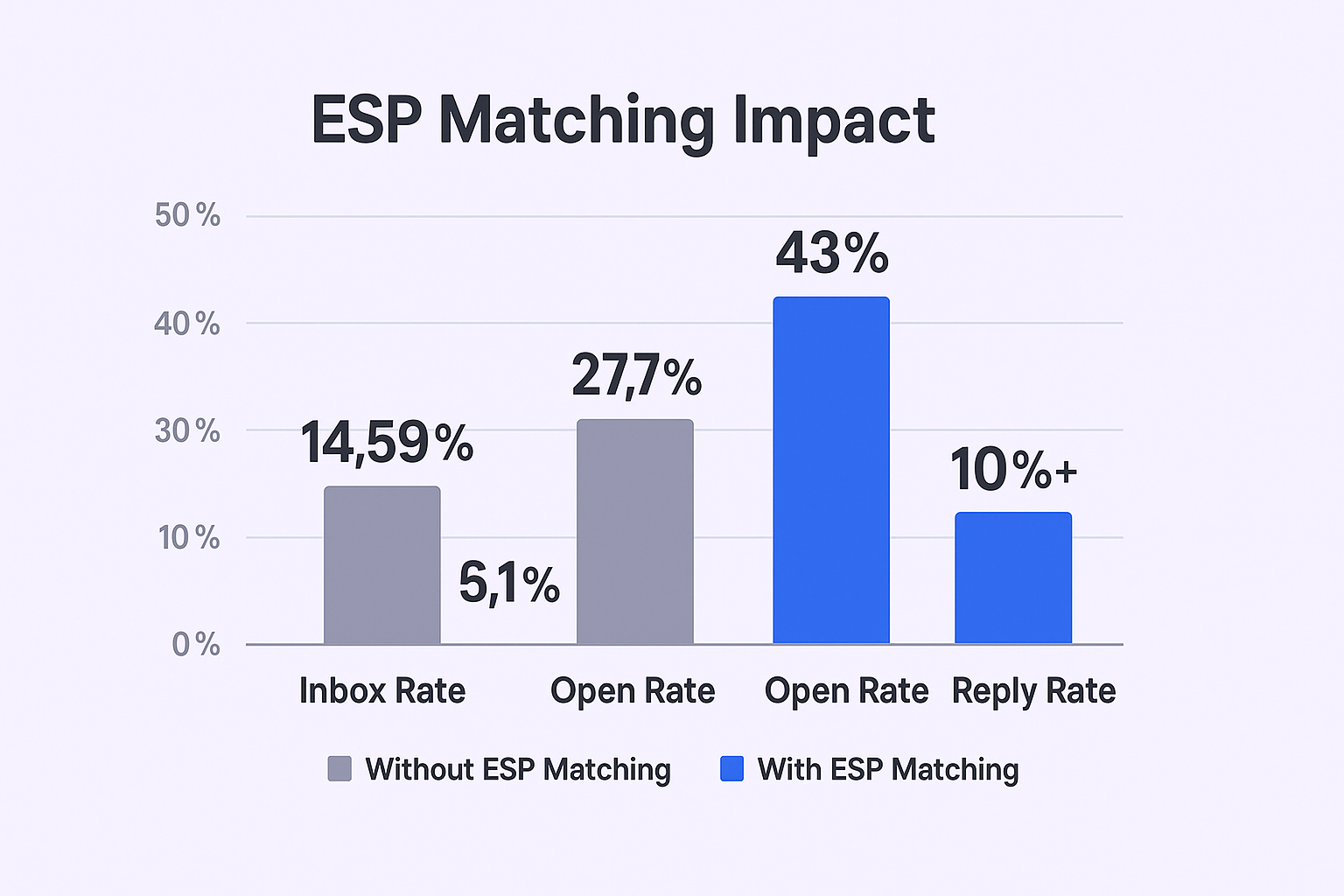
With average cold email open rates dropping to just 27.7% and reply rates hovering around 5.1%, the numbers tell a sobering story. But here’s the kicker: nearly 17% of emails never even reach the intended inbox, disappearing into the digital void before prospects ever see them.
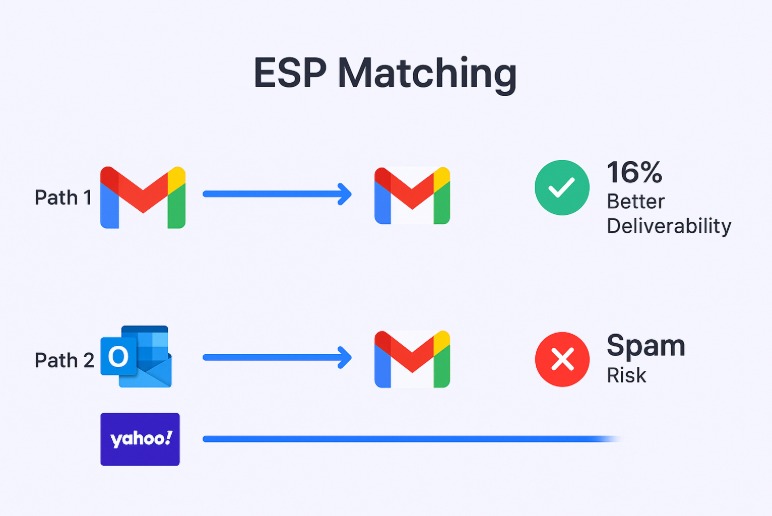
The solution isn’t another copywriting framework or personalization tactic. It’s ESP Matching—a technical approach that can boost your email deliverability by up to 16% by speaking the same language as your recipients’ email providers.
What is ESP Matching?
ESP Matching is a cold email strategy that aligns your sending email provider with your recipient’s email provider. Simply put, it ensures that:
- Emails to Gmail addresses are sent from Gmail accounts
- Emails to Outlook addresses are sent from Outlook accounts
- Emails to other service providers are matched accordingly
Think of it as digital diplomacy. When an email travels from one Gmail server to another Gmail server, it’s treated like an internal communication. The receiving server recognizes the origin, trusts the infrastructure, and processes it with preferential treatmen
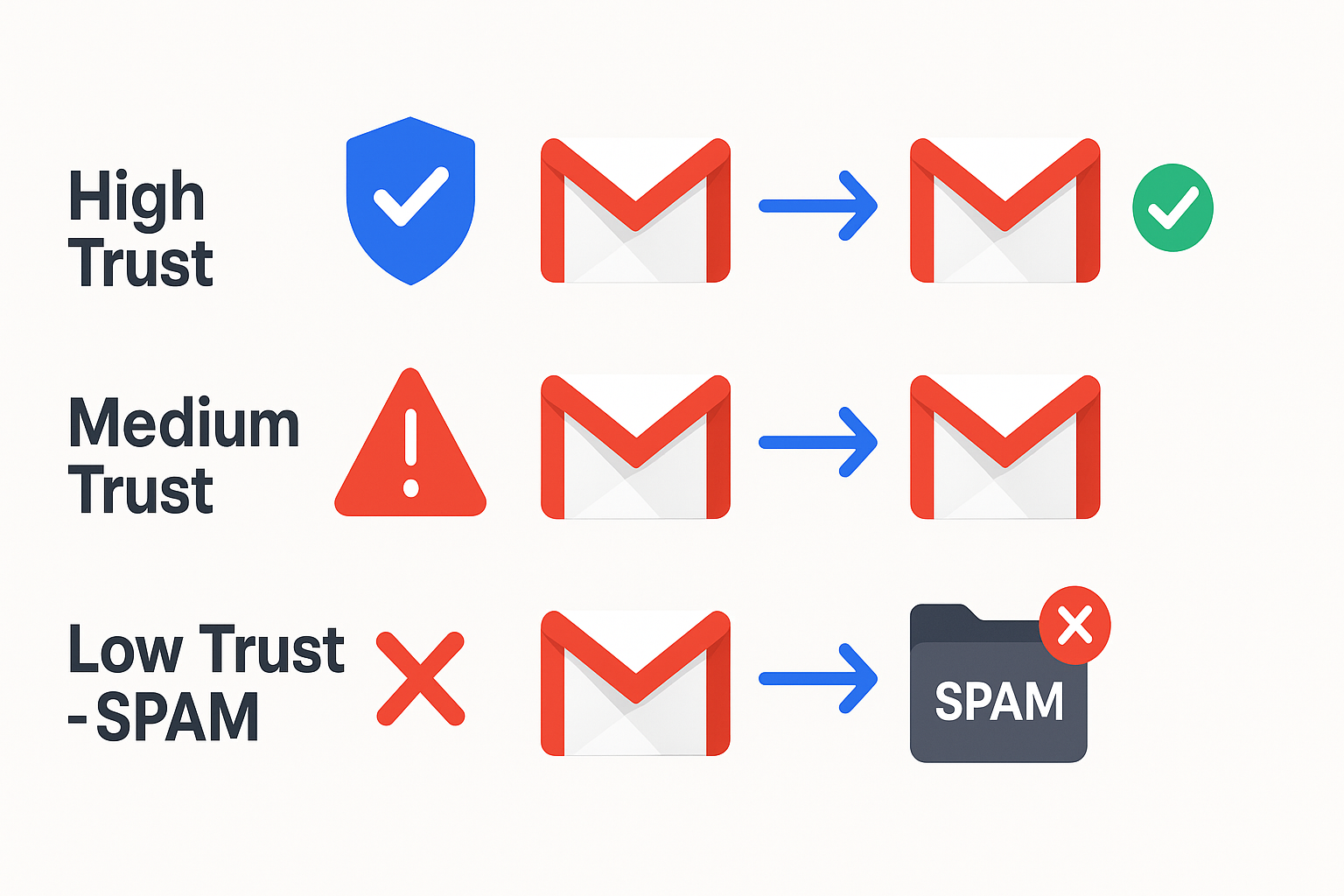
Conversely, emails arriving from unfamiliar external servers are scrutinized heavily by spam filters because their origin is unknown and potentially suspicious.
The Impact of Better Deliverability: When more emails reach the inbox, the cascading effects are substantial:
- Higher open rates from better inbox placement
- Improved sender reputation through positive engagement signals
- Reply rates can reach 10% or higher with proper optimization
- Long-term compounding benefits for future campaigns
How does ESP Matching Work in Salesso?
Salesso takes ESP Matching beyond basic email routing, incorporating it into a comprehensive deliverability strategy that maximizes your campaign performance.
Automated ESP Detection and Allocation
When you upload your prospect list to Salesso, the system immediately analyzes each email address to identify the recipient’s service provider. It examines the domain (the part after “@”) and its associated MX records to determine whether someone uses Gmail, Outlook, Yahoo, or other providers.
Simultaneously, Salesso organizes all your connected sender accounts by their providers, creating distinct pools of available sending accounts: Google accounts, Microsoft accounts, and others.
Intelligent Prioritization Logic
Here’s how Salesso executes ESP Matching at the moment of sending:
Perfect Match Scenario: Your campaign targets 100 prospects—50 using Gmail, 50 using Outlook. You’ve connected sufficient Gmail and Outlook sender accounts. Salesso executes perfect 1-to-1 matching: all Gmail recipients receive emails from your Gmail accounts, all Outlook recipients from your Outlook accounts.
Overflow Management: You’re targeting 200 Gmail users but only have 3 connected Gmail accounts. Salesso prioritizes using the Gmail accounts first, then intelligently overflows to other available accounts once daily limits are reached. This ensures your campaign never stops while maximizing the matching benefit.
Advanced Features in Salesso
Sender Rotation Integration: Salesso automatically distributes sending volume across all connected accounts, preventing any single mailbox from exceeding daily limits and triggering spam filters.
Daily Limit Compliance: The platform enforces email provider limits (500/day for Google Workspace) while optimizing ESP Matching benefits.
Real-time Monitoring: Track deliverability metrics in real-time to see ESP Matching impact on your specific campaigns.
Setting Up ESP Matching in Salesso
Getting started with ESP Matching in Salesso is straightforward:
- Connect Multiple Email Accounts: Add both Gmail and Outlook accounts to create diverse sender pools
- Upload Your Prospect List: Salesso automatically analyzes and categorizes recipients by ESP
- Enable ESP Matching: Toggle on the feature in your campaign settings
- Configure Advanced Rules: Set provider-specific preferences or limits if needed
- Launch and Monitor: Track performance metrics to quantify the deliverability improvement
Beyond ESP Matching: The Complete Deliverability Strategy
While ESP Matching provides significant benefits, elite performance requires a holistic approach:
Technical Foundation
- SPF Records: Validate sending server authorization
- DKIM Signatures: Ensure email integrity with digital signatures
- DMARC Policies: Provide comprehensive email validation
Domain Reputation Management
New domains need strategic warm-up processes. Gradually increasing sending volumes over several weeks helps establish trust with email providers and build positive sender history.
List Quality Control
Poor list hygiene results in high bounce rates, which damages sender reputation. Always verify email addresses before launching campaigns to maintain deliverability.
Content Optimization
Even with perfect technical setup, poorly written emails get deleted. Focus on:
- Personalization: Personalized subject lines see 50% higher open rates
- Brevity: Keep emails under 100 words for better performance
- Clear CTAs: Guide prospects toward specific, low-commitment next steps
- Follow-up Sequences: Follow-ups can increase reply rates by 50% or more
Key Statistics That Matter
Understanding cold email benchmarks helps set realistic expectations:
Open Rates:
- Industry average: 27.7%
- Good performance: 15-25% range
- Top campaigns: 80%+ open rates
Reply Rates:
- Industry average: 1-5%
- Good performance: Above 15%
- Top performers: 40-50%+
Timing Insights:
- Best days: Monday and Tuesday
- Optimal times: 11 AM or 1 PM
- 95% of responses come within 24 hours
Follow-up Impact:
- 2-4 follow-ups recommended
- Multi-contact outreach boosts response by 93%
- Persistence increases conversion significantly
