

🎉Find Prospects and Send Cold Emails & LinkedIn Outbound | All in One Place

Cold Email vs Spam: The Complete Guide to Legal Outreach in 2025

Table of Contents

TL;DR – Cold Email vs Spam

Cold emails aren’t spam – if you follow the rules. Here’s what you need to know:

  • Cold email = targeted, personalized, one-to-one business outreach
  • Spam = bulk, generic, unsolicited mass messaging
  • Legal difference: Cold emails are legal when personalized and compliant
  • Success rate: Top performers achieve 15-25% reply rates vs 5.8% average
  • Key to success: Quality over quantity, proper authentication, and value-driven messaging

The bottom line? Cold emailing works when you treat prospects like humans, not numbers.

What Is Cold Emailing? How Is It Different From Spam?
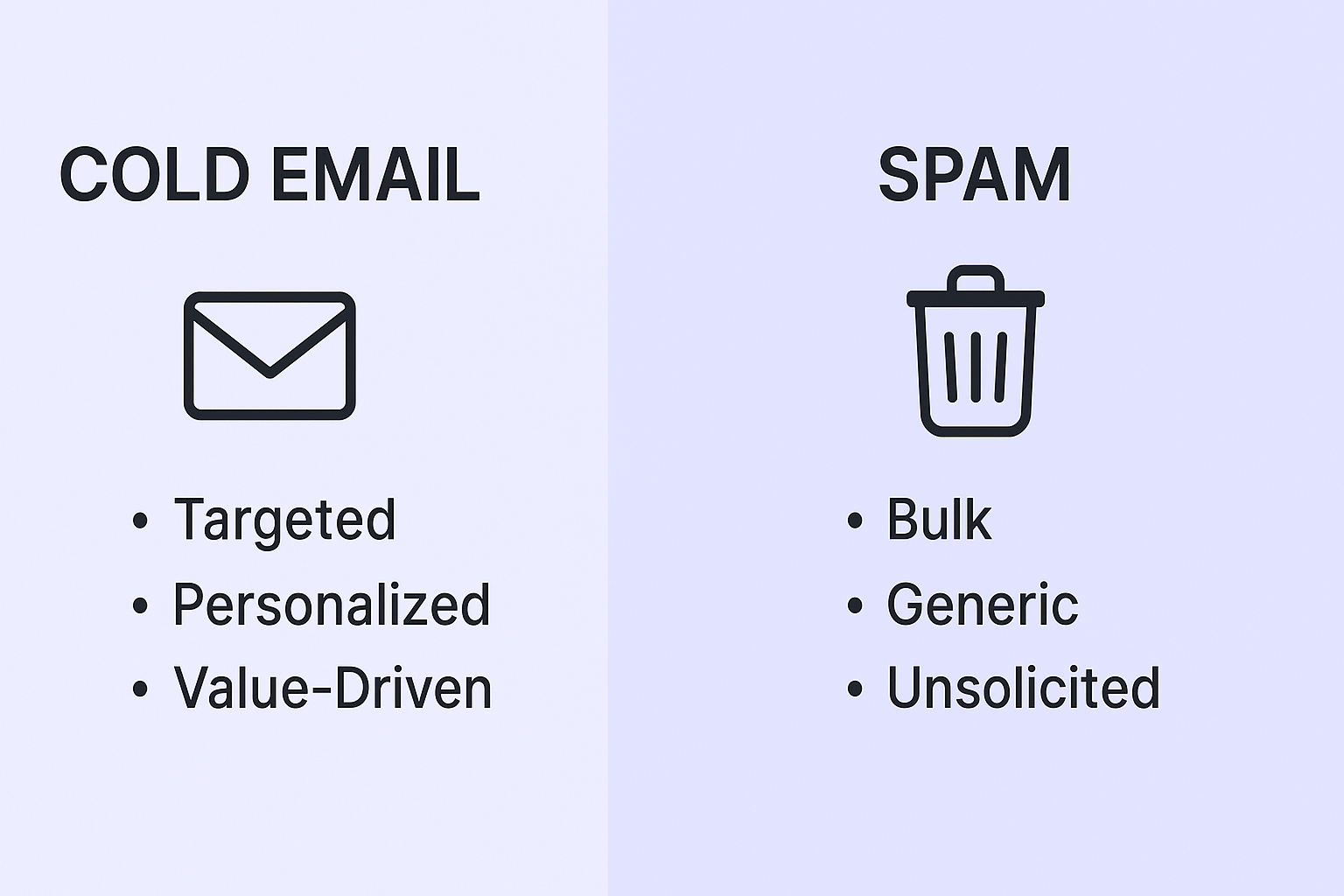


Cold emailing gets a bad rap. Many people think any unsolicited email equals spam, but that’s simply not true.

Cold emailing is a targeted, personalized business communication sent to someone you haven’t contacted before. The goal is to start a professional conversation and build a relationship.

Spam, on the other hand, is bulk messaging sent to massive lists without personalization or value.

The Professional Definition of Cold Email

A legitimate cold email has three core characteristics:

  • Targeted and Personalized: Sent to specific people who fit your ideal customer profile, with content tailored to their role, company, or recent activities
  • Value-Driven: Provides upfront value by addressing specific pain points or offering relevant solutions
  • Transparent and Compliant: Honest about sender identity and purpose, with clear opt-out options

The Legal Definition of Spam

According to anti-spam laws like CAN-SPAM, an email is only legally spam when it has ALL three characteristics:

  1. Sent in bulk to hundreds or thousands of recipients
  2. Not personalized – generic content applicable to anyone
  3. Unsolicited – sent without express consent

Here’s the key insight: Being unsolicited alone doesn’t make an email spam. A personalized, one-to-one cold email avoids the “bulk” and “not personalized” criteria, keeping it legal and effective.

Is Cold Emailing Legal?

Yes, cold emailing is legal in most countries when done correctly. But compliance isn’t optional – it’s essential for protecting your business and maintaining deliverability.

United States: CAN-SPAM Act

The CAN-SPAM Act allows cold emailing with these requirements:

  • Accurate sender information: Domain and email address must be legitimate
  • Non-deceptive subject lines: Must reflect actual email content
  • Clear identification: Identify as commercial communication
  • Physical address: Include valid street address
  • Easy opt-out: Provide clear unsubscribe option, honor within 10 days

Penalty: Up to $50,120 per violation per email

European Union & UK: GDPR & ePrivacy
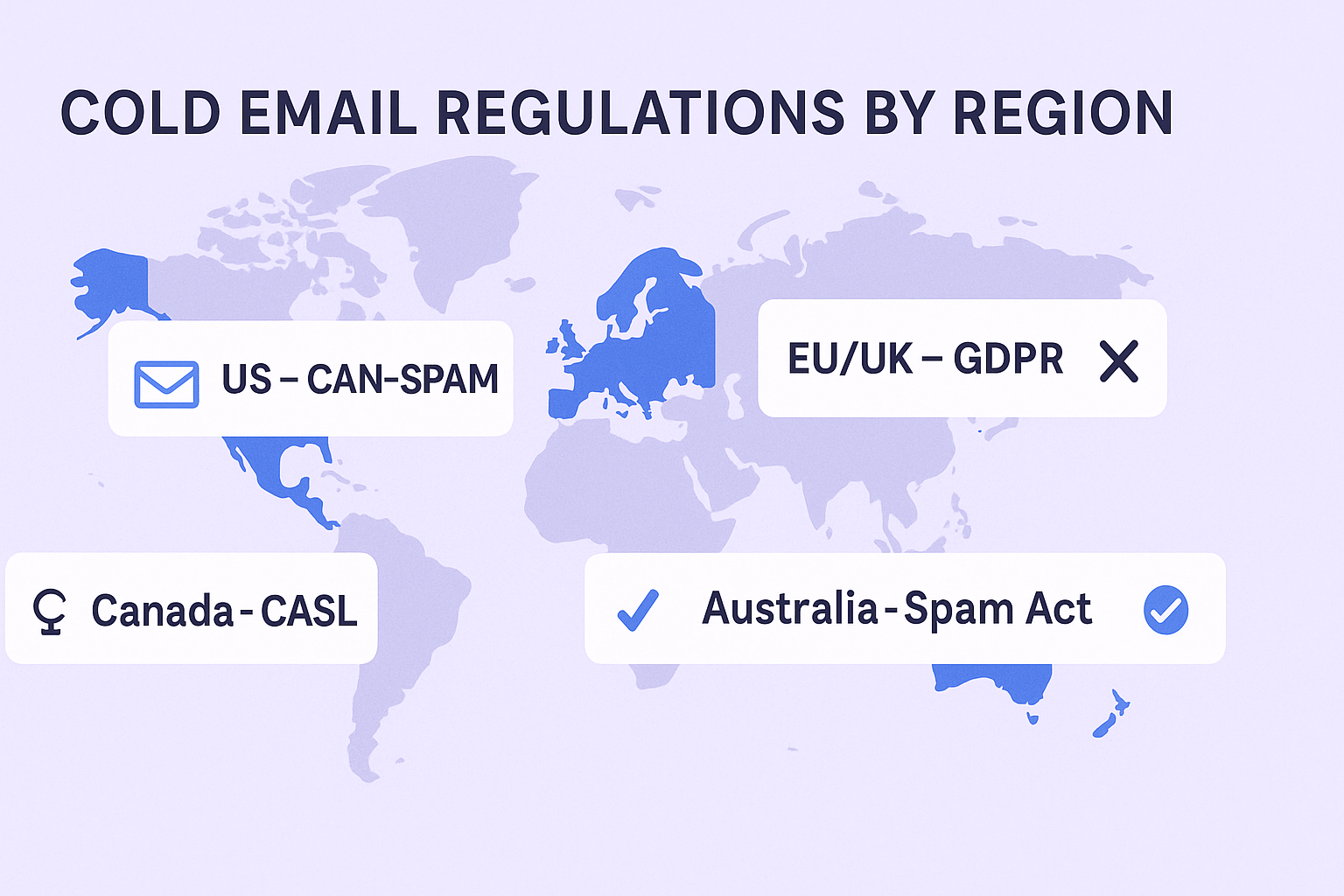


EU regulations are stricter but still allow B2B cold emailing:

  • Legitimate Interest for B2B: Can contact business emails if relevant to their role
  • Explicit consent for B2C: Required for personal/consumer emails
  • Must document justification and provide easy opt-out

Key Global Requirements

Region

Primary Law

B2B Allowed?

Key Requirements

US

CAN-SPAM

Yes

Accurate info, opt-out, physical address

EU/UK

GDPR/ePrivacy

Yes (legitimate interest)

Documented justification, clear opt-out

Canada

CASL

Limited

Explicit/implied consent required

Australia

Spam Act

Risky

Explicit consent preferred


Best Practices to Keep Cold Emails Out of the Spam Folder

Avoiding the spam folder isn’t luck – it’s science. Email providers use sophisticated algorithms to evaluate sender reputation and message quality.

Technical Foundation: Email Authentication

Your technical setup determines whether emails reach the inbox:

SPF (Sender Policy Framework): Authorizes which servers can send emails for your domain DKIM (DomainKeys Identified Mail): Cryptographically signs emails to prevent tampering
DMARC (Domain-based Message Authentication): Enforces policies for failed authentication

Without proper authentication, even perfect emails land in spam.

Sender Reputation Factors

📬 Bypass Email Authentication Completely

LinkedIn outbound reaches decision-makers directly—no SPF, DKIM, or spam filters to worry about.

Internet Service Providers track your behavior:

  • Complaint rates: Recipients marking emails as spam
  • Bounce rates: Emails to invalid addresses (keep under 3-5%)
  • Spam trap hits: Sending to addresses designed to catch spammers
  • Engagement: Opens, clicks, replies boost reputation

Cold Email Best Practices

Research Before You Write

  • Use LinkedIn, company websites, recent news
  • Reference specific, recent developments
  • Prove you understand their business challenges

Craft Human-Like Messages

  • Keep subject lines under 7 words
  • Use conversational tone
  • Include one specific, relevant detail
  • Provide clear value proposition

Optimize Sending Behavior

  • Send during business hours in recipient’s timezone
  • Limit daily volume (start with 50-100 per day)
  • Use verified email lists only
  • Maintain consistent sending patterns

The Numbers That Matter

Recent data shows the stark reality of cold email performance in 2025:

  • Average open rate: 27.7% (down from 36% in 2023)
  • Average reply rate: 5.8% (industry declining)
  • Bounce rate: 7-8% average
  • Top performers: Achieve 15-25% reply rates with proper strategy

Best Cold Email Templates to Avoid the Spam Folder

 🎯 Get 15-25% Replies Consistently

 Our LinkedIn outbound engine delivers these results without deliverability risks through complete targeting and campaign design.

The right template can make or break your campaign. Here are proven frameworks that consistently avoid spam filters and generate responses.

The Pain Point Template

Subject: Quick question about [specific challenge]

Hi [First Name],

I noticed [specific observation about their company/role].

Many [job title] at companies like [their company] struggle with [specific pain point]. Last month, I helped [similar company] [specific result/metric].

Worth a quick chat to see if this could help [their company]?

Best, [Your name]

When to use: When you’ve identified a clear, industry-specific challenge

The CBTH (Compliment-Benefit-Time-Help) Template

Subject: [Company name] + [relevant topic]

Hi [First Name],

Impressive work on [specific achievement/project].

I help [job title] at [type of company] achieve [specific benefit]. For example, [Company X] saw [specific metric/result] in [timeframe].

Would 15 minutes next week make sense to explore if this could work for [their company]?

[Your name]

When to use: When you can genuinely compliment recent achievements

The Case Study Template

Subject: How [Similar Company] achieved [specific result]

Hi [First Name],

[Similar company] in [industry] recently faced [challenge]. After implementing [solution], they achieved [specific metrics].

Given [their company’s] focus on [relevant area], this might be relevant.

Worth a brief conversation?

[Your name]

When to use: When you have strong, relevant case studies

Follow-Up Best Practices

Most sales professionals give up after one email – a critical mistake. The optimal sequence includes 4-6 emails over 2-3 weeks:

  • Email 1: Initial outreach
  • Email 2: 3 days later – add new value/insight
  • Email 3: 1 week later – different angle/case study
  • Email 4: 1 week later – final soft touch

Each follow-up should provide new value, not repeat the same pitch.

Cold Emailing: Is It Still a Great Strategy in 2025?

Despite declining averages, cold emailing remains one of the highest ROI sales activities when executed strategically.

The Shifting Landscape

The cold email landscape has fundamentally changed:

The Bad News:

  • Average open rates down 23% since 2023
  • 17% of cold emails never reach the inbox
  • Increased spam filter sophistication

The Good News:

  • Top performers achieve 40-50% reply rates in some campaigns
  • Personalization increases replies by 140%
  • Average ROI still $36 for every $1 spent
  • Less competition as poor senders get filtered out

Why Cold Email Still Works

💡 Why Top B2B Teams Use LinkedIn

No spam folders, direct decision-maker access, and 40% higher response rates than declining email averages.

Email remains the preferred business communication channel. While social media grabs attention, professionals still conduct serious business via email.

Modern tools enable personalization at scale. AI and automation allow you to research and personalize hundreds of emails efficiently.

Quality beats quantity. The shift toward precision over volume rewards those who invest in proper strategy.

The Strategic Advantage

Companies mastering cold email in 2025 gain significant competitive advantages:

  • Lower customer acquisition costs than paid advertising
  • Direct communication with decision makers
  • Scalable outreach without platform dependency
  • Measurable results and optimization opportunities

Cold vs Warm Email Strategy

Understanding when to use each approach maximizes results:

Cold Email Characteristics:

  • Audience: Complete strangers
  • Goal: Initiate conversations
  • Reply Rate: Lower but can be optimized
  • Best for: Generating new leads from scratch

Warm Email Characteristics:

  • Audience: Previous interactions/engaged prospects
  • Goal: Nurture and convert
  • Reply Rate: Higher engagement
  • Best for: Converting existing leads

The most effective sales professionals use cold email to fill the top of the funnel, then transition prospects to warm nurturing sequences.

🚀 Advanced LinkedIn Targeting

Strategic demographic segmentation delivers personalized campaigns with systematic scaling approaches

7-day Free Trial |No Credit Card Needed.

Cold Email vs Spam: FAQs

Is sending cold emails illegal?

No, cold emails are legal when they comply with anti-spam laws. Key requirements include accurate sender information, clear opt-out mechanisms, and avoiding bulk, generic messaging.

How many cold emails can I send per day?

Start with 50-100 per day from a new domain. Gradually increase to 200-300 as your sender reputation improves. Sending too many too quickly will hurt deliverability.

What's the difference between cold email and spam?

Cold emails are targeted, personalized, one-to-one communications. Spam is bulk, generic messaging sent to mass lists. The legal distinction matters for compliance and effectiveness.

Which email provider has the best spam filter?

No single provider is perfect. Google Workspace and Microsoft 365 offer strong built-in protection, but modern threats require layered security combining provider filters with behavioral analysis tools.

How do I improve cold email reply rates? Focus on personalization, relevant value propositions, and proper technical setup. Research prospects thoroughly, reference specific details, and provide clear solutions to their pain points.

Focus on personalization, relevant value propositions, and proper technical setup. Research prospects thoroughly, reference specific details, and provide clear solutions to their pain points.

Skip the Spam Folder Entirely

LinkedIn outbound gets 15-25% reply rates with zero deliverability issues. No authentication headaches.

Segmentation That Actually Converts

LinkedIn outbound targets precise demographics with strategic campaign design and scaling methods

How to Build a High-Converting B2B Sales Funnel from Scratch on LinkedIn ​