
🎉Find Prospects and Send Cold Emails & LinkedIn Outbound | All in One Place

Data Enhancement vs Data Enrichment: The Complete Guide for Better Business Intelligence

Table of Contents

TL;DR: Data enhancement cleans and fixes your existing data, while data enrichment adds new information from external sources. You need both for maximum impact – enhancement first to create a reliable foundation, then enrichment to unlock deeper insights and personalization.

In today’s competitive landscape, your success depends on the quality of your data. Every day, teams struggle with bounced emails, outdated contact information, and missed opportunities because their data foundation is shaky. Yet many businesses confuse two critical processes: data enhancement and data enrichment.

While both improve business intelligence, they solve completely different problems. Understanding this distinction isn’t just technical knowledge – it’s the key to maximizing productivity, improving personalization, and driving revenue.
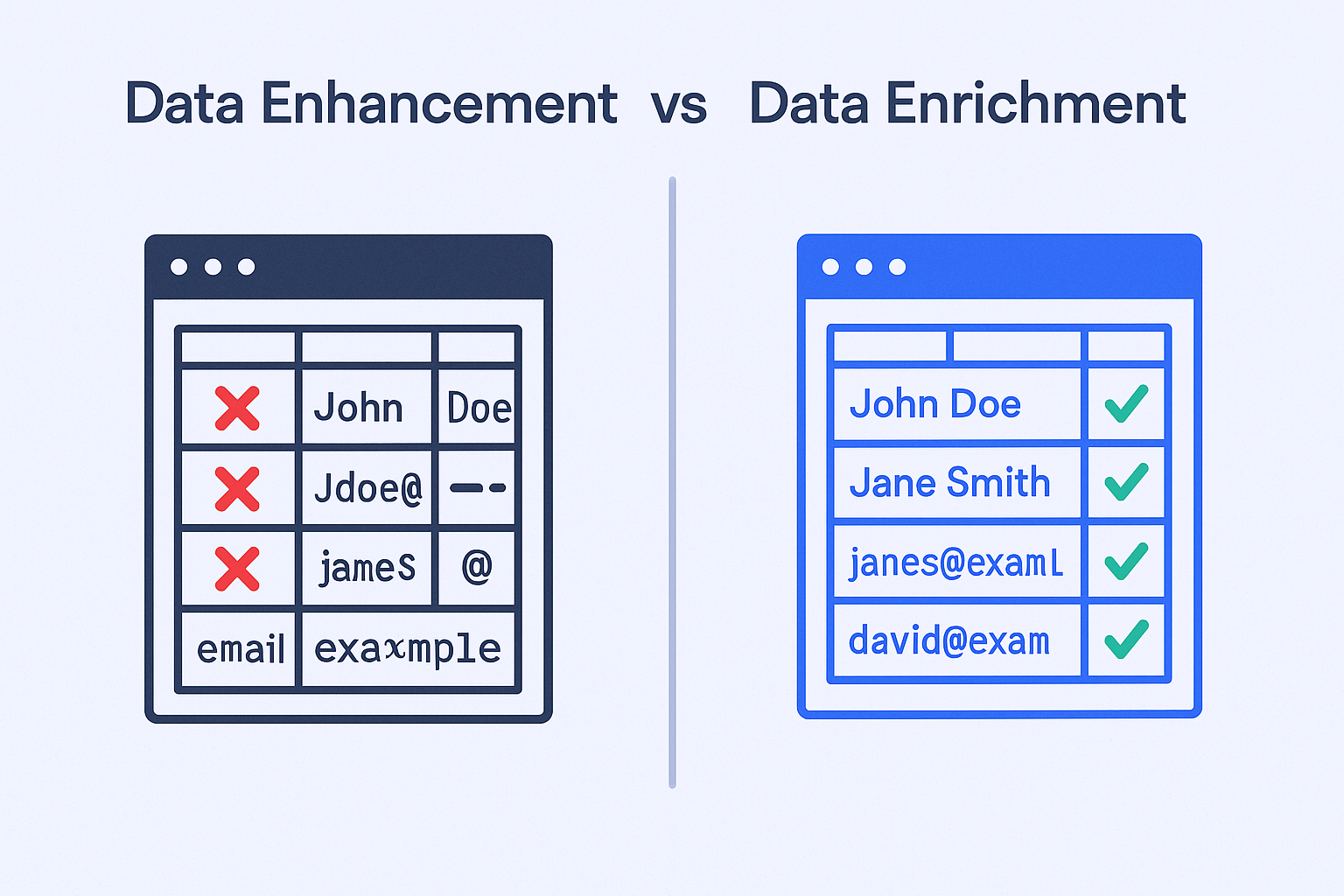
This guide breaks down everything you need to know about data enhancement vs data enrichment, so you can make smart decisions about your data strategy.

What is Data Enhancement?

Think of data enhancement as giving your existing data a complete tune-up. It’s a corrective process focused on cleaning, updating, and standardizing the information you already have.

Data enhancement addresses the foundational issues that plague most databases. It removes typos, fixes formatting inconsistencies, and standardizes phone numbers and addresses. The process validates that contact details are still active, preventing your emails from bouncing or calls from reaching dead numbers.

Enhancement also tackles one of the biggest productivity killers: duplicate records. It identifies and merges duplicate contacts, ensuring you’re not wasting time reaching out to the same person multiple times through different records.
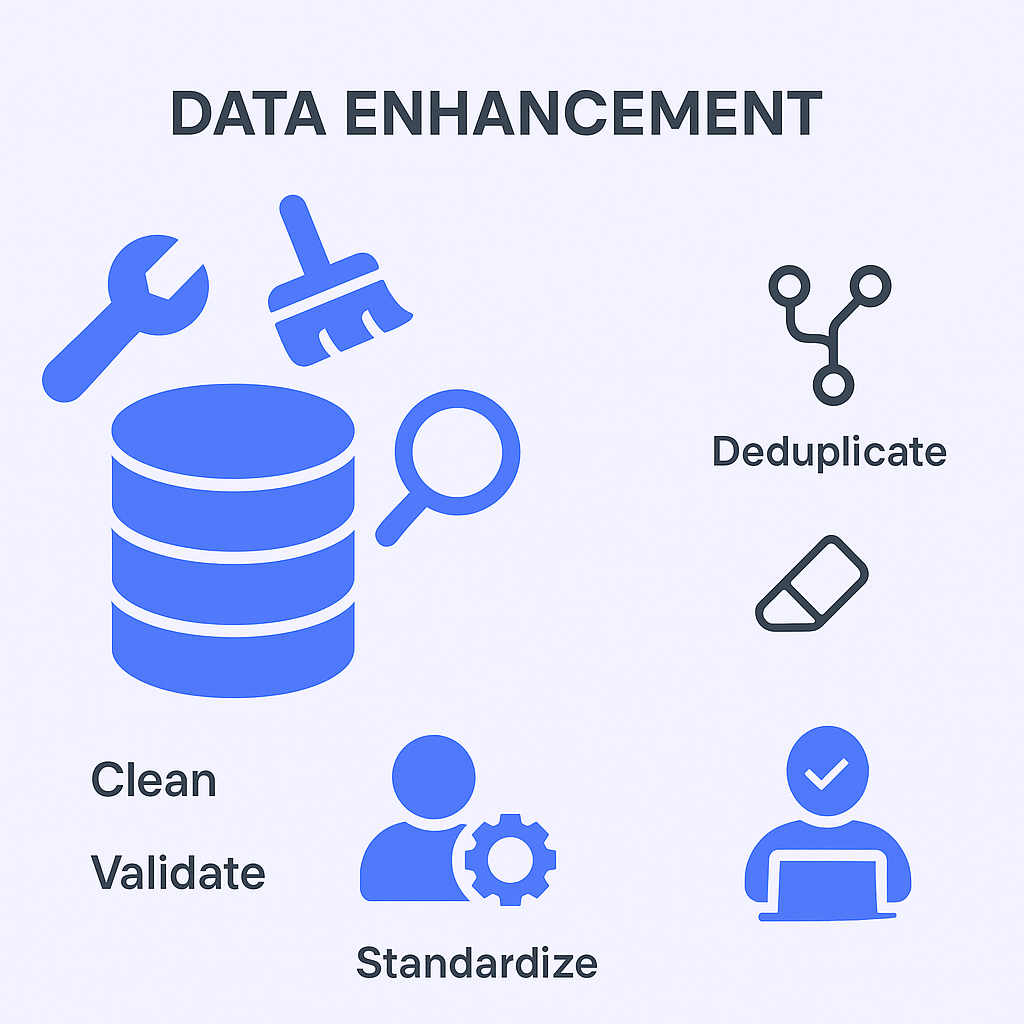


Key activities in data enhancement include:

  • Data cleaning: Fixing typos, standardizing formats
  • Data validation: Verifying contact information is active
  • Updating records: Refreshing outdated job titles and company information
  • Deduplication: Removing or merging duplicate entries

The immediate value is clear: enhanced data creates a reliable foundation that eliminates wasted effort and improves team productivity.

💡 Bypass Email Data Issues Entirely

LinkedIn outbound eliminates deliverability problems while our targeting and campaign design connect you with verified decision-makers

What is Data Enrichment?

If enhancement is a tune-up, enrichment is adding a turbocharger and GPS system to your car. Data enrichment is an expansive process that adds new, external information to build richer prospect profiles.

This process transforms basic contact records into strategic assets. Instead of just having a name and email, you gain insights into company size, industry, technology stack, and buying behavior.

Data enrichment pulls information from third-party providers, APIs, and public databases to append valuable attributes to your records. This might include firmographics (company details), technographics (software used), behavioral data (website visits), or intent signals (content downloads).
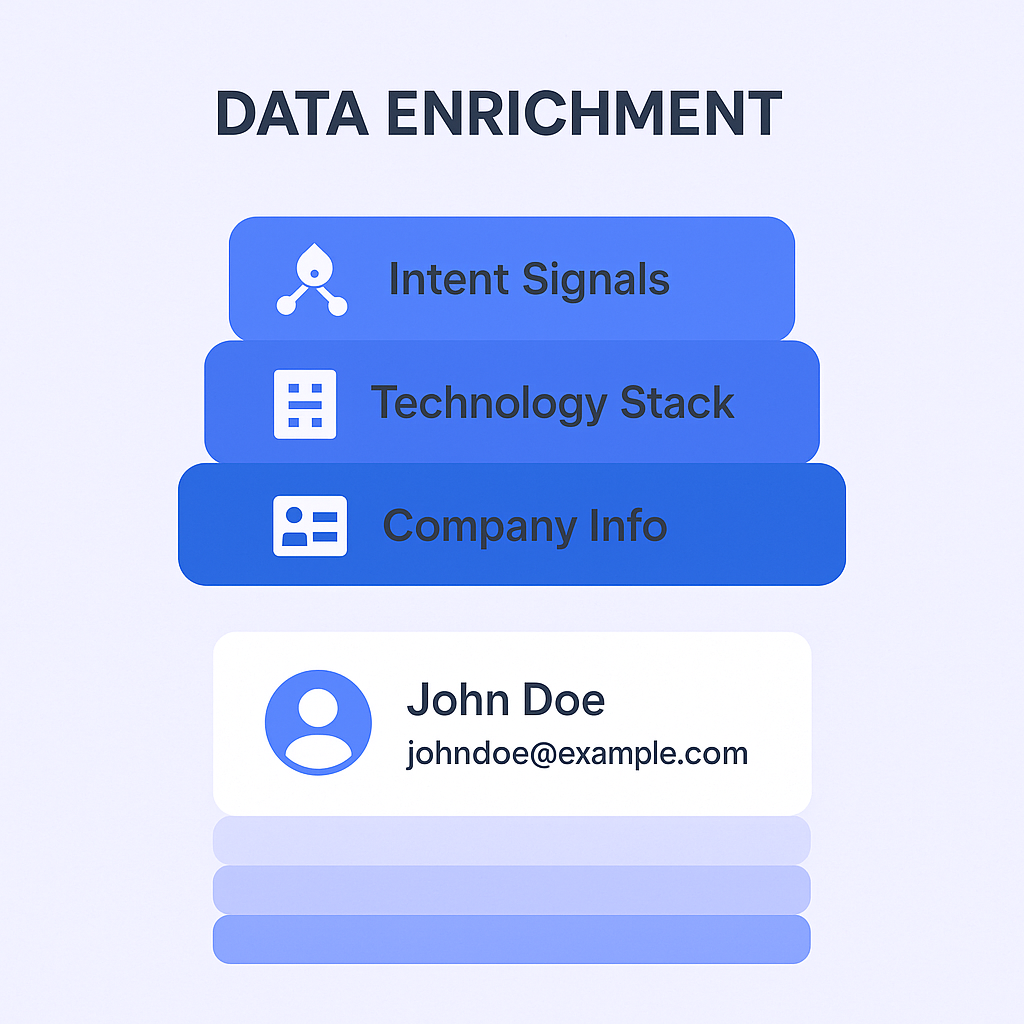


Common types of enriched data:

  • Firmographics: Company size, revenue, industry, location
  • Technographics: Software and technology stack details
  • Behavioral data: Website visits, content engagement, buying signals
  • Contact details: Direct phone numbers, social profiles, job titles

The result is a complete picture of each prospect that enables hyper-personalization and smarter outreach strategies.

🎯 Get Rich Prospect Data Built-In

LinkedIn profiles provide verified firmographics and behavioral signals our complete outbound system leverages for 15-25% response rates

Data Enhancement vs Data Enrichment: Key Differences

Understanding the core differences helps you choose the right approach for your specific challenges.

Purpose: Enhancement fixes existing problems in your data, while enrichment creates new opportunities by adding context and depth.

Data Source: Enhancement works with your internal data using validation tools and processes. Enrichment brings in fresh information from external, third-party sources.

Process: Enhancement corrects and updates what you already have. Enrichment appends entirely new attributes and insights.

Outcome: Enhancement delivers a reliable, compliant database you can trust. Enrichment provides a strategic asset for personalization and better lead scoring.

Quick Comparison Table

Aspect

Data Enhancement

Data Enrichment

Purpose

Fix existing data issues

Add new context and insights

Source

Internal data, validation tools

External sources, APIs

Process

Correct and update information

Append new attributes

Focus

Accuracy and reliability

Context and personalization

Outcome

Clean, trustworthy database

Strategic intelligence asset

The Benefits of Data Enrichment

Data enrichment transforms basic contact lists into competitive advantages. The impact shows up in three key areas:

Hyper-Personalization at Scale Enriched data lets you craft messages that resonate immediately. When you know a company’s technology stack, you can highlight specific integrations. Understanding their industry challenges means your pitch addresses real pain points.

Personalized email subject lines are 26% more likely to be opened, and this level of personalization is only possible with enriched data.

Improved Lead Qualification Adding firmographic and behavioral data dramatically improves lead scoring accuracy. You can identify which prospects fit your ideal customer profile and prioritize outreach accordingly.

Companies using enriched data for segmentation see 14.31% higher open rates compared to generic campaigns.

Better Conversion Rates When your outreach is relevant and timely, prospects respond. Enriched data helps you reach the right person with the right message at the right moment, leading to higher engagement and conversion rates.

The Benefits of Data Enhancement

The cost of poor data quality is staggering, and data enhancement directly addresses these losses:

Massive Time Savings Workers waste up to 50% of their time hunting for data, correcting errors, and confirming sources. Enhancement eliminates this productivity drain by ensuring data accuracy from the start.

Revenue Protection Poor CRM data accounts for over 10% of lost annual revenue for many companies. Sales departments lose almost 550 selling hours every year due to inaccurate information.

Deliverability Improvements Enhanced data means fewer bounced emails and more successful outreach attempts. This directly translates to better campaign performance and ROI.

The numbers tell the story: businesses lose $9.7 million annually on average due to poor data quality. Enhancement is your defense against these losses.

📊 Stop Losing Pipeline to Bad Data

Our LinkedIn outbound engine handles targeting, campaign design, and scaling without email verification headaches or deliverability issues

Best Tools for Data Enrichment and Data Enhancement

Modern platforms combine both capabilities, powered by artificial intelligence to automate tedious manual processes:

Leading Solutions Include:

  • Salesso: Comprehensive cold email platform with built-in email verification, list cleaning, and deliverability optimization
  • ZoomInfo: Massive B2B database with extensive enrichment and cleansing features, including real-time buyer intent data
  • Apollo.io: Data enrichment with 30+ data points plus CRM and CSV cleanup capabilities
  • Snov.io: Email finder and verifier serving both enhancement and enrichment purposes

The AI Advantage Artificial intelligence revolutionizes these processes by:

  • Instantly detecting and correcting errors
  • Real-time data enrichment as information enters your system
  • Predictive modeling to identify high-conversion prospects
  • Automated validation and cleaning at scale

The best platforms use AI to ensure your data stays clean and enriched automatically, eliminating the need for manual intervention.

How to Choose the Best Data Enrichment & Enhancement Tool?

Follow this simple three-step framework:

Step 1: Audit Your Current Data Assess your database health. Are emails bouncing? Do you have duplicate records? High bounce rates and data inconsistencies signal a need for strong enhancement capabilities first.

Step 2: Define Your Strategic Goal If you need better deliverability and productivity, prioritize enhancement features. If you want improved personalization and lead scoring, focus on enrichment capabilities like firmographics and intent data.

Step 3: Evaluate Integration and Quality Look for platforms that offer both capabilities and integrate seamlessly with your existing tools. Data quality should be your top priority – ensure the tool provides verifiable, reliable information from trustworthy sources.

Data Enrichment vs Data Enhancement: Which One Should You Choose?

The most effective strategy isn’t choosing one over the other – it’s using both in the right sequence.

You wouldn’t build a house addition on a crumbling foundation. Similarly, adding rich insights (enrichment) to flawed data (poor quality) creates more problems than solutions.

The Optimal Approach:

  1. Start with Enhancement: Clean, validate, and standardize your existing data to create a trustworthy foundation
  2. Follow with Enrichment: Add layers of insight to build detailed prospect and account profiles
  3. Maintain Continuously: Given that B2B data decays at up to 70% per year, both processes must be ongoing, not one-time projects

This combined approach maximizes your return on investment and ensures your data strategy scales with your business.

🚀 Scale Outbound Without Data Decay

LinkedIn keeps prospect data current automatically while our complete campaign strategy delivers predictable pipeline month after month

7-day Free Trial |No Credit Card Needed.

Data Enrichment vs Data Enhancement: FAQs

How often should I enhance/enrich my data?

With B2B data decaying at up to 70% per year (about 2.1% monthly), these processes should be continuous and automated. One-time cleanups quickly become obsolete.

Can artificial intelligence replace these processes?

AI doesn't replace these processes - it powers them. Machine learning automates the tedious manual work, allowing you to scale your efforts and keep pace with rapid market changes.

What's the most important factor when choosing a tool?

Data quality is paramount. Look for tools that provide verifiable, reliable, and up-to-date information from trustworthy sources. Accuracy and completeness ensure your outreach efforts are effective and productive.

Is this just for large enterprises?

Absolutely not. Poor data quality impacts businesses of all sizes. When your database contains inaccurate or incomplete information, it leads to wasted time, lost opportunities, and diminished results regardless of company size.

Skip Data Headaches with LinkedIn

Our complete LinkedIn outbound engine delivers verified prospects without email deliverability nightmares

Segmentation That Actually Converts

LinkedIn outbound targets precise demographics with strategic campaign design and scaling methods

How to Build a High-Converting B2B Sales Funnel from Scratch on LinkedIn ​