

- blog
- Sales Development
- Engineer: Complete Guide to the New Revenue Growth Role
GTM Engineer: Your Complete Guide to the New Go-to-Market Powerhouse
Table of Contents
The modern sales landscape is broken. Response rates are at an all-time low, prospects are overwhelmed by generic outreach, and the traditional “more headcount equals more revenue” model is crumbling. Enter the GTM Engineer – the hybrid professional who’s revolutionizing how companies approach revenue growth.
If you’re tired of watching deals slip through the cracks because your departments operate in silos, or if you’re wondering why your revenue growth is slower than expected despite having a decent-sized team, this guide will show you exactly how GTM Engineers are solving these problems for companies worldwide.
Who Is a GTM Engineer?
A GTM Engineer is the chief architect of a company’s revenue engine. They’re hybrid professionals who seamlessly combine technical skills, business acumen, and deep understanding of sales and marketing strategies to design, build, and scale the systems that power company growth.
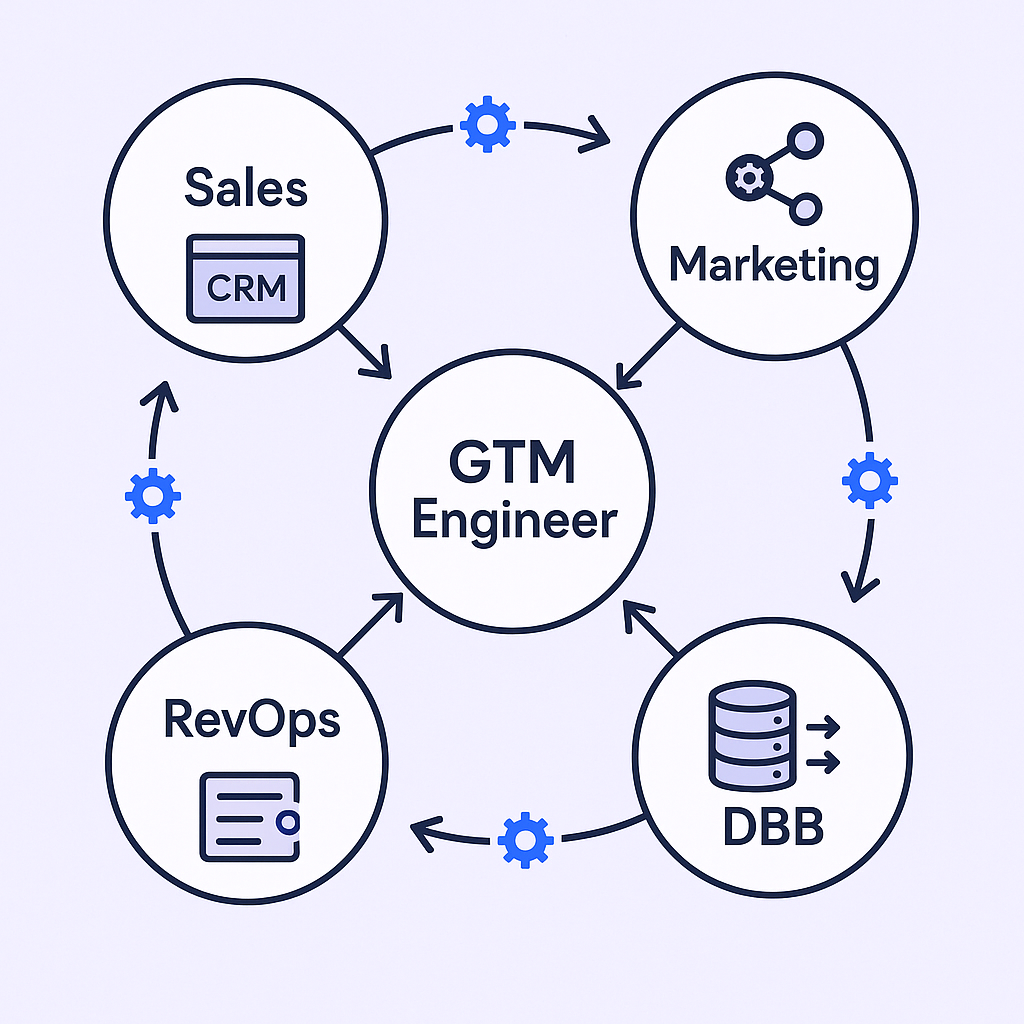
Think of them as strategic problem-solvers who bridge the gap between departments. They integrate tools, streamline workflows, and ensure customer and prospect data flows seamlessly across all platforms. The GTM Engineer’s work enables organizations to automate repetitive processes, allowing teams to focus on high-impact, human-centric activities.
This role emerged as a direct response to a fundamental shift in the business landscape. The outdated notion that “more headcount equals more revenue” is being replaced by a precision-engineered, data-driven approach. With 47% of sales professionals already using generative AI for content creation and automation becoming essential, GTM Engineers are the professionals making this transition possible.
🎯 Scale Pipeline Without Scaling Headcount
LinkedIn outbound delivers 15-25% response rates with complete targeting, campaign design, and automation strategy
Instead of hiring an army of sales reps to scale outbound sales (which is increasingly inefficient), GTM Engineers offer a way to scale smarter with automation and artificial intelligence. This enables small, lean teams to achieve the output of much larger sales organizations.

The Key Responsibilities of a GTM Engineer
A GTM Engineer’s responsibilities center on building a high-leverage, data-driven outbound machine that magnifies the impact of every sales and marketing professional. Their work directly tackles the inefficiencies that hold back traditional growth models:
Engineering Revenue Systems
The primary responsibility is designing and developing the entire end-to-end revenue pipeline. This involves orchestrating the flow of leads, data, and deals from the initial touchpoint all the way through to customer renewal. The GTM Engineer ensures that data flows seamlessly and that the entire go-to-market tech stack works as a single, cohesive system.
Automating Workflows
GTM Engineers are automation wizards who create and manage workflows that handle mundane, repetitive tasks. They build trigger-based cadences that automatically enrich lead data, score prospects for fit, and enroll them in nurturing sequences. By automating activities like personalized message creation and sales follow-ups, they ensure no lead falls through the cracks.
⚡ Automate Outbound Like a GTM Engineer
We handle targeting, campaign design, and scaling so your team focuses on closing deals, not prospecting
Tech Stack Management
This role owns the integration of all tools. In a world where companies use 15 or more different platforms, GTM Engineers use middleware platforms like Zapier and Make, along with custom API scripts, to ensure everything is connected and data syncs reliably. This eliminates context-switching pain, reduces redundant tools, and fixes data flow issues.
Data-Driven Optimization
A GTM Engineer constantly monitors funnel metrics such as open rates, reply rates, and demo conversion rates to identify where leads are getting stuck. They run A/B tests across variables like subject lines and sequence structure to refine strategies based on real-time data, not guesswork.
These responsibilities directly impact efficiency. Sales professionals currently spend an estimated 2 hours and 15 minutes daily on manual tasks like data entry and scheduling. By automating these activities, GTM Engineers free up 82% of sales teams to focus on building stronger client relationships.
Key Differences Between RevOps, SDRs, and GTM Engineers
Understanding the GTM Engineer role becomes clearer when comparing it to traditional sales roles. While SDRs and RevOps are essential, their functions are distinct from the GTM Engineer’s unique hybrid approach:
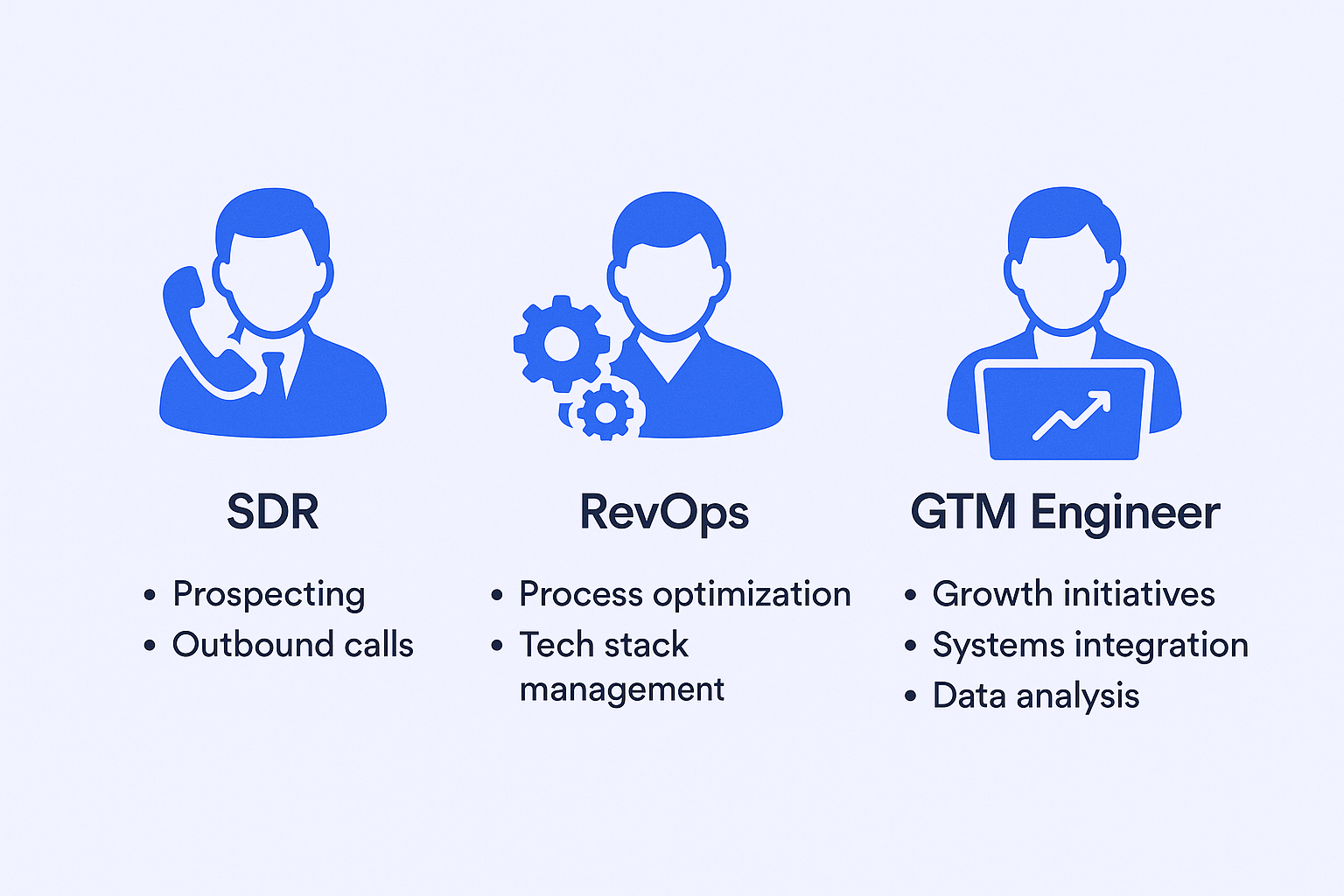
Role | Primary Goal | Core Responsibilities | Key Activities |
SDRs | Prospecting & Qualification | Fill the top of the pipeline with opportunities | Manual research, cold calls, personalized emails, booking meetings |
RevOps | Operations & Efficiency | Maintain the tech stack, ensure data integrity, support sales with reporting | Process optimization, CRM management, tool integrations, analytics |
GTM Engineers | Automation & Growth | Engineer scalable systems for revenue growth and directly drive pipeline | Building automated sequences, AI-driven personalization, integrating tools with APIs/scripts |
The distinctions are clear: RevOps professionals serve as the “maintainers” of the tech stack, ensuring CRM, email tools, and enrichment platforms work together seamlessly. Their focus is on stability and scaling what has already been proven to work.
Traditional SDRs are the “executors,” but their volume-based approach is becoming outdated due to declining response rates and prospect fatigue.

🚀 LinkedIn Outbound: Your Revenue System
Superior to cold email with higher response rates and complete campaign strategy from targeting to scaling
A GTM Engineer is the “builder.” They build smarter workflows on top of the systems that RevOps maintains. Their role is not just to support sales, but to actively generate pipeline. They’re constantly experimenting and testing new ideas, using data to push revenue growth even further.
What Key Skills are Required to Succeed as a GTM Engineer?
To excel in this multifaceted role, professionals need a unique blend of technical and business skills. The GTM Engineer is often described as an “automation wizard” who is as comfortable with a CRM as they are with an API.
The Technical Foundation
This isn’t about being a full-stack developer, but about having the technical proficiency to solve real-world business problems:
CRM Mastery: Deep expertise in at least one major CRM like Salesforce or HubSpot. This involves understanding how to architect entire revenue systems, not just create reports or add custom fields.
Automation & Integration: Proficiency with no-code/low-code tools such as Zapier, Make, and Workato is essential. The ability to connect platforms through APIs and manage webhooks separates a professional GTM Engineer from a basic automation user.
Data Skills: Strong data analysis capabilities, including the ability to pull data using SQL and understand how to manage data pipelines from various enrichment tools.
The Business Acumen
What truly distinguishes a GTM Engineer is their deep understanding of the go-to-market process:
Sales & Marketing Knowledge: GTM Engineers must have firsthand understanding of lead generation, funnels, and customer engagement. Every workflow they build should be designed to help close more deals.
Strategic Problem-Solving: A GTM Engineer must be “part engineer, part growth hacker.” They see broken workflows as opportunities to design better systems and are constantly experimenting with new approaches to improve conversion rates and customer acquisition costs.
The market is rewarding this unique combination with a significant “skills premium,” which doubled from 15-25% in 2023 to 30-40% in 2024. Many GTM Engineers start in sales development or account management, leveraging their existing business knowledge while developing highly sought-after technical skills.
What Are Some Examples of Work Done by GTM Engineers?
The best way to understand GTM Engineer value is seeing their work in action. Their projects aren’t about automating broken processes but redesigning them to be more effective and human-centric:
Personalized Outbound at Scale
The Problem: Sales reps manually sending generic, low-response emails. The Solution: Orchestrate an automated sequence using AI and data enrichment to create personalized outreach at scale. This allows one person’s automated program to generate more booked demos than a team of five did collectively.
💼 Build Your Outbound Machine on LinkedIn
Complete done-for-you campaigns with targeting, AI personalization, and proven scaling methods that GTM teams need
7-day Free Trial |No Credit Card Needed.
Lead Handoffs
The Problem: Leads falling through the cracks or sitting unassigned, leading to lost revenue. The Solution: Implement a trigger-based workflow where new leads are automatically enriched, scored, and routed to the right representative, or trigger Slack alerts when high-intent prospects visit pricing pages.
Post-Sale Expansion & Churn Prevention
The Problem: No systematic way to identify upsell opportunities or at-risk accounts. The Solution: Tap into product usage data and trigger automated emails or check-in calls to proactively prevent churn and encourage expansions.
These examples illustrate that GTM Engineers are strategic partners, not just technicians. They identify business problems first and then use technical skills to engineer solutions that fundamentally improve business outcomes.
Top Tools Used by GTM Engineers for Automation
GTM Engineers rely on a specialized tech stack to build and manage their automated systems. These tools form the foundation of a modern revenue engine:
CRMs
Platforms like Salesforce and HubSpot are the central nervous systems of go-to-market operations. GTM Engineers architect workflows within these systems and ensure all other tools connect to them.
Automation & Integration Platforms
Tools like Zapier, Make, and Workato are the “glue” that allows data to flow between disparate platforms. They enable GTM Engineers to create sophisticated automations without writing code, significantly reducing bottlenecks and speeding up experiments.
Data & Enrichment Tools
A GTM Engineer’s workflows are only as good as the data they use. Tools like Clearbit, Crunchbase, and ZoomInfo provide the fuel for personalized campaigns and lead scoring. These platforms enrich leads with real-time firmographics and intent data.
AI Assistants & Personalization Engines
GTM Engineers are at the forefront of AI adoption in business. They integrate tools like ChatGPT or Claude into actual business workflows to create scalable, yet hyper-personalized, outreach campaigns. This enables a shift from “mass-blast emails” to “micro-relevance,” significantly improving engagement and response rates.
The rise of the “AI-first” enterprise is a direct result of GTM Engineers who seamlessly integrate AI into revenue workflows. 43% of sales professionals are already using automation tools, and GTM Engineers are the professionals making this vision a reality.
Which Companies Benefit the Most From Hiring GTM Engineers?
The demand for GTM Engineers has seen massive growth, with job postings on LinkedIn increasing by 65% from 2023 to 2024. This growth is driven by specific types of companies facing challenges that only GTM Engineers can solve:
Early-Stage and High-Growth SaaS Startups
For these companies, speed is survival. They need to scale go-to-market operations rapidly without the prohibitive cost of hiring an army of salespeople. A GTM Engineer builds scalable systems that enable a small team to achieve the output of a much larger one.
Enterprises with Complex Tech Stacks
The average company uses multiple tools, leading to fragmented workflows and data silos. GTM Engineers are “generalists who understand a bit of everything” and can stitch together these disparate systems into a cohesive revenue engine.
AI-First Enterprises
Companies wanting to integrate ai automation into their sales and marketing processes from day one are ideal candidates. GTM Engineers have the skills to implement and manage AI-driven personalization and lead enrichment at scale.
Account-Based Marketing (ABM) Companies
The hyper-personalization and data-driven targeting required for successful ABM strategy align perfectly with the GTM Engineer’s skill set. They can build automated workflows that identify key accounts and deliver highly relevant outreach.
The increasing demand and lengthy time-to-hire, which has risen by 25% to 120-150 days, indicates a fundamental market shift. Companies recognize this isn’t a luxury hire but a strategic necessity.
What Role Do GTM Engineers Play in the Organizational Structure?
A GTM Engineer’s role is unique because it doesn’t fit neatly into a single siloed department. Instead, they’re the vital link ensuring marketing, sales, and RevOps work together seamlessly toward a unified goal. Their primary function is bridging the gap between departments using technology and data.
GTM Engineers can have varied reporting lines, depending on company structure and needs. They may report to sales leadership, revenue operations, or even head of product development. Regardless of reporting structure, GTM Engineers coordinate closely with sales teams and other revenue teams.
Their work directly addresses the common problem where “everything is connected except your GTM stack.” Siloed departments lead to fragmented data, broken workflows, and slower-than-expected revenue growth. By designing and implementing integrated systems, GTM Engineers ensure fluid exchange of data and information, allowing every part of the go-to-market process to function optimally.
How to Hire a GTM Engineer for Your Organization?
Hiring a GTM Engineer can be challenging, with time to fill these positions lengthening to up to 150 days. To find the right fit, look beyond traditional job descriptions:
Look for a Problem-Solver
A great GTM Engineer sees broken workflows not as frustrations, but as opportunities to design better systems. The ideal candidate is an “operator, not an optimist” who can show a portfolio of projects they’ve built and tangible results they delivered.
Assess a Hybrid Skill Set
The right candidate isn’t a pure coder or pure marketer. They must blend technical expertise, deep sales process knowledge, and a data-driven mindset. Evaluate their mastery of tools like Zapier, understanding of sales funnels, and ability to use data for decisions.
Consider Internal Upskilling
Given the difficulty and cost of external hiring, a viable and often faster alternative is identifying and upskilling existing talent. Many GTM Engineers have backgrounds in sales, marketing, or operations, so professionals with strong analytical and technical aptitude are perfect candidates for internal transitions. This approach is more cost-effective and results in culturally aligned employees who already understand business pain points.
What Is the Career Path for a GTM Engineer?
The GTM Engineer role is a high-growth career path with significant earning potential, making it attractive for professionals looking to future-proof their careers. The average salary for a GTM Engineer in the US rose from $120,000-$180,000 in 2023 to $140,000-$220,000 in 2024 – a 15-20% increase.
As the role is relatively new, there’s no single standard background. Many GTM Engineers come from marketing, sales, data analysis, or operations roles. They leverage their firsthand understanding of sales and marketing processes and then develop technical skills required to build automated systems.
The career trajectory is promising. Entry-level or junior GTM Engineers can advance to mid-level or senior roles. From there, their holistic view of the entire revenue engine, combined with hands-on problem-solving skills, makes them ideal candidates for leadership positions. They can lead teams of other GTM engineers or transition into high-impact roles like Product Manager or Sales Engineering Lead.
The GTM Engineer’s focus on ai automation, data, and systems thinking is preparing them for the most in-demand leadership roles of the future.
Final Thoughts: The Age of GTM Engineers is Here
The rise of the gtm engineer isn’t a fleeting trend but a fundamental shift in how companies approach growth. The traditional model of hiring more people to generate more revenue is broken, and a new era of efficiency and intelligence has arrived.
This role is about engineering a sustainable, end-to-end machine for generating pipeline, closing deals, and retaining happy customers. By leveraging automation and AI, GTM Engineers enable small sales teams to achieve the output of much larger ones.
This allows sales professionals to escape the “manual grunt work” of data entry and generic outreach and focus on high-value, human-centric parts of their job, such as building relationships and closing deals.
The future of sales and marketing belongs not to the person who can work the hardest but to the person who can work the smartest. The GTM Engineer is at the forefront of this revolution, and for any company looking to scale efficiently and profitably, this role is no longer a luxury but an essential investment.
FAQs About GTM Engineers
What is the average salary of a GTM Engineer?
What are the maiIs GTM Engineering the same as RevOps?n benefits of LinkedIn Premium for job seekers?
Do I need to be a software engineer to become a GTM Engineer?
Why is this role so in-demand?
Build Your GTM Engine with LinkedIn
Complete outbound strategy: targeting, AI campaigns, and proven scaling methods for GTM teams
Segmentation That Actually Converts
LinkedIn outbound targets precise demographics with strategic campaign design and scaling methods