
🎉Find Prospects and Send Cold Emails & LinkedIn Outbound | All in One Place

Data Enrichment Strategies: 9 Proven Methods to Transform Your Sales Performance

Table of Contents

Data Enrichment Strategies: 9 Proven Methods to Transform Your Sales Performance

Let’s cut straight to the point. Your sales team is struggling because your data is incomplete, outdated, or just plain wrong.

You’re not alone. 91% of companies struggle with data quality issues that directly impact their revenue. But here’s the thing – the companies that nail data enrichment are seeing 32% higher conversion rates and 27% better customer retention.

This isn’t about having perfect data. It’s about having useful data that turns cold prospects into paying customers.

What is Data Enrichment?

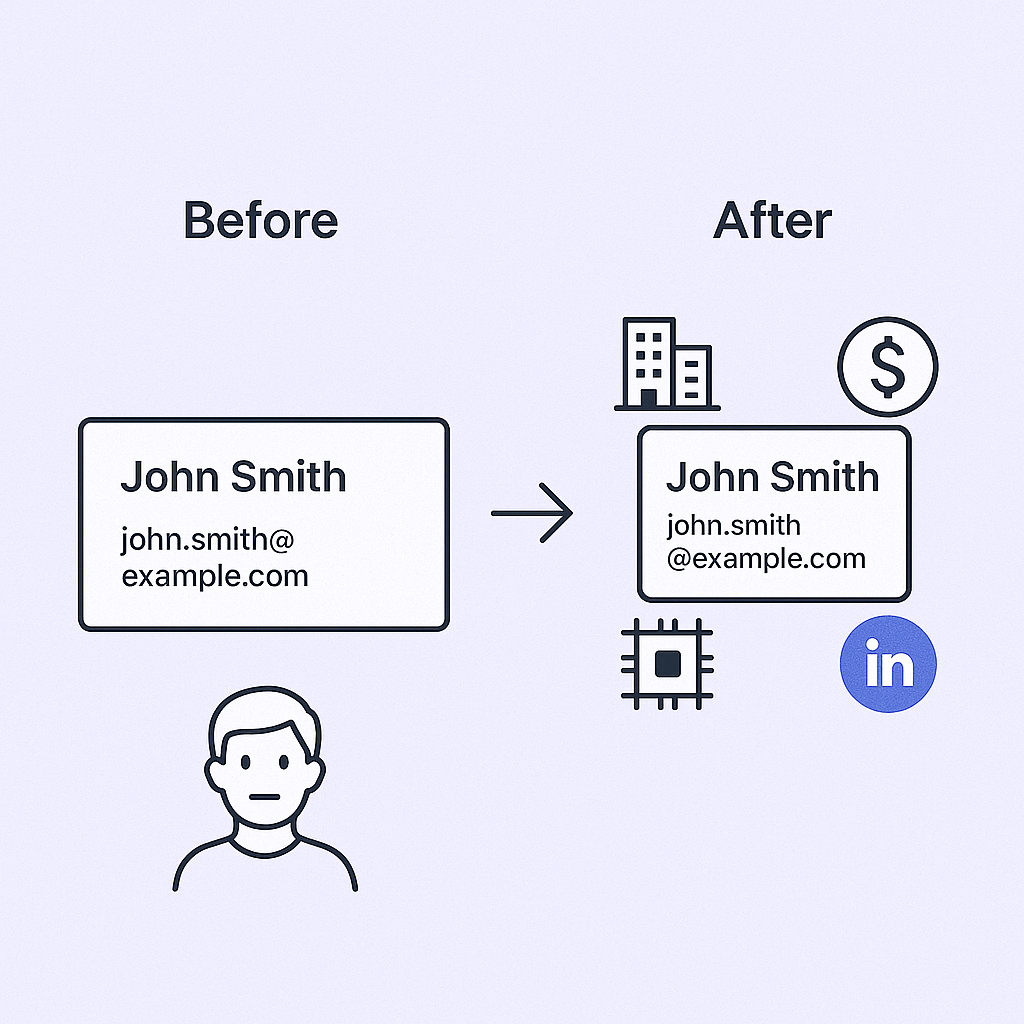
Data enrichment is the process of enhancing your existing customer data with additional information from external sources. Think of it as taking a basic contact card and turning it into a comprehensive customer profile.

Instead of just knowing someone’s name and email, enriched data tells you their company size, recent funding rounds, technology stack, and even their social media activity. Companies using enriched data see 2.4x higher revenue growth compared to those relying on basic contact information alone.


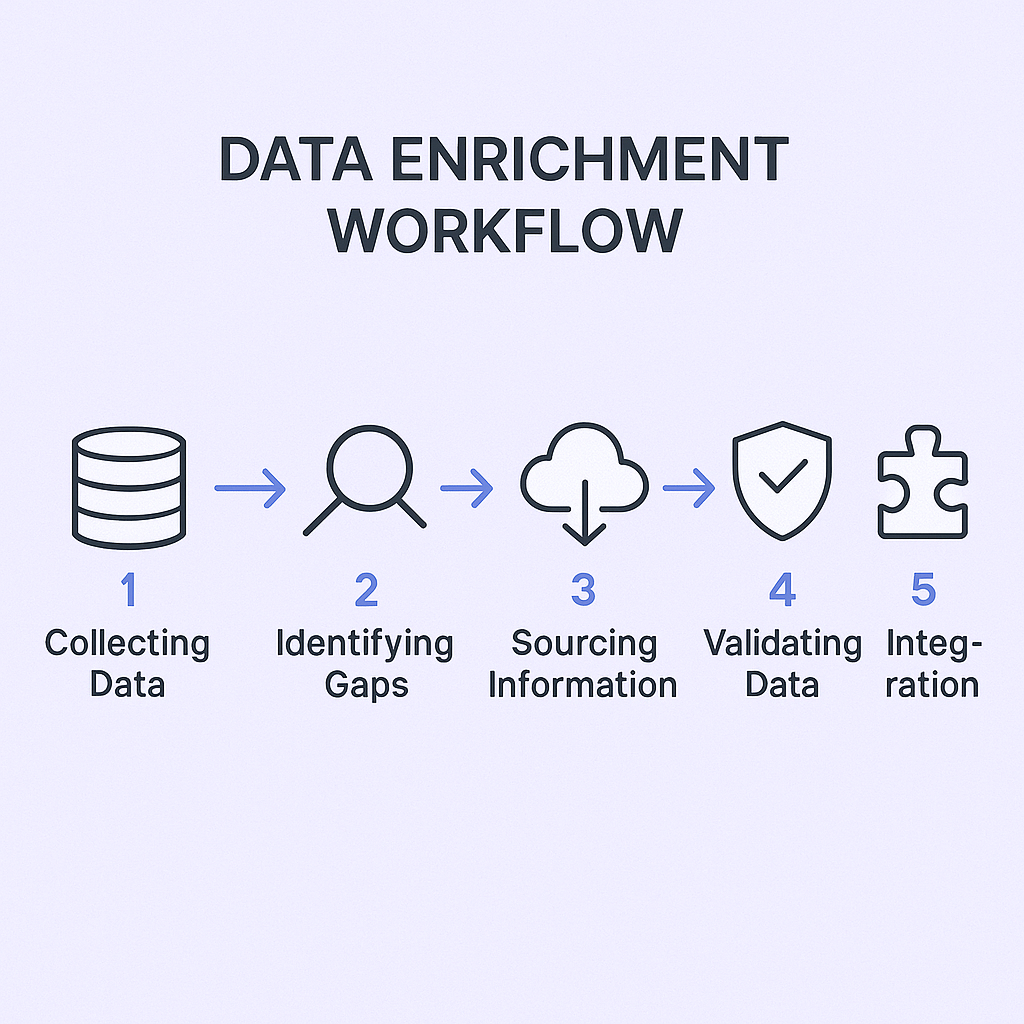
The data enrichment process typically involves:

  • Collecting raw customer data from various touchpoints
  • Identifying gaps in existing customer profiles
  • Sourcing additional information from reliable databases
  • Validating and cleaning the enhanced dataset
  • Integrating enriched profiles into your sales workflow

When done right, customer data enrichment transforms how your team operates. Instead of shooting in the dark, you’re targeting with precision.


Top 9 Data Enrichment Strategies

Strategy 1: Demographic and Firmographic Enhancement

This is your foundation. Demographic data covers individual characteristics while firmographic data focuses on company details.

What to collect:

  • Job titles and seniority levels
  • Company size and revenue
  • Industry classifications
  • Geographic locations
  • Years in business
  • Employee count ranges
  • Organizational structure
  • Decision-making hierarchies

Why it works: Companies with complete firmographic data achieve 73% higher lead conversion rates. When you know a prospect works at a Series B startup with 50-200 employees, you can craft messages that speak directly to their scaling challenges.

The magic happens when you combine demographics with behavior. A VP of Sales at a 100-person SaaS company facing rapid growth has completely different pain points than a VP at a 10,000-person enterprise managing efficiency.

Pro tip: Focus on data points that directly impact buying decisions. Company growth stage matters more than office address for most B2B sales.

Real example: One marketing automation company increased their qualified leads by 156% by targeting companies that had recently raised Series A funding and were hiring marketing roles. The timing was perfect – these companies needed solutions to scale their operations.

Strategy 2: Behavioral Data Integration

Behavioral data reveals how prospects actually engage with your brand and content. This isn’t just website visits – it’s the complete digital footprint that shows buying intent.

Key behavioral signals:

  • Content consumption patterns
  • Email engagement history
  • Website browsing behavior
  • Social media interactions
  • Product demo requests
  • Webinar attendance
  • Download activities
  • Search query patterns
  • Time spent on pricing pages

The impact: Teams using behavioral data for enrichment see 47% more qualified leads and 23% shorter sales cycles. When you know a prospect downloaded three pricing guides and attended your webinar, that conversation starts very differently.

Here’s what most companies miss – behavioral data has a shelf life. Someone who visited your pricing page yesterday is worth 10x more than someone who visited six months ago. Recency matters.

Data quality insight: Behavioral enrichment requires clean tracking. 68% of companies lose valuable behavioral data due to poor attribution and tracking setup. Fix your foundation first.

Strategy 3: Social Media Intelligence

Social platforms are goldmines of real-time prospect intelligence. LinkedIn alone provides insights into job changes, company updates, and professional interests that traditional databases miss.

What to track:

  • Recent job changes or promotions
  • Company announcements and news
  • Professional interests and pain points
  • Network connections and mutual contacts
  • Content sharing patterns
  • Industry event participation
  • Thought leadership activities
  • Engagement with competitors

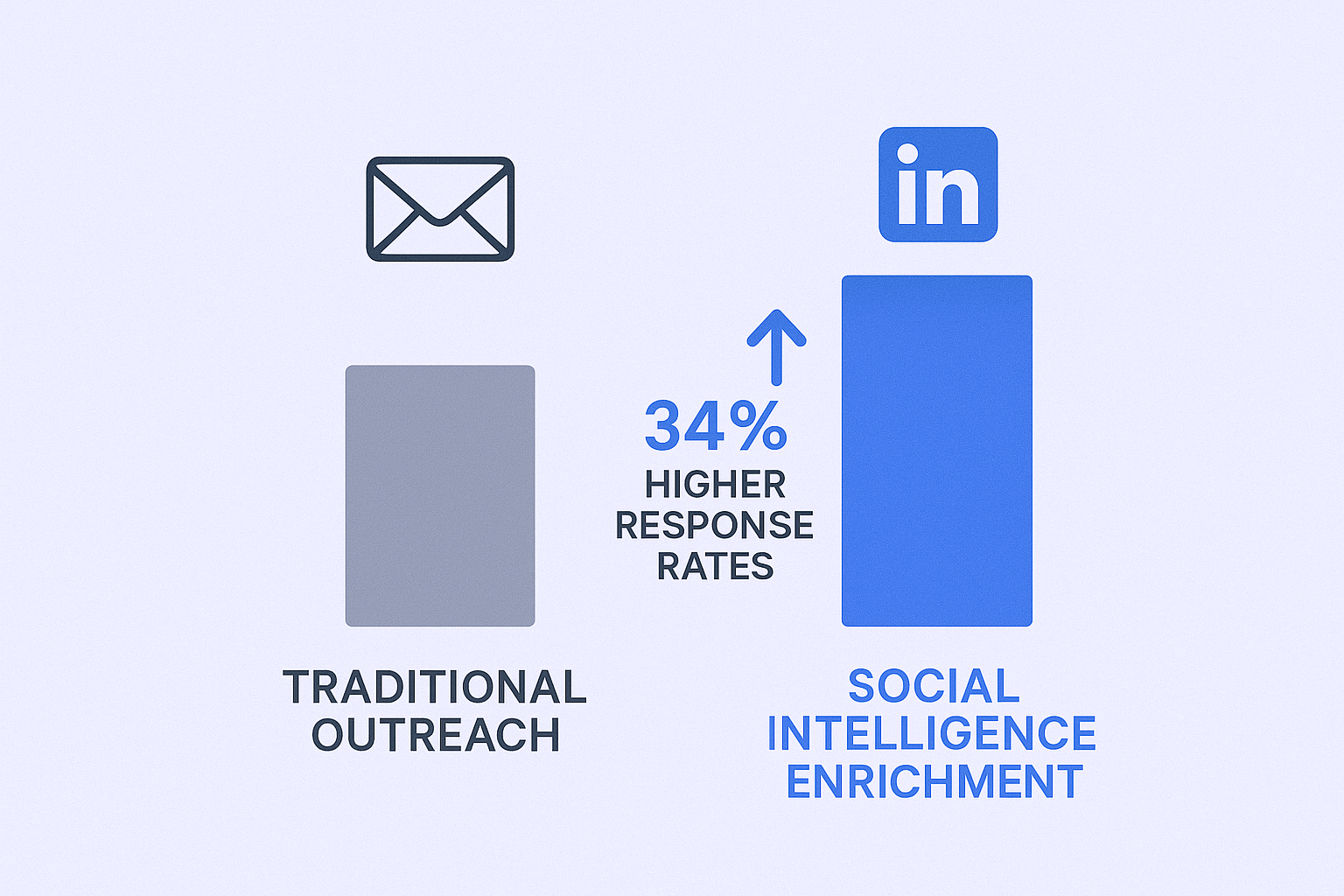
Real results: Sales teams using social enrichment data report 34% higher response rates on outreach campaigns. Why? Because you’re reaching out when prospects are most receptive to change.


The best social intelligence goes beyond basic profile scraping. It identifies trigger events – new funding, executive changes, expansion announcements – that create immediate opportunities.

🎯 LinkedIn Outbound Does This Automatically

Stop enriching data. Start messaging decision-makers with complete context built-in.

Timing is everything: Prospects are 3x more likely to respond within 30 days of a job change. Social intelligence helps you catch these golden windows.

Strategy 4: Technographic Profiling

Understanding your prospect’s technology stack reveals budget priorities, integration challenges, and competitive landscape positioning. It’s like having X-ray vision into their operations.

Essential technographic data:

  • Current software solutions
  • Technology spending patterns
  • Integration requirements
  • Security and compliance needs
  • Digital transformation initiatives
  • Cloud adoption stage
  • Data infrastructure setup
  • Marketing and sales tech stack

The payoff: Companies leveraging technographic data close deals 42% faster. When you know a prospect uses Salesforce and HubSpot, you can position your solution as the missing piece of their tech puzzle.

Critical insight: Technology adoption follows predictable patterns. Companies using basic CRM solutions often upgrade within 18-24 months. Timing your outreach to these upgrade cycles increases success rates by 89%.

Budget intelligence: Organizations that recently adopted new technology are 2.3x more likely to invest in complementary solutions within the next quarter. Their budget is already allocated for growth.

Strategy 5: Intent Data Enrichment

Intent data shows when prospects are actively researching solutions like yours. It’s the difference between cold prospecting and warm outreach.

Intent signals to monitor:

  • Keyword research activity
  • Competitor comparison searches
  • Solution category exploration
  • Pricing page visits
  • Review site engagement
  • Content consumption spikes
  • Search volume increases
  • Third-party research activities

The numbers speak: Teams using intent data see 87% higher qualified lead generation and 35% improvement in sales velocity. You’re no longer guessing who’s ready to buy – you know.

📍 Target Active Buyers Without Intent Tools

LinkedIn outbound reaches decision-makers based on real-time signals—no third-party data required.

Intent data works best when layered with other enrichment strategies. Someone researching “marketing automation pricing” becomes incredibly valuable when you also know they’re a growing SaaS company that just raised funding.

Actionability factor: Intent data decays quickly. 50% of intent signals lose relevance within 48 hours. Speed matters more than perfection.

Strategy 6: Financial and Funding Intelligence

Financial data helps qualify prospects and time your outreach perfectly. Recently funded companies have budget. Growing companies have problems to solve.

Critical financial indicators:

  • Recent funding rounds
  • Revenue growth trends
  • Financial health scores
  • Investment activity
  • Budget allocation patterns
  • Credit ratings
  • Public financial statements
  • Acquisition activities

Success story: One SaaS company increased their close rate by 54% by targeting prospects within 90 days of funding announcements. Fresh capital means urgent growth initiatives and available budget.

Qualification power: Financial enrichment eliminates 43% of unqualified leads before they enter your pipeline. You stop wasting time on prospects who can’t buy.

Risk assessment: Financial data also identifies at-risk customers. Companies with declining revenue or funding challenges need different conversations than those experiencing growth.

Strategy 7: Contact Verification and Validation

Enriched data is worthless if it’s wrong. Data cleansing and verification ensures your enhanced profiles are accurate and actionable.

Verification essentials:

  • Email deliverability checks
  • Phone number validation
  • Job title confirmation
  • Company information accuracy
  • Social profile verification
  • Address standardization
  • Duplicate identification
  • Role-based email detection

Critical stat: Poor data quality costs companies an average of $15 million annually. Verification isn’t optional – it’s essential for campaign success.

Email deliverability focus: 23% of email databases contain outdated or incorrect email addresses. Bad emails don’t just bounce – they damage your sender reputation and hurt future deliverability.

Real-time validation works best: Batch verification misses recent changes. Companies using real-time verification see 67% fewer bounces and 31% higher inbox placement rates.

Strategy 8: Predictive Analytics Integration

Predictive analytics turns historical data into future insights. Instead of reacting to customer behavior, you anticipate it.

Predictive enrichment applications:

  • Lead scoring automation
  • Churn risk identification
  • Upsell opportunity detection
  • Optimal outreach timing
  • Competitive threat assessment
  • Lifetime value prediction
  • Purchase propensity modeling
  • Engagement likelihood scoring

The advantage: Companies using predictive enrichment see 38% higher customer lifetime value and 29% better retention rates. You’re not just collecting data – you’re predicting outcomes.

Machine learning impact: Modern predictive models analyze hundreds of data points simultaneously. They identify patterns humans miss and get smarter with every interaction.

Accuracy improvement: Advanced predictive models achieve 85-92% accuracy in identifying high-value prospects, compared to 34% accuracy with traditional demographic scoring alone.

Strategy 9: Real-Time Enrichment Automation

Manual data enrichment doesn’t scale. Automated enrichment keeps your customer profiles current without constant maintenance.

Automation opportunities:

  • New lead enrichment triggers
  • Profile update alerts
  • Data decay monitoring
  • Integration synchronization
  • Quality score maintenance
  • Workflow automation
  • Alert systems for changes
  • Batch processing schedules

Efficiency gains: Automated enrichment reduces data management time by 67% while improving data accuracy by 45%. Your team focuses on selling, not data entry.

Speed advantage: Automated systems enrich new contacts in seconds, not hours. Your sales team has complete information before their first outreach attempt.

Scalability factor: Manual enrichment breaks down beyond 1,000 contacts. Automation handles millions of records with consistent accuracy and speed.

Turning Enriched Data into Better Sales

Having enriched data is just the beginning. The real value comes from activation – turning those insights into revenue.

💬 Get 15-25% Response Rates on LinkedIn

Complete outbound campaigns with targeting, messaging, and scaling—all done for you.

Personalization at Scale

Enriched data enables hyper-personalized outreach that feels one-to-one but scales to thousands. Personalized emails generate 6x higher transaction rates than generic messages.

Personalization tactics:

  • Reference recent company news or funding
  • Mention specific technology challenges
  • Connect to industry trends and pain points
  • Highlight relevant case studies and success stories
  • Time outreach to behavioral triggers

The psychology behind personalization: People pay attention to information that feels relevant to them. Generic messages get ignored because they don’t create personal connection.

Advanced personalization: The best teams use enriched data for dynamic content. Email templates automatically populate with relevant company information, recent news, and industry-specific pain points.

Results that matter: Personalized outreach based on enriched data achieves 41% higher open rates and 112% higher click-through rates compared to generic campaigns.

Smarter Lead Scoring

Traditional lead scoring relies on basic demographics. Enriched data creates scoring models that actually predict buying behavior.

Enhanced scoring factors:

  • Intent signal strength
  • Behavioral engagement patterns
  • Technographic fit scores
  • Financial health indicators
  • Competitive analysis results
  • Social media activity
  • Content consumption patterns
  • Timing factors

Companies with advanced lead scoring see 77% more leads converted to opportunities and 17% higher close rates.

Scoring evolution: Modern lead scoring uses machine learning to weight factors dynamically. What matters most changes based on your historical conversion data.

False positive reduction: Enriched lead scoring eliminates 52% of false positives that waste sales time. Your team focuses on prospects who actually buy.

Targeted Campaign Development

Enriched customer profiles enable precise audience segmentation. Instead of broad campaigns, you create targeted messages for specific customer segments.

Segmentation strategies:

  • Industry-specific messaging
  • Company size customization
  • Technology stack alignment
  • Growth stage targeting
  • Geographic personalization
  • Behavioral cohorts
  • Intent level groupings
  • Competitive positioning

Results: Segmented campaigns based on enriched data deliver 3x higher click-through rates and 50% more qualified leads than generic campaigns.

Micro-targeting power: Enriched data enables segments as specific as “Series B SaaS companies with 50-200 employees using Salesforce who visited pricing pages in the last 30 days.” That’s precision marketing.

Account-Based Marketing Excellence

Account-based marketing requires deep account intelligence. Enriched data provides the foundation for effective ABM campaigns.

ABM enrichment priorities:

  • Complete stakeholder mapping
  • Buying committee identification
  • Decision-making process insights
  • Competitive landscape analysis
  • Account engagement history
  • Relationship mapping
  • Influence identification
  • Budget and timing intelligence

Teams using enriched data for ABM report 208% higher marketing revenue compared to traditional approaches.

Stakeholder complexity: B2B purchases involve 6.8 stakeholders on average. Enriched data helps you identify and engage the complete buying committee.

Account intelligence depth: The best ABM campaigns use enriched data to understand not just who makes decisions, but how they make them. This insight transforms your approach from pitching to consultative selling.

Data Enrichment Best Practices

Start with Data Strategy

Before enriching anything, define what success looks like. 73% of data enrichment initiatives fail because they lack clear objectives and success metrics.

Strategic questions to answer:

  • What specific business outcomes are you trying to improve?
  • Which customer segments matter most to your revenue goals?
  • What data points directly impact buying decisions?
  • How will you measure enrichment ROI?

Focus on Data Quality Over Quantity

More data isn’t always better. High-quality, relevant data beats comprehensive but inaccurate datasets every time.

Quality indicators:

  • Accuracy rates above 95%
  • Data freshness within 90 days
  • Source reliability and reputation
  • Verification and validation processes

Implement Gradual Rollouts

Don’t try to enrich everything at once. Start with your highest-value segments and expand based on results.

Rollout phases:

  1. Phase 1: Enrich top 20% of prospects by value
  2. Phase 2: Add behavioral and intent data layers
  3. Phase 3: Implement automation and real-time updates
  4. Phase 4: Scale to entire database

Maintain Data Governance

Enriched data requires ongoing governance. Data decay happens at 30% annually – your enrichment strategy needs maintenance plans.

Governance essentials:

  • Regular accuracy audits
  • Data retention policies
  • Privacy compliance monitoring
  • Access control management
  • Update frequency schedules

Measure and Optimize Continuously

Data enrichment is an ongoing process, not a one-time project. The most successful teams treat it as a continuous optimization cycle.

Key performance indicators:

  • Lead conversion rate improvements
  • Sales cycle length reduction
  • Email response rate increases
  • Customer acquisition cost decreases
  • Revenue per lead improvements

Common Data Enrichment Mistakes to Avoid

Mistake 1: Over-Enriching Without Purpose

Adding every possible data point creates noise, not clarity. 62% of sales teams report information overload reduces their effectiveness.

Solution: Map each data point to a specific use case. If you can’t explain how a piece of data improves outcomes, don’t collect it.

Mistake 2: Ignoring Data Privacy Regulations

Data enrichment must comply with GDPR, CCPA, and other privacy laws. Regulatory violations cost companies $4.4 million on average.

Solution: Work with enrichment providers who prioritize compliance and implement consent management systems.

Mistake 3: Relying on Stale Data

Old data is worse than no data. It creates false confidence and leads to embarrassing outreach mistakes.

Solution: Implement data freshness monitoring and automated refresh cycles for critical data points.

Mistake 4: Neglecting Integration Challenges

⚡ Zero Integration. Immediate Results.

LinkedIn outbound delivers qualified meetings without CRM headaches or data management complexity.

7-day Free Trial |No Credit Card Needed.

Enriched data stuck in silos doesn’t improve performance. 47% of enrichment initiatives fail due to integration problems.

Solution: Plan integration requirements before selecting enrichment tools. Ensure your CRM and marketing automation platforms can utilize enriched data effectively.

FAQs About Data Enrichment Strategies

How often should I refresh enriched data?

Contact information changes frequently - 30% of data becomes outdated annually. Refresh critical data points monthly and comprehensive profiles quarterly. Automated enrichment tools can handle updates in real-time. Timing recommendations: Contact information: Monthly Company data: Quarterly Behavioral data: Weekly Intent data: Daily Financial data: Quarterly

What's the ROI of data enrichment?

Companies investing in data enrichment see average returns of $4.60 for every dollar spent. Benefits include higher conversion rates, shorter sales cycles, and improved customer retention. ROI calculation factors: Increased conversion rates (typically 20-40% improvement) Reduced prospecting time (30-50% time savings) Higher deal values (15-25% increase) Improved retention rates (10-20% improvement)

How do I ensure data privacy compliance?

Always use enrichment sources that comply with GDPR, CCPA, and other privacy regulations. Implement consent management and data retention policies. Work with vendors who prioritize compliance and transparency. Compliance checklist: Verify vendor privacy certifications Implement data retention schedules Maintain consent records Provide data access and deletion capabilities Regular compliance audits

Should I enrich all contacts or focus on high-value prospects?

Start with your highest-value segments - enterprise prospects, qualified leads, and existing customers. As you see results, expand enrichment to broader contact lists. Quality over quantity always wins. Prioritization framework: Tier 1: Existing customers and hot prospects Tier 2: Qualified leads and engaged prospects Tier 3: Cold prospects matching ideal customer profile Tier 4: Broader prospect database

What's the difference between data enrichment and data cleansing?

Data cleansing fixes existing data errors and removes duplicates. Data enrichment adds new information to expand customer profiles. Both are essential for effective sales and marketing operations. Key differences: Data cleansing: Fixes, standardizes, and deduplicates existing data Data enrichment: Adds new data points and insights Best practice: Cleanse first, then enrich for maximum effectiveness

Scale Your LinkedIn Outbound Like the Top 1%

Share your current approach. We’ll show you exactly how to 10X your qualified conversion

Segmentation That Actually Converts

LinkedIn outbound targets precise demographics with strategic campaign design and scaling methods

How to Build a High-Converting B2B Sales Funnel from Scratch on LinkedIn ​