

🎉Find Prospects and Send Cold Emails & LinkedIn Outbound | All in One Place

LinkedIn Learning Usage Statistics: Is It Actually Worth Your Time in 2026?

Table of Contents

LinkedIn Learning Usage Statistics

  • 27 million active users globally – making it one of most widely-adopted corporate learning platforms, roughly equivalent to entire population of Australia
  • 148 hours of content consumed every minute – equivalent of watching six full days worth of video per minute across platform, indicating genuine engagement not just sign-ups
  • 24,000+ courses currently available – constantly updating library ensures content matches what’s actually happening in business world
  • 50 new courses added every week (2,600+ per year) – rapid release cycle means learning current tactics, not outdated theory from 2-3 years ago
  • 7 native languages supported, subtitles in 46 languages – enables teams spanning Tokyo to Toronto to access same foundational training
  • 94% of employees would stay longer at companies investing in career development – attractive retention tool without raising salaries every six months
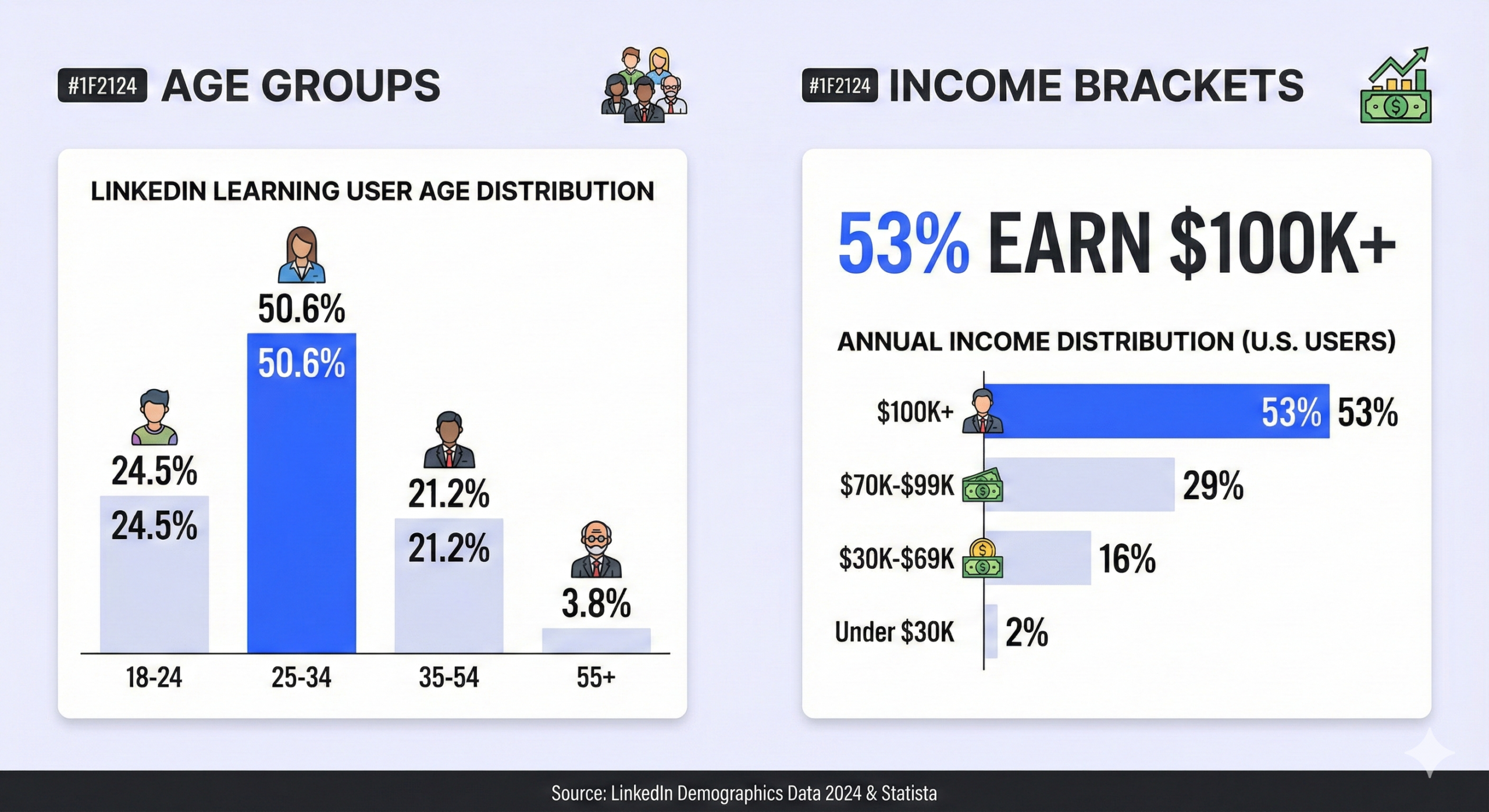
  • 25-34 age bracket dominates as most active demographic – career acceleration phase with 3-7 years experience looking to level up into management
  • 20% of users fall between 35-54 years old – mid-level managers and directors investing in own development, creating shared language around skills
  • Over 50% of US adults with bachelor’s degree or higher use LinkedIn – platform attracts people who already value formal education
  • 53% of US adults earning over $100K+ annually use LinkedIn – popular among knowledge workers who see connection between skills and earning potential
  • 36% increase in job postings dropping degree requirements (2019-2022) – companies like Google, Apple, IBM hiring based on skills not credentials
  • 140% increase in LinkedIn members adding AI skills to profiles since 2022 – everyone from sales to HR learning AI fundamentals for existing jobs
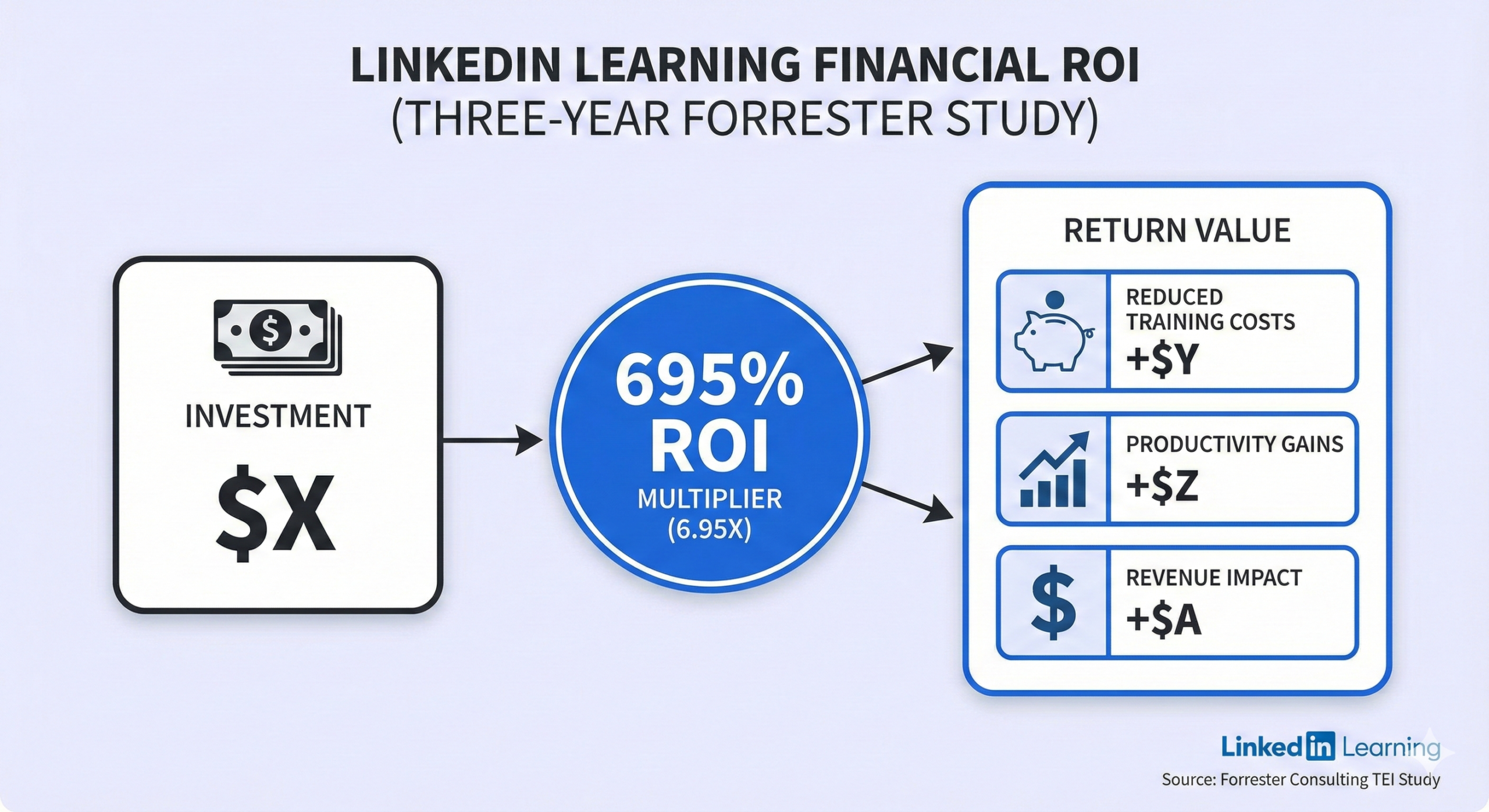
  • 695% three-year ROI for organizations using LinkedIn Learning – according to IDC research, with less than 6-month payback period
  • 58% of QS top global universities use LinkedIn Learning – Stanford, MIT, Oxford integrate platform to bridge gap between theory and practical application
  • 71% of US government workers report being unengaged at work – LinkedIn Learning provides low-cost professional development for rigid public sector budgets

Here’s what nobody tells you about LinkedIn Learning—27 million users are on there right now, consuming over 148 hours of content every single minute. But does that mean it’s the right move for you?

Look, the professional development world is flooded with options. You’ve got everything from free YouTube tutorials to $10,000 bootcamps. So where does LinkedIn Learning fit? And more importantly, is it worth the monthly subscription or your company’s training budget?

Let’s cut through the marketing speak and look at the actual numbers.

linkedin learning usage statistics

The raw data tells a pretty compelling story. LinkedIn Learning has crossed 27 million active users globally, making it one of the most widely-adopted corporate learning platforms in existence. To put that in perspective, that’s roughly the entire population of Australia using one learning platform.

But here’s where it gets interesting—those 27 million users aren’t just browsing casually. Every single minute, they consume over 148 hours of learning content. That’s the equivalent of watching six full days worth of video per minute across the platform. This kind of engagement suggests people aren’t just signing up and forgetting about it—they’re actually using it.

The Content Library That Never Sleeps
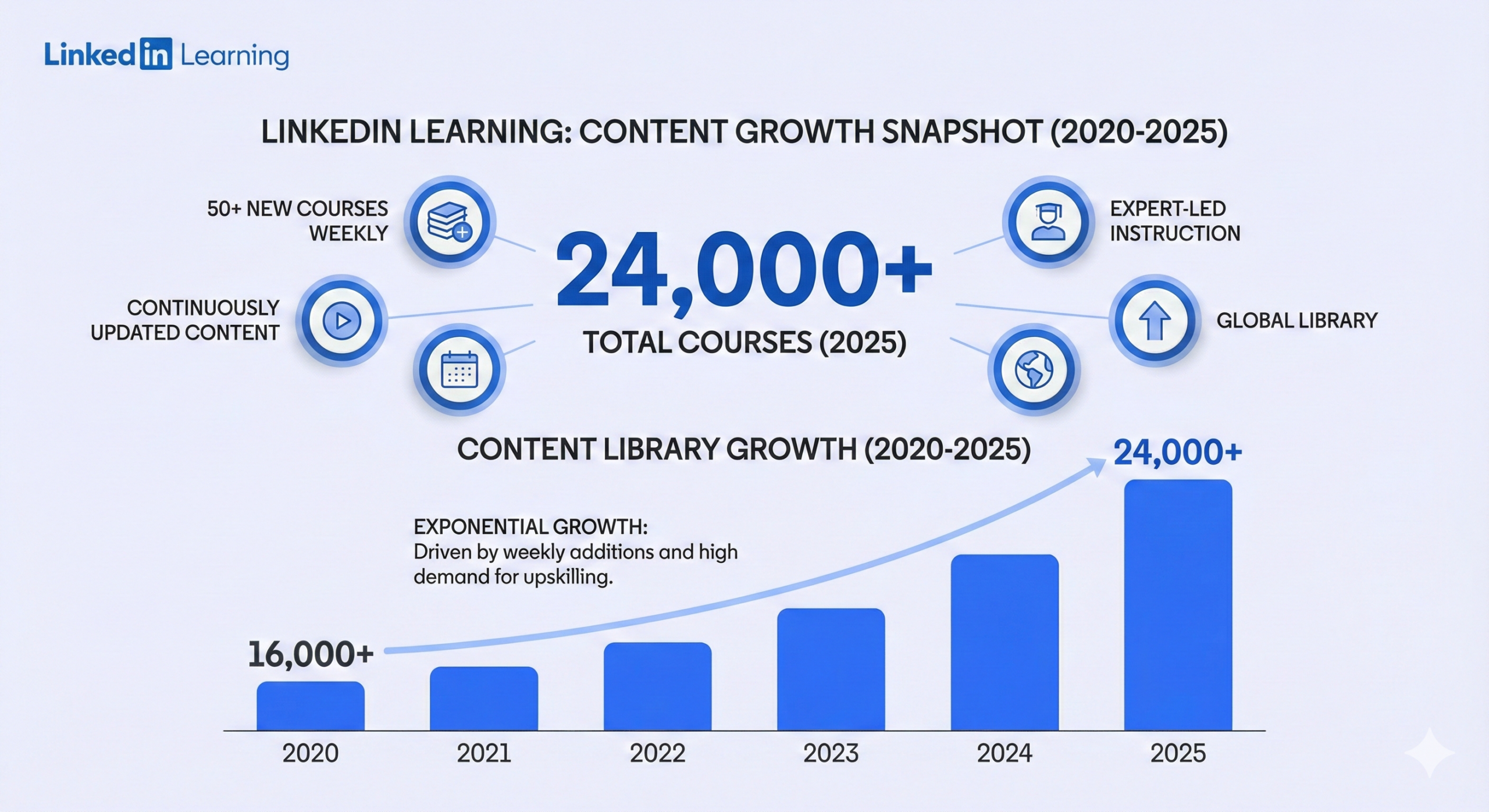


The platform hosts over 24,000 courses right now, and they’re not sitting still. LinkedIn adds approximately 50 new courses every single week. That’s more than 2,600 new courses per year, which means the library is constantly updating to match what’s actually happening in the business world.

This matters because professional skills have a shelf life now. A marketing course from 2020 might not mention TikTok ads or AI writing tools. A sales course from 2019 probably doesn’t cover video prospecting or LinkedIn automation. The rapid release cycle means you’re learning current tactics, not outdated theory.

The Global Reach Factor

LinkedIn Learning isn’t just popular in Silicon Valley. The platform supports seven native languages and offers subtitles in 46 languages. This isn’t just about being nice to international learners—it’s about practicality. If your team spans from Tokyo to Toronto, everyone can access the same foundational training in their preferred language.

94% of employees say they’d stay longer at a company that invests in their career development. For companies trying to retain talent without raising salaries every six months, that’s a pretty attractive statistic.

The Business Case: Who’s Actually Using This?

Let’s talk about the users themselves, because who’s on the platform tells you a lot about whether it’s worth joining.

The 25-34 Age Group Dominates

The most active demographic on LinkedIn Learning is the 25-34 age bracket. This is your career acceleration phase—people who have 3-7 years of experience and are looking to level up into management roles or specialized positions. They’re not complete beginners, but they’re also not set in their ways yet.

What’s surprising is that 20% of users fall between 35 and 54 years old. These aren’t just junior employees learning the basics—these are mid-level managers and directors investing in their own development. When leadership is on the same learning platform as their teams, that creates shared language around skills and concepts.

The Education and Income Split

Here’s a stat that might surprise you: Over 50% of US adults with a bachelor’s degree or higher use LinkedIn, compared to only 10% of those with just a high school education. This creates an interesting dynamic—LinkedIn Learning tends to attract people who already value formal education and are looking to supplement it with practical skills.

On the income side, 53% of US adults earning over $100,000 annually use LinkedIn. This suggests the platform is popular among knowledge workers who see the connection between skills and earning potential. These aren’t people taking courses for fun—they’re making calculated bets on their career trajectories.
 

 📊 Tired of Cold Outreach That Goes Nowhere?

Our complete LinkedIn outbound strategy covers targeting, campaign design, and scaling. See 15-25% response rates consistently.

What Actually Works: The Most Popular Course Categories

The platform tracks what people are actually watching, and the data reveals some clear trends about what’s valuable right now.

Business Skills Still Lead the Pack

The “Business” category remains the most popular, but it’s not what you might think. These aren’t generic MBA-style lectures about organizational theory. The top-performing business courses focus on practical, immediately applicable skills:

  • Social selling and LinkedIn prospecting
  • Project management fundamentals
  • Time management and productivity systems
  • Leadership communication

The common thread? You can watch a course in the morning and apply the technique that afternoon. There’s no six-month delay between learning and implementation.

Technology Is the Fastest Growing

While business courses are popular, technology courses are growing the fastest. Since 2022, there has been a 140% increase in LinkedIn members adding AI skills to their profiles. Everyone suddenly wants to understand ChatGPT, machine learning basics, and AI integration into their workflow.

This isn’t just tech workers either. Sales professionals are learning AI for email writing. Marketers are learning AI for content creation. Even HR teams are learning AI for resume screening. The technology skills being taught aren’t “learn to code”—they’re “learn to use AI tools to do your existing job better.”

Soft Skills Are the New Hard Skills

Here’s a counterintuitive finding: Courses on communication, leadership, and emotional intelligence are outperforming pure technical training in terms of completion rates and user ratings. Why?

Because AI can write code now. It can analyze data. It can even design presentations. But AI can’t build trust with a difficult client. It can’t negotiate a partnership deal. It can’t manage a team through a stressful project.

The 2025 Workplace Learning Report identifies “human skills” as more valuable than ever. As automation handles more tactical work, the premium is on uniquely human abilities—empathy, creativity, strategic thinking, and relationship building.

🚀 Ready to 10X Your Lead Generation? LinkedIn outbound eliminates spam filters, deliverability issues, and defensive prospects. Complete done-for-you strategy.

The ROI Question: Is It Actually Worth It?

Let’s talk money, because that’s what most people actually want to know.

For Individual Professionals

The platform costs approximately $39.99 per month for individuals, or $19.99 per month if you pay annually ($239.88/year). But here’s the catch most people miss—this is bundled with LinkedIn Premium Career, which includes:

  • InMail credits to message people outside your network
  • Seeing who viewed your profile (crucial for sales professionals)
  • Unlimited people search
  • Featured applicant status on job applications

If you were going to buy LinkedIn Premium anyway for networking purposes, the learning platform is essentially a free bonus. For professionals who use LinkedIn actively for business development or job searching, this changes the math significantly.


For Companies and Teams

The corporate ROI is where things get really interesting. Organizations using LinkedIn Learning see a three-year ROI of 695%, according to IDC research sponsored by LinkedIn. That’s not a typo—695%.

Here’s how they calculate it:

  • Reduced training costs: Replaces expensive in-person seminars and travel costs (estimated savings of $51k per 1,000 users)
  • Productivity gains: Employees spend less time searching for answers
  • Revenue impact: Sales teams with formal training achieve 91.2% of quota vs industry average of 60-70%

The payback period is estimated at less than six months. For a finance team evaluating training budgets, that’s an easy sell.

The University Partnership Factor

Here’s a signal about quality: 58% of the QS top global universities use LinkedIn Learning to supplement their curricula. Universities like Stanford, MIT, and Oxford—institutions that are notoriously picky about what they endorse—are integrating this platform into their programs.

Why? Because there’s a gap between what universities teach (theory, frameworks, concepts) and what companies need (practical application, current tools, real workflows). LinkedIn Learning fills that gap.

For students and recent graduates, many schools offer free access through their university credentials. If you’re currently enrolled or recently graduated, check your school’s career services—you might already have access without knowing it.

The Competition: How Does It Stack Up?

LinkedIn Learning isn’t the only game in town. Let’s compare it to the main alternatives.

vs. Udemy

Udemy is a marketplace where anyone can create and sell courses. This leads to massive variety (over 200,000 courses) but inconsistent quality.

Pros of Udemy:

  • Individual courses can be cheap ($10-20 during sales)
  • Extremely niche topics covered quickly
  • One-time purchase, lifetime access

Cons of Udemy:

  • Quality varies wildly (no curation process)
  • No integration with professional networking
  • Certificates don’t carry much weight

Verdict: Udemy is better if you need to learn a specific, niche software tool this weekend. LinkedIn Learning is better for ongoing professional development and skills that employers actually search for.

vs. Coursera

Coursera partners with universities to offer academic-style courses, including full degree programs.

Pros of Coursera:

  • Extremely high academic rigor
  • Accredited certificates and degrees
  • Partnerships with top universities

Cons of Coursera:

  • Time-consuming (courses take weeks or months)
  • More theoretical than practical
  • Expensive for degree programs

Verdict: Coursera is for deep academic upskilling (like getting a Master’s degree). LinkedIn Learning is for practical, immediate application to your current job.

💡 LinkedIn Learning vs LinkedIn Outbound

Education is great, but qualified meetings are better. Get complete targeting, campaign design, and scaling strategy.

Higher Education and Government Adoption

The adoption patterns from institutions tell us something important about credibility and effectiveness.

The Business Higher Education Bridge

Business higher education institutions are increasingly using LinkedIn Learning to bridge the gap between theoretical knowledge and practical application. Students might learn economic theory in class, but they learn Excel modeling, data visualization, and presentation skills through the platform.

This creates a “finishing school” effect. Graduates who leverage both their degree education and LinkedIn Learning certificates have a distinct advantage in the job market—they can speak both academic language and business language.

Government Team Implementation

The adoption by government teams is particularly telling. Public sector organizations face unique challenges: rigid budgets, aging workforces, and legacy systems. Yet they’re adopting LinkedIn Learning in significant numbers.

71% of US government workers report being unengaged at work, according to Gallup. For education government leaders and HR teams, LinkedIn Learning provides a low-cost way to offer professional development that might not otherwise exist. When you can’t offer raises due to pay scales, offering growth opportunities becomes the retention strategy.

Agencies like the State of Nebraska and the City of Bloomington have deployed the platform to thousands of employees. For smaller municipalities with minimal training budgets, $300-400 per employee per year for unlimited learning access is significantly cheaper than sending people to conferences or bringing in external trainers.

The AI Revolution Impact

We can’t talk about 2025 learning trends without discussing AI’s massive impact.

The Explosion of AI-Related Content

The demand for AI literacy has exploded. Since 2022, there’s been a 140% increase in LinkedIn members adding AI skills to their profiles. This isn’t limited to software engineers—everyone from accountants to HR professionals is learning AI fundamentals.

LinkedIn Learning has responded with hundreds of AI-focused courses covering:

  • ChatGPT and prompt engineering
  • AI for sales and marketing automation
  • Machine learning basics for business professionals
  • AI ethics and responsible use

The key insight: You don’t need to become a machine learning engineer. You need to understand how to use AI tools effectively in your existing role.

AI-Powered Learning Features

The platform itself is integrating AI. New features include AI-powered coaching and personalized course recommendations. Imagine asking, “I have a presentation to C-level executives in 30 minutes, what should I watch?” and getting a curated 5-minute video on executive presence.

This “just-in-time” learning is the future. Instead of taking a 4-hour course on leadership when you get promoted, you take focused 10-minute modules right before specific situations where you need those skills.

Conclusion

So, is LinkedIn Learning worth it in 2025? The data suggests yes, if you’re using LinkedIn actively for professional networking or job searching anyway.

Here’s the TL;DR:

✅ 27 million users consuming 148 hours per minute indicates strong engagement ✅ 24,000+ courses with 50 new courses weekly means current, relevant content
✅ 695% ROI for companies and less than 6-month payback period ✅ 58% of top universities use it, signaling academic credibility ✅ Bundled with LinkedIn Premium, making the effective cost lower than it appears

The platform works best for professionals who:

  • Use LinkedIn for networking and business development
  • Want practical, immediately applicable skills
  • Value certificates that appear on their LinkedIn profile
  • Need flexibility to learn in short bursts (10-30 minute videos)

It’s less ideal for:

  • People wanting deep academic education (go with Coursera)
  • Those needing niche technical training on obscure tools (try Udemy)
  • Anyone who doesn’t use LinkedIn professionally

The adoption by universities, government agencies, and Fortune 500 companies tells you something: this isn’t just another edtech fad. It’s become infrastructure for professional development.

Want to explore lead generation strategies that actually work? Check out our guide on social selling and discover how professional outreach can transform your business development approach.

🚀 Advanced LinkedIn Targeting

Strategic demographic segmentation delivers personalized campaigns with systematic scaling approaches

7-day Free Trial |No Credit Card Needed.

FAQs

Is LinkedIn Learning worth it for career development?

Yes. LinkedIn Learning delivers proven ROI through direct profile integration and certificates that appear in LinkedIn searches. More valuable than courses alone: the platform connects learning to professional networking, where 53% of $100K+ earners actively engage, creating immediate visibility for your new skills.

How many people actively use LinkedIn Learning?

Over 27 million professionals use LinkedIn Learning, consuming 148 hours of content every minute globally, making it one of the largest corporate learning platforms with proven engagement metrics.

What age group uses LinkedIn Learning the most?

The 25-34 age group represents the largest user segment, with 20% of users between 35-54 years old, indicating strong adoption across career acceleration and leadership development phases.

Does LinkedIn Learning work for government employees?

Yes. Government teams use LinkedIn Learning extensively, with 71% of unengaged government workers finding value in accessible professional development that rigid budgets typically can't provide through traditional training methods.

Can LinkedIn Learning help with AI skills?

Absolutely. Since 2022, LinkedIn members adding AI skills increased 140%, with the platform offering hundreds of AI courses covering ChatGPT, automation, machine learning basics, and practical AI integration for business professionals.

How to Build a High-Converting B2B Sales Funnel from Scratch on LinkedIn

How to Build a High-Converting B2B Sales Funnel from Scratch on LinkedIn ​