
Let's Build Your First Campaign Together with our LinkedIn Expert

LinkedIn Statistics for Small Businesses: The 2025 Data You Need

Table of Contents

LinkedIn Statistics for Small Businesses

  • 1.15 billion members globally across 200+ countries – nearly one-eighth of human population with professional profiles making active buying decisions daily, not passive scrollers
  • US dominates with 31.25% traffic (234+ million users) – followed by India 148+ million, Brazil 83+ million, China 60+ million providing massive target market access
  • 65+ million decision-makers with 10 million C-level executives active – plus 61 million senior-level influencers reachable without fighting through gatekeepers, CEO three clicks away
  • 25-34 age group dominates at 50.6% of users – managers, directors, VPs making tech stack decisions and approving budgets, not junior employees anymore
  • 53% of US users from households earning $100K+ annually – educated audience with buying power and budget authority looking for solutions not just browsing
  • 77% hold at least bachelor’s degree – sophisticated audience valuing data-driven communication over flashy pitches, requiring professional approach
  • 94% of B2B marketers agree building trust is most important factor – on LinkedIn trust comes from personal connection not logo size, founder’s voice beats Fortune 500 brand
  • Personal profiles: 2.75x more impressions and 5x more engagement vs company pages – employee-shared content receiving 8x more engagement than official brand channels
  • 78% of salespeople engaged in social selling outsell peers not using social media – high Social Selling Index scores creating 45% more opportunities, 51% more likely hitting quotas
  • Only 1% of LinkedIn users post content weekly – posting once per week mathematically puts you in top 1% of entire network, unlike Twitter/Instagram noise
  • 80% of B2B social media leads come from LinkedIn – platform 277% more effective for lead generation than Facebook/Twitter combined, owning B2B completely
  • 40% of B2B marketers rate LinkedIn as most effective channel for high-quality leads – despite $5-15 CPC vs Facebook’s $1-2, 58% say best ROI due to precision targeting
  • LinkedIn InMail/DM: 10-25% response rates vs cold email 1-10% – some studies reporting up to 85% for warm messages with proper context due to social proof
  • Connection requests without notes: 66% acceptance rate vs lower for personalized notes – blank requests leveraging curiosity as personalized notes signal incoming sales pitch triggering resistance

30% average connection acceptance rate, 50%+ considered excellent – below 20% indicates targeting or profile needs work, with 63% acceptances happening within first 24 hours

You’re scrolling through LinkedIn at 9 AM. Coffee in hand. Inbox screaming. Calendar packed.

Another day of hoping your outreach works.

But here’s the thing—hope isn’t a strategy. And in 2025, guessing your way through LinkedIn is costing you real money.

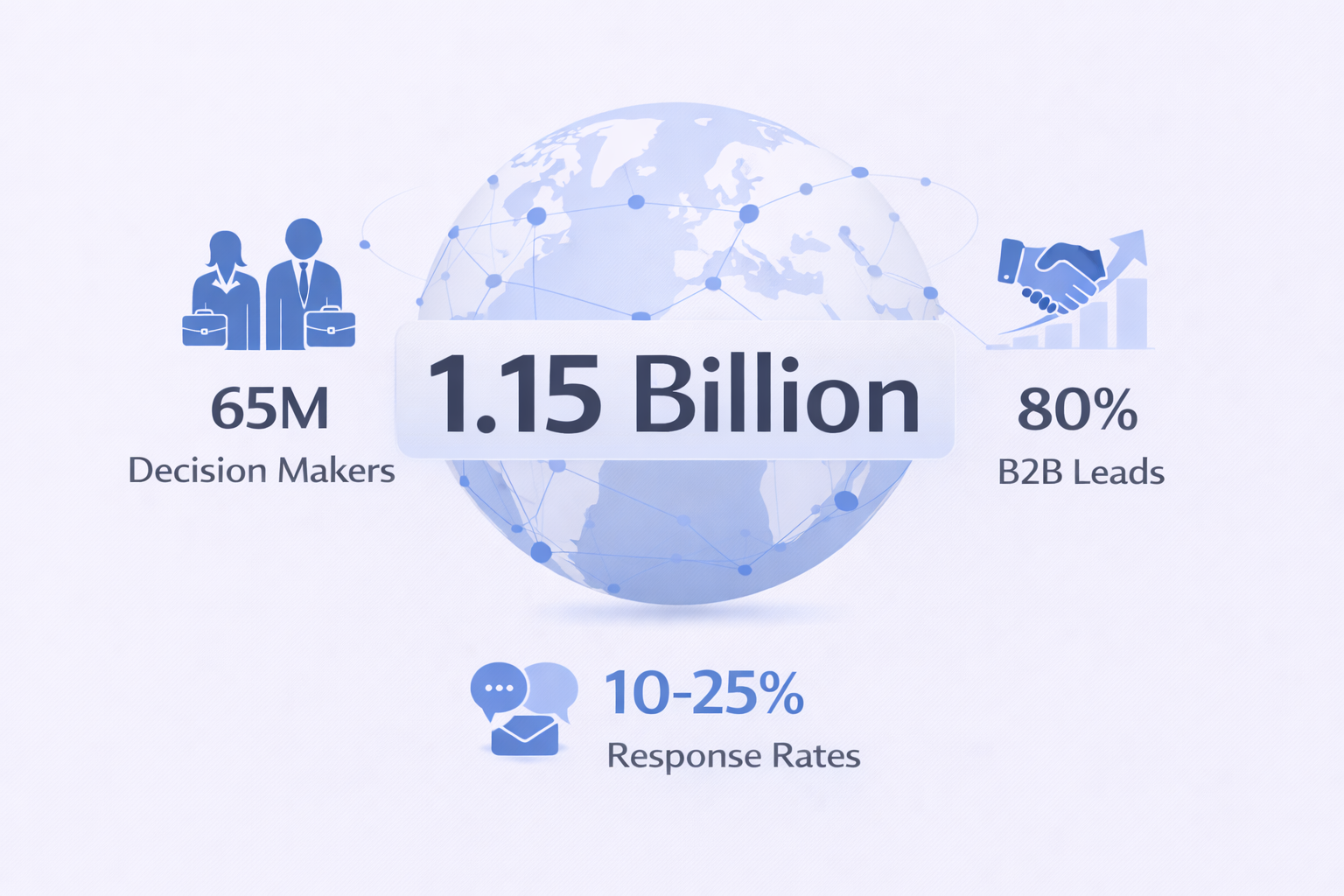
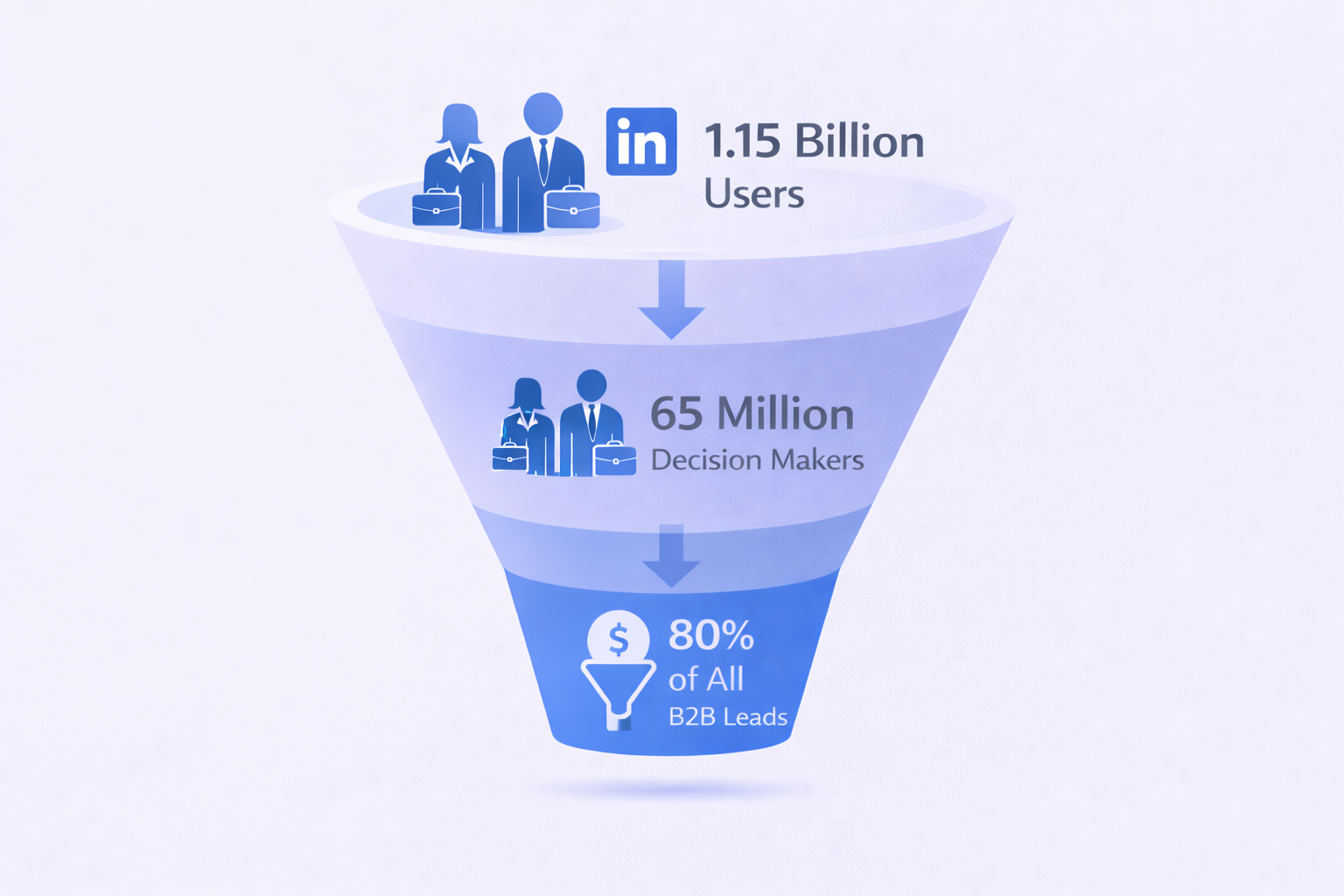
The platform has over 1.15 billion members spread across 200+ countries. That’s not just big. That’s a tsunami of opportunity that most small business owners are completely missing.

Why? Because they’re playing by 2019 rules in a 2025 game.

This isn’t another fluff piece telling you LinkedIn is “important.” You already know that. This is the data-driven breakdown showing you exactly why LinkedIn outperforms every other channel for small businesses—and more importantly, how to use it without wasting months of trial and error.


We’re talking response rates that blow traditional methods out of the water. Lead generation that actually converts. And a playing field where your 10-person team can compete head-to-head with enterprise giants.

Let’s dig into the numbers that matter.

The Platform Your Customers Actually Use

LinkedIn isn’t social media. It’s where decisions happen.

1.15 billion members globally means you’re looking at nearly one-eighth of the human population with professional profiles. These aren’t passive scrollers—they’re active professionals making buying decisions daily.

Here’s the breakdown that changes everything:

The United States dominates with 31.25% of total traffic—that’s 234+ million users in your target market. India follows with 148+ million, Brazil at 83+ million, and China at 60+ million.

But size isn’t the win. Access is.

LinkedIn houses 65+ million decision-makers who can actually sign checks. Over 10 million C-level executives are active on the platform right now. That’s 61 million senior-level influencers you can reach without fighting through gatekeepers.

Compare that to cold calling, where you’re lucky to get past the receptionist. On LinkedIn, the CEO is three clicks away.

The demographics tell you everything you need to know about who you’re reaching. The dominant age group? 25-34 years old at 50.6% of users. These aren’t junior employees anymore—they’re your managers, directors, and VPs making tech stack decisions and approving budgets.

Even better: 53% of US users come from households earning over $100,000 per year. These people have buying power. They have budget authority. They’re not browsing—they’re looking for solutions.

77% hold at least a bachelor’s degree. This is an educated, sophisticated audience that values data-driven communication over flashy pitches.

💼 Skip LinkedIn’s Learning Curve

Stop guessing. We build complete LinkedIn outbound systems that book 15-25% response rates vs email’s 1-5%.

Why Small Businesses Win on LinkedIn

Here’s what nobody tells you: being small is your advantage.

While enterprise companies rely on brand recognition, you compete on something more powerful—trust.

94% of B2B marketers agree that building trust is the most important factor for brand success. And on LinkedIn, trust doesn’t come from logo size. It comes from personal connection.

Buyers check with people they trust before making decisions. Peer and customer recommendations are valued 1.65x more than high brand awareness. Translation? Your founder’s authentic voice beats a Fortune 500 logo every time.

The numbers prove it: 77% of consumers are more likely to purchase from a company if its founder has a strong social media presence.

Personal profiles dominate company pages. Sharing content through a personal profile results in 2.75x more impressions and 5x more engagement than company profiles. Employee-shared content receives 8x more engagement than official brand channels.

LinkedIn users are 3x more likely to engage with content featuring a CEO or founder.

This is the David vs. Goliath advantage for small businesses. You don’t need unlimited budget. You need a face, a voice, and consistent value delivery.

Profile photos alone get you 14x to 21x more views. Users with fully completed profiles are 40x more likely to receive opportunities.

Your profile isn’t a resume. It’s a landing page that’s working 24/7.

🎯 Turn Your Profile Into a Client Magnet

Most LinkedIn profiles repel buyers. We build targeting systems, campaign sequences, and scaling methods that actually convert.

The Social Selling Advantage That Actually Converts

“Social selling” sounds like marketing buzzword soup. But the data doesn’t lie.

78% of salespeople engaged in social selling outsell their peers who don’t use social media. That’s not a small edge—that’s a different game entirely.

Those with high Social Selling Index scores create 45% more sales opportunities. They’re 51% more likely to hit their revenue quotas.

Why does this work?

Traditional cold outreach triggers immediate sales resistance. You’re interrupting someone’s day with an ask. Social selling flips the script—you’re warming up prospects through passive engagement before you ever send a message.

Like their post. Comment with genuine insight. Share their content. By the time you send that connection request, you’re not a stranger. You’re a familiar face who provides value.

This is how small businesses with limited sales teams compete with 50-person SDR armies.

Content Strategy: The 1% Opportunity

Here’s the shocking truth: only 1% of LinkedIn users post content weekly.

Read that again. Just 1%.

This means posting once per week mathematically puts you in the top 1% of the entire network. Unlike Twitter or Instagram where your voice drowns in noise, LinkedIn is still relatively quiet.

The opportunity is massive—but only if you post the right formats.

Video content gets 5x more engagement than text-only posts. LinkedIn Live generates 24x more engagement than pre-recorded video. Posts with PDFs (carousels) generate 1.9x to 3x more engagement than standard posts.

Even simple image posts receive 2x higher comment rates than text-only content.

Why does video crush it? Parasocial trust. When prospects see your face and hear your voice, their brain processes it similarly to face-to-face interaction. Viewers retain 95% of a message in video compared to just 10% in text.

Timing matters too. The data consistently points to midweek mornings—Tuesdays, Wednesdays, and Thursdays between 10 AM and noon see the highest engagement.

The algorithm weighs comments much heavier than likes. A post with discussion in the comments will travel further than a post with 100 silent likes.

Play by these rules and you’re not just posting—you’re building an audience that converts.

📈 Content That Actually Books Meetings

Random posting doesn’t scale. We engineer LinkedIn campaigns with precise targeting, proven messaging frameworks, and systematic follow-up.

Lead Generation: Where LinkedIn Destroys the Competition

If you’re tracking ROI, this section changes everything.

80% of B2B social media leads come from LinkedIn. Not Facebook. Not Twitter. Not Instagram. LinkedIn owns B2B lead generation.

The platform is 277% more effective for lead generation than Facebook and Twitter combined. 40% of B2B marketers rate LinkedIn as the most effective channel for driving high-quality leads.


But here’s where small businesses get nervous—cost.

LinkedIn Ads aren’t cheap. Average Cost Per Click ranges from $5 to $15. The CPM (Cost Per Thousand Impressions) sits around $33.

Compare that to Facebook’s $1-2 CPC and you might panic. Don’t.

58% of marketers say LinkedIn Ads provide the best ROI despite the higher cost. Why? Because you’re paying for precision. You’re reaching specific job titles at specific companies with specific budgets.

No wasted impressions on teenagers or retirees. Every dollar targets a potential buyer.

The secret weapon? Lead Gen Forms. These pre-filled forms use profile data and convert at an average of 13%—significantly higher than the industry average of 2.35% for traditional landing pages.

Exposure to LinkedIn ads increases purchase intent by 33%. The platform generates 2x higher conversion rates for B2B campaigns compared to other networks.

For advanced targeting, you can layer company size, seniority level, industry, and even specific groups. This level of precision doesn’t exist anywhere else.

Response Rates: The LinkedIn vs Email Reality

Let’s talk about the elephant in the room: where should you spend your limited time?

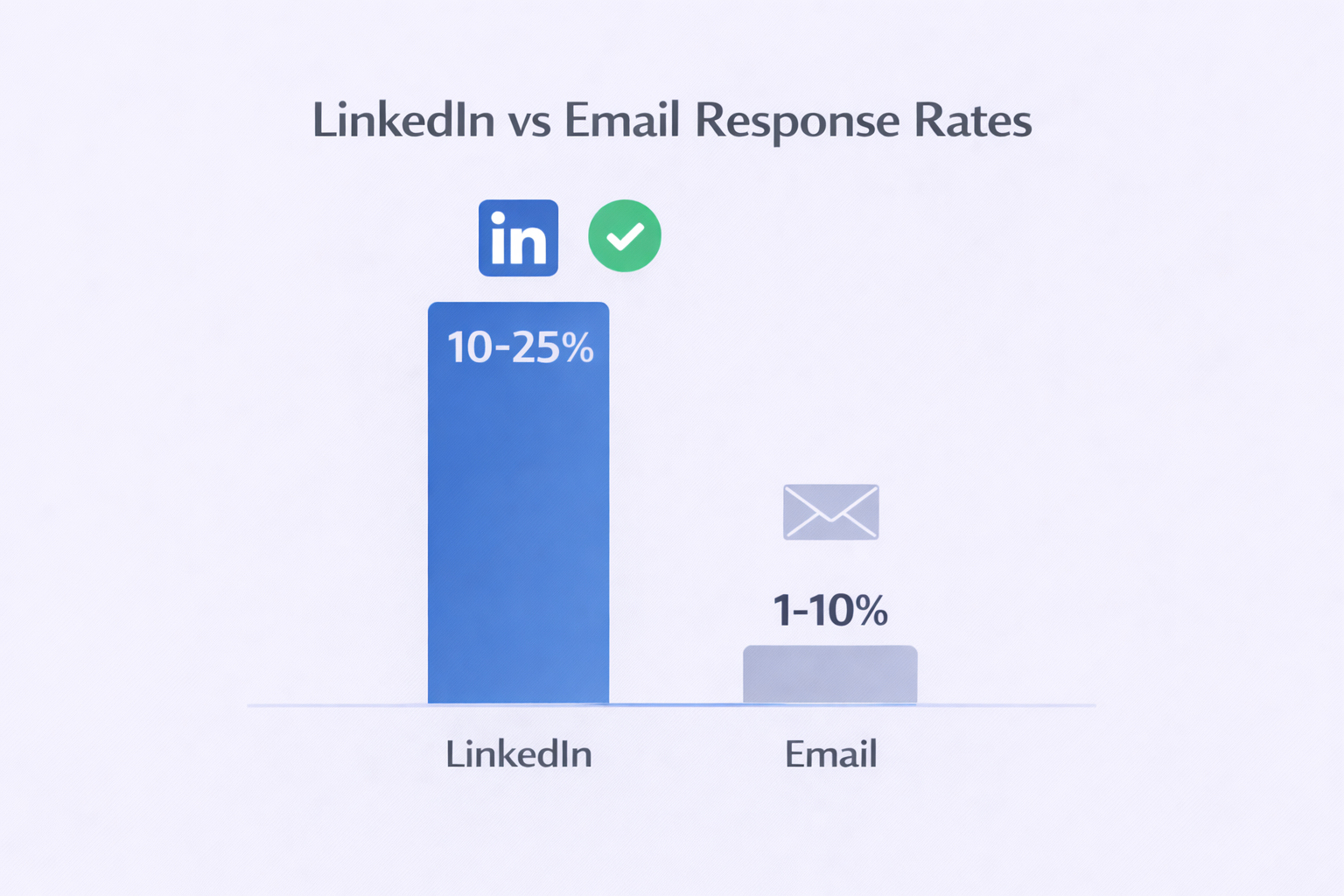
LinkedIn InMail and direct messages see response rates between 10% and 25%. Some studies report rates up to 85% for warm messages with proper context.

Cold email? Typically 1% to 10% response rates.


Why such a massive difference?

LinkedIn messages carry social proof. The prospect clicks your face, sees your job title, views mutual connections, and reads your recent content. Context warms the interaction instantly. An email is text in a void, fighting spam filters and skepticism.

But here’s the critical limitation: scalability.

LinkedIn restricts users to roughly 100-200 connection requests per week to prevent spam. You cannot blitz a large market on LinkedIn alone without risking account restrictions.

Email? With proper infrastructure setup, you can send thousands of emails per day.

This is why the hybrid approach wins: use email for volume and LinkedIn for high-value relationship building.

The strategy looks like this: engage with a prospect on LinkedIn (view profile, like a post). Then send a cold email referencing that engagement (“Saw your post about X…”). This multi-channel touchpoint strategy increases response likelihood dramatically.

LinkedIn provides trust and face recognition. Email provides scalable, direct communication.

⚡ The Hybrid System That Scales

We combine LinkedIn engagement with email volume to create "surround sound" outreach. Complete targeting, sequencing, and conversion optimization.

7-day Free Trial |No Credit Card Needed.

Connection Strategy: What the Data Actually Shows

For years, sales trainers preached: “Always send a personalized note with your connection request.”

The data tells a different story.

A study of over 16,000 connection requests found that those sent without notes had higher acceptance rates—66% of invites sent without notes were accepted compared to those with personalized notes.

Why does this happen? A personalized note (unless hyper-relevant) signals a sales pitch is coming. It triggers immediate resistance. A blank request leverages curiosity—the prospect clicks your profile to investigate, and if your profile is optimized, they accept based on professional relevance.

The exception? Highly personalized notes referencing specific mutual connections, recent events, or content they wrote can work effectively. But generic “I’d love to add you to my network” notes hurt your conversion rates.

Average acceptance rates across industries sit around 30%. An acceptance rate of 50% or higher is considered excellent and indicates precise targeting. If you’re below 20%, your targeting or profile needs work.

Timing matters too. 63% of all acceptances happen within the first 24 hours. 88% happen within the first 7 days. 99% occur within 30 days.

Strategic move: implement a weekly cleanup routine. Withdraw pending requests older than 2-3 weeks. This keeps your queue clean and signals to LinkedIn’s algorithm that you’re a quality user.

For those using automation tools, remember that LinkedIn monitors behavior closely. Focus on quality over quantity to protect account health.

The Future: AI and Automation in 2025

AI hiring on LinkedIn is surging 30% faster than overall hiring. 64% of UK SMEs view AI as key to their growth.

As AI tools make content creation easier, the volume of noise increases. This makes authentic, human-centric content—like video or personal stories—even more valuable as a differentiator.

LinkedIn is fighting back against bot automation. They’re restricting limits and monitoring account behavior more strictly. This reinforces the need for quality outreach over quantity on the platform.

For lead extraction, many businesses are shifting volume outreach to email where they own the infrastructure, using LinkedIn primarily for research and high-value targeting.

The winning move? Don’t fight the algorithm. Play by its rules while building authentic relationships that convert.

For growth hacking strategies, focus on providing value first, selling second.

Conclusion

LinkedIn in 2025 isn’t just another social platform. It’s the central nervous system of B2B commerce.

The data is undeniable: 80% of B2B leads come from here. Response rates that 10-25x traditional methods. Access to 65+ million decision-makers without gatekeepers.

But success requires strategy, not hope.

For small businesses, this is your moment. While enterprise competitors rely on brand recognition, you compete on trust, authenticity, and direct relationships. Your founder’s voice can out-perform any corporate marketing team—if you use it strategically.

The numbers don’t lie. The opportunity is massive. Now it’s time to execute.

For those comparing platforms, check out Apollo alternatives to see how different tools stack up for lead generation.

FAQs

What is the best time to post on LinkedIn for maximum engagement?

Post Tuesday-Thursday, 10 AM-noon for peak engagement.

Should I send a personalized note with connection requests?

Blank requests often perform better—66% higher acceptance rate than generic notes.

How can LinkedIn outbound help my small business scale faster?

LinkedIn outbound bypasses spam filters, reaches verified decision-makers (65M+ on platform), and delivers 10-25% response rates vs email's 1-5%. We provide complete targeting systems, campaign sequences, and scaling methods that book qualified meetings consistently. Book a strategy meeting to see our framework.

What type of content gets the most engagement on LinkedIn?

Video content generates 5x more engagement than text-only posts.

How many decision-makers are actually on LinkedIn?

Over 65 million decision-makers and 10 million C-level executives actively use the platform.

What to Build a High-Converting B2B Sales Funnel from Scratch on LinkedIn

Build a Full LinkedIn Pipeline in Just 30 Days—Guaranteed