
How the Recruitment Industry Works in 2025
Modern recruiting functions like a high-performance sales engine. It’s no longer about posting jobs and waiting. It’s about precision targeting, multi-channel outreach, and data-driven decision-making.
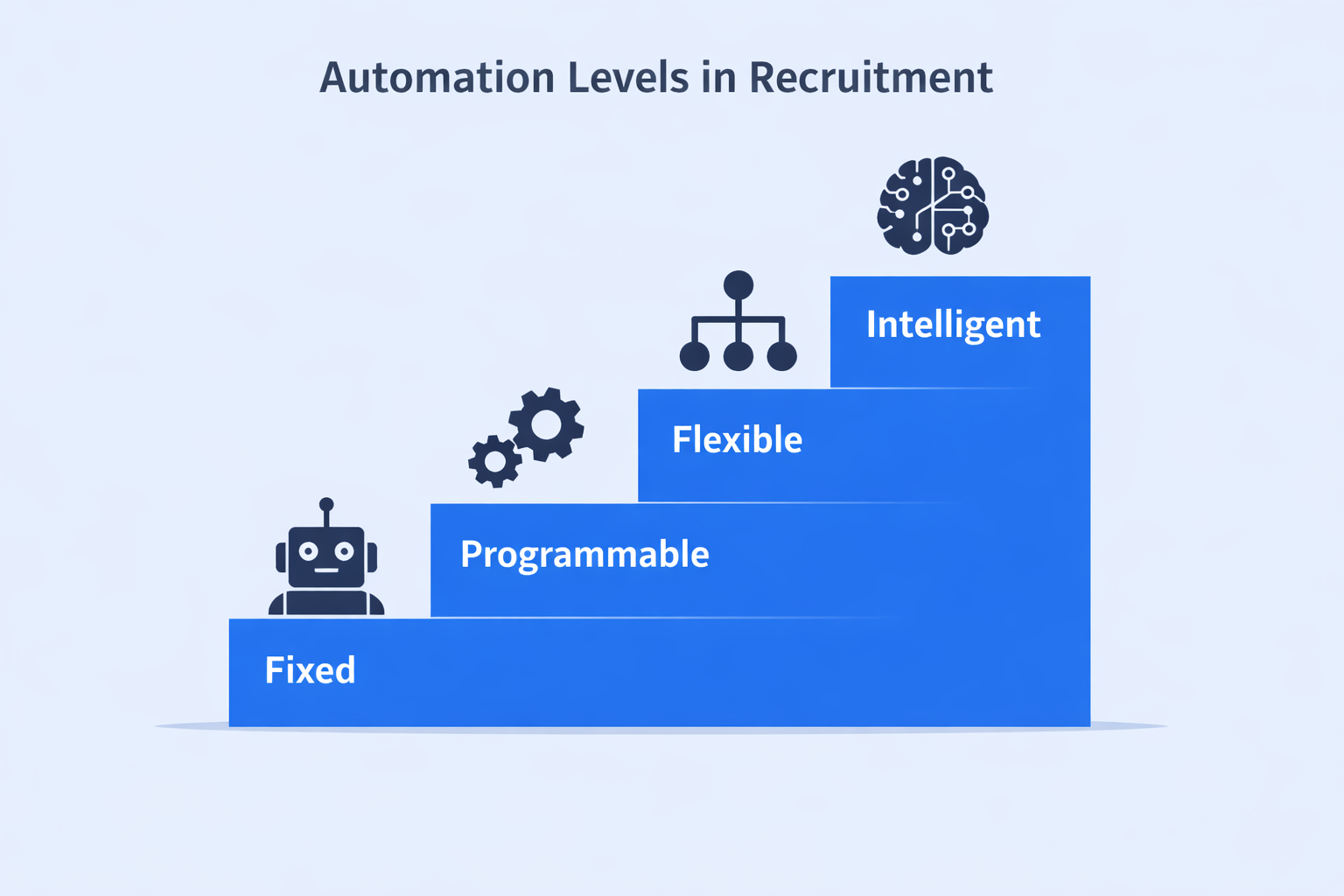
The infrastructure runs on four automation levels working in sequence:
Fixed automation handles repetitive tasks. Job postings go live across boards automatically. Resume parsing extracts candidate data without manual entry.
Programmable automation uses logic triggers. When a candidate passes screening, interview invitations send automatically. When applications hit a threshold, hiring managers get notified.
Flexible automation adapts to different roles. Engineering hires follow technical assessment paths. Sales hires get personality evaluations. Each pipeline management tool matches the role’s requirements.
Intelligent automation uses machine learning for judgment calls. It ranks candidates based on historical performance data, predicts which applicants will accept offers, and flags dropout risks before they happen.
This layered approach transformed recruiting from administrative work into strategic warfare. Companies using all four automation levels reclaim approximately 20% of their work week—one full day every week—from manual tasks.
The recruitment process now mirrors sophisticated sales operations. Target accounts get identified through data analysis. Outreach happens across multiple channels simultaneously. Follow-ups trigger based on engagement signals. Everything flows through integrated systems that track every interaction.
Global Market Values: UK and Australia in Focus
The numbers tell the real story.
United Kingdom: The UK recruitment market is valued at £141 billion with 30,035 active agencies. These firms add £43 billion to the British economy every year. London houses 31% of all agencies, creating an incredible concentration of hiring power.
But size creates pain. The UK faces a skills gap costing businesses £6.6 billion annually. The digital sector suffers most—seven open positions exist for every one qualified candidate.
Here’s what it actually costs to hire:
- Average employee hire: £6,125
- Management-level hire: £19,000
- Bad manager hire: £132,000 (including wasted salary, training, and replacement costs)
- Average time to fill: 42 days
- Time to hire (application to acceptance): 4.9 weeks
About 59% of UK businesses use external agencies to fill roles. Why? Because navigating the talent shortage requires specialized expertise and established candidate networks.
Despite these costs, 67% of UK employers plan new hires in 2024-2025. The public sector leads with 82% planning recruitment compared to 62% in private businesses.
Australia: Australia’s recruitment market reached USD 29.4 billion (AUD 44.5 billion) in 2024, representing 18% of Asia-Pacific revenue. The market has stabilized after years of extreme tightness.
In 2023, 36% of occupations were hard to fill. By late 2025, that dropped to 29% as labor supply improved and wage pressures eased in lower-skilled roles.
Sector-specific activity shows where the opportunities are:
- Accommodation & Food Services: 68% recruitment rate (highest in Australia)
- Healthcare & Social Assistance: 54% recruitment rate
- Renewables & Defense: Booming with thousands of new roles
- STEM & IT: Mid-to-senior positions dominating
The Australian defense budget hit AUD 55.7 billion in FY2024-25, creating massive demand for project managers, engineers, and cybersecurity specialists.
Australian businesses have embraced flexibility. About 75% of contractors rate flexible hours as critical, and 64% prefer hybrid work models. This shift allows companies to scale teams without long-term commitments—a crucial advantage when economic conditions change fast.
LinkedIn Statistics for Professional Hiring
LinkedIn isn’t just another social platform. It’s the professional marketplace where hiring actually happens.
By early 2025, LinkedIn surpassed 1.15 billion members across 200+ countries. But raw size doesn’t tell the full story. The platform’s power comes from who’s there and how they engage.
Who’s Actually on LinkedIn
The demographics matter when you’re trying to fill roles:
- 77% hold bachelor’s degrees or higher (educated talent pool)
- 53% earn over $100,000 annually (high-income professionals)
- 47.3% to 50.6% are aged 25-34 (prime career growth phase)
- 65 million decision-makers (people who actually hire)
- 10 million C-level executives (strategic partnership potential)
Four out of five LinkedIn members drive business decisions. 80% influence buying decisions within their companies. This concentration of decision-making power exists nowhere else.
For small businesses and growing companies, this levels the playing field. You can reach the same decision-makers that enterprise companies target—if you know how to engage them.
Engagement Patterns That Drive Results
Content shared through personal profiles gets 2.75 times more impressions and five times more engagement than company page posts. Why? People trust people more than brands.
The most effective content formats in 2025:
- Multi-image carousels: 6.6% engagement rate
- Document posts (PDFs/Slides): 6.1% engagement rate
- Video posts: 5.6% engagement rate (video viewership up 36% in first half of 2025)
Premium subscriptions saw 50% adoption increase over two years as professionals recognize the prospecting value. Companies with dedicated LinkedIn Career Pages receive 8 times more applications than those without.
The Outreach Effectiveness Gap
Here’s where things get interesting for anyone trying to reach candidates or clients.
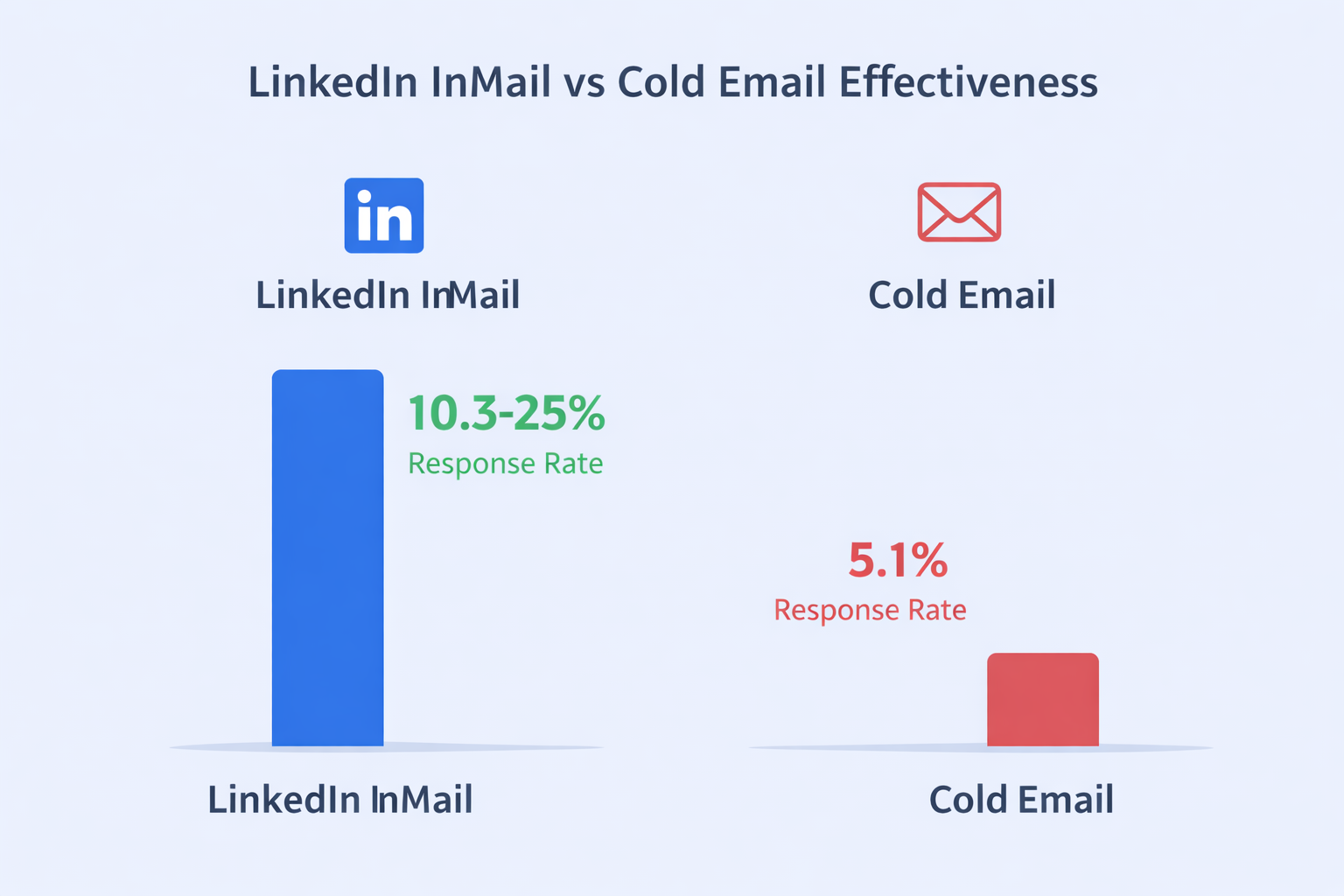
LinkedIn InMail currently delivers 10.3% to 25% response rates. Traditional cold email averages 5.1%. That’s a 2x to 5x difference in effectiveness.
Let’s break down why:
Metric | Cold Email | LinkedIn InMail |
Average Response Rate | 5.1% | 10.3% – 25% |
Average Open Rate | 27.7% | 50%+ |
Deliverability | ~83% (17% bounce/spam) | High (spam-free environment) |
ROI Per Dollar | $42 (if personalized) | $7.90 per meeting |
Cold email faces brutal challenges. Only 1% to 5% of cold emails generate any response. About 95% get ignored completely. Spam filters have become increasingly aggressive, and inbox clutter means your message competes with hundreds of others. Companies are turning to email deliverability alternatives to improve inbox placement rates.
But here’s the nuance: cold email still maintains superior ROI scalability when executed with AI-driven personalization. The $42 return per dollar invested beats most marketing channels. Many teams use deliverability testing to ensure messages reach inboxes consistently.
The winning approach? Omnichannel outreach. Combining email, LinkedIn, and phone touches increases engagement by over 287%. Use each channel where it performs best.
This is exactly why many growing companies use lead enrichment tools to build comprehensive contact databases spanning multiple channels.
Skills-Based Hiring and Changing Expectations
The degree requirement is dying. Data shows 94% of employers believe skills-based hiring better predicts job performance than resumes.
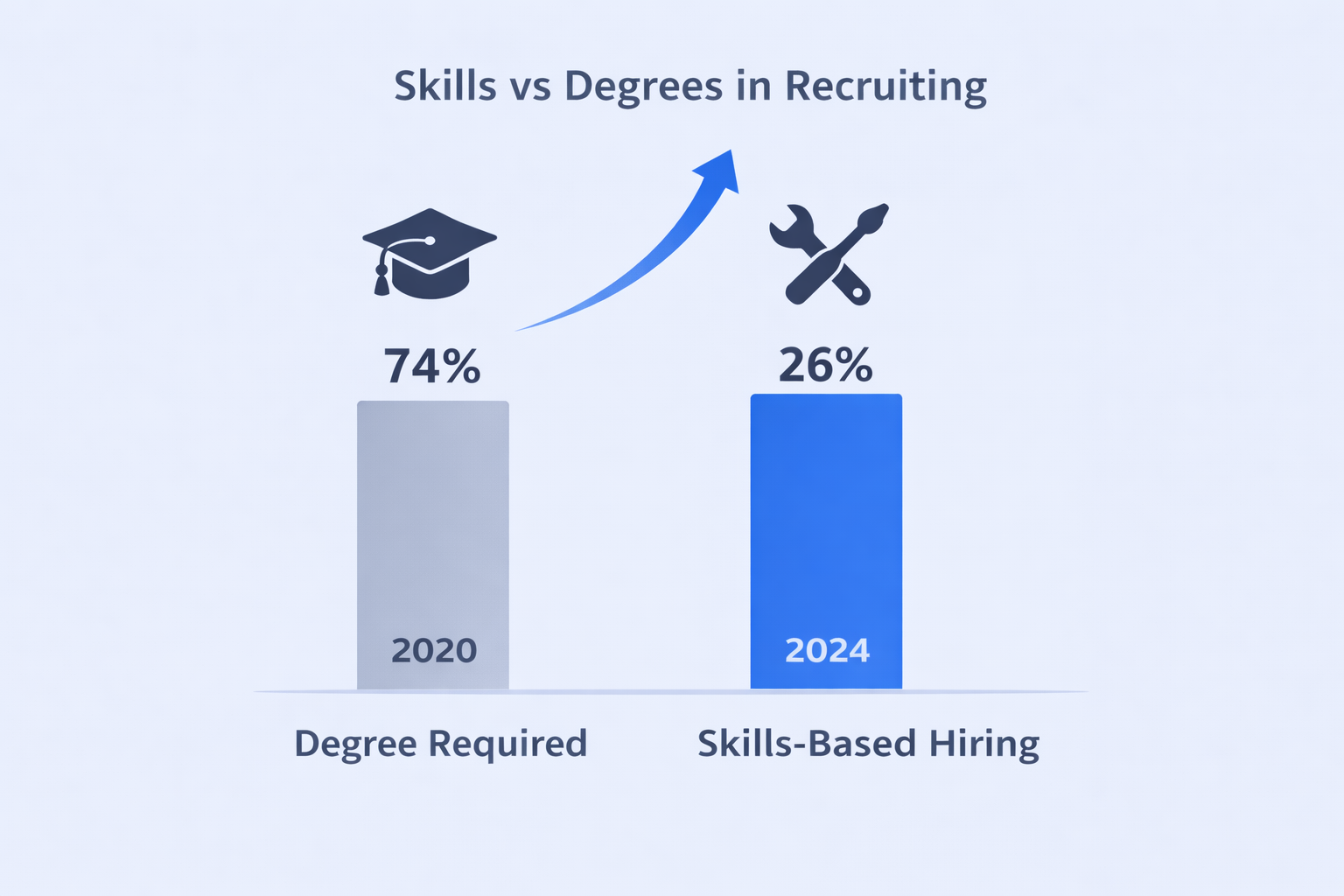
LinkedIn data reveals 26% of paid job posts in 2024 didn’t require a degree—a 16% increase from 2020. This shift opens talent pools previously blocked by arbitrary education requirements.
But only 41% of job seekers still believe a degree is crucial for success. The gap between employer practices and candidate perceptions is closing fast.
Modern candidates prioritize different factors:
Flexibility matters most. About 59% of global employees stay at companies primarily due to flexible work arrangements. In Australia, 75% of contractors rate flexible hours as critical, with 64% preferring hybrid models.
Feedback closes the loop. About 79% of candidates would consider reapplying to a company if they received feedback after an interview, even after rejection. Most companies ignore this zero-cost retention opportunity.
Authenticity drives trust. Employee-generated content achieves 561% greater reach than the same messages from official brand channels. About 55% of people trust employee posts more than official corporate content.
For anyone trying to attract talent in 2025, these numbers point to clear actions: drop unnecessary degree requirements, offer flexibility by default, and create feedback loops that keep rejected candidates in your ecosystem.
Social Media’s Role in Modern Recruiting
About 91% of UK employers use social media to attract talent. More importantly, 82% use it specifically to reach passive candidates—people not actively job hunting but open to the right opportunity.
The multi-platform approach works:
30% of companies use three or more social accounts for hiring. This diversification reduces dependency on any single channel and reaches different audience segments.
Video content drives 34% higher engagement than static posts. Companies creating authentic behind-the-scenes content and employee testimonials see significantly better results than polished corporate marketing.
Employee advocacy multiplies reach. Messages shared by employees achieve 561% greater reach than the same content from brand channels. Building internal advocacy programs costs minimal resources but dramatically expands hiring visibility.
For smaller companies without dedicated recruiting teams, social media offers the most cost-effective path to reaching quality candidates. But it requires consistency and authenticity—two things that can’t be automated or faked.
Many companies now integrate their recruitment efforts with prospecting tools originally designed for sales to create comprehensive candidate engagement systems.
Conclusion
The recruitment industry in 2025 operates at the intersection of sophisticated technology and human relationship-building. Companies spending £132,000 on bad hires in the UK or watching 60% of candidates abandon applications have clear problems—but also clear solutions.
Data shows the path forward: embrace skills-based hiring, create omnichannel outreach strategies, improve candidate experience through simple communication, and leverage AI for efficiency while maintaining human judgment for final decisions.
LinkedIn’s 10.3-25% response rates versus email’s 5.1% prove that channel selection matters as much as message quality. The 87% of companies using AI recruitment tools aren’t optional early adopters—they’re the new baseline.
For UK businesses facing £6.6 billion in skills gap costs and Australian companies navigating 29% hard-to-fill positions, the winners will be those who adapt fastest to these new realities while maintaining the human touch that technology can’t replace.
The “Great Alignment” favors organizations that balance automated efficiency with transparent, engaging candidate experiences. That’s not theory. That’s what the numbers show.

