

The Money Math That Makes Sense
Forget hourly billing. It’s a trap that punishes your efficiency.
Think about it: If you solve a $1 million problem in one hour, charging $500 for that hour is absurd. You’re selling outcomes, not time. That’s why retainer pricing works.
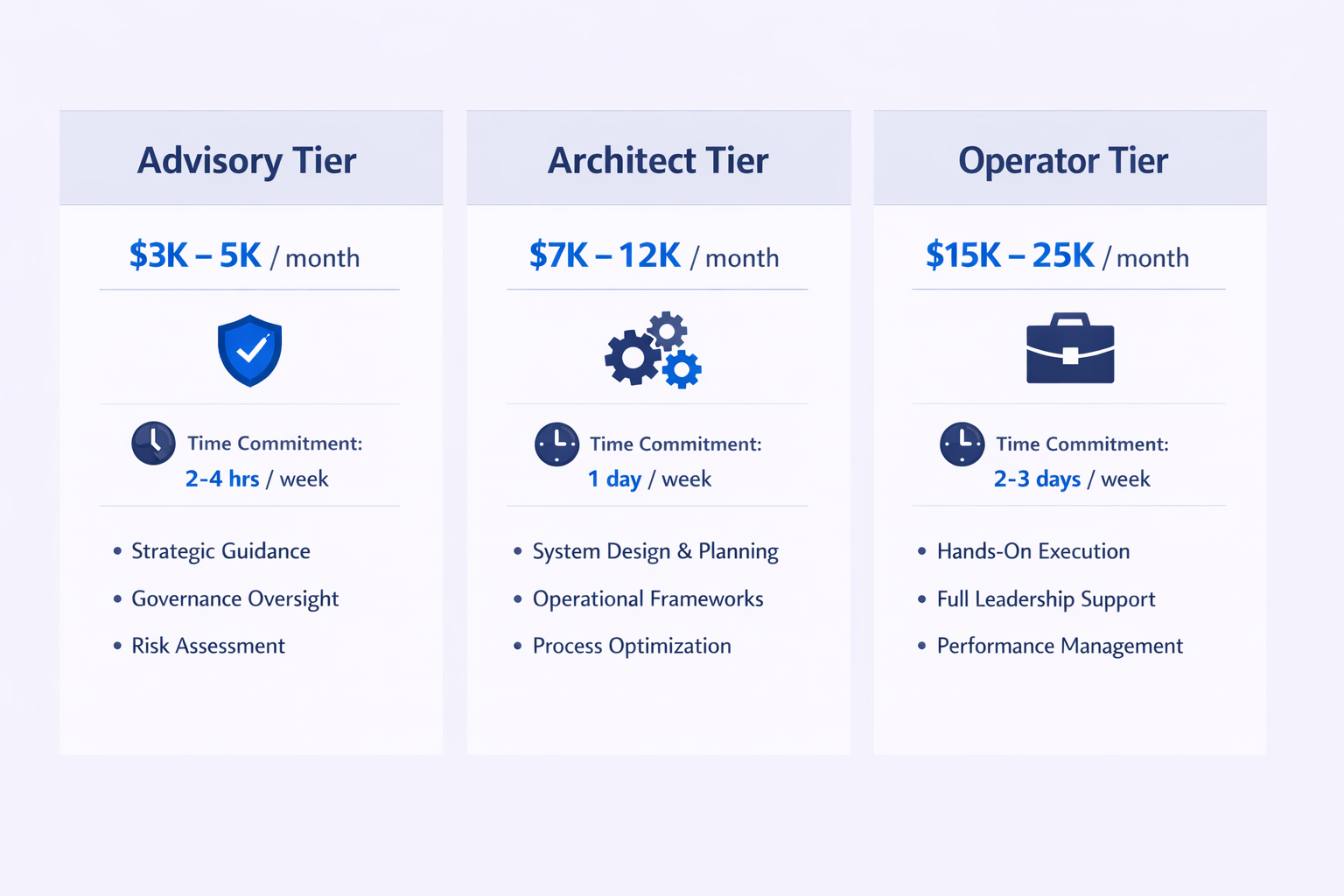
Here’s your pricing ladder:
Advisory Tier runs $3,000-$5,000 monthly for 2-4 hours plus unlimited async communication. You’re the strategic sounding board attending board meetings and reviewing key documents. Perfect for stable companies needing governance.
Architect Tier is your sweet spot at $7,000-$12,000 monthly for one day weekly. You run leadership meetings, own KPIs, and directly manage key reports. This is where 68% of fractional CEOs make their core revenue.
Operator Tier commands $15,000-$25,000 monthly for 2-3 days weekly with full P&L responsibility. You’re handling turnarounds, exits, or major transitions. Think of this as using workflow automation at the executive level.
Let’s run the numbers on a typical practice:
Two architect-tier clients at $9,000 each = $18,000 monthly. One advisory client at $4,000 monthly. Add $2,500 in project fees. That’s $24,500 monthly revenue or $294,000 annually. Your tech stack and insurance costs? Maybe $1,500 monthly.
You’re netting $276,000 while working 50% capacity. The other 50%? Business development, family time, or scaling further.
Building Your Client Acquisition Engine
Here’s where most fractional executives fail: They rely on referrals instead of controlling their own destiny.
Referrals are great until they dry up. You need a systematic outbound engine that generates qualified meetings on demand. This is where your sales background becomes your superweapon.
The infrastructure starts with technical foundations. Never send cold emails from your primary domain. If it gets blacklisted, your client communication dies. Instead, buy secondary domains like “getsmithconsulting.com” or “trysmithconsulting.com” that redirect to your main site.
Authentication is non-negotiable. Set up SPF, DKIM, and DMARC protocols. Google and Yahoo implemented strict requirements in 2024 – without these, your emails hit spam folders automatically.
Domain warm-up takes patience but pays off. Start with 5 emails daily in week one, scale to 15 in week two, then 30 in week three. Never exceed 50 emails per inbox per day. According to research on LinkedIn automation, maintaining deliverability is everything.
Targeting That Actually Converts
Generic outreach dies in spam. Context-specific outreach gets replies.
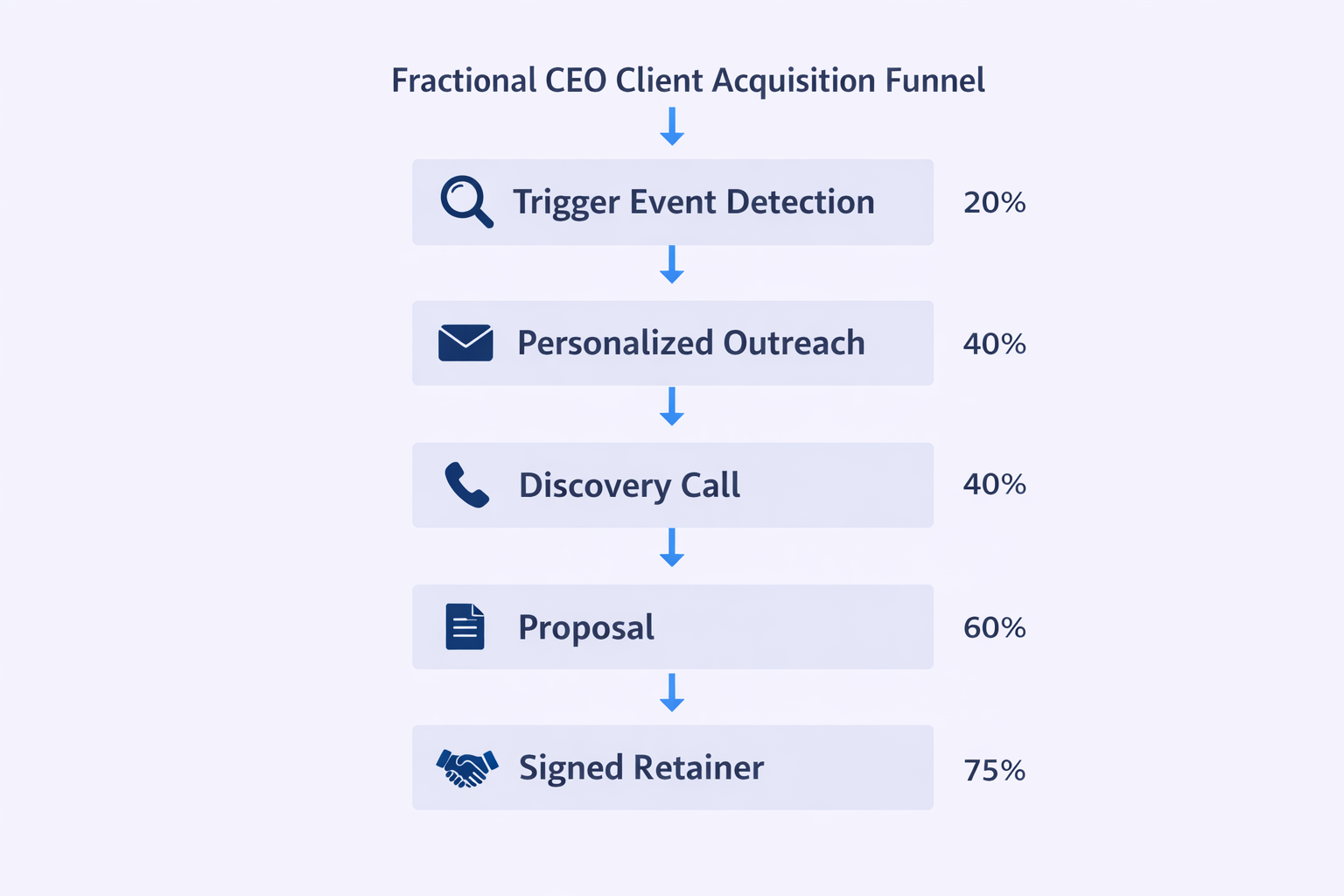
Hunt for trigger events that signal need:
Recent fundraising creates massive pressure to scale. Companies raising $5M+ Series A rounds suddenly need operational maturity they don’t have. Use tools similar to what you’d find in a ZoomInfo review to track funding announcements.
Job postings reveal pain. When a company posts for “VP Operations” or “Chief of Staff,” they’re drowning in operational work. They’re telling you exactly what they need.
Rapid headcount growth breaks processes. If a company grows their sales team 20% in six months, their systems are probably buckling. That’s your opening.
Here’s a template that works:
Subject: Process scaling at [Company]
“Hi [Name], I noticed [Company]’s expansion into [market]. The jump from $5M to $10M is usually where founder-led operations start breaking down. I work with companies at this exact stage installing operating systems that scale. Worth comparing notes on your Q3 roadmap? – [Your Name]”
Notice what it doesn’t say? “I need a meeting.” Instead, it offers peer-level perspective. You’re not begging, you’re offering value.
The First 90 Days That Make or Break You
Once you land a client, you need immediate momentum or the relationship dies.
Days 1-30 are diagnostic. Deep dive into financials, interview every key stakeholder, and map the shadow culture (how things really get done versus how they’re supposed to work). Your goal: One quick win that builds political capital. Fix an obvious broken process – maybe a billing issue or toxic vendor relationship.
Days 31-60 install the operating system. Establish weekly leadership meetings with fixed agendas. Define 5-7 KPIs that actually matter and create a dashboard. Clarify who owns each number. If everyone owns it, nobody owns it.
Days 61-90 accelerate growth. Now that the ship is stable, chart the course. Develop 1-year and 3-year strategic plans. Assess the team against this strategy and begin upgrading talent density. Present your Quarterly Business Review to justify contract renewal.
Your tech stack needs to work like a machine. CRM for managing your deal flow, project management for client work, time tracking to prevent scope creep, and async video tools like Loom to replace 30-minute meetings with 3-minute updates.
Studies on LinkedIn growth hacking show that systematic approaches always beat sporadic effort.
Legal Protection You Can’t Skip
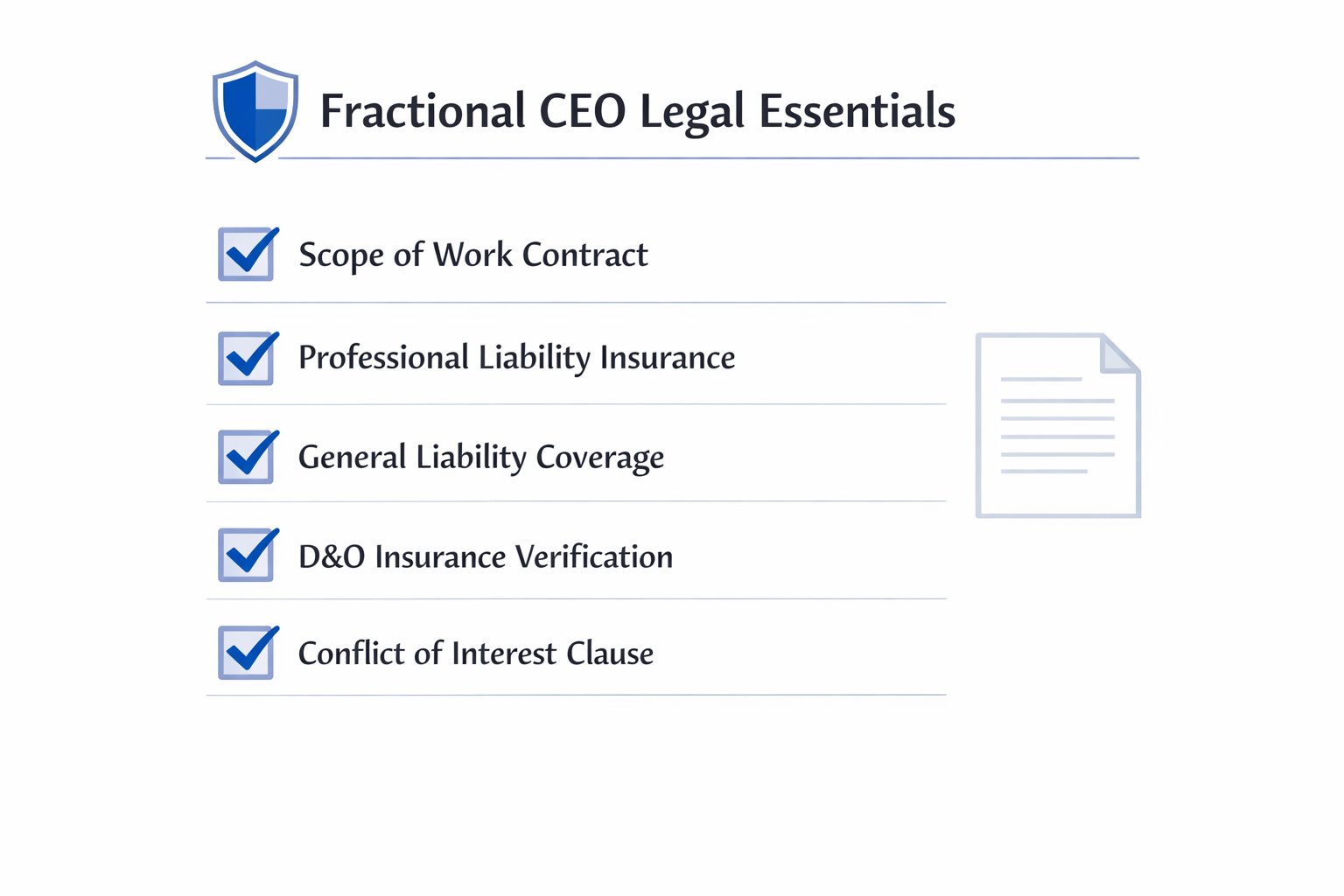
Your contract prevents scope creep from killing margins.
Be explicit about what’s in-scope: “Four weekly meetings, one monthly board meeting, unlimited email support.” And what’s out-of-scope: “Capital fundraising roadshows, interim coverage for other roles, legal counsel.”
Include a pre-agreed hourly rate for any work requested outside boundaries. This one clause saves thousands in lost time.
Insurance is your safety net. Professional liability covers negligence claims. If a client says “your strategy cost us revenue,” you’re protected. General liability is standard business coverage.
Critical warning on D&O insurance: If you act as a statutory officer – signing contracts, being listed as CEO on their website – you must be covered by the client’s Directors & Officers policy. Your personal policy won’t cover acts performed as an officer of another company.
Using advanced LinkedIn search techniques, you can find other fractional executives to learn from and network with.
Managing Multiple Clients Without Burning Out
The magic number is 2-4 clients depending on engagement intensity.
A balanced portfolio might look like this: One high-touch operator client (2-3 days weekly) paying $18,000 monthly, plus two architect clients (1 day weekly each) at $9,000 each. That’s $36,000 monthly revenue with strategic variety that keeps the work interesting.
Context switching is real. Beyond four clients, your brain starts mixing up details and service quality drops. Better to charge more per client than spread yourself too thin.
Block your calendar strategically. Mondays and Thursdays for client work, Wednesdays for business development, Fridays for deep work and planning. Protect that Wednesday religiously – it’s your pipeline generation day.
Many successful fractional CEOs use similar principles found in LinkedIn Sales Navigator alternatives to maintain organized prospect management.
