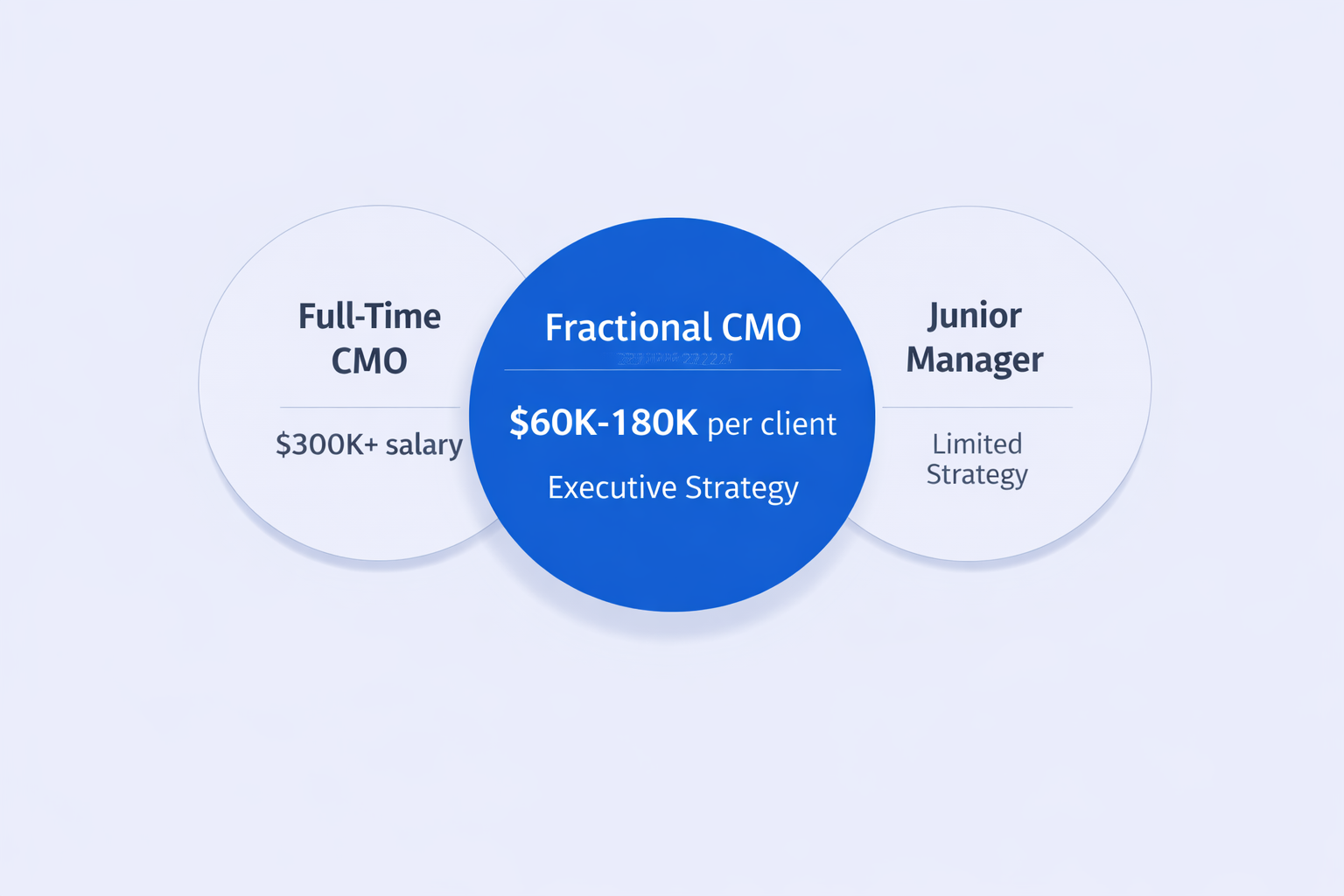
The executive world is changing fast. Companies don’t want to commit $300,000+ salaries for full-time marketing leaders anymore. They want flexibility. They want expertise without the overhead. That’s where you come in.
Starting a fractional CMO business lets you package your marketing expertise into high-value retainers while working with multiple clients. You’re not just a consultant dropping recommendations—you’re an embedded executive who drives real results. The average fractional CMO earns between $60,000 and $180,000 per client annually, working just 10-20 hours per month per engagement.
The market timing couldn’t be better. Full-time CMO tenure has dropped to just 40 months—the lowest in the C-suite. Companies are tired of hiring mistakes and expensive severance packages. They’re looking for proven leaders who can deliver Fortune 500 strategy without the Fortune 500 price tag.
This guide walks you through everything: from positioning yourself in the market to landing your first clients and scaling your practice. Let’s build your fractional empire.
Starting a Fractional CMO Business
Why the Fractional Model Works Right Now
The numbers tell a compelling story. Small to mid-sized companies (those earning $2M to $50M in revenue) face an impossible choice: hire a seasoned marketing executive for $250,000-$550,000 plus equity, or settle for junior marketing managers who lack strategic vision.
Over 70% of these companies can’t justify a full-time CMO’s salary, but they desperately need executive-level marketing leadership. That gap is your opportunity.
Here’s what makes fractional work so powerful:
Cost Arbitrage: Companies get C-suite expertise for $2,000-$12,000 monthly instead of $20,000+ for a full-timer. Your typical retainer covers 8-12 days of work per month—focused entirely on high-impact strategy, not administrative overhead.
Risk Mitigation: Most fractional contracts have 30-day termination clauses. If it’s not working, either party can exit quickly. Compare that to hiring a full-time CMO—recruiting costs average $50,000, plus severance if things go south.
Portfolio Income: You’re not dependent on one employer. Stack 3-4 clients and you’re earning $180,000-$480,000 annually while maintaining schedule flexibility. One client has a bad quarter? Your income barely dips.
The Skills You Actually Need
You don’t need a marketing degree from Harvard. But you do need real-world experience—typically at least 10 years of driving measurable results. Clients are buying your pattern recognition: the ability to look at a broken funnel and immediately know what’s wrong because you’ve seen it before.
Here’s what matters most:
Strategic Alignment: Can you connect marketing activities to business outcomes? Revenue, EBITDA, customer lifetime value—not vanity metrics like “brand awareness” or social media likes. CEOs don’t care about impressions; they care about pipeline contribution.
Cross-Functional Leadership: You’ll work across sales, product, customer success, and finance. 67% of B2B marketing leaders say aligning sales and marketing is their biggest challenge. If you can bridge that gap, you’re immediately valuable.
Financial Literacy: Understand unit economics. What’s an acceptable Customer Acquisition Cost (CAC)? How does Lifetime Value (LTV) justify marketing spend? Can you defend your budget to a skeptical CFO using their language?
Systems Thinking: Build processes that work without you. Your clients are paying for 10-20 hours monthly. You need to create frameworks, dashboards, and playbooks that keep the engine running when you’re not there.
If you’re coming from sales leadership (like many successful fractional CMOs), focus on learning top-of-funnel mechanics. You know how to close deals; now master how to generate thousands of website visitors. Take courses on workflow automation software, SEO fundamentals, and marketing analytics platforms like GA4 or HubSpot.
Finding Your Profitable Niche
Here’s the mistake most people make: trying to be a fractional CMO for “everyone.” That’s a fast track to commoditization and price competition.
The most successful practices focus on narrow, lucrative niches. Specialization lets you charge premium rates because you’re not a generic marketer—you’re THE expert in solving a specific problem for a specific type of company.
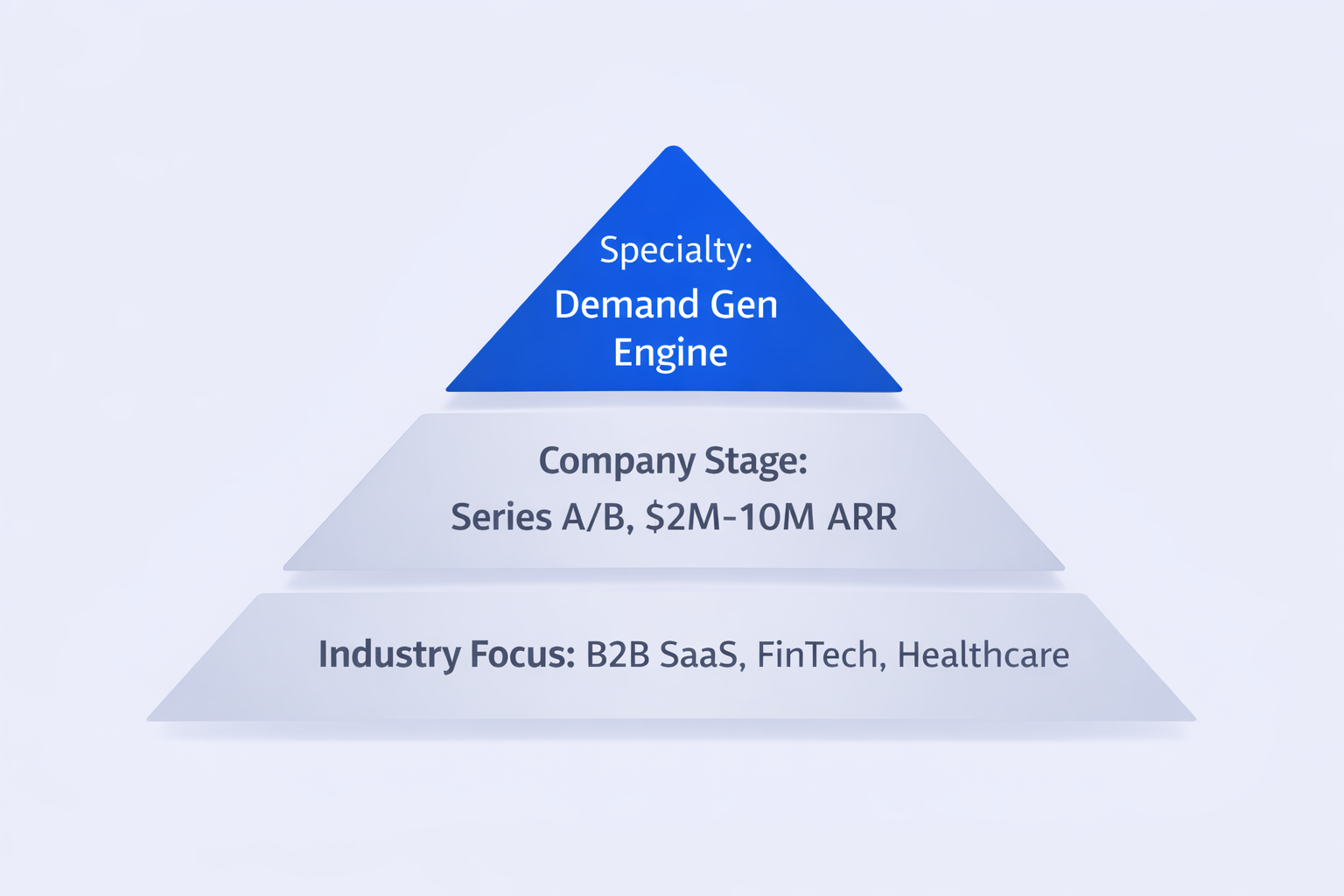
Industry Verticals work well: B2B SaaS, healthcare tech, manufacturing, fintech, D2C e-commerce. Pick one industry, learn its unique challenges, and become the go-to expert.
Company Stage is another angle: seed-stage startups need foundational marketing systems. Series A/B companies need scaling infrastructure. Pre-exit companies need their marketing “cleaned up” for due diligence.
Problem-Centric positioning is powerful: “I fix broken funnels,” “I launch new products,” “I rebuild marketing after bad agency relationships.”
A specialized positioning statement might sound like: “I help Series A B2B SaaS companies scale from $2M to $10M ARR by building predictable demand generation engines.” Notice how specific that is? That clarity attracts the right clients and repels bad fits.
Packaging Your Services (Don’t Sell Hours)
Trading time for money caps your income. To scale, package your expertise into clear service tiers. This creates predictability for clients and efficiency for you.
The Advisor Tier ($4,000-$7,000/month): Strategic guidance, team mentorship, vendor selection, weekly check-ins. You’re not executing; you’re directing. Ideal for early-stage startups with junior teams who need a North Star.
The Architect Tier ($7,500-$9,500/month): Strategy plus systems. You audit the tech stack, hire key roles, build the go-to-market roadmap, and set up KPI frameworks. Perfect for Series A companies undergoing digital transformation.
The Executive Tier ($10,000-$18,000+/month): Full leadership. You participate in board meetings, manage budgets, oversee agencies, and own revenue accountability. High-growth scale-ups preparing for M&A or exit need this level.
Some fractional CMOs also offer equity/performance hybrid models—a lower cash retainer (like $5,000) plus 0.25%-1% equity or bonuses tied to revenue milestones. Approximately 35% of fractional executives report taking some form of equity compensation.
Always include clear “scope exclusions” in contracts. You’re not writing daily social media posts or designing graphics. Define response times (24-hour email turnarounds, not instant Slack replies) to manage expectations around your fractional availability.
How to Land Your First Clients
This is where marketing expertise meets sales hustle. Many marketers fail here because they wait for inbound leads. Early-stage growth requires an outbound “hunter” mindset.
LinkedIn is Your Storefront: Optimize your profile not as a resume but as a landing page. Your headline should scream value: “I Help Series B SaaS Companies Lower CAC by 30%” beats “Marketing Executive | 15 Years Experience.”
Post consistently with these content pillars:
- The Contrarian: Challenge industry norms (“Why gating your best content kills pipeline”)
- The Playbook: Share specific frameworks (“My exact 30/60/90 day roadmap template”)
- The Case Study: Anonymous client wins (“How we cut CAC by 40% for a $10M SaaS company”)
Cold Outreach That Actually Works: Use advanced LinkedIn search to find companies with a “leadership void”—they have marketing managers or heads of sales but no CMO. These are your hottest prospects.
Boolean search example: (“CEO” OR “Founder”) AND (“SaaS” OR “Software”) AND (“Series A”) AND NOT (“Chief Marketing Officer” OR “CMO”)
Your cold email should be hypothesis-driven and respectful of their time:
Subject: Quick observation about [Company]’s growth
Body: “Hi [Name], noticed you’re scaling your sales team (congrats on the 3 recent hires). I usually see companies at your stage struggle with lead quality—sales teams grow faster than marketing can feed them. I recently helped [Similar Company] solve this by restructuring their demand gen engine. Lowered CAC by 25% in 90 days. Worth a brief chat?”
That’s specific, relevant, and offers immediate value. No fluff.
Referral Partnerships: The most sustainable lead source is your network of “adjacency partners.” Fractional CFOs and CTOs are already inside your target companies. When they spot wasted marketing spend, they’ll recommend you. Build relationships with them.
Similarly, VC operating partners need to insert marketing leadership into struggling portfolio companies. Become their go-to fixer for marketing turnarounds.
Research shows that 60% of fractional CMO engagements come through referrals after the first year in business. But you can’t wait a year—outbound fills your pipeline now while you build your referral engine.
Your First 90 Days: Delivering Quick Wins
Your tenure as a fractional CMO is fragile at first. Clients pay premium rates expecting fast results. The first 90 days must demonstrate visible value to secure the long-term retainer.
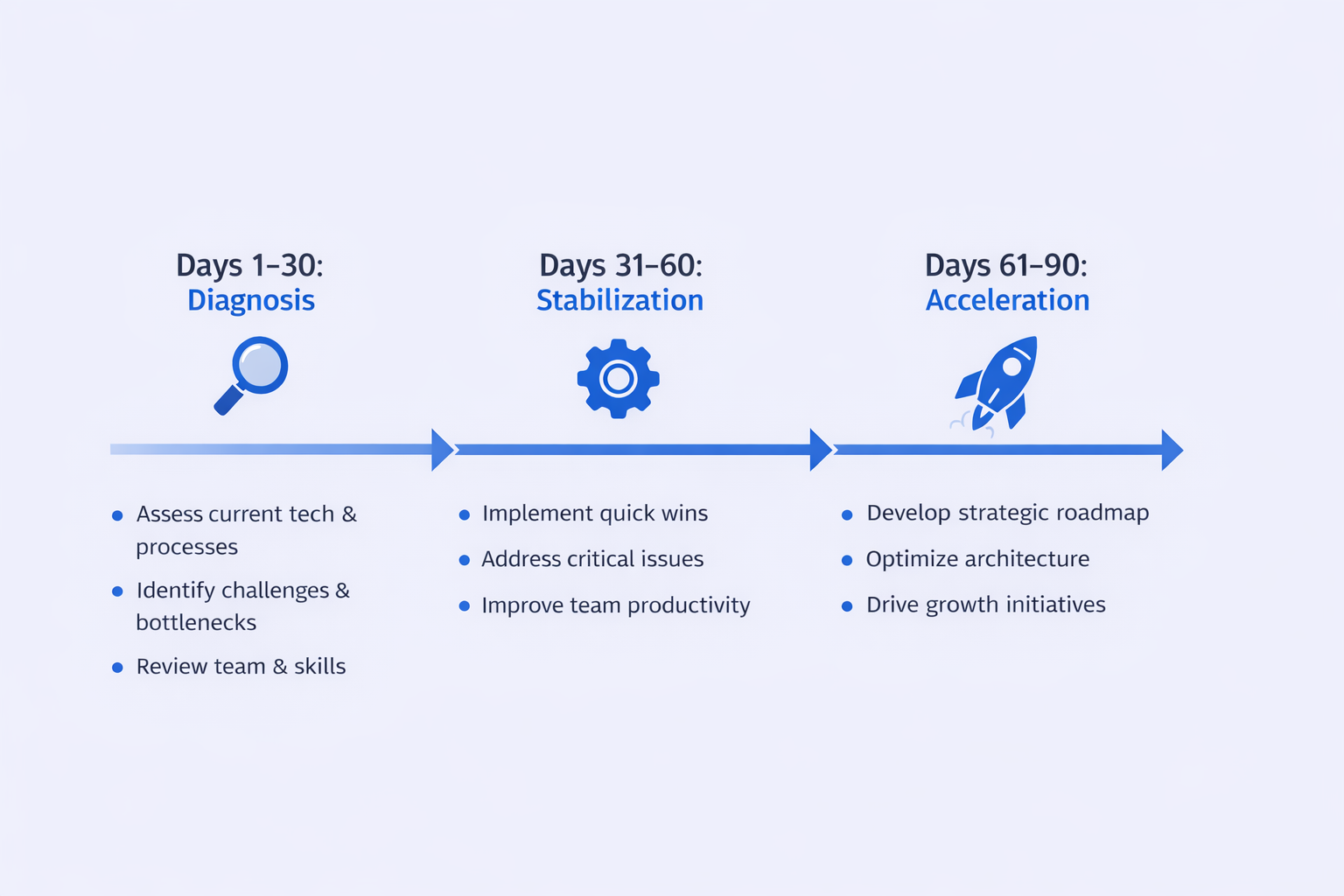
Days 1-30: Diagnosis
- Deep dive into tech stack, funnel metrics, brand consistency
- Interview the sales team to understand lead quality complaints
- Conduct a “Marketing Health Check” audit
- Deliverable: State of the Union report with a 30/60/90 day roadmap
- Quick Win: Identify “bleeding necks” and fix them immediately—turn off wasted ad spend, repair broken conversion paths, optimize high-traffic pages
Days 31-60: Stabilization
- Implement weekly reporting cadences and project management systems
- Clarify MQL/SQL definitions with sales leadership
- Set up dashboards tracking leading indicators (not just lagging metrics)
- Deliverable: Finalized go-to-market strategy deck and KPI framework
Days 61-90: Acceleration
- Launch your first major strategic initiative (new nurturing campaign, website overhaul, account-based marketing program)
- Host first Quarterly Business Review showing trend improvements
- Deliverable: Proof of momentum—rising traffic, improving engagement rates, growing pipeline velocity
One fractional CMO case study showed K9 Resorts (a luxury pet hotel) implemented automated lead nurturing that was previously manual. Result? 50% revenue increase in year one just from systematizing follow-ups with HubSpot.
That’s the power of executive-level systems thinking applied to everyday marketing problems.