Step 3: Craft Messages That Feel Personal
Generic templates are dead. In 2026, prospects can smell mass emails from a mile away. Your local advantage only works if your message proves you’re actually local.
The local email framework that works:
Subject line: “Question about [Business Name]’s [Neighborhood] location”
Opening line: “Hi [Name], I noticed [Business Name] has been in [Neighborhood] since [Year they opened]. That’s impressive longevity.”
Problem agitation: “I’m working with several [Industry] businesses in [City] who are struggling with [Specific Pain Point]. For example, [Local Competitor] recently told me [relevant challenge].”
Solution tease: “We built a way to [Your Value Prop] without [Common Obstacle]. Given the [Local Market Condition—new development, seasonal pattern, regulatory change], I thought it might be relevant for your team.”
Soft close: “Open to a quick 10-minute call to see if there’s a fit? If not, no worries—I respect your time.”
Why this works: You’ve anchored the email in physical reality. The street name, the competitor reference, the local market insight—all of it screams “I’m not a bot.” That gets replies.
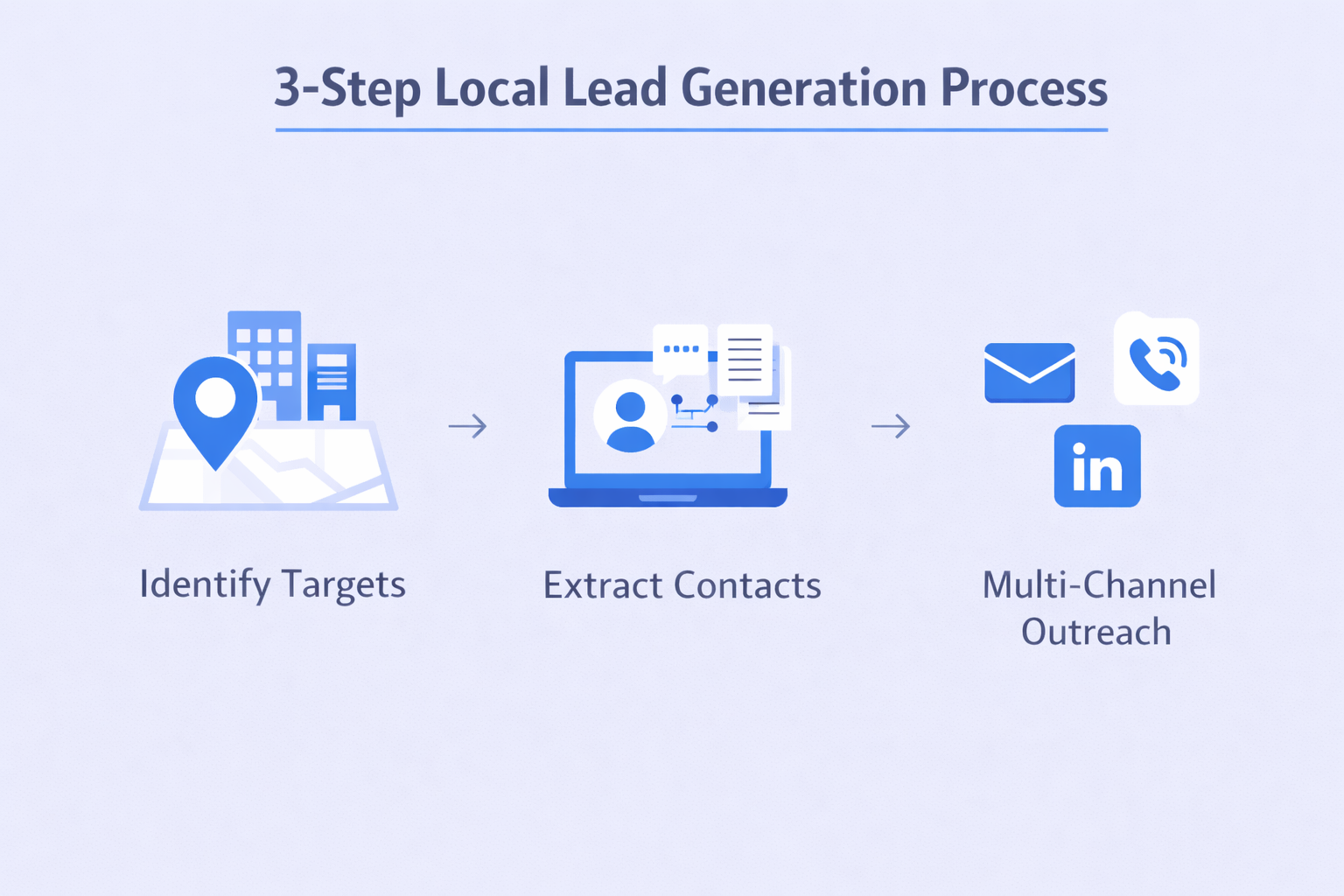
Step 4: Execute Multi-Channel Sequences
Email alone won’t cut it. Modern lead generation requires touching prospects across multiple platforms. According to LinkedIn lead generation statistics, combining LinkedIn and email increases response rates by 47%.
The 10-day multi-channel sequence:
Day 1: Send email #1 (the local framework above) Day 1: Send LinkedIn connection request with local note Day 3: Call attempt #1 (leave specific voicemail) Day 5: Send email #2 (provide local market insight or case study) Day 7: Call attempt #2 (no voicemail) Day 8: LinkedIn message (if connected) Day 10: Breakup email (“I assume this isn’t a priority…”)
The psychology of persistence: Most people give up after one or two touches. The data shows 80% of sales require 5+ follow-ups, yet 44% of salespeople quit after one rejection. That gap is your opportunity.
The technology stack for this:
- Email: Apollo, Instantly.ai, or Woodpecker
- LinkedIn: Use advanced LinkedIn search techniques to find decision-makers first
- Phone: Your CRM’s built-in dialer or CloudTalk
- Tracking: Ensure all activities log to your CRM automatically
Step 5: Measure What Matters
If you’re not tracking metrics, you’re guessing. These are the only numbers that actually predict revenue:
List Quality Metrics:
- Email bounce rate (must be under 5%)
- Phone connect rate (aim for 15-20%)
- LinkedIn acceptance rate (should exceed 30%)
Engagement Metrics:
- Email open rate (15-25% is healthy)
- Email reply rate (3-7% for cold, 10-20% for warm)
- Call-to-conversation rate (1 conversation per 20-30 dials)
Revenue Metrics:
- Cost per qualified lead (CPL)
- Lead-to-opportunity conversion rate
- Average contract value (ACV)
- Return on investment (ROI) = (Revenue – Cost) / Cost
The math that matters: If you spend $1,500/month on tools and 40 hours on outreach, and you close two $10,000 deals, your ROI is 1,233%. That’s the power of local lead generation done right.
Advanced Strategies: Going Beyond the Basics
Once you’ve mastered the fundamentals, these advanced tactics will separate you from competitors still stuck in 2024.
The AI Voice Agent Revolution
Here’s what nobody’s talking about: AI voice agents are replacing cold-calling teams. Not assisting—replacing.
Modern AI agents like Retell AI and Synthflow can now dial 1,000 local businesses in a single hour, ask qualifying questions, and warm-transfer interested prospects to human closers. The latency has dropped under 800 milliseconds, making conversations feel completely natural.
The economics are absurd. Instead of paying 10 junior salespeople $50,000 each to cold call, you pay one AI fleet manager $75,000 to oversee the machines. The cost per qualified lead drops by 70-80%.
For local lead generation specifically, AI agents excel because they can reference local information programmatically. The AI mentions your street name, your weather, your local news—all automatically personalized at scale.
Map-Based Territory Planning
If you manage a territory, spreadsheets are amateur hour. Visual intelligence wins.
Apollo’s map view (and similar features in Pipedrive) let you see prospect density geographically. This transforms route planning from guesswork into science.
The strategy: Before driving to a client meeting, check the map for other prospects in a 5-mile radius. Schedule three “pop-in” visits in the same trip. This technique can triple your daily face-to-face interactions without adding drive time.
Field sales teams using map-based prospecting close 30-40% more deals simply because they’re in front of customers more often. Video calls are fine, but nothing beats a firm handshake.
Intent Data for Local Markets
Intent data traditionally served enterprise sales, but 2026 brought it to local markets. Advanced platforms now track signals like:
- Local business filing for renovation permits (capital to invest)
- Job postings for new locations (expansion mode)
- Website traffic spikes (active marketing)
- Technology stack changes (open to new tools)
When you reach out during these moments, you’re not interrupting—you’re arriving at the perfect time. Response rates jump 3-5x compared to random outreach.
Pricing Breakdown: What You’ll Actually Pay
Let’s cut through the marketing fluff and talk real numbers. Software companies love to hide their pricing behind “contact sales” buttons. Here’s what you’ll actually spend in 2026.
Budget-Friendly Stack ($150-250/month)
Data Source: GrowMeOrganic ($99/month) Email Tool: Instantly.ai ($79/month) Verification: MillionVerifier ($50/month for 100k credits) CRM: Pipedrive ($15/user/month)
Total: ~$240/month
Best for: Solo founders, agencies, or anyone selling services under $5,000 to local businesses.
Mid-Market Stack ($500-800/month)
All-in-One Platform: Apollo.io ($99/user/month for 2 users) Enrichment: Clay (variable, ~$200/month average) CRM: HubSpot Sales Pro ($90/user/month)
Total: ~$600/month
Best for: B2B companies with dedicated sales teams and average contract values between $10,000-50,000.
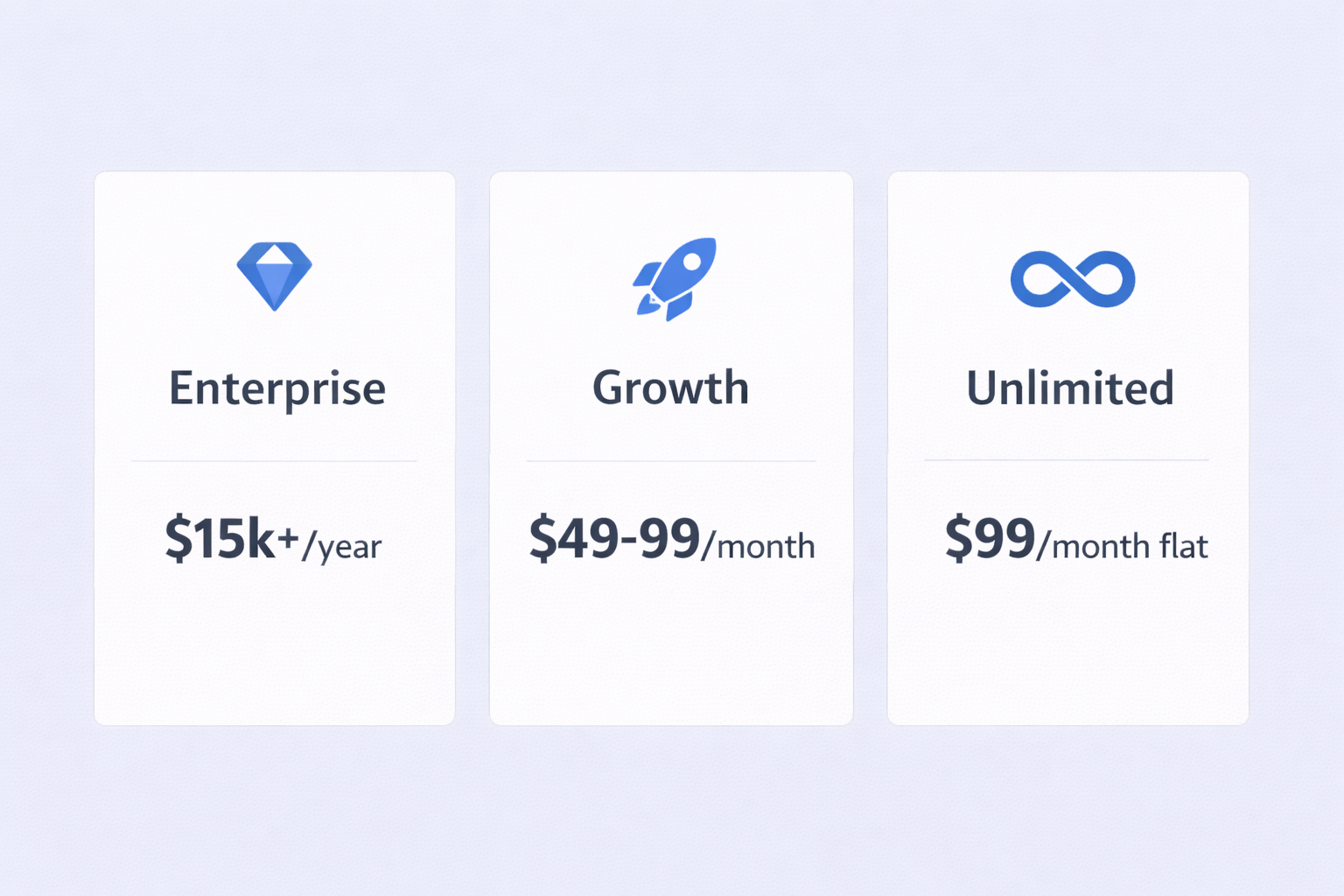
Enterprise Stack ($2,000+/month)
Intelligence: ZoomInfo ($15,000/year = $1,250/month) Engagement: Salesloft ($100/user/month) CRM: Salesforce (Sales Cloud, ~$150/user/month)
Total: ~$2,000+/month per rep
Best for: Companies selling six-figure deals where data accuracy is non-negotiable and one mistake costs more than the software.
The Hidden Costs Nobody Mentions
Email verification: Budget $40-100/month depending on volume Domain warming: If you’re sending cold emails, expect to buy 3-5 domains at $12/year each Time cost: The average sales rep spends 2-3 hours weekly managing these tools Training: Plan for 5-10 hours of learning curve per new platform
The real question isn’t “what’s the cheapest tool?” It’s “what’s the highest ROI tool for my business model?” A $15,000 annual ZoomInfo subscription that generates three $100,000 deals is a bargain. A $99/month scraper that generates zero deals because the data is trash is expensive.
Common Mistakes That Kill Local Lead Generation
You’ve got the software. You’ve built the lists. You’ve sent the messages. And… crickets. Here’s why most local lead gen campaigns fail.
Mistake #1: Forgetting to Clean Your Data
Raw data is toxic. Whether you’re pulling from Apollo or scraping Google Maps, expect 20-40% of contacts to be outdated or invalid.
The symptom: Your email bounce rate exceeds 10%, and within weeks, Gmail starts sending your messages directly to spam. You’ve just blacklisted your domain.
The fix: Always verify emails before importing to your CRM. Set up a staging area (Google Sheet or Airtable) where you clean data first. Remove obvious junk (info@, hello@, admin@), verify the rest, then import only the good stuff.
Mistake #2: Treating Local Like National
The biggest irony: People buy local lead generation software, then send the same generic templates they’d use for national campaigns.
The symptom: Low reply rates despite good contact data. Prospects ignore you because they can’t tell you’re actually local.
The fix: Force yourself to include at least TWO local references in every message. Street names, weather, local competitors, recent news, regional events—anything that proves you’re not a template robot.
Mistake #3: Ignoring Multi-Channel Reality
Email isn’t enough. LinkedIn isn’t enough. Cold calling isn’t enough. 73% of prospects prefer interacting with sales reps through multiple channels.
The symptom: You get decent email opens but zero replies. Your LinkedIn messages get read but no responses. Each channel alone is too weak to convert.
The fix: Design sequences that hit prospects on email, LinkedIn, and phone within the same week. When someone sees your name three times across three platforms, familiarity (and trust) build exponentially faster.
Mistake #4: Giving Up Too Early
The average person quits after two touches. The average deal closes after 8-12 touches. See the problem?
The symptom: You feel like you’re “bothering” people, so you stop after one polite email and one phone call. Your pipeline stays empty.
The fix: Build mechanical sequences that force persistence. Use tools that automate follow-ups so your feelings can’t sabotage your results. Remember: 80% of sales happen after the 5th follow-up.
Mistake #5: Neglecting Your Sender Reputation
Your domain reputation is everything. One month of bad email practices can take six months to fix.
The symptom: Your emails suddenly land in spam for everyone. Your carefully crafted messages never reach the intended recipients.
The fix: Warm new domains slowly (start at 20 emails/day, increase by 20% weekly), keep bounce rates under 3%, maintain spam complaint rates under 0.1%, and never buy email lists.
The Future of Local Lead Generation
Where is this all heading? Three massive shifts are reshaping local lead generation in ways that will create unfair advantages for early adopters.
The Contact Information Commodity
By 2027, basic contact data will be essentially free. Every B2B email and phone number will be accessible through a dozen different tools. The competitive moat won’t be “I can find their number”—it will be “I know when they’re ready to buy.”
What this means for you: Stop buying tools based on database size alone. Start investing in platforms that provide intent signals, trigger events, and buying window indicators.
The Rise of Autonomous Sales Agents
We’re moving from “AI-assisted” to “AI-autonomous.” Instead of AI writing the email while you send it, AI will soon find the lead, write the email, send it, handle objections, and book the meeting without human involvement.
The new role: Sales professionals will become “Campaign Architects,” designing strategies and managing fleets of AI agents rather than doing individual outreach. One person will manage the work of 10-20 traditional sales reps.
Privacy and Regulation
GDPR was just the beginning. As privacy laws tighten globally, scraping will face legal headwinds. Tools that rely on “consented data” or public directories will be safer than those scraping private profiles.
The smart move: Audit your software vendor’s data sourcing. Ask explicitly: “Where does this data come from?” If they can’t give a clear answer about compliance, you’re taking on legal risk.
Conclusion
Local lead generation software isn’t magic—it’s leverage. The right tools turn hours of manual research into minutes of focused execution.
Here’s your decision framework:
If you’re targeting local Main Street businesses (restaurants, shops, service providers), GrowMeOrganic’s Google Maps scraping is unmatched. Pair it with solid email verification and you’ve got an affordable, high-volume machine.
If you’re selling B2B software or services to established companies, Apollo.io delivers the best balance of database quality, features, and price. It’s the operating system for modern sales teams.
If you’re playing in enterprise where deals are $50,000+, ZoomInfo’s intent data and organizational intelligence justify the premium cost. Bad data costs more than the software when you’re closing six-figure deals.
But here’s what matters most: Software accelerates strategy, but it can’t replace strategy. The winners in 2026 won’t be those with the fanciest tools—they’ll be those who use these tools to find the right people in their local communities and engage them with relevance, timing, and genuine value.
The opportunity is real. While your competitors spam strangers nationwide, you can build relationships with neighbors who actually need what you sell. Start local. Start smart. Start today.