Let's Build Your First Campaign Together with our LinkedIn Expert

Solar Lead Generation Software: Your Complete Guide to Finding Better Solar Prospects in 2026

Table of Contents

Let’s be real—buying shared solar leads is killing your conversion rates and burning through your budget. You’re competing with five other companies calling the same homeowner within seconds, dealing with 1-5% conversion rates, and watching your customer acquisition costs skyrocket. The era of easy solar leads is over.

Here’s the thing: 61% of marketers say improving their prospecting strategy is their top priority, and for good reason. The solar market has matured. Interest rates are higher, policies like California’s NEM 3.0 have shifted the value proposition, and homeowners are weary of aggressive sales tactics. The traditional “buy leads and dial” approach isn’t just expensive—it’s becoming obsolete.

But there’s a better way. Modern solar lead generation software gives you control of your pipeline by helping you find and connect with prospects directly. Instead of fighting over shared leads from aggregators, you can use data enrichment tools, email automation platforms, and social selling software to build exclusive relationships with potential customers.

This guide breaks down the top software platforms that actually work for solar sales in 2026—no fluff, just practical insights on which tools help you capture solar inquiries automatically and close more deals. Whether you’re targeting commercial installations or building residential referral partnerships, you’ll discover exactly which platforms fit your strategy and budget.

Understanding Solar Lead Generation Software

Think of solar lead generation software as your digital prospecting team. While traditional methods like door-knocking or buying leads from aggregators have their place, software platforms let you scale your outreach exponentially without proportionally increasing costs.

These tools fall into three main categories:

Data & Contact Discovery Platforms help you find decision-makers with verified contact information. Instead of guessing who manages facility operations at that warehouse with the perfect roof, tools like Apollo.io, ZoomInfo, and UpLead give you the Operations Manager’s email address in seconds. Research shows that email marketing delivers an average ROI of $42 for every dollar spent, making data accuracy your first critical investment.

Outreach & Automation Tools handle the actual communication once you’ve identified prospects. Platforms like Woodpecker, SalesHandy, and Snov.io send personalized email sequences that mimic human behavior, dramatically improving deliverability. Unlike mass marketing blasts that trigger spam filters, these tools send emails one-by-one with randomized intervals—getting your message into primary inboxes where 80% of professionals prefer to be contacted for business purposes.

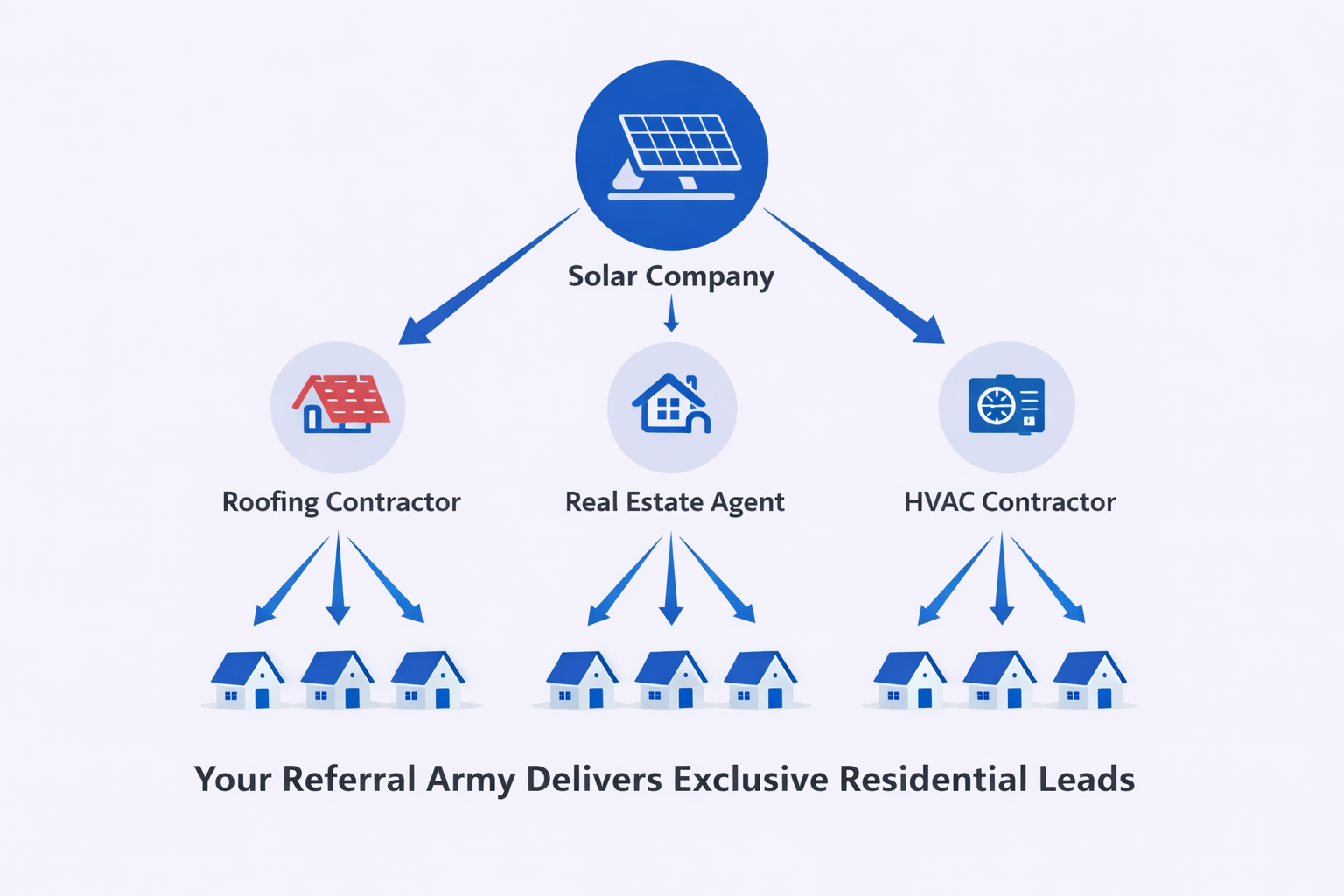
Scraping & Intelligence Tools like GrowMeOrganic and Wiza extract contact data from public sources like Google Maps and LinkedIn. This is particularly powerful for solar sales because you can target allied trades (roofers, HVAC technicians, electricians) who can become your referral army for residential solar projects.

The key advantage? Exclusivity. When you use cold email software to reach a manufacturing plant owner directly, you’re not competing with four other solar companies. You’re the only one in their inbox at that moment, which immediately improves your odds.

🌞 Stop Chasing Shared Solar Leads

Get Exclusive Prospects with LinkedIn Outbound

Our complete targeting, campaign design, and scaling system helps solar professionals book 15-25% response rates—without buying overpriced leads from aggregators.

The Shift from Buying Leads to Generating Them

Here’s what most solar companies miss: the “ping tree” economy is rigged against you. When a homeowner fills out a form on a solar aggregator site, their information enters an algorithmic auction. The lead gets sold to the highest bidder, then the second highest, then the third. By the time you call that “exclusive” lead (that cost you $150-$250), they’ve already received multiple calls and possibly committed to a competitor.

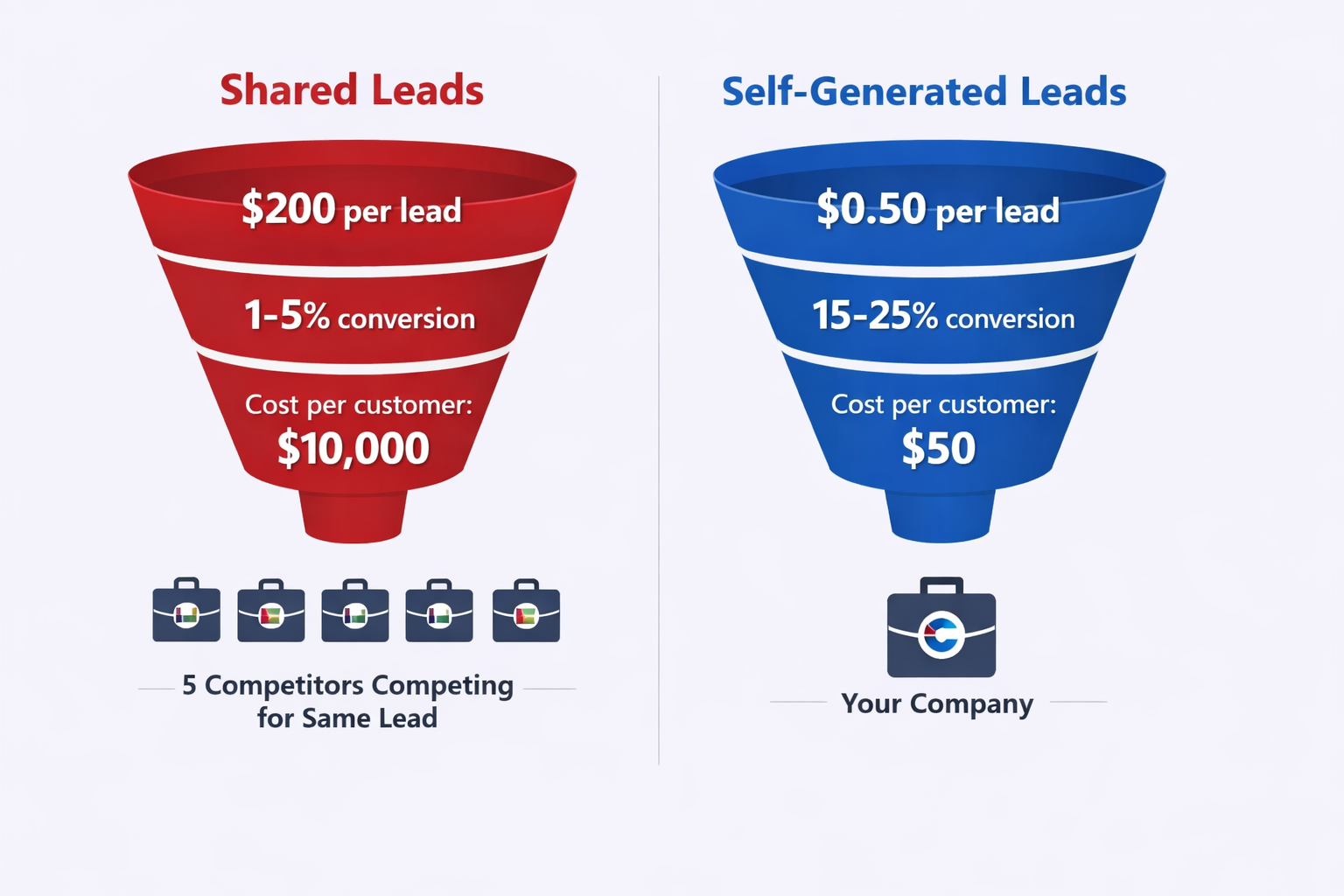
Studies show that shared solar leads convert at just 1-5%, compared to self-generated leads that can convert at 15-25% or higher. The math is brutal: if you’re spending $200 per shared lead and converting 2%, your cost per acquisition is $10,000. Generate your own leads for pennies through email outreach, and suddenly your economics completely flip.


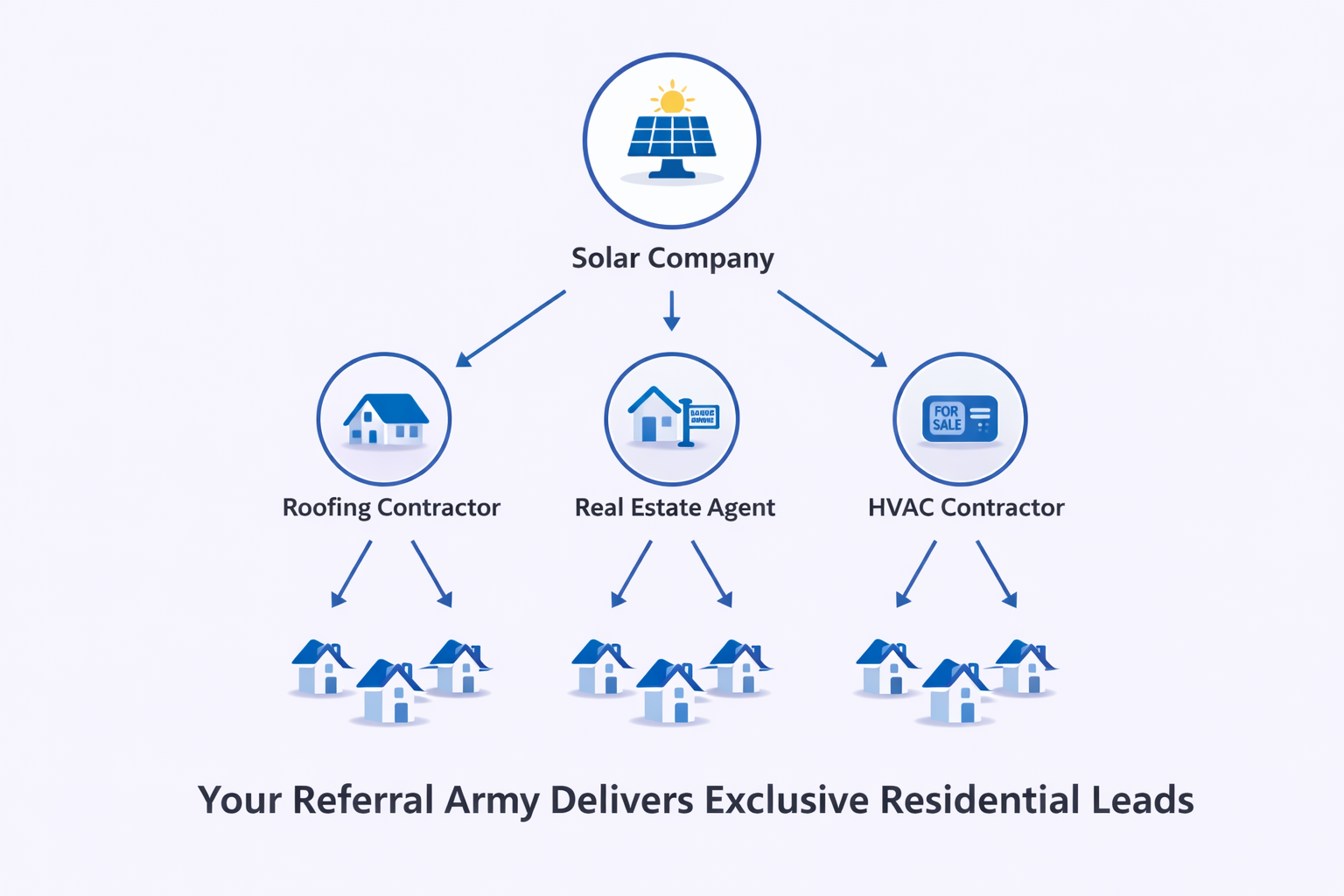
The “B2B2C” strategy changes everything for residential solar. Since directly emailing homeowners involves privacy complexities and sparse data availability, successful teams pivot to allied professionals. Use LinkedIn prospecting to find every roofing contractor, real estate agent, and home improvement contractor in your territory. Build relationships with these trusted advisors who enter homes during critical decision moments—buying a house, replacing a roof, upgrading HVAC systems.


Here’s a practical playbook: scrape 2,000 local trade businesses using GrowMeOrganic. Upload them to your email automation tool. Send a partnership offer: “We pay $1,000 for every roof you refer that goes solar.” These professionals become your residential lead source, and you’ve bypassed homeowner prospecting entirely.

For commercial solar, the opportunity is even clearer. Manufacturing plants, cold storage facilities, and warehouses with large flat roofs and high energy costs are perfect targets. Tools like Apollo.io let you filter by industry (“Food Manufacturing,” “Logistics”), geography (states with high electricity rates), and company size (20-200 employees to avoid enterprise bureaucracy). Export the CEO, CFO, and Facilities Manager contacts, then launch coordinated email sequences highlighting IRA incentives and energy cost reduction.

The shift isn’t just about software—it’s about strategy. You’re moving from being a passive recipient of expensive, low-quality leads to becoming an active architect of your own pipeline. With the right combination of cold emailing agencies techniques and data tools, your cost per acquisition drops dramatically while your conversion rates soar.

Comparing Top Solar Lead Generation Software Platforms

Let’s cut through the marketing fluff and look at which platforms actually deliver for solar professionals. Each tool has specific strengths that align with different solar sales strategies.


Apollo.io: The Volume Prospector

Apollo.io democratized B2B data by offering over 275 million contacts through a freemium model that makes it accessible to solo brokers and large teams alike. For solar sales, Apollo’s breadth is its superpower.

Best for: High-volume B2B2C referral strategies and commercial solar prospecting

Key advantage: All-in-one workflow. Find a lead, verify their email, add them to an automated sequence—all without leaving the platform. This reduces software bloat and friction that kills momentum on smaller teams.

Solar application: Want to build that referral army? Use Apollo’s filters to find every “Real Estate Broker” and “Roofing Contractor” in Arizona. With a few clicks, you can identify 5,000 targets and enroll them in sequences pitching partnership opportunities. For commercial solar, filter by “Owner” or “Founder” of manufacturing facilities in high-electricity-cost states, then launch targeted sequences about IRA tax incentives.

Trade-off: Data accuracy fluctuates compared to premium platforms. Expect slightly higher bounce rates, which means you’ll need careful domain management to protect sender reputation. Pro tip: Start with smaller test batches to verify data quality before scaling volume.

☀️ LinkedIn Beats Shared Solar Leads

Book 5-10 Qualified Appointments Weekly

Our LinkedIn outbound engine bypasses lead aggregators completely. Direct access to decision-makers, 15-25% response rates, complete campaign design included.

ZoomInfo: The Enterprise Intelligence Engine

ZoomInfo is the gold standard for B2B data accuracy, particularly valuable for large commercial solar installations where deal sizes justify premium costs. Annual contracts often start in five figures, making this a tool for established teams with dedicated budgets.

Best for: Complex commercial solar deals requiring multiple stakeholder engagement

Key advantage: “Scoops” feature identifies trigger events within companies—facility expansions, new construction, funding rounds. Timing is everything in commercial solar. Pitching a warehouse owner after they’ve replaced their roof is too late. ZoomInfo signals when companies plan expansions, letting you integrate solar into initial builds rather than difficult retrofit conversations.

Solar application: Set triggers for “New Construction” or “Facility Expansion” in your territory. When a logistics company breaks ground on a new distribution center, reach out to their Director of Construction immediately. Commercial solar deals involve buying committees—the Facilities Manager cares about roof integrity, the CFO about Investment Tax Credits, the Sustainability Director about ESG goals. ZoomInfo’s organizational charts let you map entire decision-making units and run coordinated Account-Based Marketing plays.

Trade-off: Cost. Small residential installers and solo consultants should probably look elsewhere. This is infrastructure for teams with marketing operations budgets.

UpLead: The Accuracy Obsessive

UpLead positions itself as the antidote to bad data, promising 95% email accuracy with real-time verification at download. In solar sales where reputation matters, bounced emails to high-value prospects aren’t just annoying—they’re professionally damaging.

Best for: “Sniper” approaches targeting high-value commercial accounts

Key advantage: Real-time email verification means you pay only for valid contacts. If you’ve identified the top 50 manufacturing plants in your county with large flat roofs, you cannot afford to burn through these leads with bad data.

Solar application: Use UpLead’s technographic tracking to identify modern, forward-thinking companies. A manufacturer using cloud-based ERPs and modern HR software is statistically more likely to adopt modern energy solutions than one running legacy on-premise systems. This data point helps you prioritize outreach.

Trade-off: Cost per lead is higher than volume platforms, but waste approaches zero. For commercial solar where deal values range from $100K to multi-millions, paying $3-5 per verified contact is negligible compared to deal size.

GrowMeOrganic: The Local Trade Network Builder

GrowMeOrganic offers something unique: Google My Business scraping. Most B2B databases scrape LinkedIn, which works great for corporate employees but terrible for local tradespeople who often lack LinkedIn profiles.

Best for: Building residential solar referral networks

Key advantage: Find allied trades who live on Google Maps, not LinkedIn. Roofers, electricians, HVAC technicians, general contractors—these businesses are your gateway to residential solar customers.

Solar application: Search “Roofing Contractor in Austin, TX” and instantly scrape contact details from thousands of Google My Business listings. Upload this list to GrowMeOrganic’s unlimited email sender and launch partnership pitches: “We pay $1,000 for every residential roof you refer that goes solar.” This transforms local tradespeople into your residential lead source.

Trade-off: Data accuracy varies since it’s scraped from public listings. However, the unlimited credit model removes friction—you can experiment with high-volume campaigns without worrying about burning through credits.

Using LinkedIn automation tools alongside GrowMeOrganic creates a powerful combination for both commercial and residential solar prospecting.

⚡ Tired of 1-5% Conversion Rates?

Get 15-25% Response Rates with LinkedIn Outbound

Stop competing over shared solar leads. Our complete targeting, campaign design, and scaling methods deliver exclusive commercial and residential opportunities.

Wiza: The LinkedIn Extractor

Wiza specializes in turning LinkedIn Sales Navigator searches into valid email lists. If you live and breathe LinkedIn, Wiza bridges the gap between social selling and email outreach.

Best for: Property managers, multi-family housing, and niche commercial solar segments

Solar application: Build a Sales Navigator search for “Property Managers” managing “Multi-Family Units”—prime targets for community solar or commercial carport installations. Wiza exports that search into a CSV with verified emails, allowing immediate campaign launches. This works particularly well for that awkward space between residential and commercial solar that many installers miss.

Trade-off: You need Sales Navigator ($99/month) to use Wiza effectively, adding to total cost. However, LinkedIn lead generation statistics show that personalized LinkedIn outreach converts 25% better than cold calls alone, making this investment worthwhile for targeted campaigns.

Leveraging LinkedIn growth hacking techniques with Wiza can dramatically accelerate your commercial solar pipeline.

Woodpecker: The Deliverability Shield

Woodpecker isn’t a data provider—it’s a sending platform obsessed with deliverability. In solar sales where domains frequently get blacklisted from aggressive campaigns, Woodpecker’s “human-like” sending algorithms are essential infrastructure.

Best for: Protecting domain reputation while scaling outreach volume

Key advantage: Unlike marketing blast tools that send 1,000 emails simultaneously, Woodpecker sends one-by-one with randomized intervals (45 seconds, then 120 seconds). This mimics human typing behavior, tricking Google and Outlook filters into treating emails as personal correspondence rather than bulk marketing.

Solar application: Buy a new domain (e.g., trysolar.com) for prospecting to protect your main domain. Use Woodpecker’s warm-up mode to gradually increase sending volume over weeks, building domain reputation before hitting full scale. This prevents immediate blacklisting that kills many solar outreach campaigns.

Trade-off: You still need data from Apollo, UpLead, or similar platforms. Woodpecker handles delivery, not data discovery.

SalesHandy: The Closer’s Analytics

SalesHandy offers unique document analytics features critical for solar sales, where Account Executives send countless complex proposal PDFs detailing ROI, tax offsets, and energy production curves.

Best for: Tracking proposal engagement and optimizing follow-up timing

Key advantage: Precise engagement analytics. SalesHandy notifies you: “Prospect X opened the proposal and spent 4 minutes on Page 3 (Financials) but skipped Page 2 (Environmental Impact).”

Solar application: This intelligence transforms follow-up calls. Instead of generic “just checking in” calls, you know exactly what to discuss: “Hey, I wanted to walk you through the financial breakdown since I noticed you spent time on those numbers…” This data-driven approach significantly increases closing probability.

Trade-off: SalesHandy’s document tracking works best for proposals sent via email, not through CRM portals or other systems.

Using advanced LinkedIn search to identify qualified prospects, then tracking their proposal engagement with SalesHandy, creates a powerful closing workflow for commercial solar deals.

Three Proven Solar Lead Generation Playbooks

Software means nothing without strategy. Here are three battle-tested approaches for different solar market segments.

Playbook A: Commercial Retrofit Campaign

Target: Manufacturing plants, cold storage facilities, warehouses Why: High energy loads, large flat roofs, strong tax appetite Tool Stack: Apollo.io + Woodpecker

Workflow:

  1. Filter in Apollo: Industry = “Food Manufacturing” OR “Cold Storage.” Geography = states with electricity rates above $0.15/kWh. Company size = 20-200 employees (avoids enterprise bureaucracy).

  2. Extract contacts: Export CEO, CFO, and Plant Manager for each target company.

  3. Launch sequences: Send 4-email sequence over 20 days:

    • Email 1: “The IRS pays for 30% of your roof” (focus on IRA incentives)
    • Email 2: “Case study: How [Local Competitor] cut OpEx by $40K annually”
    • Email 3: “Satellite view of your roof” (include Google Earth screenshot)
    • Email 4: Friendly break-up email

Expected result: High-quality, exclusive commercial appointments with decision-makers who aren’t being contacted by competitors.

Playbook B: Referral Army Builder

Target: Roofers, HVAC contractors, real estate agents Why: Trusted advisors who enter homes during critical decision moments Tool Stack: GrowMeOrganic + Email Automation

Workflow:

  1. Scrape local trades: Search Google My Business for “Roofing Contractor” in target zip codes. Extract 1,000+ emails.

  2. Launch partnership campaign: Send offer: “I run [Your Solar Company]. We’re looking for a roofing partner to handle our re-roofs. Also, we pay $500 for any homeowner introduction.”

  3. Nurture network: Once they agree, add to monthly “Partner Newsletter” highlighting payouts given to other partners (social proof drives participation).

Expected result: Steady stream of inbound residential leads at effectively $0 ad spend. Statistics show that referral leads convert 30% better than cold leads and have higher lifetime value.

Playbook C: Business Owner Direct Outreach

Target: Small business owners (SBOs) Why: SBOs are reachable via business emails (CAN-SPAM compliant) and are often homeowners themselves Tool Stack: UpLead + SalesHandy

Workflow:

  1. Filter in UpLead: “Owner” or “Founder” of small businesses (1-10 employees) in your service area.

  2. Dual-pitch approach: “I help business owners in [City] eliminate their power bills. Whether for your shop or your home, the tax incentives right now are historic. I’d love to run the numbers for both.”

  3. Track engagement: Use SalesHandy to monitor which prospects open proposals and which sections they review longest.

Expected result: Access to high-net-worth homeowners through their business identity, plus potential commercial installations on their business properties.

Legal & Ethical Considerations

Let’s address the elephant in the room: is this legal?

For cold calling: The TCPA (Telephone Consumer Protection Act) is extremely strict. Auto-dialing cell phones or calling numbers on the Do-Not-Call registry without express written consent can result in fines of $1,500 per violation. This is why buying cell phone lists for cold calling is dangerous and expensive.

For cold emailing: The US operates under CAN-SPAM, which is an “opt-out” regime. It is legal to send unsolicited commercial emails to business addresses provided you:

  • Don’t use false or misleading headers (subject line must match content)
  • Include a valid physical postal address
  • Provide a clear, one-click unsubscribe mechanism
  • Honor opt-outs promptly (within 10 business days)

The ethics of homeowner data: While some databases contain personal email addresses (Gmail, Yahoo), ethical solar companies tread carefully here. Mass-emailing personal addresses carries higher spam complaint risk, which destroys domain reputation. Best practice: Focus cold email on business targets (commercial solar) or allied professionals (referral partners) where cold outreach is standard business practice.

For volume: To protect domain reputation, keep initial volume under 50 emails per inbox daily, ramping up to maximum 100-150. For higher volume, use “load balancing” across multiple sending domains (solar-team-a.com, solar-team-b.com) to spread risk.

Bottom line: Cold emailing businesses for commercial solar or partnership opportunities is legal, ethical, and effective when done correctly. Just follow CAN-SPAM requirements and focus on business email addresses rather than personal ones.

Conclusion

The solar lead generation landscape has fundamentally changed. Shared leads convert at 1-5%, cost $150-$500 each, and pit you against multiple competitors instantly. The math simply doesn’t work anymore in a market where interest rates are higher, policies have shifted, and consumers are more sophisticated.

Modern solar lead generation software offers a better path forward. Whether you’re using Apollo.io to find 5,000 commercial prospects, GrowMeOrganic to build a referral network of local trades, or UpLead to surgically target high-value manufacturing facilities, the right tools let you control your pipeline and your economics.

The winning teams in 2026 aren’t buying leads—they’re generating them through precision software stacks. They’re moving from being passive recipients of expensive, low-quality leads to active architects of their own revenue. Email marketing’s average ROI of $42 per dollar spent isn’t theoretical; it’s what happens when you build direct relationships with exclusive prospects.

Start with one playbook that matches your market segment. Invest in the right software combination. Build your prospecting system, measure results, and scale what works. The sun is still shining—you just need the right software to harvest it.


🚀 Ready to Scale Your Outreach?

Your profile photo is just the start. We design complete LinkedIn prospecting campaigns that fill your calendar with qualified meetings—using proven systems that work.

7-day Free Trial |No Credit Card Needed.

FAQs

Is cold emailing legal for solar lead generation?

Yes. Cold emailing is legal under CAN-SPAM provided you follow the rules: transparency, physical address, opt-out mechanism, and honor unsubscribes within 10 business days. However, target business email addresses rather than personal ones to minimize spam complaints and protect deliverability. For residential solar, the B2B2C approach (targeting allied professionals for referrals) is safer and more effective than direct homeowner outreach.

Can I filter by roof type or solar potential in these tools?

No. B2B databases like Apollo and ZoomInfo filter by people and company data (revenue, job title, location, industry). They don't have physical property data like roof type or shading analysis. To filter by roof characteristics, you'd need specialized property intelligence software like PropertyRadar, then cross-reference addresses with contact information from Apollo or UpLead.

How many cold emails should I send per day?

Start with 50 emails per inbox daily to build domain reputation, ramping up to maximum 100-150 after several weeks. If you need higher volume, successful teams use "load balancing" across multiple sending domains (e.g., solar-team-a.com, solar-team-b.com) to distribute risk and maintain high deliverability rates.

Which solar lead generation software is best for small installers?

GrowMeOrganic and Apollo.io offer the best value for small teams. GrowMeOrganic's unlimited model removes credit anxiety while letting you build referral networks through local trade partnerships. Apollo.io's freemium pricing provides access to massive B2B data without enterprise-level investment, making it perfect for bootstrapped operations testing different prospecting strategies.

Why not just stick to door knocking?

Door knocking remains effective but is inherently unscalable. It's limited by daylight hours, weather conditions, physical geography, and requires significant labor costs. Software allows you to "knock" on 5,000 digital doors in a single afternoon regardless of weather, location, or time of day, maximizing prospecting efficiency. Many successful solar teams use software-generated leads to identify high-potential neighborhoods before deploying door-knockers for final conversion.

What to Build a High-Converting B2B Sales Funnel from Scratch on LinkedIn

Build a Full LinkedIn Pipeline in Just 30 Days—Guaranteed