
Choosing the right industry category on your LinkedIn profile might seem like a small detail. But here’s the truth: it’s one of the most critical decisions for your visibility.
Your industry selection determines who finds you, how you appear in searches, and whether you connect with the right opportunities. LinkedIn’s algorithm uses your industry category as a primary filter for search results, content recommendations, and connection suggestions.
The problem? Most people pick the wrong category or leave it blank entirely.
According to LinkedIn data, profiles with accurate industry categories receive 73% more profile views than those without. Additionally, 61% of recruiters use industry filters as their first search parameter when looking for candidates.
This guide breaks down the complete list of LinkedIn industry categories, helps you choose the right one, and shows you how to use this knowledge to improve your <a href=”https://salesso.com/blog/linkedin-profile-statistics/”>profile performance</a>.
Understanding LinkedIn’s Industry System
Before diving into the full list, let’s understand how LinkedIn structures industries.
LinkedIn moved from approximately 150 legacy categories to over 434 distinct industries in their V2 update. This expansion created a hierarchical system that mirrors real-world business complexity.
Here’s why this matters: The old system couldn’t differentiate between a SaaS company, a mobile gaming studio, and a cybersecurity firm—they were all just “Computer Software.” The new system solves this problem with granular categories.
Key insight: LinkedIn’s industry categories now align more closely with the American Industry Classification System, making it easier to integrate with CRM systems and marketing tools. This means better data accuracy across your entire tech stack.
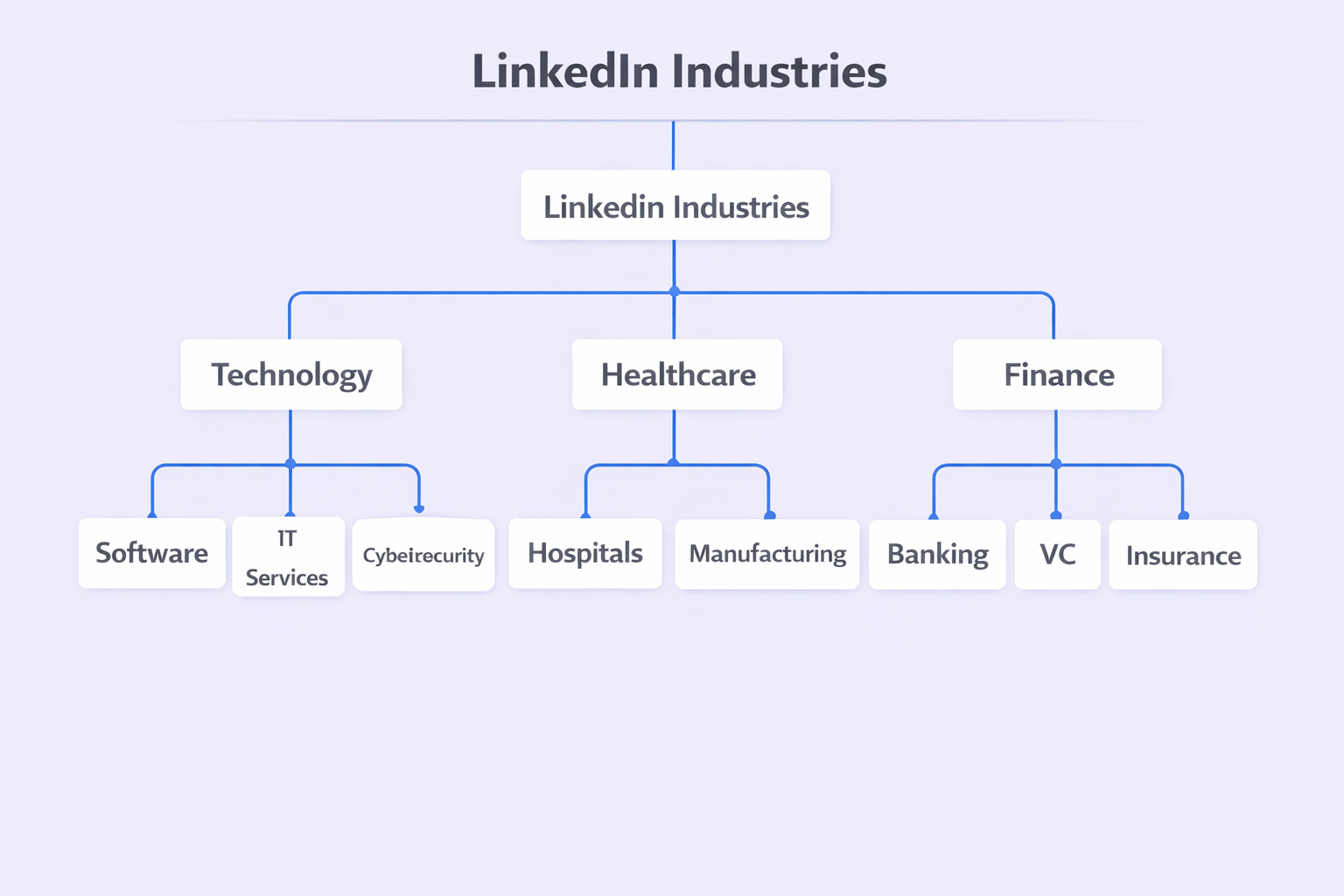
The Four-Level Hierarchy
LinkedIn organizes industries into four levels:
Level 1 – Sectors: Broad economic groupings like Technology or Healthcare
Level 2 – Industry Groups: Functional clusters within sectors
Level 3 – Industries: Specific operational definitions
Level 4 – Specialties: Highly specific niches for detailed targeting
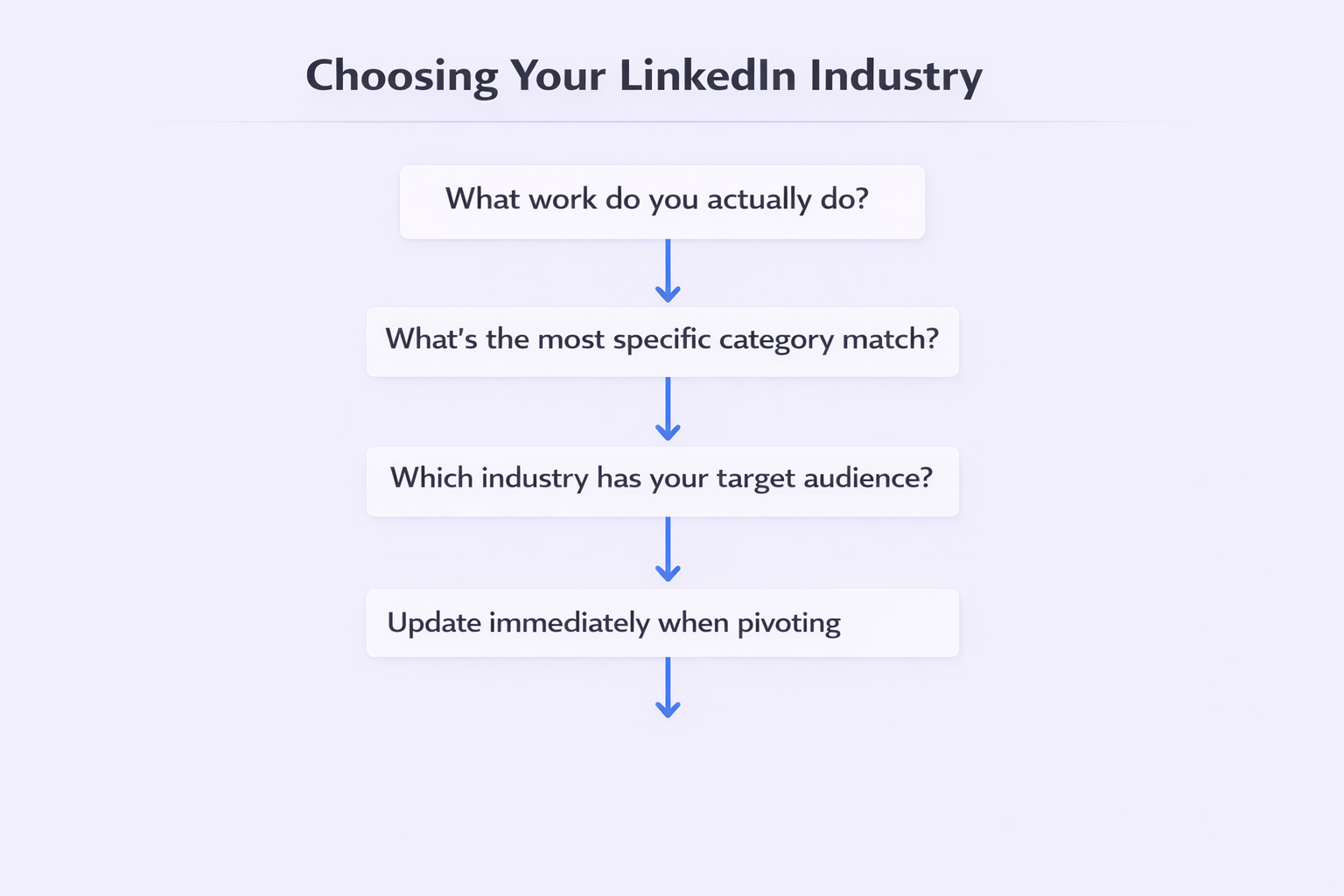
Understanding this hierarchy helps you select the most specific category that accurately represents your work. The more specific, the better your targeting becomes.
Complete List of LinkedIn Industry Categories
Let’s break down the major sectors and their sub-categories. This is your reference guide for choosing the right industry.
Technology, Information, and Media
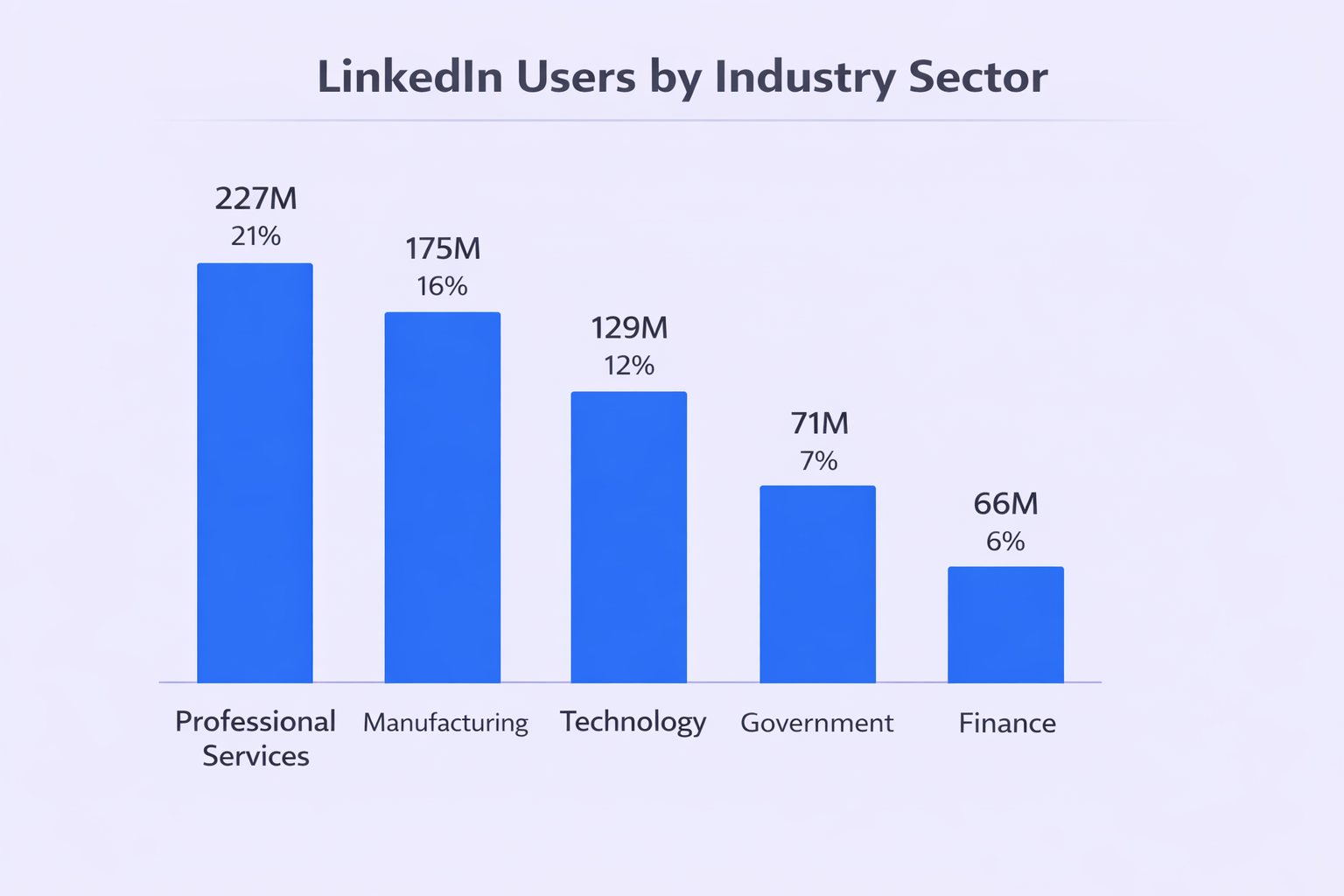
This sector dominates LinkedIn with over 129 million users representing 12% of the platform’s total user base.
Key categories include:
- Technology, Information and Internet: The catch-all for internet-based businesses
- Software Development: Companies building software products
- IT Services and IT Consulting: Service providers and implementation partners
- Cybersecurity Services: Identity management and security solutions
- Artificial Intelligence: Machine learning and AI companies
- Data Infrastructure and Analytics: Big Data and cloud computing
- Telecommunications: Wired, wireless, and satellite services
Strategic tip: If you work in tech, don’t settle for the broad “Technology” tag. Drill down to your specific niche. Someone searching for software developers won’t see “IT Consulting” profiles in their filtered results.
The difference between appearing in 100 searches versus 1,000 searches often comes down to category specificity. LinkedIn’s algorithm rewards precision.
Financial Services and Insurance
With 66 million users (6% of LinkedIn), this sector includes everyone from retail bankers to hedge fund managers.
Major categories:
- Banking: Commercial, retail, and investment banking
- Financial Services: Wealth management and advisory firms
- Investment Management: Asset management and mutual funds
- Venture Capital & Private Equity: Investment firms and principals
- Insurance: Agencies, brokerages, and carriers
- Capital Markets: Trading and exchange platforms
Why it matters: Selling to a venture capital firm requires completely different messaging than selling to a retail bank. The V2 categories let you separate these audiences. This precision matters when using <a href=”https://salesso.com/blog/advanced-linkedin-search/”>search filters</a> to find prospects.
Healthcare and Pharmaceuticals
Healthcare represents 46 million users (4% of LinkedIn) with newly improved specificity separating providers from manufacturers.
Core categories:
- Hospitals and Health Care: Patient care facilities and networks
- Medical Equipment Manufacturing: Device and surgical tool makers
- Pharmaceutical Manufacturing: Drug development and production
- Biotechnology Research: R&D focused companies
- Mental Health Care: Rapidly expanding specialty category
- Medical Practices: Private practices and clinics
Real-world impact: Someone selling practice management software needs to target “Hospitals and Health Care” while lab equipment sellers should focus on “Biotechnology Research.” Getting this wrong means missing your entire target market.
Manufacturing and Industrial
Manufacturing commands 175 million users (16% of LinkedIn), making it the second-largest sector.
Key categories:
- Industrial Machinery Manufacturing: Heavy equipment production
- Automation Machinery Manufacturing: Robotics and assembly systems
- Chemical Manufacturing: Industrial and consumer chemicals
- Plastics and Rubber Products: Material-specific manufacturing
- Defense and Space Manufacturing: Regulated, high-value sector
- Aviation and Aerospace Components: Aircraft and spacecraft parts
Critical distinction: “Transportation Equipment Manufacturing” makes the trucks. “Transportation/Trucking/Railroad” drives them. Your industry choice should reflect whether you create products or deliver services. According to industry data, 84% of manufacturing professionals use LinkedIn for business networking.
Professional Services
The largest sector on LinkedIn with 227 million users (21% of the platform).
Major categories:
- Business Consulting and Services: Strategy and management consulting
- Marketing Services: Agencies, SEO, and digital marketing
- Human Resources Services: Staffing, recruiting, and payroll
- Legal Services: Law firms and legal technology
- Accounting: CPAs, bookkeeping, and tax services
- Design Services: Graphic, industrial, and interior design
Targeting insight: If you’re building an enterprise solution, you might want to exclude “Professional Training & Coaching” from your searches. This category often includes solopreneurs and individual coaches rather than companies with purchasing power.
Consumer Goods and Retail
Retail accounts for 39 million users (4% of LinkedIn) covering the B2C landscape.
Key categories:
- Retail: Physical stores and general merchandising
- E-commerce: Online retail operations
- Food and Beverage Services: Restaurants and catering
- Luxury Goods and Jewelry: High-ticket retail
- Consumer Electronics: Distinct from computer hardware
- Sporting Goods: Equipment and apparel
Platform behavior: Consumer brands increasingly use LinkedIn for B2B partnerships, distributor relationships, and wholesale opportunities. 63% of consumer brands report LinkedIn as their primary B2B networking platform.
Real Estate and Construction
Construction represents 24 million users (3% of LinkedIn) with distinct project-based sales cycles.
Core categories:
- Commercial Real Estate: Office and industrial leasing
- Construction: General contracting and building
- Civil Engineering: Infrastructure and public works
- Architecture and Planning: Design-phase services
- Real Estate: Residential and commercial sales
Education
Education accounts for 42 million users (4% of LinkedIn) split between levels.
Primary categories:
- Higher Education: Universities and colleges
- Primary and Secondary Education: K-12 schools
- Education Administration: District-level and policy
- E-Learning Providers: Online education platforms
Content strategy: Educational professionals engage heavily with LinkedIn content. Posts in the education sector receive 40% higher engagement rates than average, making it ideal for thought leadership.
Transportation and Logistics
Major categories:
- Truck Transportation: Freight and fleet operations
- Freight and Package Transportation: Couriers and last-mile
- Maritime Transportation: Shipping and port operations
- Airlines and Aviation: Commercial carriers
- Warehousing and Storage: Fulfillment and logistics
Market insight: The logistics sector has grown 127% on LinkedIn since 2020, driven by e-commerce expansion and supply chain digitization.
Energy and Utilities
Core categories:
- Oil and Gas: Extraction and refining
- Utilities: Water, electric, and waste management
- Renewable Energy: Solar, wind, and clean tech
- Electric Power Generation: Grid and distribution
Media and Entertainment
Key categories:
- Broadcast Media: Television and radio
- Online Audio and Video Media: Streaming platforms
- Musicians: Talent and production
- Computer Games: Entertainment-focused game development
- Book and Periodical Publishing: Print and digital media
Government and Public Administration
Government accounts for 71 million users (7% of LinkedIn).
Major categories:
- Government Administration: Local, state, and federal
- International Affairs: Embassies and NGOs
- Public Policy Offices: Think tanks and lobbying
- Law Enforcement: Police and security agencies
Common Mistakes to Avoid
Mistake #1: Leaving It Blank
Profiles without industry categories receive 73% fewer profile views. Don’t skip this field.
Mistake #2: Choosing “Other”
“Other” is the worst possible choice. It removes you from virtually all filtered searches and tells the algorithm you don’t fit anywhere.
Mistake #3: Using Multiple Categories
LinkedIn only allows one primary industry per profile. Choose the most relevant category for your current focus rather than trying to cover everything in your career history.
Mistake #4: Picking Based on Your Employer
If you work at Amazon but specifically in cloud computing, choose “Cloud Services” not “Retail.” Your industry should reflect your function, not your employer’s primary business.
Optimizing Your Profile for Maximum Visibility
Choosing the right industry category is just the beginning. Here’s how to optimize the rest of your profile around this choice.
Use Industry Keywords in Your Headline
Your headline should reinforce your industry selection with specific keywords people actually search for.
Bad headline: “Helping businesses grow”
Good headline: “Helping Financial Services firms grow assets under management”
The specific industry reference immediately connects with your target audience and improves search visibility.
Leverage the About Section
Since you can only pick one primary category, use your About section to mention adjacent industries you serve.
Example: “While my core expertise is in Software Development, I have extensive experience partnering with leaders in Banking, Insurance, and Capital Markets.”
This strategy helps you appear in keyword searches for secondary industries even when you’re categorized primarily in tech. You can enhance this with strategic <a href=”https://salesso.com/blog/linkedin-automation-tool/”>automation tools</a> to manage outreach across multiple industries.
Connect With Industry Leaders
Once you’ve set your category, actively connect with recognized leaders in that industry. The algorithm notices these patterns and starts recommending you to similar professionals.
Pro tip: Engage with industry-specific content by commenting thoughtfully on posts from leaders. This increases your visibility within that industry’s network and helps with <a href=”https://salesso.com/blog/linkedin-growth-hacking/”>growth hacking</a> strategies.
Tools to Maximize Your Industry Targeting
Several tools can help you leverage LinkedIn’s industry system for prospecting and networking.
Sales Navigator Integration
<a href=”https://salesso.com/blog/linkedin-sales-navigator/”>LinkedIn Sales Navigator</a> allows you to filter prospects by industry with surgical precision. You can combine industry filters with company size, seniority level, and geographic filters to build highly targeted lists.
Real-world application: If you sell to mid-market SaaS companies, you can filter for “Software Development” + “51-200 employees” + “VP of Engineering” to build a laser-focused prospecting list.
Workflow Automation
Using <a href=”https://salesso.com/blog/top-workflow-automation-software/”>workflow automation software</a> with industry-based triggers helps you scale your outreach while maintaining personalization. You can create different messaging sequences for different industries.
Data Enrichment Tools
Tools like <a href=”https://salesso.com/blog/zoominfo-review/”>ZoomInfo</a> integrate with LinkedIn’s industry data to provide additional firmographic information. This helps you validate that prospects actually fit your industry targeting criteria.
The Future of LinkedIn Industries
LinkedIn continues refining its industry taxonomy based on emerging market trends.
Recent additions include:
- Blockchain Services: Cryptocurrency and distributed ledger technology
- Creator Economy: Content creators and influencer marketing
- Remote Workforce Solutions: Tools and services for distributed teams
What this means for you: Stay current with industry category updates. LinkedIn occasionally adds new categories or reorganizes existing ones to reflect market evolution.
Industry prediction: LinkedIn will likely continue expanding categories in high-growth areas like AI, climate technology, and Web3 over the next 12-24 months. Early adoption of new, specific categories can improve your visibility as these sectors mature.
Conclusion
Your LinkedIn industry category is more than a profile field. It’s a visibility driver, a targeting tool, and a signal to your network about where you add value.
The key takeaways:
Choose the most specific industry that matches your actual work, not your job function. Update your category immediately when you pivot industries or change focus. Use your headline and About section to reinforce your industry expertise. Leverage industry filters in Sales Navigator for precise prospecting.
Take action today: Go to your LinkedIn profile, click the pencil icon on your introduction card, and verify you have the most accurate, specific industry category selected. This five-minute update can dramatically improve your visibility and connection quality.
The professionals who master LinkedIn’s industry system don’t just get found—they get found by the right people at the right time. Make sure your category is working for you, not against you.
