
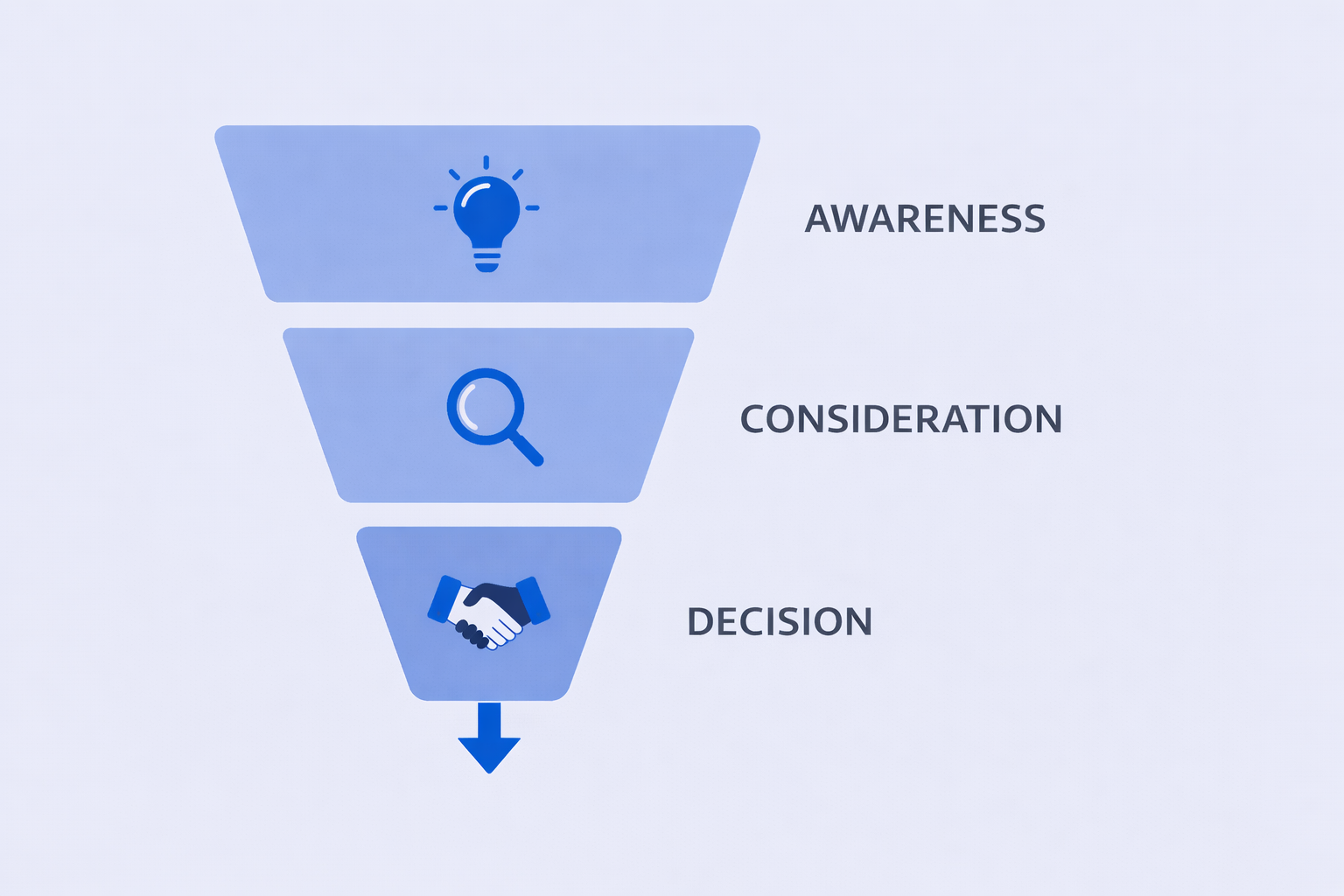
Stage 2: Consideration (They’re Exploring Solutions)
Now prospects are solution-aware. They’re comparing options and building a shortlist.
The agency shifts to trust-building content:
- Case studies from similar customers
- Email drip campaigns with detailed guides
- Product comparison resources
- Webinars and video demonstrations
Behavioral triggers are critical here. If someone clicks on “integration capabilities,” the system automatically sends relevant technical documentation.
Stage 3: Decision (They’re Ready to Buy)
At this final stage, prospects need confidence to commit. The agency provides:
- ROI calculators
- Implementation timelines
- Customer testimonials
- Free trials or demos
- Pricing information
The handoff to your sales team happens here—but only when the prospect is truly ready.
The Power of Behavioral Automation
Modern lead nurturing uses “if-this-then-that” logic:
- If a prospect opens three emails in 48 hours → Then send a meeting invitation
- If someone visits your pricing page twice → Then trigger a personalized sales call
- If a prospect downloads a case study → Then send related success stories
This isn’t guesswork—it’s data-driven engagement.
The Multi-Channel Nurturing Playbook
Single-channel outreach is dying. Multi-channel engagement is seeing 29% better results.
Here’s why: Your prospects aren’t just checking email. They’re on LinkedIn, reading blogs, watching videos, and researching across multiple platforms. A lead nurturing agency orchestrates touchpoints across at least 2-3 channels.
Email: The Foundation
Email remains the backbone of nurturing, delivering an average ROI of 261% in B2B contexts.
But effective email marketing in 2026 looks different:
- Subject lines that spark curiosity without clickbait
- First sentences that hook within 3 seconds
- Body content under 100 words focused on one clear idea
- Personalization that references real business challenges, not just names
The sequence structure:
- Email 1: Share a relevant insight or statistic
- Email 2: Provide educational content (guide, article, video)
- Email 3: Add new value (case study, tool, resource)
- Email 4-5: Gentle call-to-action for a conversation
LinkedIn: Where Decision-Makers Live
LinkedIn drives 80% of B2B social media leads. That’s not a typo.
A sophisticated agency integrates LinkedIn into every nurturing sequence:
- Personalized connection requests that reference shared content
- Comments on prospects’ posts to build familiarity
- Direct messages with value-first content
- Profile views that signal interest without being pushy
This “surround sound” approach significantly boosts response rates compared to email-only campaigns.
Content: Education That Sells
Content is the fuel that powers every touchpoint. Here’s what actually works:
- Blog posts that answer specific questions your prospects are Googling
- Video that adds authenticity in an AI-saturated world
- Case studies showing real results from customers like them
- Micro-content like quick tips, statistics, and industry insights
Social proof is the most powerful psychological lever. When prospects see that others like them got results, trust accelerates dramatically.
The Technical Infrastructure
Behind the scenes, professional agencies handle the technical details that make or break deliverability:
Domain warming: Gradually increasing email volume to avoid spam filters
Inbox rotation: Using multiple sending addresses to stay under daily limits
Authentication: Setting up SPF, DKIM, and DMARC records properly
This technical foundation is non-negotiable. Without it, even the best content never reaches your prospects’ inboxes.
Lead Scoring: Prioritizing Your Best Opportunities
Imagine getting 1,877 leads per month. How do you know which ones to call first?
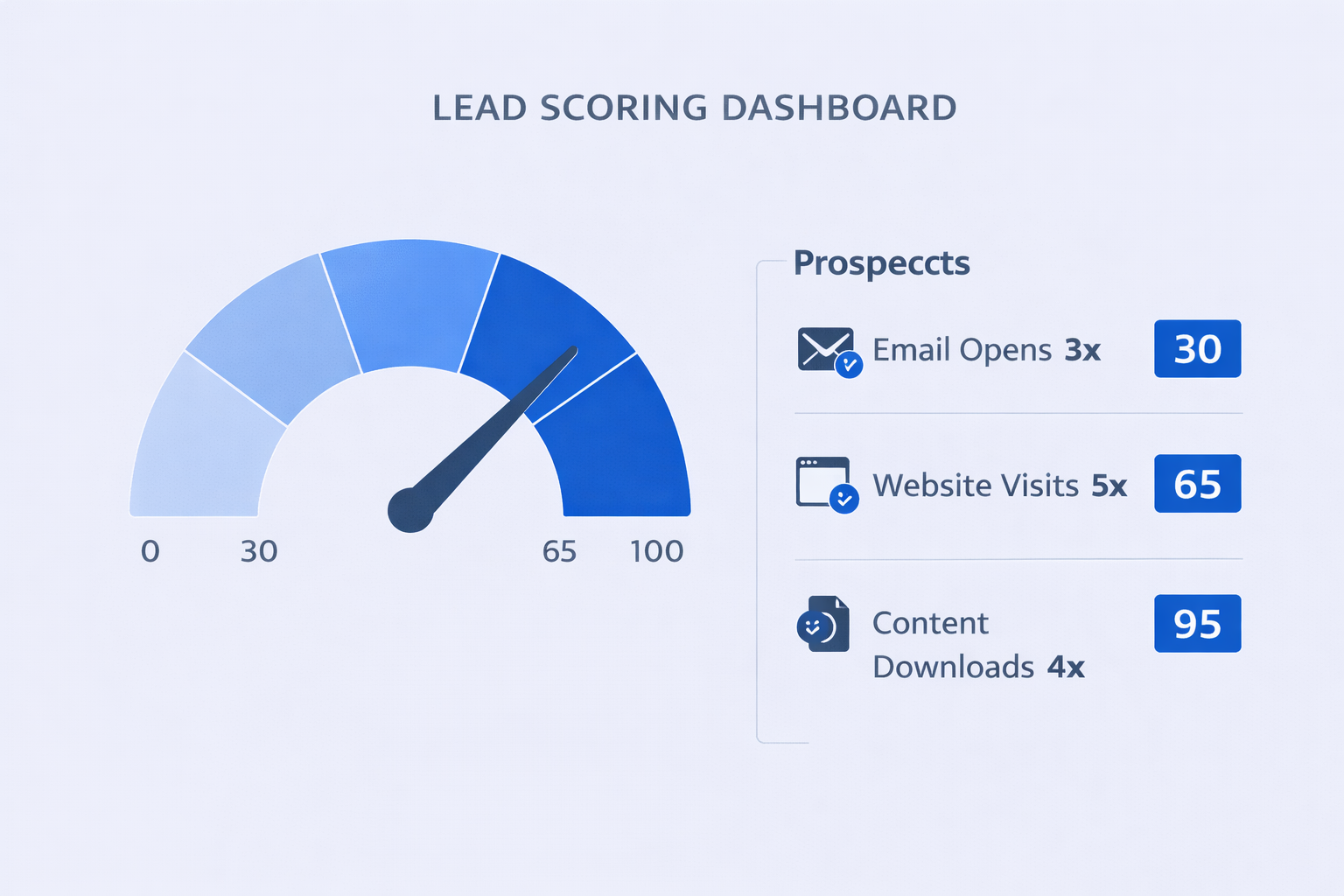
That’s where lead scoring comes in—a system that assigns numerical values to prospects based on their fit and behavior.
Traditional Scoring Models
Most agencies use rules-based scoring:
Demographic Points (Who They Are):
- Company size: +10 points for 500+ employees
- Job title: +10 points for director level or above
- Industry: +5 points for target verticals
Behavioral Points (What They D
- Email opens: +3 points
- Link clicks: +5 points
- Webinar attendance: +15 points
- Pricing page visit: +25 points
When a prospect hits a certain threshold (typically 50-75 points), they’re flagged as “sales-ready” and handed off to your team.
AI-Powered Predictive Scoring
In 2026, 69% of high-performing sales teams use AI for prospecting. Modern lead scoring uses machine learning to find hidden patterns.
For example, AI might discover that prospects who engage with three pieces of content across two channels within 72 hours are 50% more likely to buy than slower engagers.
The math behind lead scoring:
Total Score = (Demographic Factors × Weights) + (Behavioral Actions × Weights)
Translation: The system combines who someone is with what they’ve done to predict their likelihood to buy.
This level of precision ensures your sales team focuses on conversations that actually close.
The Role of AI and Automation in Modern Nurturing
AI isn’t replacing human sales teams—it’s multiplying their effectiveness.
Here’s what AI-powered marketing automation handles today:
Personalization at Scale
Modern tools can:
- Write custom email intros based on LinkedIn activity
- Reference recent company news automatically
- Adjust messaging based on prospect’s industry
- Personalize landing pages based on previous visits
The result? Every prospect feels like you’re speaking directly to them—even when you’re nurturing thousands of contacts.
Intelligent Timing Optimization
AI analyzes when each prospect typically engages with content, then sends messages at those optimal times.
Instead of sending everyone an email at 10 AM, the system might send one prospect’s email at 8:15 AM, another’s at 2:47 PM, and another’s at 7:03 PM—all based on their individual engagement patterns.
Sentiment Analysis
Advanced systems can analyze reply tone to determine next steps:
- Positive reply? Escalate to human sales rep immediately
- Neutral reply? Continue automated nurturing
- Negative or annoyed? Pause outreach and adjust strategy
This prevents your team from accidentally annoying prospects while ensuring hot leads get immediate attention.
Predictive Intent Engines
The newest technology identifies accounts likely to be in a buying window before they even visit your website, using signals like:
- Hiring patterns (are they expanding the team?)
- Funding announcements (do they have new budget?)
- Technology changes (are they switching tools?)
- Competitor mentions (are they unhappy with alternatives?)
Armed with these insights, your outreach hits prospects exactly when they’re most receptive.
Pricing and ROI: What to Expect
Let’s talk numbers. The average cost per lead across all B2B channels is $391.80 in 2026.
But that’s just half the story. The real question is: What’s the cost per customer?
Typical Agency Pricing Tiers
Entry-Level Systems: $2,500 – $5,000/month
- Basic email sequences and list management
- Limited behavioral tracking
- Standard CRM integration
- Best for: Testing the waters with nurturing
Mid-Market Solutions: $6,000 – $10,000/month
- Multi-channel engagement (email + LinkedIn + content)
- Behavioral triggers and segmentation
- Lead scoring implementation
- Best for: Growing B2B companies ready to scale
Enterprise Programs: $11,000 – $19,000+/month
- Full account-based marketing (ABM) with intent data
- AI-powered optimization
- Dedicated strategy and reporting
- Best for: Companies with complex sales cycles and high deal values
Expected Return on Investment
Here’s what the data shows:
Strategy Type | Documented ROI | Cost Reduction |
Standard outbound only | 1-2x | 0% |
Professional nurturing | 4-7x | 33% |
Enterprise ABM programs | 7.5-9.1x | 40%+ |
Even more compelling: Nurtured prospects make purchases that are 47% larger than those rushed through a transactional sales process.
Translation: Investing in proper lead nurturing doesn’t just increase conversion rates—it increases deal size too.
Timeline to Results
Be realistic about expectations. While you might see engagement signals within weeks, meaningful revenue impact typically follows your average sales cycle.
For most B2B companies, that means:
- First engagement signals: 2-4 weeks
- First qualified meetings: 4-8 weeks
- First closed deals: 8-16 weeks
Long-term channels like sales development services and nurturing usually require 4-6 months to reach full potential—but once they’re working, they deliver sustainable, predictable pipeline growth.
Choosing the Right Lead Nurturing Agency
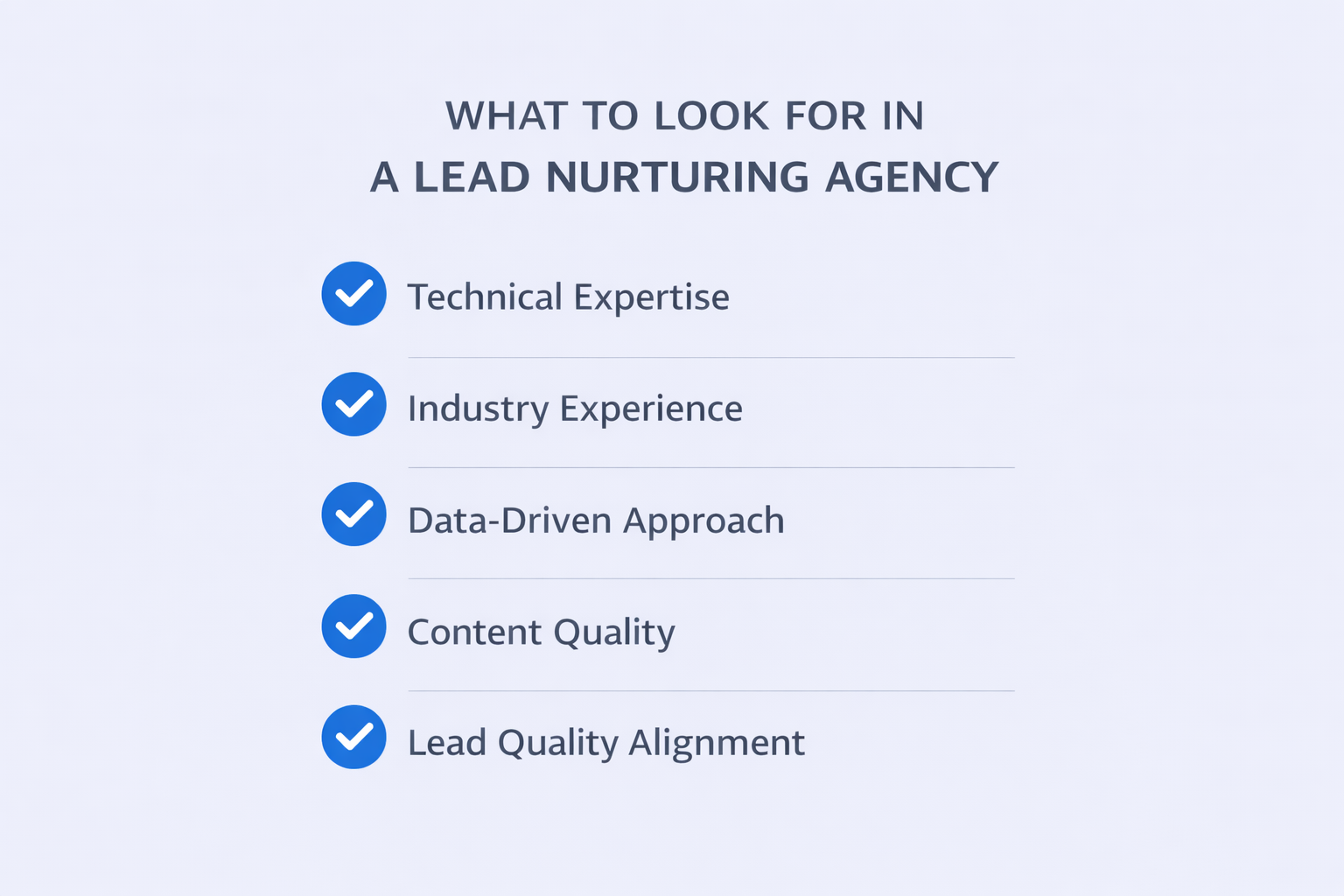
Not all agencies are created equal. Here’s what to look for:
Technical Expertise
Can they handle:
- CRM integration (Salesforce, HubSpot, Pipedrive, etc.)
- Marketing automation platforms
- Email deliverability and domain management
- Multi-channel campaign orchestration
Ask to see their technical stack. If they can’t explain their infrastructure, that’s a red flag.
Industry Experience
The best agencies specialize. Look for partners who:
- Understand your buyer’s journey specifically
- Have case studies from your industry
- Know your prospects’ pain points without you explaining them
- Can reference what works (and doesn’t) in your vertical
Data-Driven Approach
Demand transparency. A professional agency should provide:
- Regular performance reports (weekly or bi-weekly)
- Clear KPIs tied to business outcomes
- A/B test results and continuous optimization
- Lead quality metrics, not just volume numbers
Content Quality
Review their actual nurturing content. Is it:
- Genuinely educational and helpful?
- Well-written without obvious AI tells?
- Personalized beyond just using first names?
- Actually relevant to your prospects’ challenges?
If their sample sequences feel generic or salesy, keep looking.
Alignment on Lead Quality
This is critical: You and the agency must agree on what makes a “sales-ready” lead.
Many nurturing programs fail because marketing generates “qualified” leads that sales considers garbage. Before you sign anything, define together:
- What behaviors indicate buying intent?
- What firmographic criteria matter most?
- At what point should a lead be handed to sales?
- How will lead quality be measured and improved?
Get this alignment in writing.
Lead Nurturing Agency in Delhi: Regional Market Insights
The Delhi/NCR market has matured significantly, with agencies offering sophisticated B2B nurturing at competitive price points.
Top performers in the region include:
Adapts Media – Known for creative, multi-channel strategies
SEO Tech Experts – AI-powered content and technical SEO integration
Moris Media – Diagnostic-first approach with structured programs
Lead Experts – High-intent digital strategies for B2B
World Digital Agency – SMB-focused with personalized attention
What sets Delhi agencies apart: They combine global best practices with deep understanding of Indian business culture. Many successfully manage nurturing for both domestic companies and international firms expanding into India.
Reviews consistently highlight their ability to understand industry-specific nuances—whether that’s Real Estate, Healthcare, SaaS, or Education.
Price advantage: Delhi agencies often deliver enterprise-quality work at 20-40% lower cost than US or European agencies, making them attractive partners for growing companies.
Common Mistakes (And How to Avoid Them)
Even with a great agency, nurturing programs can fail. Here are the biggest pitfalls:
Mistake 1: Too Much Too Soon
Sending five emails in the first week overwhelms prospects and triggers spam flags.
Fix: Space touchpoints properly. A good rule: No more than 2-3 emails per week, mixed with other channels.
Mistake 2: Talking About Yourself
Nobody cares about your features. Prospects care about their problems.
Fix: Lead with insights, statistics, or helpful content. Make 80% of your nurturing about them, not you.
Mistake 3: Forgetting to Clean Your Lists
Dead emails and bounces destroy your sender reputation.
Fix: Run list hygiene monthly. Remove hard bounces immediately and re-engage inactive contacts before removing them.
Mistake 4: No Clear Handoff Process
Sales doesn’t know what to do with “nurtured” leads because there’s no defined process.
Fix: Create explicit handoff criteria and workflow. Sales should know exactly what nurturing a prospect received before the call.
Mistake 5: Ignoring Mobile Experience
67% of emails are opened on mobile devices. If your content isn’t mobile-optimized, you’re losing engagement.
Fix: Test everything on mobile. Use responsive design, keep subject lines under 50 characters, and make CTAs thumb-friendly.
