
Top Solar Lead Generation Companies for 2025
Let’s break down the leading players and what they actually deliver.
Energysage operates as a transparent comparison marketplace backed by U.S. Department of Energy funding. Prospects on Energysage are already comparing multiple quotes, which means they’re deep in the consideration phase. The catch? You’re competing on price from day one. Best for installers who can differentiate on service quality rather than lowest bid.
Contractor Marketing Pros specializes exclusively in renewable energy sales cycles. Unlike generalist agencies, they understand that the typical journey from inquiry to installation spans 3-6 months with multiple educational touchpoints. They focus on SEO and Local Services Ads, delivering laser-targeted campaigns for regional scaling.
WebFX leverages proprietary MarketingCloudFX technology to drive 20% higher ROI through advanced analytics and competitive intelligence. Best for large manufacturers and national installers with significant marketing budgets who need enterprise-scale campaigns.
Modernize dominates the call-transfer space, having facilitated over $4 billion in project revenue through 9+ million inquiries. Their network model provides instant warm transfers to your sales team, effectively outsourcing appointment setting.
Solar-Exclusive uses proprietary booking systems to deliver exclusive inquiries that aren’t shared with competitors. They streamline the process by eliminating cold calling—leads arrive pre-qualified and ready for technical consultations.
For commercial and B2B projects, Belkins specializes in account-based marketing (ABM) and outbound prospecting, reporting 599% ROI boosts for enterprise clients targeting large-scale installations.
Lead Generation Channels That Actually Work
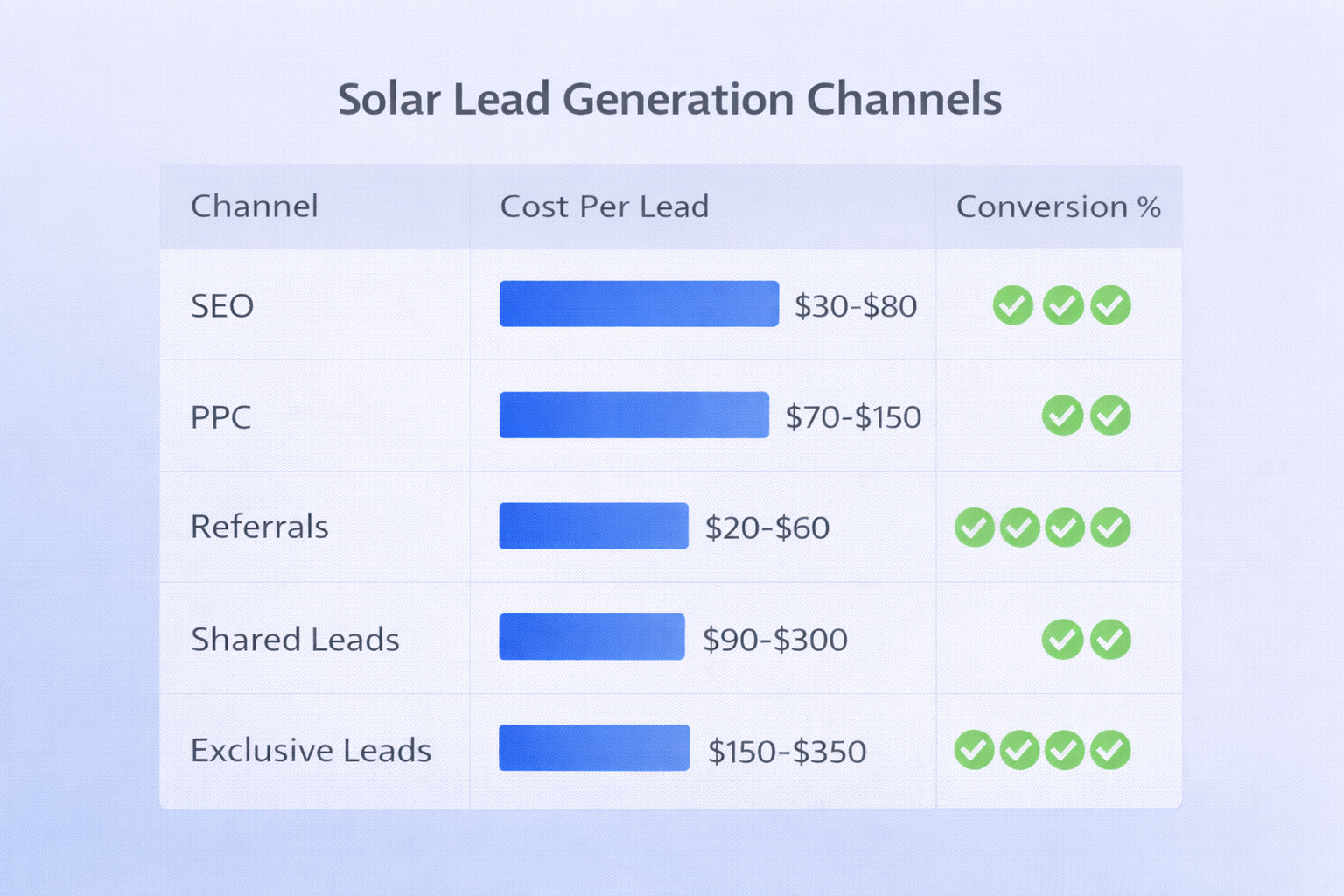
Different channels deliver wildly different results. Here’s what the data shows:
SEO and content marketing produce the highest long-term ROI. While these methods take 6-12 months to mature, they deliver leads at $60-$80 each with strong conversion rates because prospects are actively searching for solutions. One installer reported generating 30x ROI from a well-optimized content strategy.
Paid search (PPC) delivers immediate visibility but at premium cost. In competitive markets, keywords can exceed $20 per click, resulting in $110-$160 cost per lead. However, PPC offers precise targeting and predictable volume—crucial for installers needing consistent pipeline flow.
Referral programs are the gold standard, converting at nearly 30%—significantly higher than any paid channel. Because prospects come through trusted connections, the trust gap is minimal and sales cycles are shorter. The cost is essentially zero beyond referral rewards (typically $25-$100).
Social media plays a supporting role rather than primary driver. While platforms like Facebook and LinkedIn work for brand awareness and retargeting, direct solar leads from social channels typically cost more and convert lower than search-based methods. Exception: LinkedIn for commercial projects, where targeting facility managers and sustainability officers can be highly effective.
Outbound prospecting through targeted outreach delivers qualified conversations with decision-makers who haven’t raised their hand yet. For commercial solar, systematic outbound campaigns through email and LinkedIn can generate meetings at $200-$400 per booked appointment with enterprise-level buyers.
Understanding Solar Lead Compliance in 2025
The regulatory landscape shifted dramatically in 2025. Ignore these rules and you risk massive fines.
The FCC’s “One-to-One” Consent Rule (effective January 27, 2025) closed the “lead generator loophole.” Previously, a single consent form could list hundreds of “partners” authorized to contact consumers. Now, consumers must affirmatively select each individual business they consent to hear from.
Additionally, as of April 11, 2025, consumers can revoke consent through any reasonable method—replying “STOP” to a text message, for example. Marketers must honor these requests within ten business days.
For solar companies, this means:
- Verify opt-in proof for every purchased lead
- Maintain meticulous consent logs
- Honor opt-out requests immediately
- Avoid lead vendors who can’t document explicit consent
The penalties are severe: $500-$1,500 per violation under TCPA. A single complaint from a consumer who didn’t provide proper consent can trigger regulatory review of your entire lead database.
If you’re prospecting businesses for commercial solar, similar rules apply under CAN-SPAM for email and various state regulations for phone calls. Always verify you have legal permission before outreach. Learn more about cold email laws and email deliverability best practices.
ROI Benchmarks: What to Actually Expect
Let’s talk real numbers. Understanding channel economics helps you allocate budget wisely.
The formula for evaluating any lead generation strategy:
Cost Per Acquisition (CPA) = Total Marketing Spend ÷ Number of Closed Deals
ROI = (Total Revenue Generated – Total Acquisition Cost) ÷ Total Acquisition Cost × 100
Here’s a real example: You invest $10,000 in a campaign generating 100 inquiries. If 5% convert to sales, your CPA is $2,000 per customer. If average system profit is $8,000, your campaign ROI is 300%.
Now compare channels side-by-side:
Method | Cost Per Lead | Conversion Rate | Long-Term ROI |
SEO/Content | $60-$80 | High (inbound) | ~30x |
PPC Advertising | $110-$160 | 13-17% | High (scalable) |
Referral Programs | $25-$100 reward | ~30% | Highest |
Shared Prospects | $20-$100 | 5-8% | Low |
Exclusive Prospects | $100-$300 | 10-20% | Medium-High |
The national average acquisition cost sits at $5,270 per residential customer—a significant chunk of project margin. Top performers reduce this through diversified strategies: building organic traffic through lead generation content, maintaining strong referral programs, and supplementing with selective paid channels.
How to Vet Solar Lead Generation Companies
Before writing a check, ask these questions:
- What’s your opt-in source? Legitimate companies can show exactly where and when prospects provided their information. If they can’t produce opt-in documentation, walk away—you’re buying TCPA violations.
- What’s your average contact rate? Industry benchmark is 40-60% for phone numbers and 70-80% for emails. Lower rates mean data quality issues or aged leads.
- Can I test with a small sample? Quality providers offer pilot programs—typically 25-50 leads—so you can verify quality before committing to volume contracts.
- What’s your lead-to-contract rate? Ask for case studies showing conversion rates across the entire funnel, not just appointment set rates. A company claiming “80% appointment rate” means nothing if those appointments don’t close.
- How do you handle disputes? Understand the refund policy for bad data, duplicate leads, or non-responsive prospects. Top companies offer generous credits or refunds for verified bad leads.
Red flags: Companies that can’t provide specific conversion metrics, refuse sample purchases, or dodge questions about compliance documentation.
Multi-Touch Engagement: The 15-Touch Framework
A single touchpoint doesn’t close solar deals. Period.
Research shows omnichannel approaches—combining email, LinkedIn, and phone—yield significantly higher conversion rates than single-channel efforts. A high-performance cadence includes at least 15 touchpoints over three weeks.
Here’s what works:
Personalization at scale. Generic templates die in inboxes. Mentioning a company’s carbon-neutral goal or a neighbor’s recent savings increases response rates 2-3x. Use property data, local incentive programs, and business sustainability initiatives to demonstrate relevance.
Education before selling. Offer a “Solar Savings Calculator” or “2025 Tax Credit Checklist” as lead magnets. These build trust and position you as an advisor, not a vendor. Content-driven outbound lead generation process outperforms aggressive sales pitches.
Rapid response timing. The first 10 minutes following an inquiry are critical. Companies responding within this window are 9 times more likely to convert than slower competitors. Set up instant alerts and dedicate resources to immediate follow-up.
Strategic sequencing. Don’t hit prospects with the same message repeatedly. Vary your approach: Day 1 (intro email), Day 3 (case study), Day 5 (LinkedIn connection), Day 7 (phone call), Day 10 (educational content), Day 14 (special offer). Each touchpoint adds value and moves the relationship forward.
For commercial projects targeting facility managers and CFOs, a longer 30-day sequence with deeper technical content often performs better than aggressive 2-week cycles.
Handling Common Solar Objections
Every solar sales professional faces these concerns. Here’s how top performers respond:
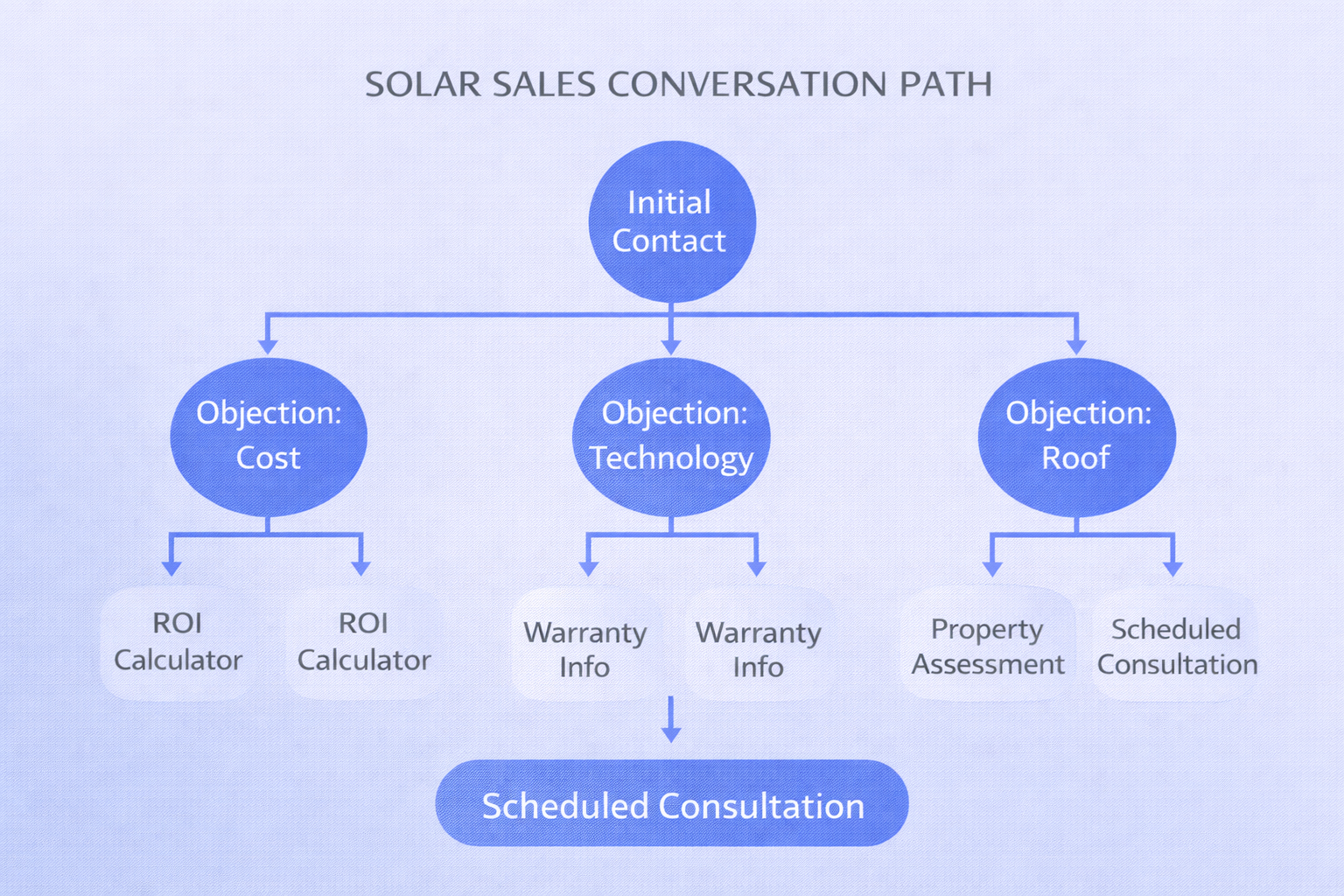
“Solar is too expensive.” Reframe from “sizable investment” to “smart investment that replaces volatile utility bills with fixed costs.” Show the 25-year cost comparison: paying escalating utility rates versus fixed solar payments. Most systems achieve positive ROI within 6-8 years.
“Technology will improve; I’ll wait.” Address obsolescence concerns by explaining solar panels are solid-state technology with minimal moving parts and 25-year warranties. Yes, efficiency improves annually—but so do utility rates. Waiting costs money.
“What about cloudy days?” Modern panels harvest ambient light even in overcast conditions. When combined with battery storage, systems maintain power during intermittent weather. Most residential systems still offset 80-90% of annual consumption in cloudy climates.
“My roof isn’t suitable.” This is why propensity scoring matters. But even for challenging roof configurations, ground-mounted systems, carport installations, and community solar programs offer alternatives. Don’t assume—evaluate.
“I’m worried about hidden costs.” Transparency wins. Break down every cost: equipment, installation, permits, interconnection fees, monitoring systems. Top performers provide itemized quotes and explain financing options including $0-down programs, power purchase agreements (PPAs), and leases.
The Indian Solar Lead Generation Ecosystem
India represents a massive opportunity for manufacturers and EPC contractors looking to expand internationally. By early 2025, India’s installed solar capacity reached 87.2 gigawatts, with a government target of 500 gigawatts by 2030.
Leading domestic manufacturers like Waaree Energies (12 GW annual capacity), Adani Solar (exporting 97% of production to U.S. markets), and Tata Power Solar (3+ GW shipped globally) are scaling rapidly. These companies need sophisticated B2B prospecting to reach international buyers.
Specialized Indian agencies like LeadShuttle, SalesAladin, and Beyond Codes focus on identifying international buyers through LinkedIn and email outreach, reporting 12-18% response rates. These firms help Indian manufacturers penetrate complex international markets where traditional marketing falls flat.
Compliance note: India implemented Digital Personal Data Protection (DPDP) Rules on November 13, 2025, requiring “specific, unambiguous, and clear” consent for data processing. Indian prospecting agencies must maintain logs and ensure third-party data meets “specified purpose” requirements.
For U.S. companies evaluating Indian manufacturing partners or considering India as an expansion market, working with local lead generation companies USA can help navigate cultural and regulatory complexities.