Here’s a hard truth: most outbound pipelines don’t fail because of bad products. They fail because they depend entirely on individual effort — and humans are inconsistent.
You’ve probably felt it. One week the pipeline looks great. The next? It’s a ghost town. Revenue swings based on who’s sick, who’s burnt out, or who just quit.
That’s the core problem with manual outbound. The output is only as good as the hours someone puts in. And that ceiling comes fast.
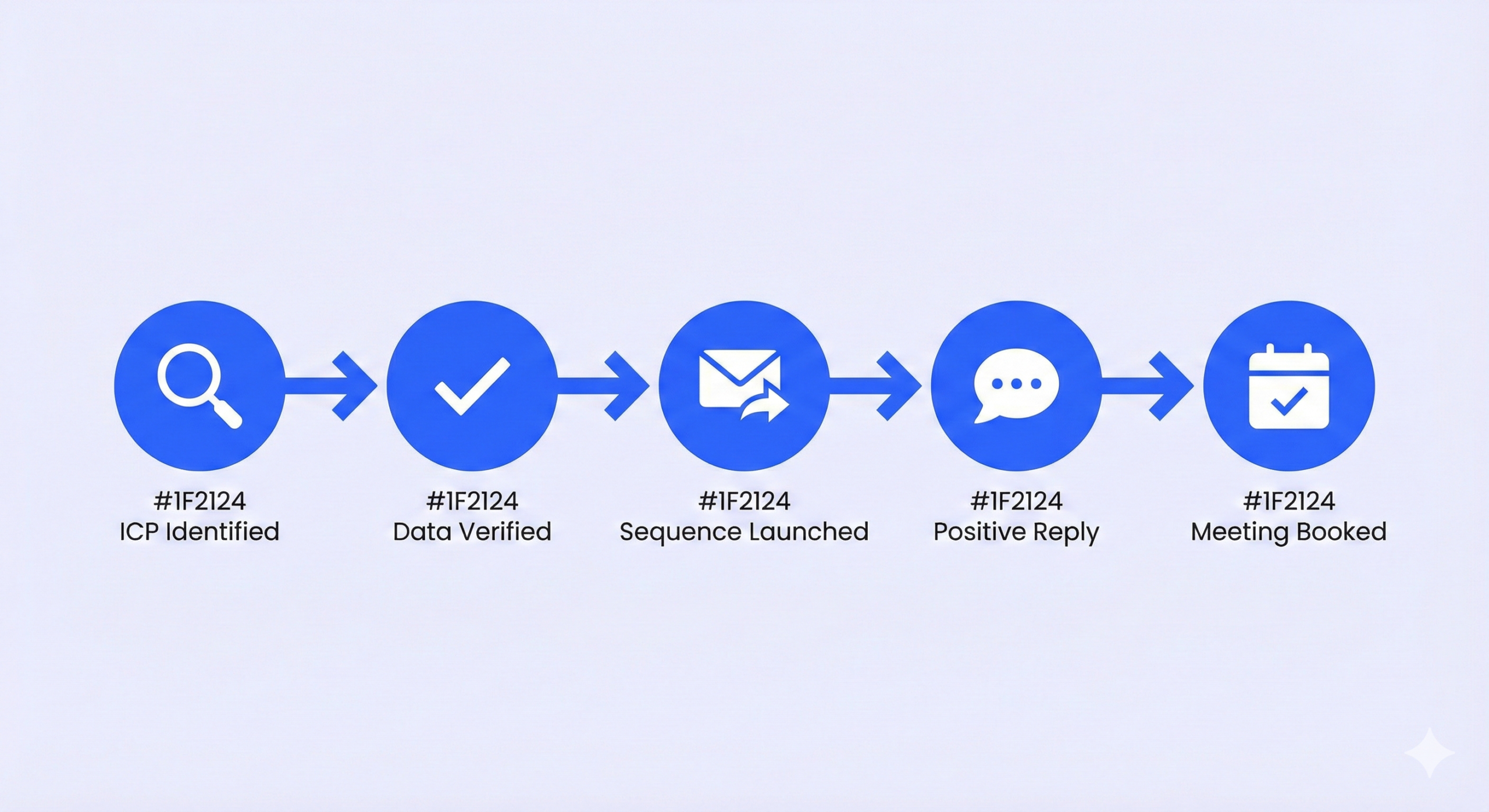
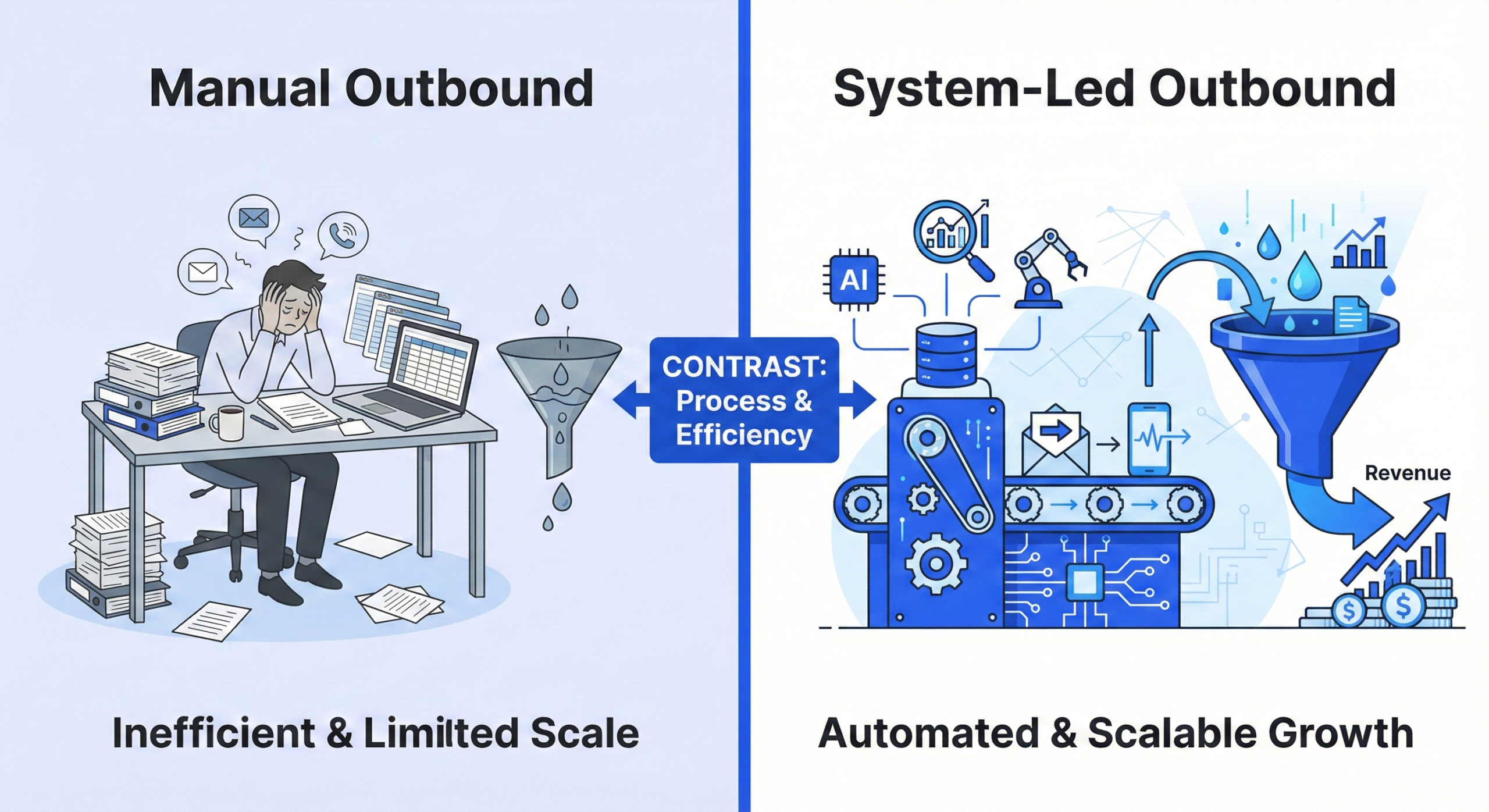
System-led outbound flips this entirely. Instead of relying on individuals to hunt for leads, write every email, and follow up manually, the system does the heavy lifting. Prospects are identified, contacted, and nurtured automatically — while your team focuses on what they’re actually good at: closing.
According to research, reps in a manual outbound model spend only 33% of their time actually selling. The other 67% disappears into research, data entry, and chasing follow-ups. System-led outbound flips that ratio — getting reps to 70%+ selling time.
If you’re trying to build predictable revenue — especially in B2B SaaS — this isn’t optional anymore. It’s the standard.
Let’s break down how it works, what the tech stack looks like, and why companies that switch don’t go back.
System-Led Outbound
At its core, system-led outbound is the decoupling of sales activity from human labor hours. In a traditional setup, the leads you generate = the hours your team works. In a system-led model, leads are generated by the system’s design, data flow, and trigger logic — not by how many hours someone puts in.
This creates something invaluable: consistency. The system doesn’t take sick days. It doesn’t get frustrated after ten rejections. It doesn’t quit on a Tuesday.
The Tech Stack That Powers It
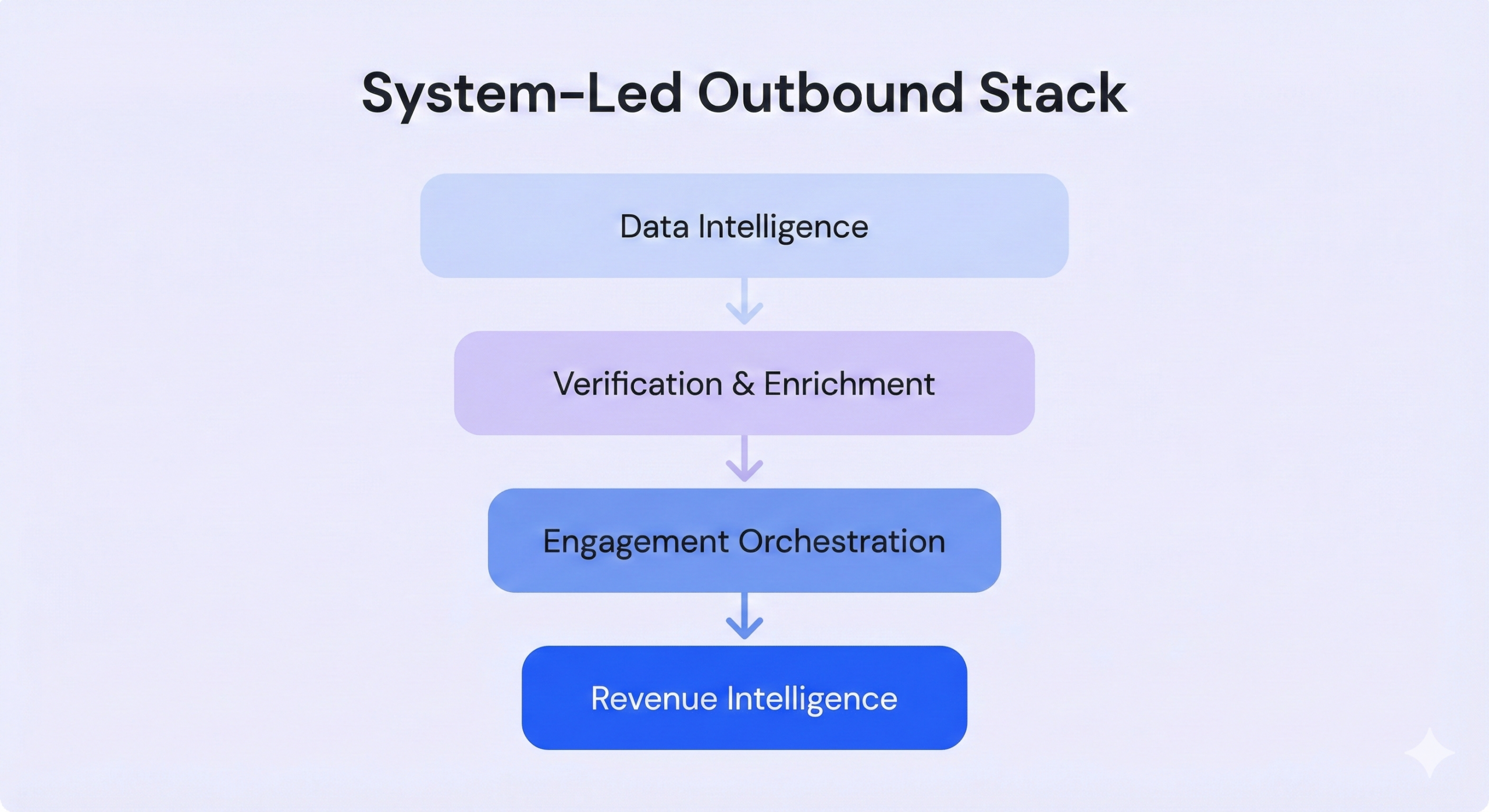
A system-led outbound engine runs on a layered tech stack. Think of it like an assembly line — each layer passes data to the next, and the result is a qualified lead landing in your team’s inbox, warm and ready for a conversation.
Here are the four layers you need:
Data Intelligence — Platforms like Apollo.io, ZoomInfo, and Cognism identify prospects matching your ideal customer profile. In a system-led setup, these aren’t used for manual searching. They’re connected via API to orchestration tools like Clay or n8n, which automatically pull new leads when specific criteria are met — like a prospect’s company adopting a new technology or a key decision-maker changing roles.
Verification & Enrichment — This layer ensures your contact data is accurate before anything is sent. Verified email addresses, direct dials, LinkedIn profiles — all auto-populated. High bounce rates destroy sender reputation, so this step is non-negotiable.
Engagement Orchestration — This is your sequence engine. It manages the multi-channel cadence across email, LinkedIn, and calls. Research shows it takes 5 to 12 touches to get a response — the system handles every one of them automatically, with intelligent wait times and trigger-based follow-ups.
Revenue Intelligence — Every interaction is tracked. Open rates, reply sentiment, meetings booked, pipeline value. This feeds directly into your CRM — giving your team a live view of what’s working and what isn’t.
The Role of AI in Scaling Personalization
This is where things get genuinely interesting — and where ai cases have changed the game completely.
Personalization used to be the bottleneck. Writing a relevant, tailored email took 15-20 minutes per prospect. At scale, that math doesn’t work.
AI research agents now crawl a prospect’s LinkedIn activity, recent press releases, and company news to generate icebreakers that feel handcrafted — in seconds. A founder CEO running a lean team can now achieve the outreach volume of a much larger organization.
The numbers back this up: 95% of companies have already invested in AI-driven use cases to some degree. By end of 2025, nearly 90% of B2B leaders plan to use generative AI in their daily sales workflows.
The productivity impact is significant. When AI handles account research, reps save 15-20 minutes per account — time that goes directly into high-value conversations.
Deliverability: The Foundation Nobody Talks About
Here’s the brutal truth about cold email: even the best-written, most personalized email is useless if it lands in spam.
System-led outbound includes a sophisticated deliverability infrastructure — and this is where most DIY setups fall apart.
The technical setup requires:
SPF/DKIM/DMARC records — authenticating your sender domain so recipient mail servers don’t immediately reject you.
Domain warming — gradually increasing your send volume to build sender reputation before scaling up.
Email verification — removing invalid addresses before they bounce. Every bounce damages your domain reputation.
Inbox rotation — distributing email volume across multiple domains and mailboxes to avoid triggering spam filters.
Why does this matter? 69% of email senders report declining cold email performance due to increasingly aggressive spam filters and AI content fatigue among buyers.
System-led outbound automates all of this — using real-time monitoring tools that detect deliverability issues and adjust infrastructure before damage becomes permanent.
This is one of the biggest advantages of working with a specialist. Whether you’re managing a lean team or scaling a larger operation, getting this infrastructure wrong costs you far more than getting it right the first time. Explore more on this in our guide to the outbound lead generation process.
Deliverability: The Foundation Nobody Talks About
Here’s the brutal truth about cold email: even the best-written, most personalized email is useless if it lands in spam.
System-led outbound includes a sophisticated deliverability infrastructure — and this is where most DIY setups fall apart.
The technical setup requires:
SPF/DKIM/DMARC records — authenticating your sender domain so recipient mail servers don’t immediately reject you.
Domain warming — gradually increasing your send volume to build sender reputation before scaling up.
Email verification — removing invalid addresses before they bounce. Every bounce damages your domain reputation.
Inbox rotation — distributing email volume across multiple domains and mailboxes to avoid triggering spam filters.
Why does this matter? 69% of email senders report declining cold email performance due to increasingly aggressive spam filters and AI content fatigue among buyers.
System-led outbound automates all of this — using real-time monitoring tools that detect deliverability issues and adjust infrastructure before damage becomes permanent.
This is one of the biggest advantages of working with a specialist. Whether you’re managing a lean team or scaling a larger operation, getting this infrastructure wrong costs you far more than getting it right the first time. Explore more on this in our guide to the outbound lead generation process.
Revenue Attribution: Knowing What’s Actually Working
One of the most underrated benefits of system-led outbound is attributed revenue — the ability to trace a closed deal all the way back to the specific email, campaign, or channel that started it.
This matters enormously in B2B SaaS where sales cycles can span 6 to 18 months and involve over 10 stakeholders. Traditional ROI measurement fails here because the trail goes cold.
System-led outbound runs multi-touch attribution models — first-touch, last-touch, or weighted — so you can see which triggers and sequences are generating the highest return on investment.
The strategic payoff: one technology company found that leads sourced through targeted outbound sequences had a 23% higher average deal size compared to other lead sources.
When you can connect every dollar of revenue back to a specific campaign, you stop guessing and start optimizing. Learn more about targeted outreach strategies that drive these results.
Product-Led Outbound: The Smart Hybrid Model
This is a newer play — and it’s changing how fast-growing companies scale revenue.
Many PLG companies (product-led growth) rely on free trials and self-serve sign-ups to acquire users. But a significant percentage of those users stall out before converting to paid plans — not because the product isn’t good, but because nobody reached out at the right moment.
System-led outbound solves this by using product usage data as the trigger for outreach. The system identifies users who are hitting usage limits, exploring premium features, or showing other Product-Qualified Lead (PQL) signals — and automatically alerts the team to reach out.
The result doesn’t feel like a cold pitch. It feels consultative. And it works: free trials in a PLG model have conversion rates nearly double those of traditional freemium approaches — and adding a targeted outbound touch compresses the sales cycle further.
Explore how sales development services can support your PLG motion.
Revenue Attribution: Knowing What’s Actually Working
One of the most underrated benefits of system-led outbound is attributed revenue — the ability to trace a closed deal all the way back to the specific email, campaign, or channel that started it.
This matters enormously in B2B SaaS where sales cycles can span 6 to 18 months and involve over 10 stakeholders. Traditional ROI measurement fails here because the trail goes cold.
System-led outbound runs multi-touch attribution models — first-touch, last-touch, or weighted — so you can see which triggers and sequences are generating the highest return on investment.
The strategic payoff: one technology company found that leads sourced through targeted outbound sequences had a 23% higher average deal size compared to other lead sources.
When you can connect every dollar of revenue back to a specific campaign, you stop guessing and start optimizing. Learn more about targeted outreach strategies that drive these results.
Product-Led Outbound: The Smart Hybrid Model
This is a newer play — and it’s changing how fast-growing companies scale revenue.
Many PLG companies (product-led growth) rely on free trials and self-serve sign-ups to acquire users. But a significant percentage of those users stall out before converting to paid plans — not because the product isn’t good, but because nobody reached out at the right moment.
System-led outbound solves this by using product usage data as the trigger for outreach. The system identifies users who are hitting usage limits, exploring premium features, or showing other Product-Qualified Lead (PQL) signals — and automatically alerts the team to reach out.
The result doesn’t feel like a cold pitch. It feels consultative. And it works: free trials in a PLG model have conversion rates nearly double those of traditional freemium approaches — and adding a targeted outbound touch compresses the sales cycle further.
Explore how sales development services can support your PLG motion.