

Here’s the thing nobody talks about when they pitch you the latest AI outreach tool: using it the wrong way can cost you up to €20 million — or 4% of your global annual revenue. Whichever is higher.
GDPR isn’t just a European regulation anymore. It’s become the global gold standard for data privacy. And as AI sales tools get smarter and more powerful, regulators are paying closer attention to how they handle prospect data.
💡 €5.88 billion in cumulative GDPR fines had been issued by January 2025 — with €1.2 billion in 2024 alone.
The good news? GDPR compliance in AI sales tools is completely achievable. And if you do it right, it actually improves your outreach performance — better data quality, higher deliverability, and stronger trust with prospects.
This guide breaks it all down so you can make a fast, confident decision about how to run compliant outbound campaigns without slowing your pipeline.
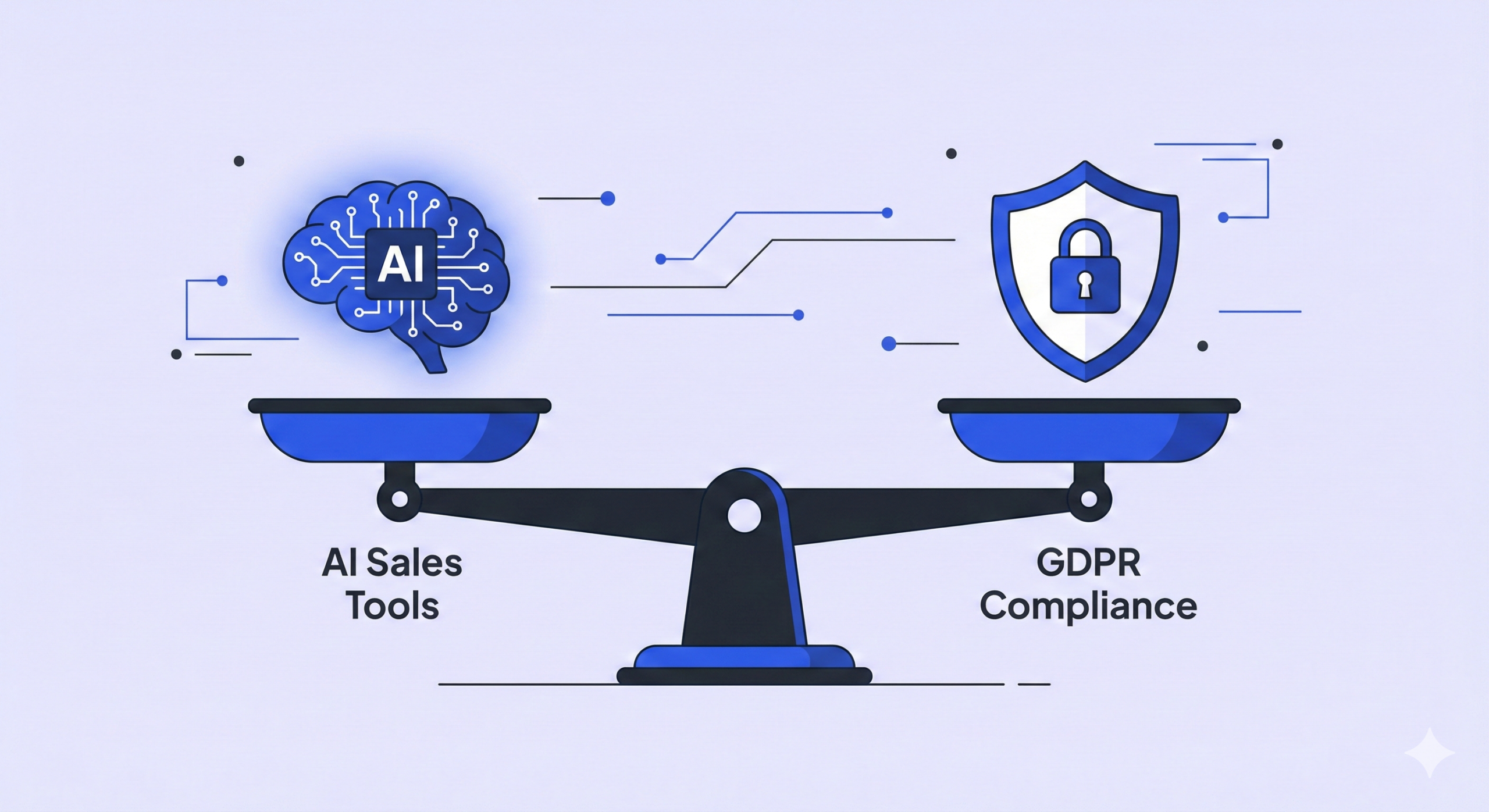
GDPR Compliance in AI Sales Tools
Why AI Makes GDPR More Complicated
Traditional cold outreach had simple rules: get an email address, send a message, include an opt-out. AI changes the equation entirely.
Modern AI tools don’t just send emails — they scrape, enrich, score, personalize, and automate decisions about your prospects at massive scale. Each of those actions has a GDPR implication. Here’s what you actually need to watch out for.
The 3 Biggest GDPR Risks in AI Outreach
- Training data leakage. When you paste prospect data into a consumer-grade AI tool (like a free version of ChatGPT), that information could be used to train the vendor’s models. That’s a data leak under GDPR. IBM’s 2025 research found that 1 in 5 organizations experienced breaches through “shadow AI” — unsanctioned tools used by employees.
- Automated profiling without human oversight. Article 22 of GDPR restricts decisions made entirely by algorithms that have a significant effect on individuals. If your AI tool auto-rejects leads, assigns them pricing tiers, or blocks outreach without any human review, you’re in risky territory.
- Storing “stale” or inaccurate data. GDPR requires data to be accurate and not kept longer than necessary. If your CRM is full of outdated contact records from six months ago, and your AI is personalizing outreach based on that data, you’re violating the Accuracy and Storage Limitation principles simultaneously.
What GDPR Actually Requires From Your AI Workflow
Let’s be practical. GDPR has 7 core principles. Here’s how they apply to your day-to-day outbound work:
GDPR Principle | What It Means For Your Outreach | Quick Action |
Lawfulness & Transparency | You need a legal reason to contact someone — “legitimate interest” is the most common basis for B2B cold outreach. | Disclose AI use in your privacy policy. |
Purpose Limitation | Data collected for prospecting can’t be used to train AI models on unrelated tasks. | Check vendor DPAs for model training clauses. |
Data Minimization | Only collect what you actually need. Don’t scrape sensitive personal info when professional details are enough. | Focus on professional B2B attributes only. |
Accuracy | Your contact data must be current and verified. AI outreach on bad data = compliance risk + wasted budget. | Use tools with real-time email verification. |
Storage Limitation | Don’t hoard prospect data forever. Industry best practice: remove non-responders within 30 days of first contact. | Set automated deletion policies in your CRM. |
Integrity & Confidentiality | Your prospect data must be encrypted and protected. | Require AES-256 encryption from your vendors. |
Accountability | You must be able to prove compliance — not just claim it. | Maintain Records of Processing Activities (RoPA). |
💡 68% of data breaches involve human error while using technology. The risk often isn’t the tool — it’s how teams use it.
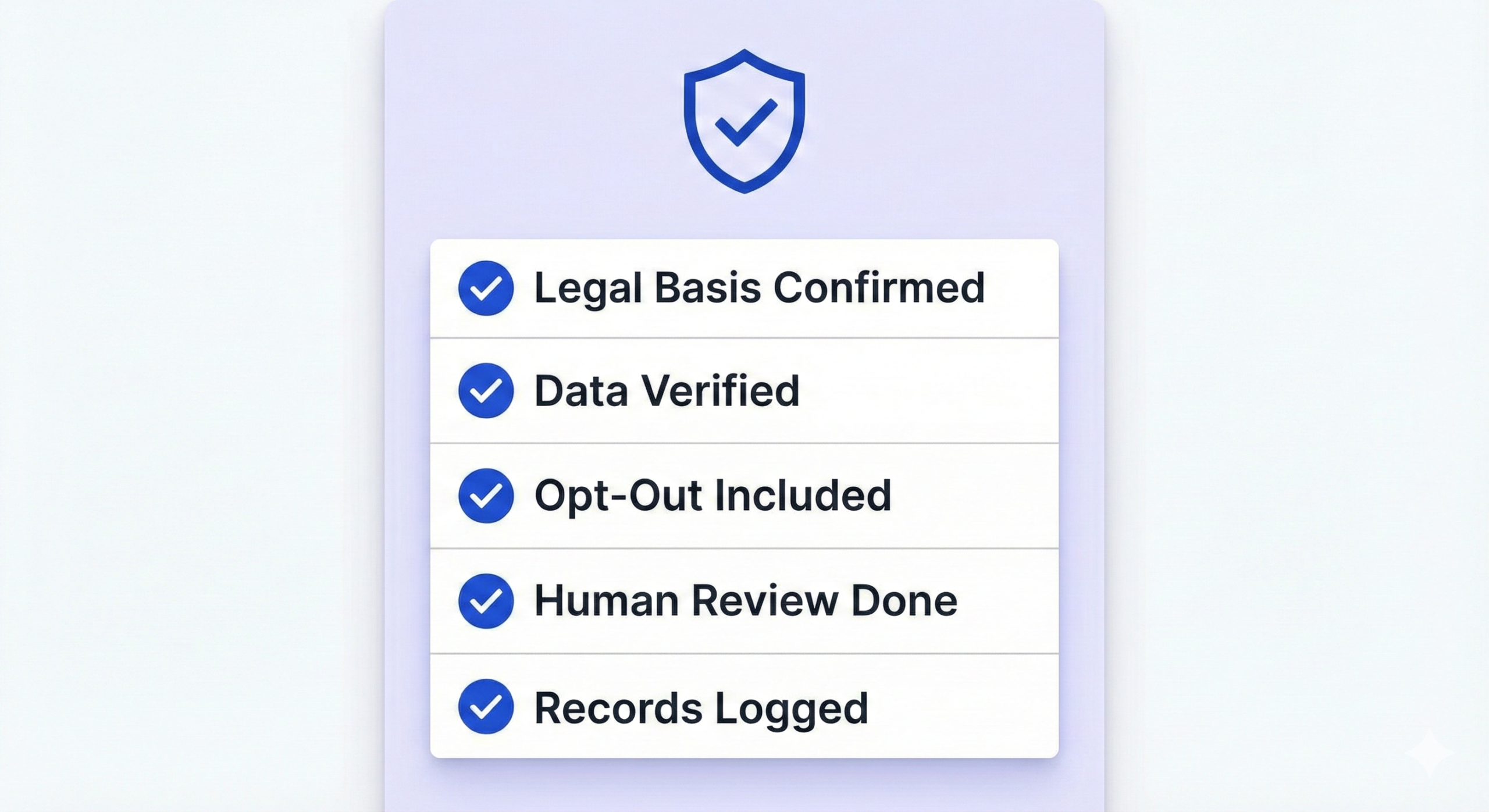
Cold Email and GDPR: The Rules Are Simpler Than You Think
Cold email is not banned under GDPR. What’s banned is reckless, untargeted, spray-and-pray outreach. Here’s what makes cold email legally sound:
- Legitimate interest: Your product or service must be genuinely relevant to the recipient’s professional role. A generic pitch to a random list? Not compliant. A targeted message to the right decision-maker at the right company? That’s fine.
- Transparency: Under Articles 13 and 14, if you sourced the contact’s info from a third party (like a data enrichment tool), you must tell them how you got it and why you’re contacting them.
- Easy opt-out: Every email must include a one-click unsubscribe. No double opt-in required for B2B cold outreach — but the opt-out must be immediate and frictionless.
Want to go deeper on compliant outreach strategy? Check out our full guide on cold email laws and our ultimate guide to email compliance for cold outreach.
Choosing AI Sales Tools That Are Actually GDPR-Safe
Not all tools are built equal when it comes to GDPR compliance in AI sales tools. Here are the non-negotiables to check before you sign up for any platform:
Data Processing Addendum (DPA). This is a contract between you and the vendor that specifies how they handle your data. Without a signed DPA, you’re the sole party liable for any breach. Make sure the DPA explicitly states your data will not be used for vendor model training.
Security certifications. Look for SOC 2 Type II and ISO 27001 certifications. These prove the vendor has undergone independent audits of their data security practices. Platforms like Apollo.io and Saleshandy publish these openly in their Trust Centers.
Real-time data verification. Tools like UpLead (which offers a 95% accuracy guarantee with real-time verification at the point of download) directly support GDPR’s Accuracy principle. Sending emails to invalid addresses isn’t just wasteful — it’s a signal to spam filters and regulators alike.
Automated data deletion. Can the tool automatically purge inactive prospects after a set number of days? If not, you’re manually managing Storage Limitation compliance — and that’s a recipe for mistakes.
DSR fulfillment speed. When a prospect asks you to delete their data, GDPR requires you to respond within 30 days. Some platforms have reduced Data Subject Request (DSR) processing from two days to just ten minutes using automation. That’s the benchmark to aim for.
💡 85–97% reduction in compliance workloads reported by organizations using privacy automation tools. Compliance doesn’t have to be manual.
The EU AI Act: What’s New in 2025
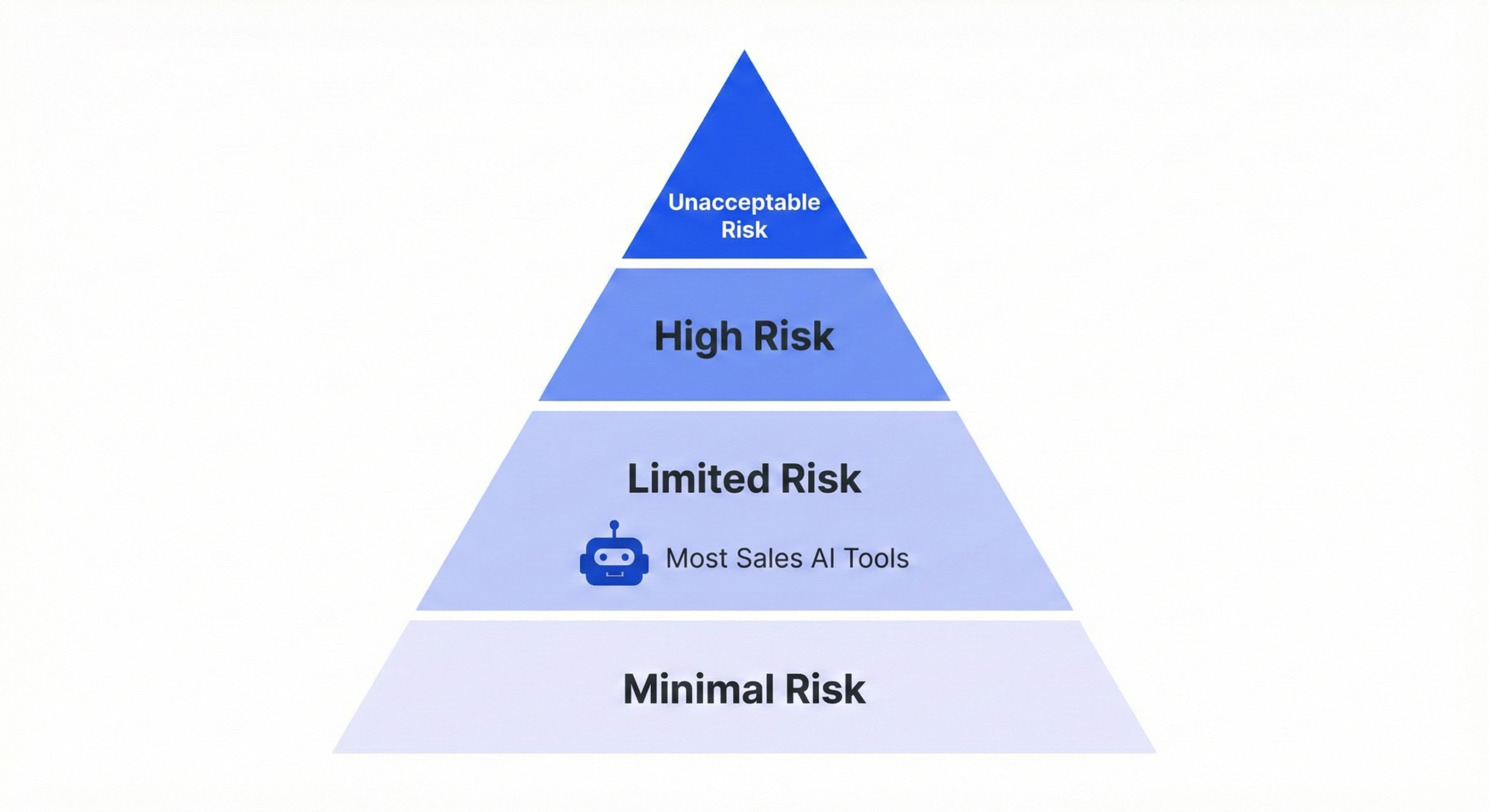
On top of GDPR, the EU AI Act is now in force. It classifies AI tools by risk level — and most ai sales tools fall into the “Limited Risk” category, meaning they must be transparent about AI usage (i.e., tell prospects when they’re interacting with AI-generated content).
Higher-risk tools — like those used for employee monitoring or behavioral profiling — face stricter requirements including mandatory conformity checks and EU database registration. Penalties under the AI Act can reach €35 million or 7% of global annual turnover — even higher than GDPR.
The practical takeaway: if your AI tool makes significant decisions about prospects automatically, without human review, you’re in the cross-hairs of both GDPR and the AI Act simultaneously.
The “Human-in-the-Loop” Rule You Can’t Ignore
Article 22 of GDPR says individuals have the right not to be subject to decisions made entirely by automated systems — especially when those decisions have significant consequences.
In outbound sales, this means: your AI can draft, recommend, score, and suggest — but a human must review and approve before it matters. If your AI automatically moves a prospect to “not qualified” or changes their pricing tier without any human review, that’s a compliance risk.
The fix is simple: build a “Human-in-the-Loop” checkpoint into your process. Think of AI as your very fast intern that prepares everything — and you as the one who hits send.
