You’ve probably noticed it — cold outreach just isn’t working the way it used to.
Inboxes are flooded. Buyers are skeptical. And if you’re still manually researching prospects and sending generic emails, you’re already behind. The global sales automation market hit $7.3 billion in 2024 — and the teams driving that number aren’t grinding spreadsheets at midnight. They’re using AI SDRs powered by real-time lead data.
This article breaks down exactly how it works, why it outperforms traditional methods, and how you can use it to fill your pipeline faster — without burning out your team.
AI SDRs and Real-Time Lead Data Explained
What Is an AI SDR?
An AI SDR (AI Sales Development Representative) is a software agent that handles the top-of-funnel prospecting work traditionally done by humans — researching prospects, writing personalized outreach, sending messages, and following up — all on autopilot.
But here’s the key difference from old-school automation: an AI SDR doesn’t just follow a rigid “send email on Day 1, follow up on Day 3” script. It makes independent decisions based on real-time signals — prospect behavior, company news, hiring activity, tech changes — and adapts its outreach accordingly.
Think of it as the difference between a vending machine and a skilled salesperson. One follows a fixed menu. The other reads the room.
According to outbound SDR statistics, sales reps spend up to 40% of their week on non-selling activities — research, CRM updates, manual follow-ups. AI SDRs absorb that grind entirely, freeing your team to focus on the conversations that actually close deals.
The Real-Time Data Engine Behind AI SDRs
Here’s where it gets interesting. An AI SDR is only as good as the data it feeds on. And in B2B sales, data decays at approximately 30% per year — meaning nearly a third of any static database is outdated within 12 months.
Real-time lead data solves this. Instead of pulling from a stale list, AI sales agents continuously monitor live digital signals across the web — and trigger personalized outreach the moment a prospect shows buying intent.
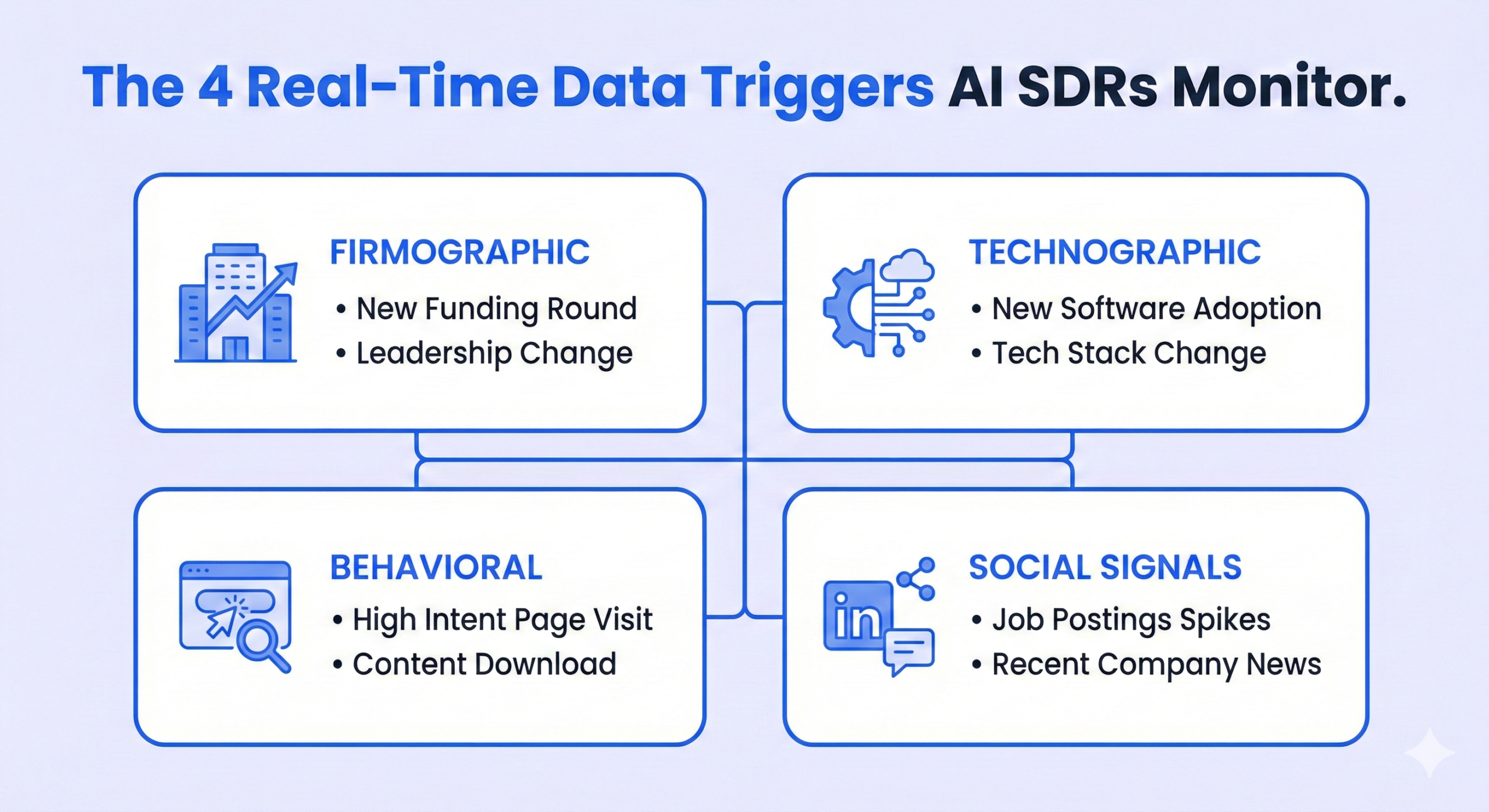
These signals fall into four categories:
Firmographic triggers — A target company announces new funding, an acquisition, or rapid hiring. These indicate budget availability and shifting priorities.
Technographic triggers — A company installs a new CRM or drops a competitor’s tool. This signals integration opportunities or competitive displacement.
Behavioral triggers — A prospect visits your pricing page, downloads a whitepaper, or leaves a G2 review. They’re in research mode. This is the moment to reach out.
Social signals — LinkedIn promotions, company news posts, executive changes. These create the “why you, why now?” personalization hook that makes cold outreach feel warm.
By processing these signals in milliseconds, AI-powered lead generation software can achieve a speed-to-lead that’s physically impossible for human teams.
Speed-to-Lead: The Stat That Changes Everything
Here’s a number that should stop you cold:
Leads contacted within 5 minutes of an inquiry are 21x more likely to enter the sales process than those contacted after 30 minutes. Every 10-minute delay decreases qualification chances by 400%.
The average human rep responds in 2–4 hours. AI SDRs respond in under 60 seconds — 24/7, across every time zone, including holidays.
That gap isn’t just an efficiency win. It’s the difference between pipeline and silence.
Real-time targeted outreach closes that gap permanently. When a prospect raises their hand — whether by visiting your site or commenting on a competitor’s LinkedIn post — your AI SDR is already in their inbox before a human rep has finished their coffee.
How AI SDRs Actually Personalize at Scale
The biggest misconception about AI sales agents is that scaling outreach means sacrificing personalization. The opposite is true.
A human rep might spend 15 minutes researching a prospect to find one relevant talking point. An AI SDR scans a prospect’s entire LinkedIn history, recent press releases, job postings, and SEC filings in seconds — then generates a message tailored to that person’s exact situation.
This matters beyond just engagement rates. In 2025 and 2026, inbox providers like Google and Microsoft use advanced AI to detect “spray and pray” patterns. Repetitive, irrelevant emails get diverted to spam. Unique, contextually relevant content maintains a higher sender reputation and lands in the primary inbox.
The result: lead enrichment combined with AI personalization isn’t a nice-to-have — it’s a deliverability strategy.
📊 Performance Comparison: Human Reps vs. AI SDRs
Metric | Human Rep | AI SDR |
Daily outreach capacity | 50–100 touchpoints | 500–4,000+ touchpoints |
Follow-up consistency | 65–75% | 100% |
Avg. response time | 2–4 hours | < 1 minute |
Monthly cost | $6,000–$8,000 | $500–$2,000 |
Ramp time | 3–4 months | 1–2 weeks |
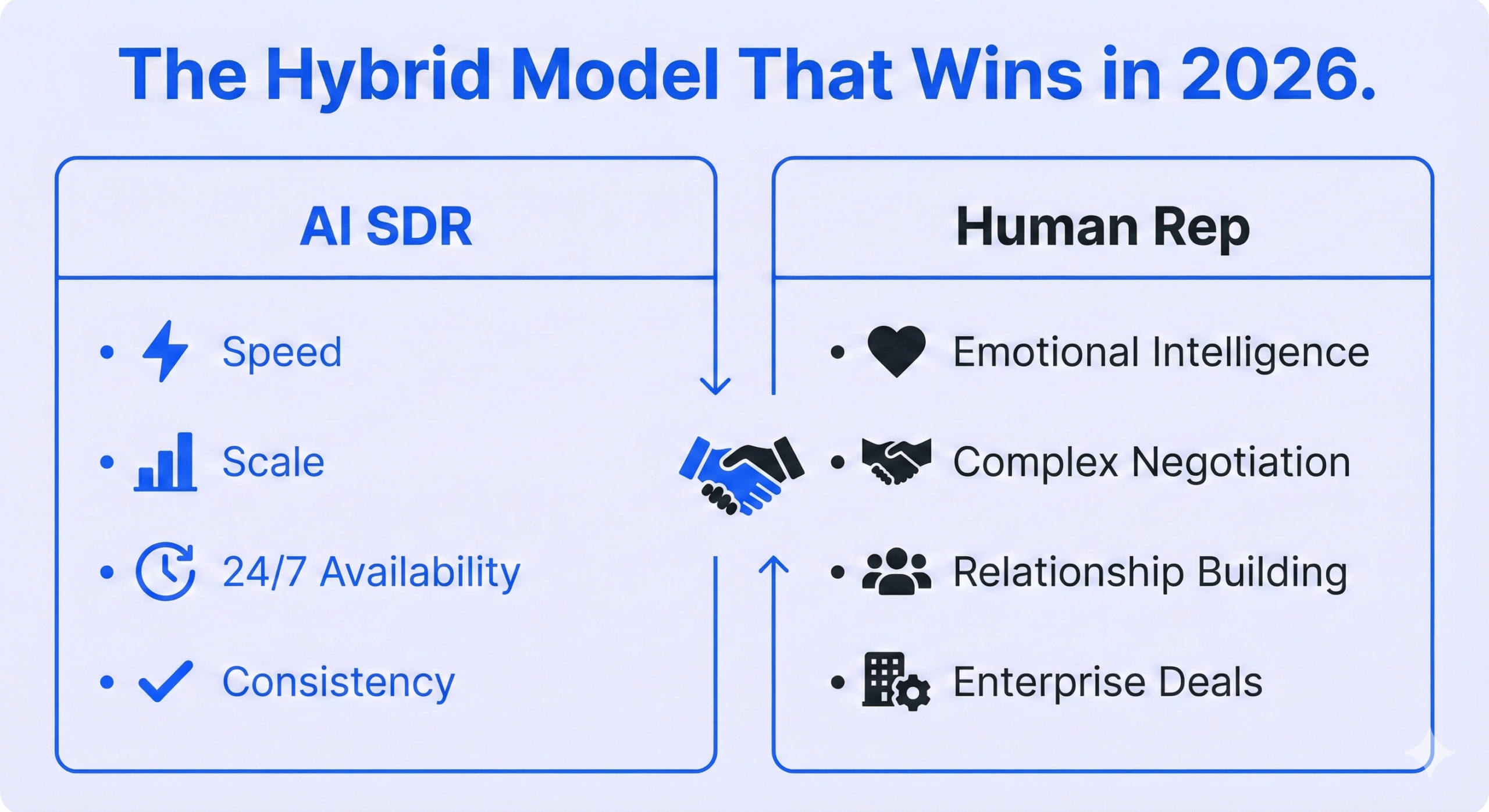
The numbers are stark. But the goal here isn’t replacement — it’s leverage. AI SDRs handle the volume and speed at the top of the funnel. Your human team handles the complex conversations, relationship-building, and closing at the bottom. That’s the hybrid model winning teams run in 2026.
The Technical Side: Why Data Quality Is Non-Negotiable
For AI sales agents to actually deliver results, they need a technically sound foundation. Bad data doesn’t just waste effort — at AI speed, it compounds damage fast.
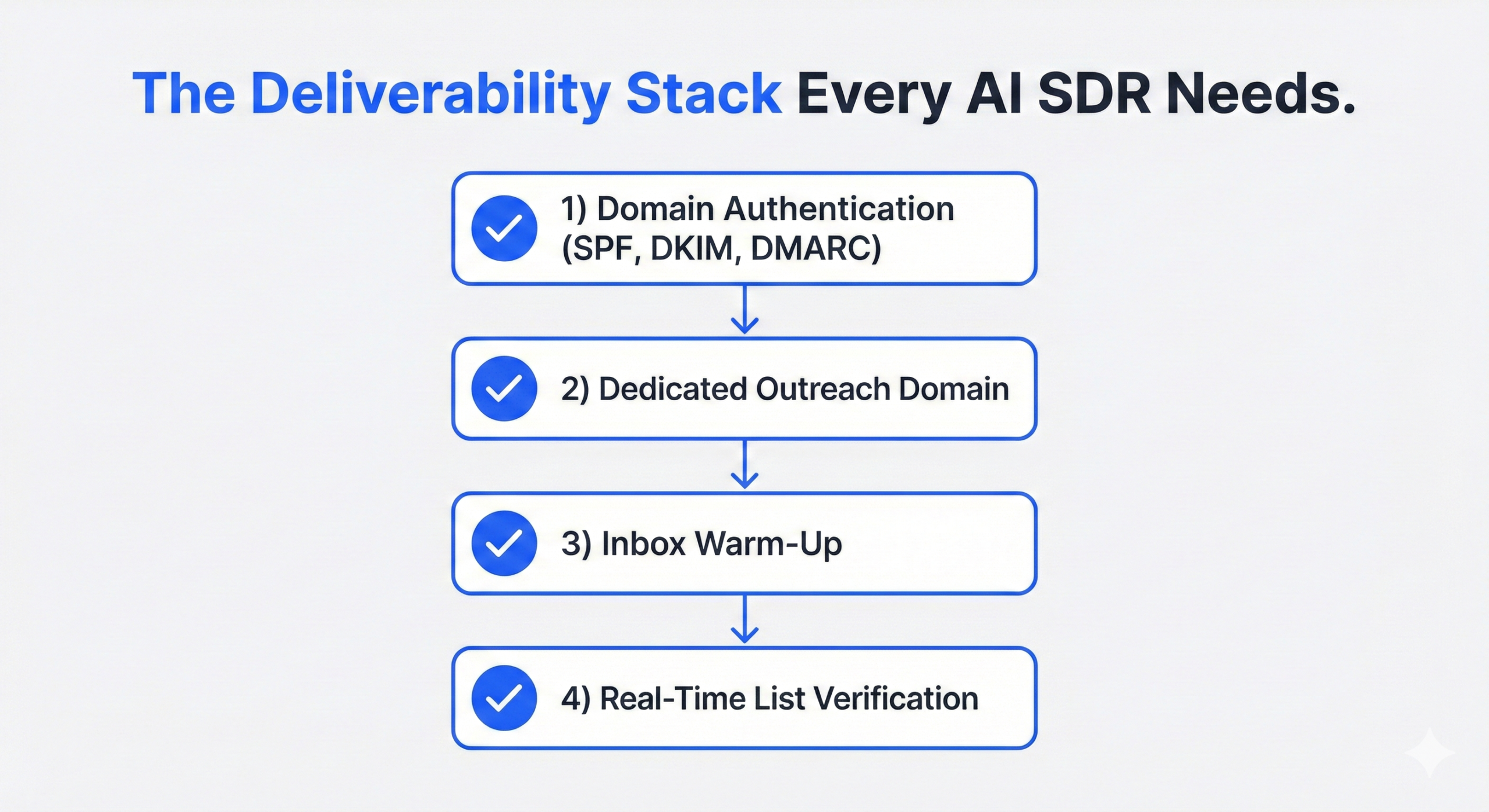
Here’s what the infrastructure stack needs to look like:
Domain authentication — Every outreach domain must have SPF, DKIM, and DMARC properly configured. Without these, ISPs automatically flag your emails as untrustworthy.
Dedicated outreach domains — Never send cold outreach from your primary corporate domain. Use dedicated domains (e.g., trycompany.com vs. company.com) to protect your brand reputation.
Inbox warm-up — New domains need gradual warm-up to build a trust score with ISPs before high-volume campaigns launch.
Real-time list verification — A bounce rate above 2% is a primary blacklisting signal. Every email address should be verified immediately before sending.
When these elements are in place, organizations can achieve a 70% contact rate — compared to the industry average of just 15% for traditional manual outreach.
Email marketing, executed with precise targeting and high deliverability, delivers an average ROI of 4,200% (Litmus, 2024). Poor data destroys that math entirely.
This is why data enrichment isn’t a backend task — it’s the engine your entire outbound motion runs on.
Choosing the Right Stack
The market is crowded. Here’s a quick lay of the land so you can cut through the noise:
Apollo.io — All-in-one speed for high-volume SMB outreach. Great for smaller teams who need a single tool.
ZoomInfo — The enterprise standard for data depth, especially North American direct dials. High cost, complex interface.
Saleshandy — Strong deliverability focus with AI-powered lead search. Ideal for teams prioritizing global reach and real-time verification.
Clay — A data orchestration layer pulling from 50+ sources. Best for RevOps teams who need maximum custom control.
Artisan AI & 11x — AI-native platforms running fully autonomous agents from prospecting to follow-up with minimal human intervention.
No matter which tools you combine, the principle is the same: real-time, verified data feeding intelligent outreach at scale. That’s the foundation of modern lead generation.
Do AI SDRs Replace Human Reps?
No. And the strongest GTM teams in 2026 aren’t trying to make that tradeoff.
The consensus across industry leaders is a hybrid “copilot” model: AI SDRs handle the volume, speed, and consistency of top-of-funnel prospecting. Human reps take the warm, context-rich leads and close them.
Humans remain unmatched at navigating complex organizational politics, reading emotional cues in live calls, and building the kind of long-term trust that turns one deal into a decade of partnership.
The math on this is compelling: most organizations report a payback period of approximately 5.2 months when adopting AI sales agents. Unlike human hires who need 3–4 months to ramp up, digital agents are generating pipeline within 1–2 weeks of implementation.
Explore how sales development services can blend both sides of this equation for your team.