

If you’re running outbound sales, you’ve probably heard of both Instantly and Apollo. Maybe you’re already using one of them. Maybe you’re wondering if you’re leaving money on the table by not using the other.
Here’s the truth: these two tools are built for different jobs. And choosing the wrong one — or using either without a clear strategy — can quietly kill your reply rates.
The cold outreach landscape is brutal right now. The average response rate for cold email sits between 1% and 5%. About 16.9% of all emails never even reach the inbox — they bounce or get flagged as spam before anyone sees them. And yet, for every $1 spent on cold email, the potential ROI is still $36 to $42 — making it one of the highest-returning channels in B2B sales.
So the tools you pick genuinely matter. Let’s break down Instantly vs Apollo side by side — based on actual tested findings — so you can make a fast, confident decision.
Instantly vs Apollo: 5+ Differences To Know (Our Tested Findings)
Difference 1: What Each Tool Is Actually Built For
This is the most important distinction — and most people get it wrong.
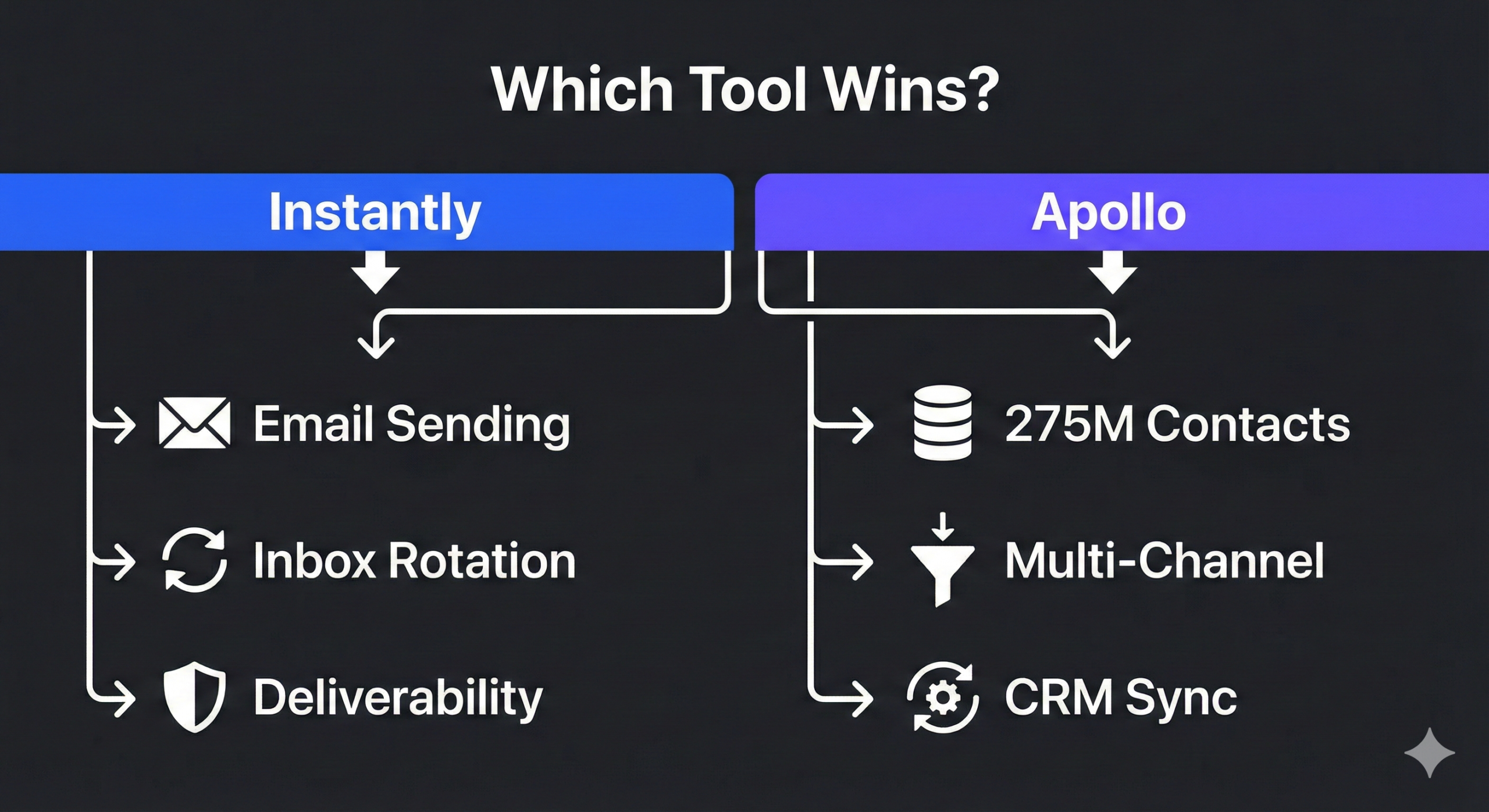
Apollo is a prospecting-first platform. It’s built around a massive database of 275 million contacts and 75 million companies. You research, target, and reach out — all inside Apollo. It’s an all-in-one sales operating system with a built-in dialer, LinkedIn automation, CRM integrations, and intent signals that tell you which companies are actively shopping for what you sell.
Instantly is a delivery-first platform. It doesn’t try to be everything. Instead, it focuses on one thing: making sure your cold emails actually land in the inbox — not the spam folder. It does this through unlimited email warmup, inbox rotation, and server/IP sharding technology.
Think of it this way: Apollo helps you find the right people. Instantly makes sure your message reaches them.
Difference 2: Lead Data — Quality, Depth, and Accuracy
Apollo’s database gives you access to 65+ advanced filters — including technographics, funding rounds, company revenue, and buying intent signals. These filters let you target companies at the exact moment they’re most likely to buy. For anyone who needs to access direct decision-maker data at scale, Apollo is arguably the most powerful database available at this price point.
Surprisingly, Instantly has now built a Lead Finder database of 450 million contacts — larger than Apollo’s. But the filtering is more basic: title, location, and industry. No technographic data, no intent signals, no funding round triggers.
Apollo also claims 91% email accuracy — but real-world testing tells a different story. Many teams report significant bounce rates even with “verified” emails from Apollo, which is why adding a secondary verification step (tools like ZeroBounce or MillionVerifier) is a smart move regardless of which platform you use.
Feature | Apollo | Instantly |
Database Size | 275M+ Contacts | 450M+ Contacts (Lead Finder) |
Advanced Filters | 65+ (incl. technographics) | Basic (Title, Location, Industry) |
Intent Signals | ✅ Advanced Buying Intent | ❌ Not available |
Verification Method | Built-in / Real-time | Multi-step screening |
Data Best For | Deep ICP research & targeting | Teams with existing clean lists |
Difference 3: Deliverability — Who Actually Gets to the Inbox?
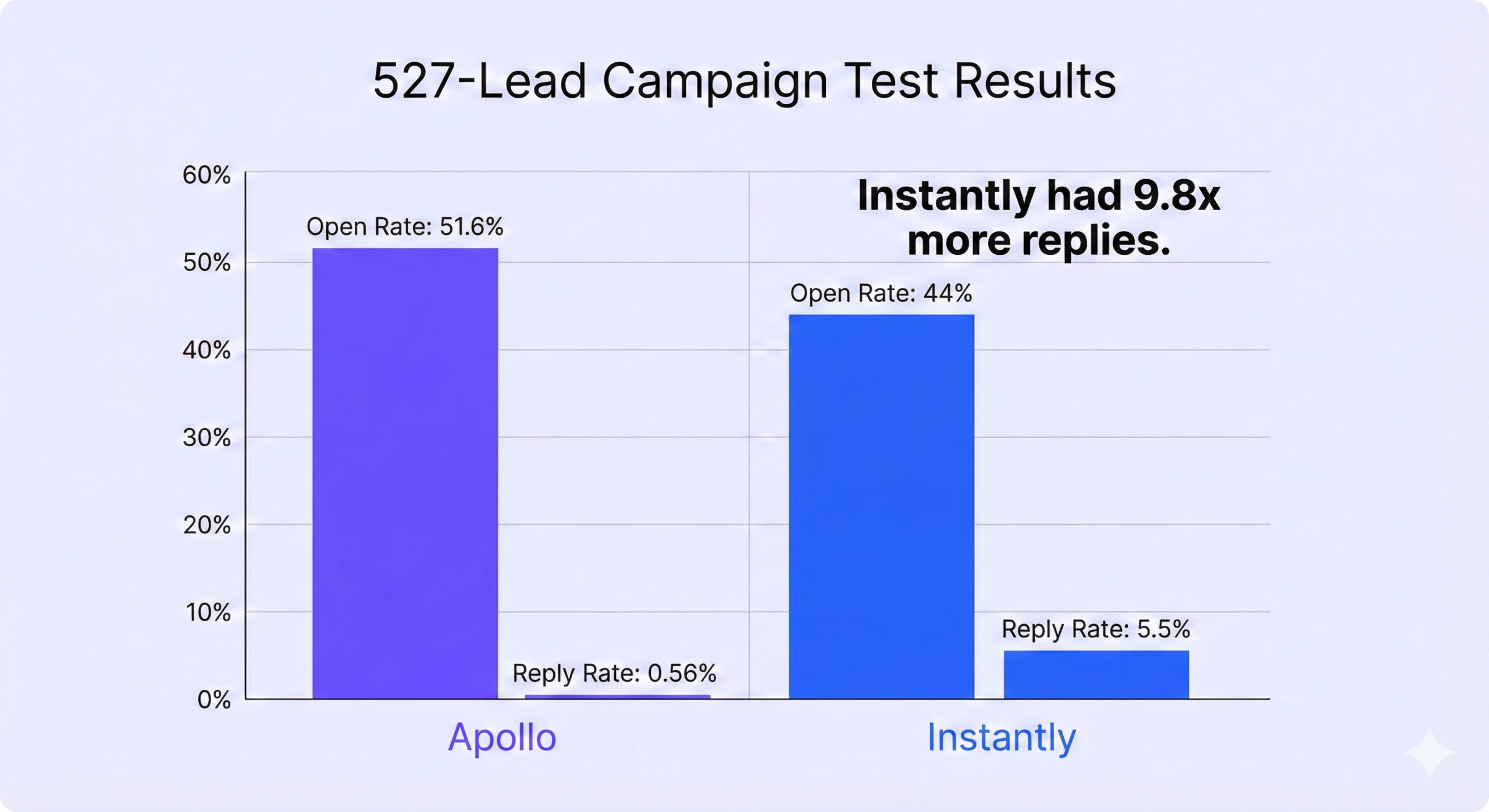
Here’s where things get interesting. In a tested 527-lead campaign comparison, Apollo achieved higher initial open rates (51.6% vs 44%) — suggesting strong initial inbox placement. But Instantly produced a dramatically higher reply rate: 5.5% vs 0.56%.
That’s not a small gap. That’s the difference between running a campaign that generates conversations and running one that generates silence.
Instantly’s advantage comes from its Smart Inbox Sending Rotation (SISR) — a system that spreads your sending load across unlimited email accounts and IPs, so no single domain hits volume thresholds that trigger spam filters. The warmup network spans 4.2 million accounts, automatically building your sender reputation before you ever send a real email.
Apollo is more conservative. It focuses on protecting individual mailbox health through slower ramp-ups and stricter daily limits. This works well for low-volume, highly personalized outreach. But for anyone running high-volume campaigns, Apollo’s deliverability infrastructure can create a bottleneck — and increase the risk of domain damage if volume limits are pushed.
The complete guide to email deliverability breaks down exactly what technical steps protect your sender reputation for the long term.
Difference 4: Multi-Channel vs Email-Only Workflow
Apollo shines in multi-channel sequences. You can build automated sequences that combine cold emails, LinkedIn profile views, connection requests, and phone calls — all tracked and logged inside Apollo or synced to your CRM. This is critical for anyone running a structured outbound process that requires touching a prospect across multiple channels before they respond.
Instantly is primarily an email tool. It has introduced some basic multi-channel features, but most practitioners still use it as a standalone email engine. What it lacks in breadth it makes up for in simplicity — you can connect your mailboxes and launch a campaign in minutes, making it ideal for lean teams or agencies running campaigns across multiple markets.
If you’re exploring the best cold email software options beyond just these two platforms, there are strong alternatives worth evaluating depending on your workflow needs.
How Instantly and Apollo Compare to Other Tools
You should also know how these two stack up against other tools in the market — because your competitors are evaluating them too.
Platform | Best For | Key Weakness |
Apollo | Multi-channel GTM + CRM sync | Data decay / High cost at scale |
Instantly | High-volume email / Agencies | Email-only / No CRM sync |
Saleshandy | Email automation + time-zone sending | Limited data sourcing |
Woodpecker | Stable, human-like sending patterns | Smaller feature set |
UpLead | High-accuracy data (95% guarantee) | No engagement tools |
ZoomInfo | Enterprise / European data | Extremely high cost |
Snov.io / Wiza | LinkedIn-specific verification layer | Not full outreach platforms |
For a deeper look at Apollo alternatives and how they fit different outbound motions, there’s a full breakdown worth reviewing.
Conclusion
Here’s the fast version if you’re in a hurry:
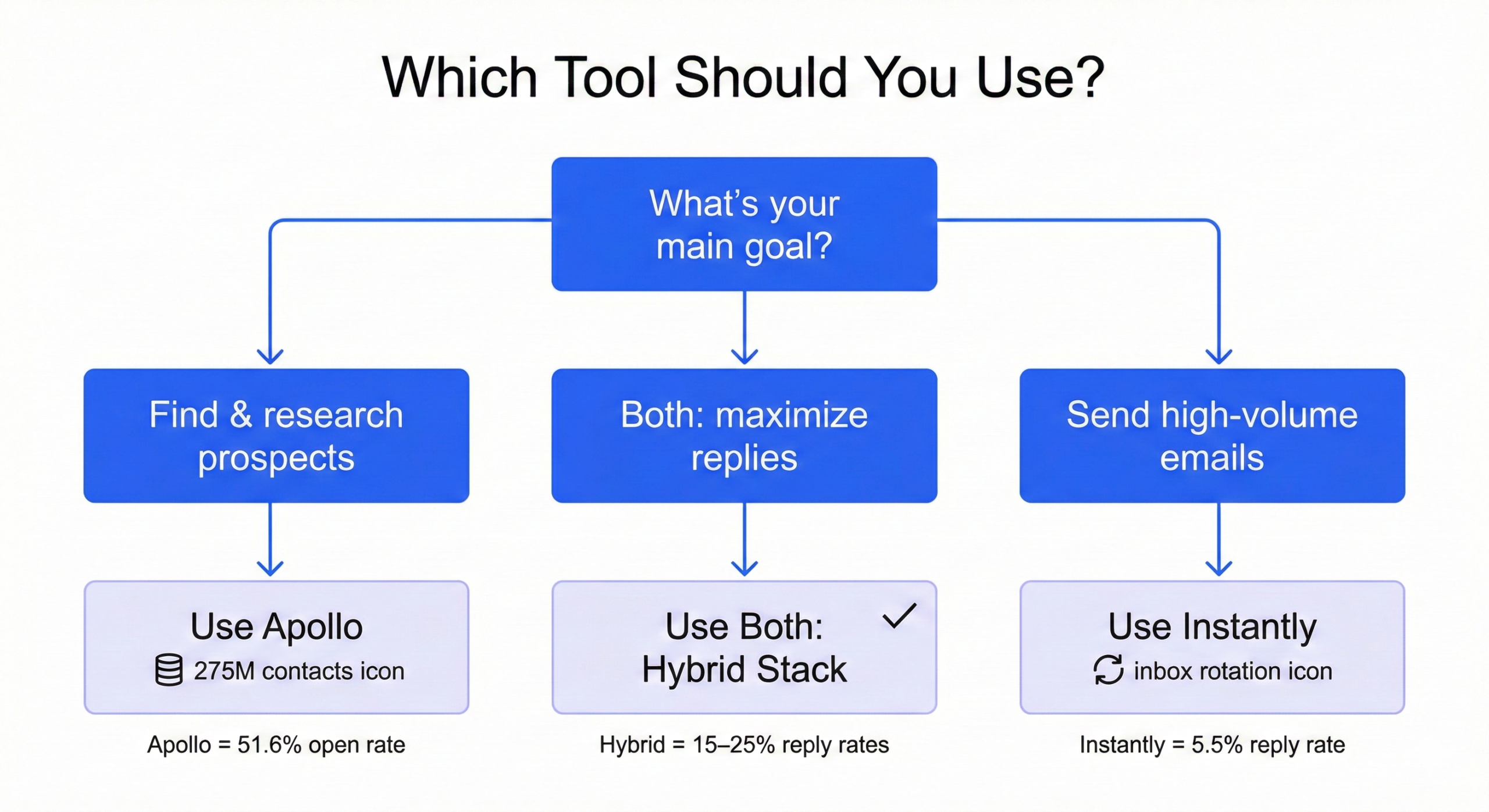
Choose Instantly if your main challenge is getting emails into the inbox, managing high send volumes, or running campaigns across multiple client accounts at a flat cost.
Choose Apollo if you need deep prospect research, multi-channel sequences, and tight CRM integration for a complex B2B sales process.
Use both if you want elite-level reply rates. Source and research in Apollo. Execute in Instantly. This is the setup that consistently outperforms — and it’s what top outbound teams are doing right now.
But here’s the thing — even the best tools don’t replace a great outbound strategy. If you want to skip the setup headache and go straight to qualified meetings in your calendar, that’s exactly what SalesSo’s lead generation service delivers. We handle the targeting, the campaign design, and the scaling — across LinkedIn, email, and cold calling.
Take a look at how targeted outreach with the right methodology translates into a predictable pipeline — regardless of which tools you’re running underneath.
