
Ultimate Guide to Email Compliance for Cold Outreach
Why Email Compliance Actually Matters
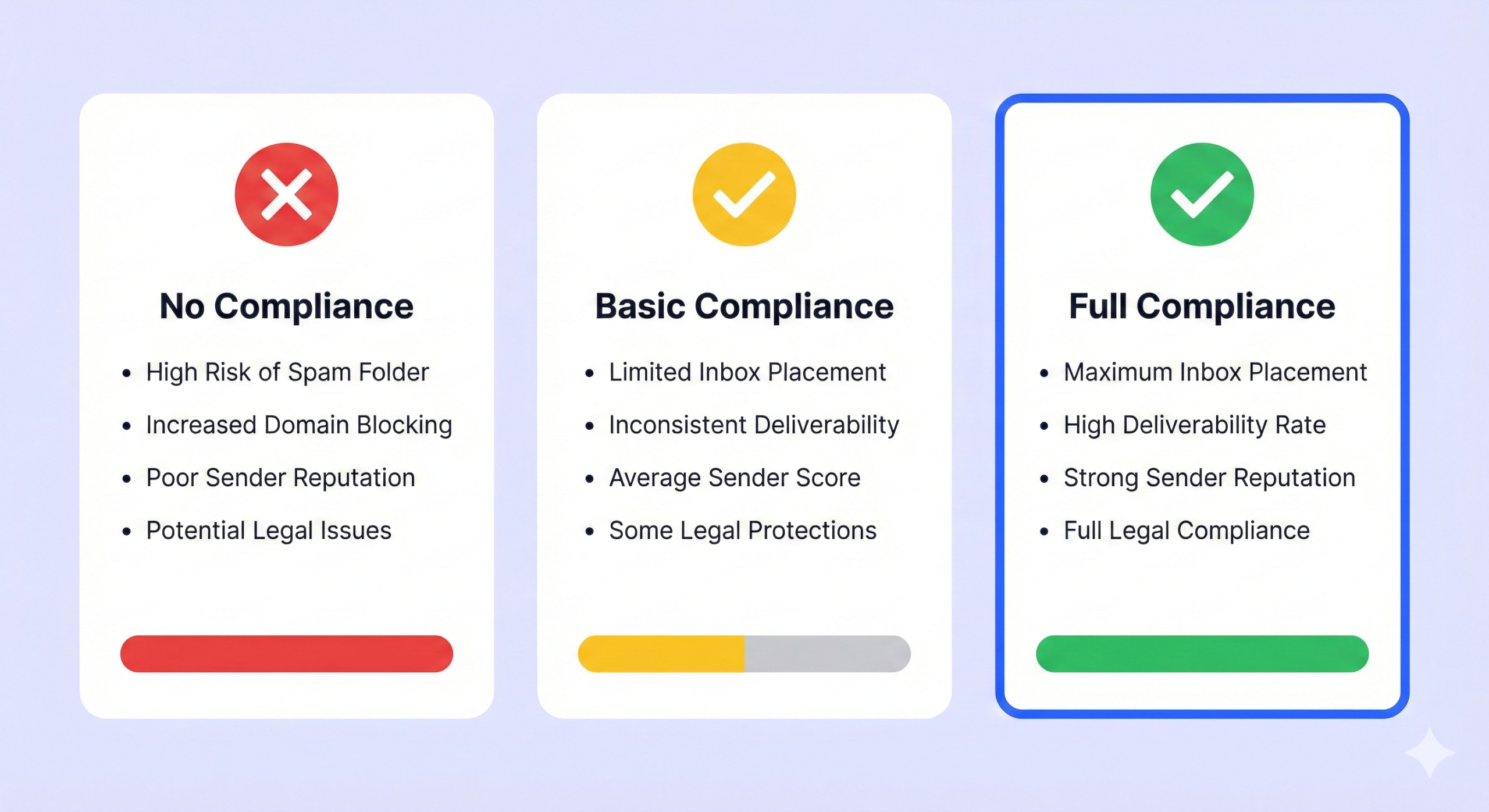
Compliance isn’t just about avoiding legal trouble. It’s directly tied to whether your emails get delivered. In 2025, major inbox providers like Google and Yahoo have moved from a “warn and educate” model to a binary Pass/Fail system. If your emails don’t meet authentication standards, they don’t go to spam anymore — they get rejected entirely at the protocol level.
For anyone running lead generation at scale, this is a game-changer. Your DNS records now matter as much as your subject lines.
The Global Regulatory Landscape
Here’s where most people get tripped up: there’s no single global email law. Each region has its own rules, its own penalties, and its own definition of what counts as “consent”. Let’s break it down.
CAN-SPAM Act (United States)
The U.S. is actually the most flexible when it comes to b2b sales outreach. CAN-SPAM does not require prior consent to email someone. But don’t let that fool you — the rules are still strict about transparency and opt-outs.
Every email must include a valid physical postal address, a clear way to opt out, and a non-deceptive subject line. The penalty for ignoring this? Up to $50,000+ per individual email in violation.
GDPR (European Union)
If you’re reaching into Europe, the GDPR treats a professional email address as personal data — because it identifies a natural person. That means processing personal data for sales purposes requires a valid legal basis.
Most outreach teams rely on “Legitimate Interest” as their legal basis. This allows outreach without prior consent IF the message is professionally relevant and you’ve documented a Legitimate Interest Assessment (LIA). The assessment must weigh your business purpose against the recipient’s privacy rights.
CASL (Canada)
Canada’s Anti-Spam Legislation is one of the strictest regimes globally. It requires express or implied consent before most commercial emails can be sent. Implied consent in a B2B context typically applies only when the recipient has publicly published their contact without a “no solicitation” statement, and your message is directly relevant to their role.
CASL also requires meticulous record-keeping — consent records must be maintained for three years after the relationship ends.
CCPA / CPRA (California, USA)
California residents can request their data be deleted even if they haven’t opted out under CAN-SPAM. This means your CRM and lead lists must have the ability to purge records on request — something many outbound teams overlook entirely.
Regulation | Consent Model | ID Required | Unsubscribe Window |
CAN-SPAM (US) | Opt-Out (No prior consent) | Physical Address | 10 Business Days |
GDPR (EU/EEA) | Legitimate Interest or Opt-In | Data Source Disclosure | Effectively Immediate |
CASL (Canada) | Explicit or Implied Opt-In | Full Contact Info | 10 Business Days |
PECR (UK) | Opt-In (B2B exceptions) | Clear Sender Identity | Effectively Immediate |
Technical Authentication: SPF, DKIM, and DMARC
Beyond the legal layer, there’s a technical layer — and in 2025, this is non-negotiable. Without proper email deliverability authentication, your emails don’t stand a chance regardless of how good your copy is.
SPF (Sender Policy Framework) is a DNS record that tells inbox providers which IP addresses are authorized to send mail on your behalf. Without it, your domain looks like a spoofing target.
DKIM (DomainKeys Identified Mail) adds a cryptographic signature to every email you send, verifying that the message hasn’t been altered in transit. This is critical for building long-term domain reputation.
DMARC (Domain-based Message Authentication, Reporting, and Conformance) is the policy layer that ties SPF and DKIM together. It tells ISPs what to do when authentication fails — do nothing, quarantine the message, or reject it entirely. As of 2024–2025 enforcement, bulk senders must have a DMARC policy in place to reach Gmail and Yahoo inboxes.
Protocol | What It Does | Why It Matters |
SPF | Authorizes sending IP addresses | Prevents domain spoofing |
DKIM | Signs message content | Proves email integrity in transit |
DMARC | Sets the failure policy | Mandatory for Gmail/Yahoo bulk senders in 2025 |
TLS | Encrypts data in transit | Required to prevent protocol-level rejection |
The 2025 Gmail and Yahoo Enforcement: What Changed
This is the most important shift of the last decade for anyone running cold email outreach at scale.
Once your domain crosses 5,000 emails to Google or Yahoo users in a single 24-hour period, you’re permanently classified as a “bulk sender”. From that point on, you must adhere to the highest authentication standards — no exceptions.
The old system gave senders “reputation scores” and some wiggle room. The new system is binary: your Compliance Status is either Pass or Fail. A misconfigured DKIM record or a spike in spam complaints triggers a Fail — and your emails are rejected at the server level, not just filtered to spam.
The hard spam rate limit? Keep it below 0.1%. Hit 0.3%, and Google withdraws mitigation support. That’s just 3 people out of 1,000 hitting “Report Spam” — which is why list quality and targeted outreach matter more than ever.
Data Sourcing and Ethical List Building
The foundation of any compliant cold outreach campaign is clean, verified, ethically-sourced data. In 2025, using scraped lists or data from unknown brokers is one of the fastest ways to trigger an algorithmic ban.
California’s Delete Act (SB-361) has introduced new responsibilities for data providers. They must register with the state and provide deletion mechanisms for residents. As a buyer of that data, you share legal liability if you use records that haven’t respected these deletion requests.
Every email address in your sequence should be verified before it goes live. Bounce rates above 2% are a red flag for ISPs and a direct indicator of low data quality. Tools like ZeroBounce or NeverBounce should be a standard part of your workflow — not an afterthought.
Under GDPR’s “Data Minimization” principle: only collect what you actually need. Storing personal details beyond professional context not only risks compliance violations — it comes across as intrusive, which drives up spam complaints.
The One-Click Unsubscribe Requirement
For bulk senders, the one-click unsubscribe (RFC 8058) is now a technical requirement — not a nice-to-have. Recipients must be able to opt out without logging into a portal or navigating multiple pages.
Here’s the smarter way to think about it: a prospect who can easily unsubscribe is far less likely to hit “Report Spam”. And every spam report chips away at the domain reputation you’ve worked hard to build. Under GDPR and the 2025 Google/Yahoo requirements, unsubscriptions must be honored within 48 hours. Under CAN-SPAM and CASL, you have 10 business days — but faster is always better.
For a deeper dive into writing follow-up emails that maintain compliance and drive replies, check out this guide on how to write a follow-up email.
Crafting Compliant and Effective Messages
Compliance isn’t just in your DNS settings — it’s embedded in the content of your emails themselves. Generic, mass-blast templates are increasingly flagged by AI-powered spam filters that analyze content patterns. To pass these filters, your message must demonstrate relevance.
Research into reply rates shows that “Timeline Hooks” — which focus on specific achievement windows and metric progression — outperform traditional “Problem Hooks” by over 2.3x. Prospects respond better to specific, value-driven insights than to generic pain point questions.
Hook Type | Avg. Reply Rate | Meeting Rate | Why It Works |
Timeline Hook | 10.01% | 2.34% | Shows a clear, time-bound path to value |
Numbers Hook | 8.57% | 1.86% | Leverages peer benchmarks |
Social Proof | 6.53% | 1.25% | Builds trust through success stories |
Problem Hook | 4.39% | 0.69% | Often perceived as generic |
Also worth noting: BIMI (Brand Indicators for Message Identification) is becoming an increasingly important trust signal. When your brand logo appears in the inbox next to your email, it increases open rates and signals legitimacy to both humans and ISPs.
Infrastructure and Technical Risk Mitigation
Relying on a single domain for all your cold email volume is a strategic mistake. Sophisticated outreach operations use distributed infrastructure to protect against blacklisting.
The smart approach: spread volume across multiple secondary domains — limiting each inbox to 30–50 emails per day. If one domain’s reputation takes a hit, your overall engine keeps running.
New domains also need warming. A “cold” domain sent 100 emails on day one will be blocked immediately. Email warming — using automated tools to simulate organic engagement — typically takes 4 to 6 weeks to build a trustworthy sending history.
Monitor your domain reputation proactively using Google Postmaster Tools and Microsoft SNDS. A sudden drop in inbox placement is usually the first warning sign before a full deliverability crisis hits.
2025 Performance Benchmarks for Cold Outreach
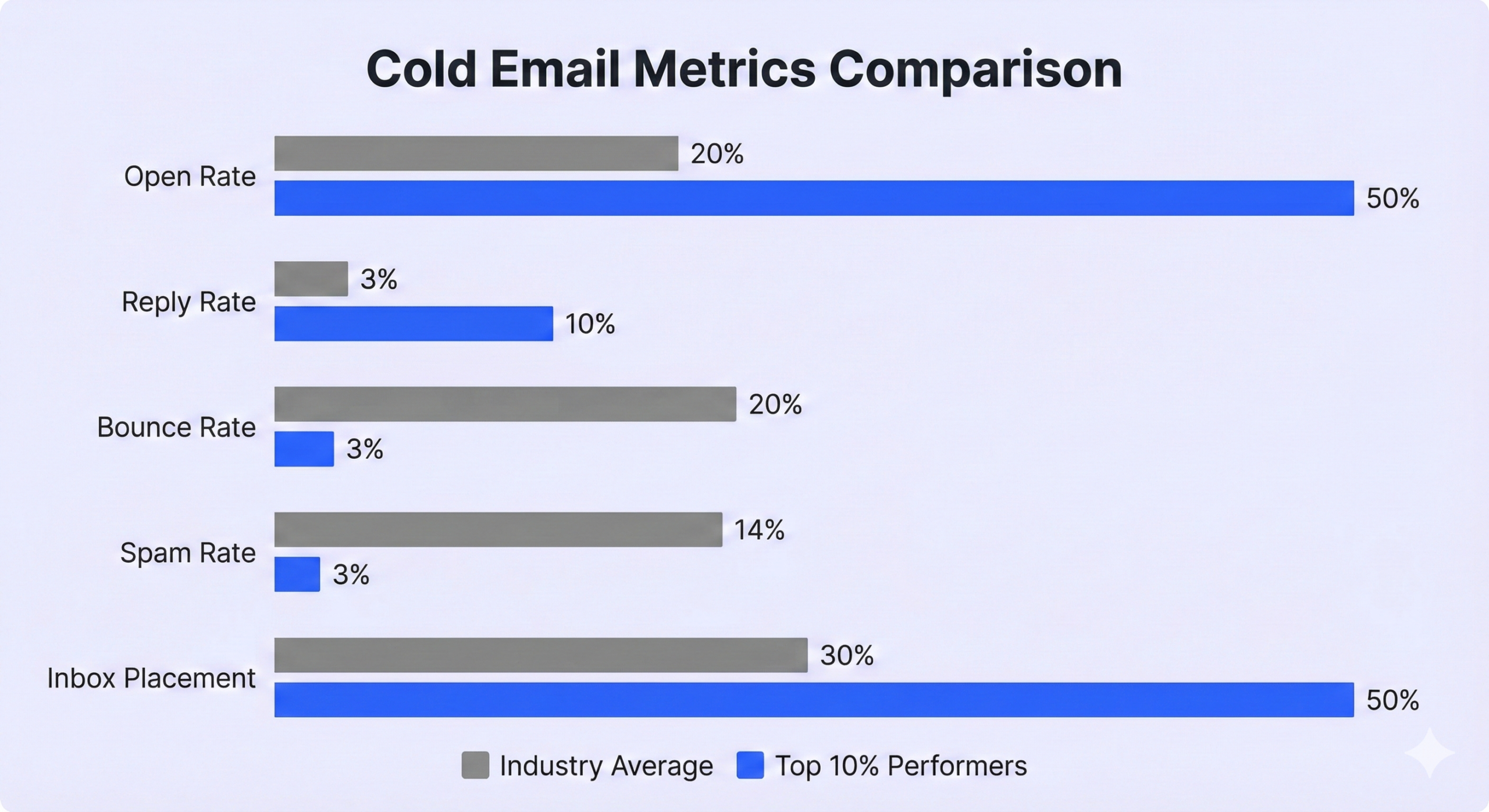
Metric | Industry Average | Top 10% Performers | Warning Level |
Open Rate | 27.7% | 50%+ | < 15% (Domain Issue) |
Reply Rate | 3.43% | 10.7%+ | < 1% (Messaging Issue) |
Bounce Rate | 7–8% | < 2% | > 5% (Data Quality Issue) |
Spam Rate | 0.15% | < 0.05% | > 0.3% (Compliance Issue) |
Inbox Placement | 83.1% | 95%+ | < 80% (Technical Issue) |
These numbers tell a clear story: the average sender is losing nearly 1 in 6 emails to spam filters or delivery failures. Teams that master compliance consistently achieve double-digit response rates and near-perfect inbox placement.
Conclusion
Email compliance in 2025 is not a burden — it’s your competitive advantage. The teams that treat it that way are the ones consistently booking meetings while others wonder why their campaigns aren’t working.
Here’s what it comes down to: get your technical authentication right (SPF, DKIM, DMARC), understand the laws that apply to your audience (CAN-SPAM, GDPR, CASL), build your lists ethically, honor opt-outs immediately, and send messages that are genuinely relevant.
The era of blasting generic emails to massive lists is over. The future of cold outreach belongs to those who send fewer, better, more targeted messages — with the technical infrastructure to back it up.
If you want help building a compliant, high-performing outbound system without spending months figuring it all out yourself, Salesso specializes in exactly this. We design complete outbound strategies — targeting, campaign design, and scaling — that book you qualified meetings while keeping your domain safe.
