

If you’re still building lead lists manually in 2025, you’re playing the game on hard mode.
80% of generated leads never convert — not because the product is bad, but because the outreach is generic, mistimed, or sent to the wrong person entirely. That’s a massive leak in the pipeline.
Clay fixes that.
It’s not just another database. It’s an orchestration layer — a system that finds your ideal prospects, enriches their data from 150+ sources, and helps you personalize outreach at scale. Think of it as a programmable brain that sits in front of your CRM.
This guide breaks down exactly how to use Clay for B2B lead generation — step by step, no fluff.
How to Use Clay for B2B Lead Generation?
Clay works on a simple but powerful framework: Find → Enrich → Transform → Export (FETE).
Every lead that enters your pipeline goes through this process automatically. By the time a message is sent, the prospect has been researched, verified, and personalized — without you lifting a finger.
Here’s how each step works in practice.
Start With Signal-Based Sourcing
The old way: export a list of 10,000 companies by industry and start blasting.
The new way: find the 500 companies that are actively in-market right now.
Clay connects directly to LinkedIn, Apollo, Crunchbase, Google Maps, and dozens of other sources. You can pull targeted lists based on criteria like:
- Companies that recently raised a funding round
- Businesses actively hiring for specific roles (signals internal pain points)
- Prospects using competitor tools (technographic targeting)
- Decision-makers who engaged with relevant content this week
This is what modern B2B prospecting looks like. You’re not spraying and praying — you’re targeting accounts with a buying signal already in place.
Why it matters: Lead generation is the top priority for 91% of B2B marketers, yet most teams still rely on static lists that decay at 25–30% every year. Signal-based sourcing keeps your pipeline fresh.
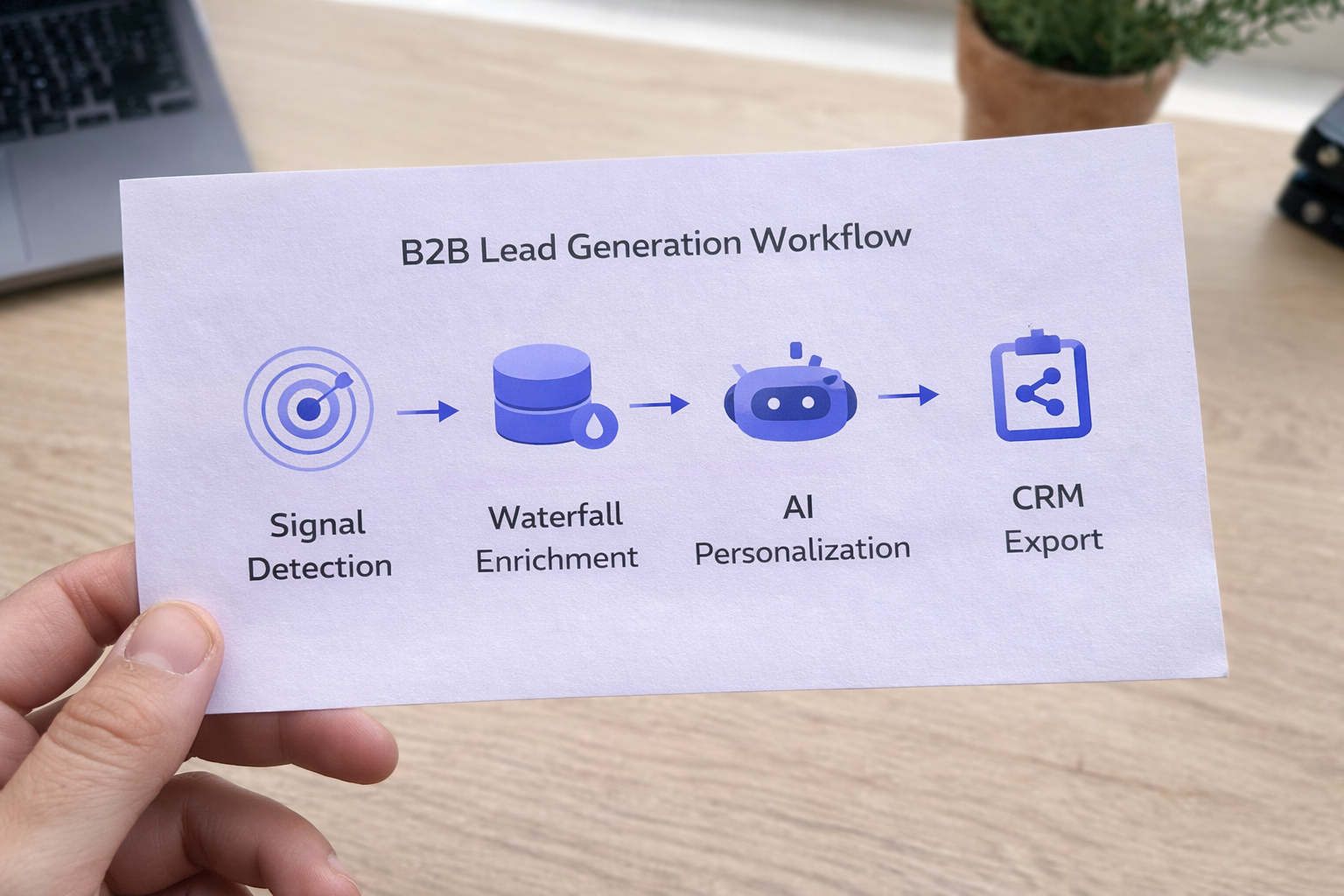
Use Waterfall Enrichment to Maximize Email Match Rates
Here’s the dirty secret about most data providers: no single provider covers everyone.
Apollo might find 40% of your list. Hunter finds another 30%. Findymail picks up another 20%. Alone, each is incomplete. Together, they’re nearly bulletproof.
That’s waterfall enrichment — stacking multiple data providers in sequence so that if Provider A fails, Provider B takes over automatically. Clay does this natively.
The math is compelling:
If each of five providers has a 40% success rate independently, your cumulative match rate exceeds 92%.
Compare that to the industry standard of 40–50% when using a single database. That’s the difference between a mediocre pipeline and a full calendar.
Clay’s waterfall logic works in tiers:
Tier | Providers | Role |
Tier 1 | Apollo, Hunter, Snov.io | Broad initial coverage |
Tier 2 | Findymail, Dropcontact, Lusha | High-accuracy niche domains |
Tier 3 | Nimbler, People Data Labs | Enterprise emails + direct dials |
Tier 4 | NeverBounce, ZeroBounce | Final deliverability validation |
You only pay for successful lookups. No wasted credits. No bloated annual contracts. That’s financial arbitrage compared to the ZoomInfo model.
Beyond emails, you can also enrich firmographic context — department headcounts, funding dates, tech stacks — everything you need to personalize intelligently. Explore more on lead enrichment tools that integrate with this workflow.
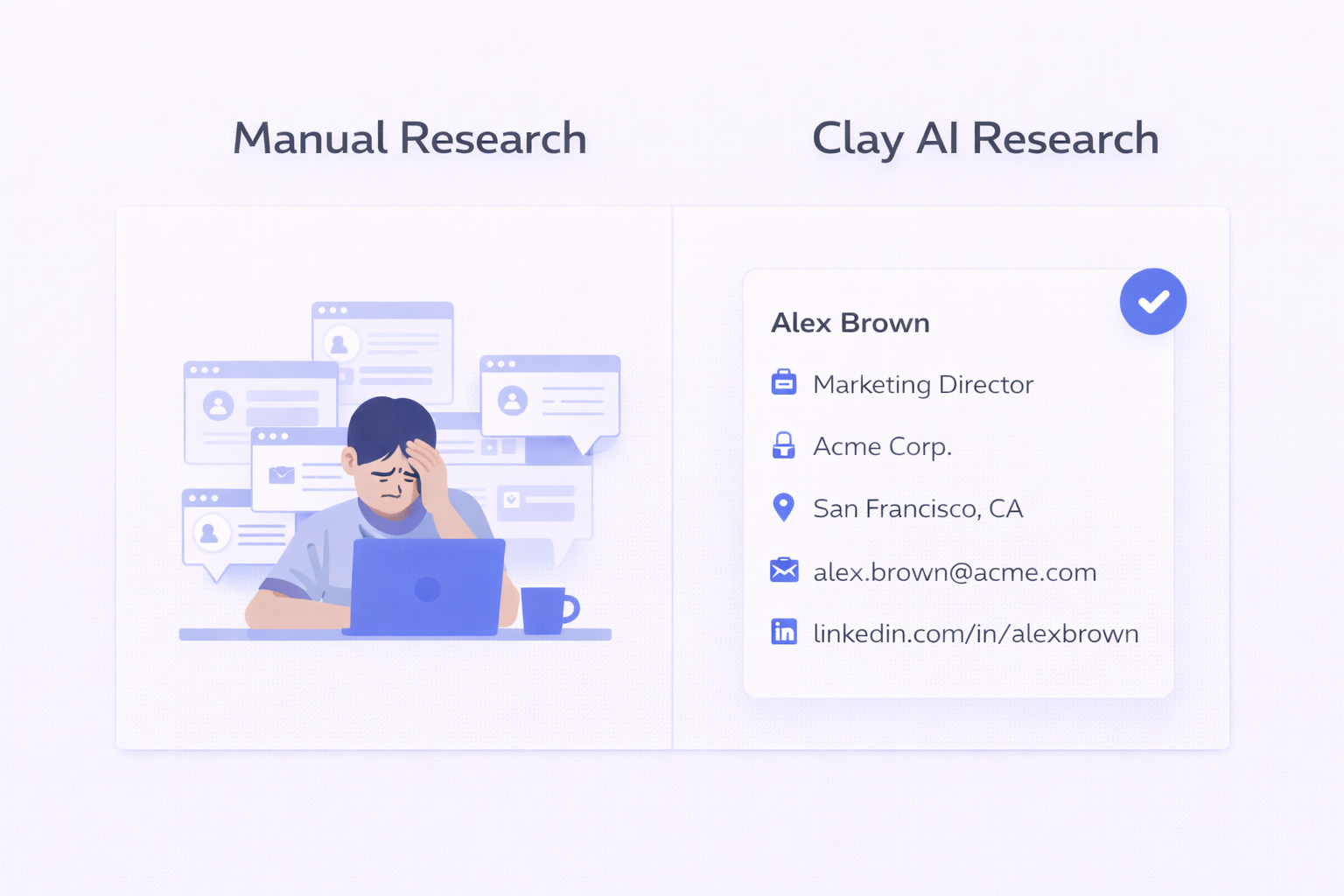
Let AI Do the Research (Without Sounding Like a Robot)
This is where Clay gets genuinely impressive.
Clay’s built-in AI agent — Claygent — can visit a prospect’s LinkedIn profile, read their last three posts, scan their company’s news section, and extract a specific pain point. All in under 30 seconds.
Then it maps that pain point to your product and writes a hyper-relevant opening line.
A typical Claygent workflow looks like this:
- Visit prospect’s LinkedIn → summarize their 3 most recent posts
- Identify a specific frustration or initiative they mentioned
- Match it to a relevant product feature or outcome
- Draft a 15-word opening line that sounds like it came from a colleague, not a bot
The result? Personalized messages at scale without the “AI slop” that buyers have learned to filter out.
And if a prospect hasn’t posted in 30 days? Clay automatically triggers a fallback — maybe a recent award the company won, or a new tool they adopted. The system never forces a generic line. This kind of AI-powered approach is why orchestrated outreach hits 5–10%+ response rates vs. the 1–3% you get from traditional cold email.
Teams using this approach report spending less than 30 seconds per lead on research — compared to the 40% of the workday that used to go toward manual tasks.
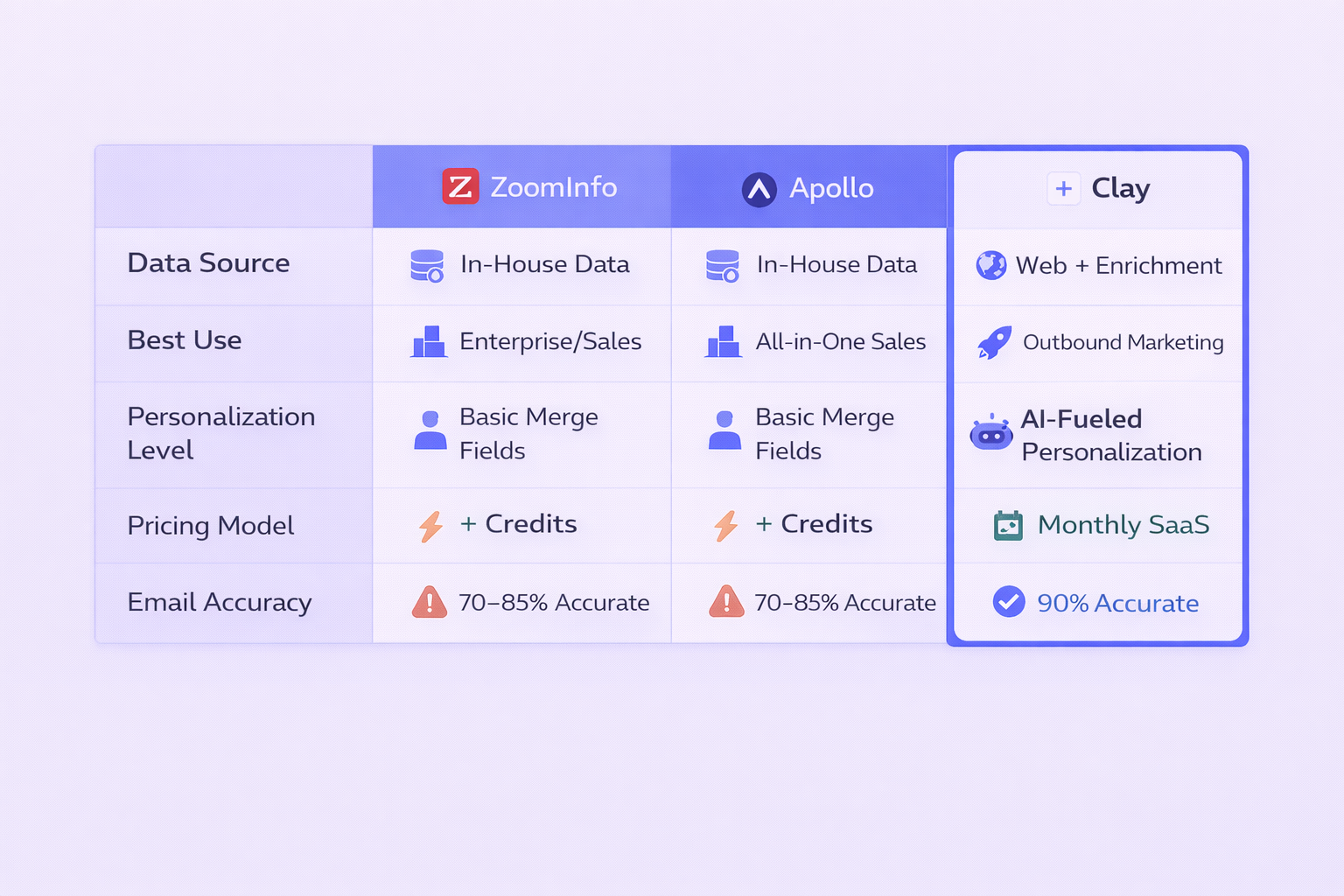
How Clay Compares to Apollo and ZoomInfo
Before you go all-in on any tool, it helps to understand where Clay sits in the market.
Feature | ZoomInfo | Apollo | Clay |
Data Source | Proprietary DB | Internal + Scraping | 150+ External APIs |
Best For | Enterprise volume | High-speed simplicity | Custom GTM workflows |
Personalization | Static variables | Basic AI | Deep AI research agents |
Pricing | Annual contract | Tiered monthly | Credit-based |
Email Accuracy | High (US-focused) | Varies by region | Waterfall-verified |
ZoomInfo is the legacy choice — deep data, enterprise pricing, static datasets. Apollo is the all-in-one starter option. Clay is the modular system that powers both.
Most mature teams use Clay on top of Apollo — querying Apollo through Clay’s waterfall, then layering in additional providers and AI research for maximum accuracy and personalization.
For teams running targeted outreach at scale, Clay is the infrastructure layer that makes everything else smarter.
How Clay Compares to Apollo and ZoomInfo
Before you go all-in on any tool, it helps to understand where Clay sits in the market.
Feature | ZoomInfo | Apollo | Clay |
Data Source | Proprietary DB | Internal + Scraping | 150+ External APIs |
Best For | Enterprise volume | High-speed simplicity | Custom GTM workflows |
Personalization | Static variables | Basic AI | Deep AI research agents |
Pricing | Annual contract | Tiered monthly | Credit-based |
Email Accuracy | High (US-focused) | Varies by region | Waterfall-verified |
ZoomInfo is the legacy choice — deep data, enterprise pricing, static datasets. Apollo is the all-in-one starter option. Clay is the modular system that powers both.
Most mature teams use Clay on top of Apollo — querying Apollo through Clay’s waterfall, then layering in additional providers and AI research for maximum accuracy and personalization.
For teams running targeted outreach at scale, Clay is the infrastructure layer that makes everything else smarter.
The Real ROI of Using Clay
Here’s what the numbers actually look like when organizations make this shift:
- Email discovery rate jumps from 40–50% to 80–92% with waterfall enrichment
- Response rates increase from 1–3% to 5–10%+ with AI personalization
- Research time per lead drops from 15–20 minutes to under 30 seconds
- Pipeline volume increases by an average of 20% with signal-based targeting
- Sales revenue grows by up to 25% while costs drop by 30%
The math is straightforward: automate the top of the funnel, and the entire revenue engine becomes more efficient without adding headcount.
