Here’s a number that should make you stop scrolling: sales reps spend only about 25% of their time actually selling. The rest? Buried in admin work, manual research, and chasing leads that were never going to buy in the first place.
And it gets worse. 67% of lost sales can be traced back to poor qualification upfront. That’s not a pipeline problem — it’s a prioritization problem.
This is exactly where AI in lead scoring changes the game. Instead of guessing which leads are worth your time, AI tells you — with data. It ranks your prospects by actual purchase likelihood, so your team focuses on the people most likely to say yes.
Whether you’re running cold email, LinkedIn outreach, or cold calling, the foundation is the same: you need to know who’s worth reaching out to before you pick up the phone or hit send. Let’s break down how this works, why it matters, and how to make it work for you.
What Is AI Lead Scoring?
Traditional lead scoring works like this: your team assigns point values to certain actions — +10 points for downloading a whitepaper, +5 points for opening an email — then adds them up and calls it a day. It sounds logical. But it’s deeply flawed.
The problem is that these rules are static, created by humans with biases, and can only handle a handful of variables at once. Your buyer’s journey is anything but simple, so why should your scoring be?
AI lead scoring replaces that guesswork with machine learning. Instead of fixed rules, it analyzes hundreds of signals simultaneously — website behavior, email engagement, company size, tech stack, intent data from third-party sources — and calculates a real probability that this person will buy.
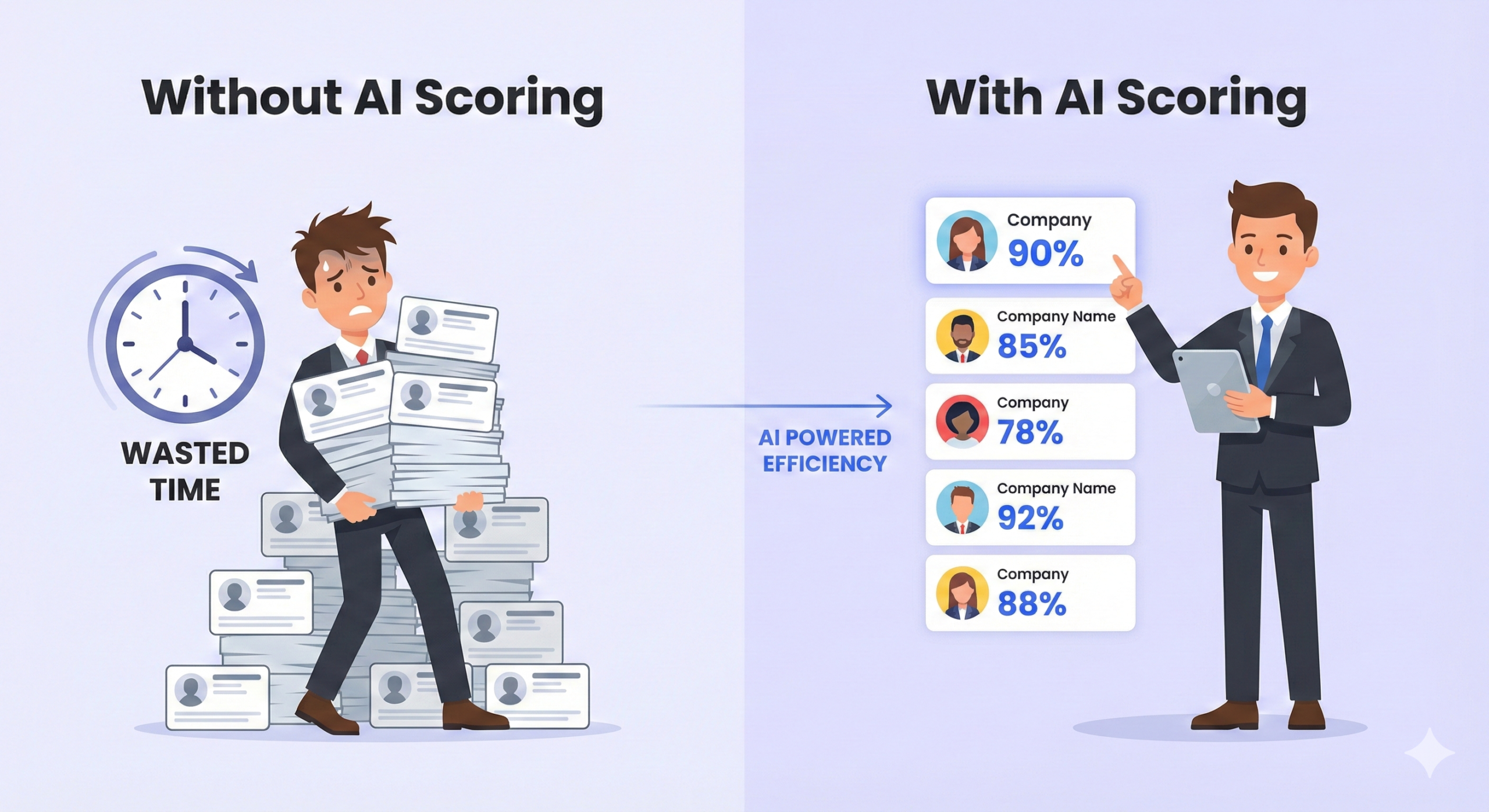
The result: your team wakes up every morning with a ranked list. Not 200 equal-looking leads. A prioritized view of who’s hot, who’s warm, and who needs more time.
How AI Models Actually Work
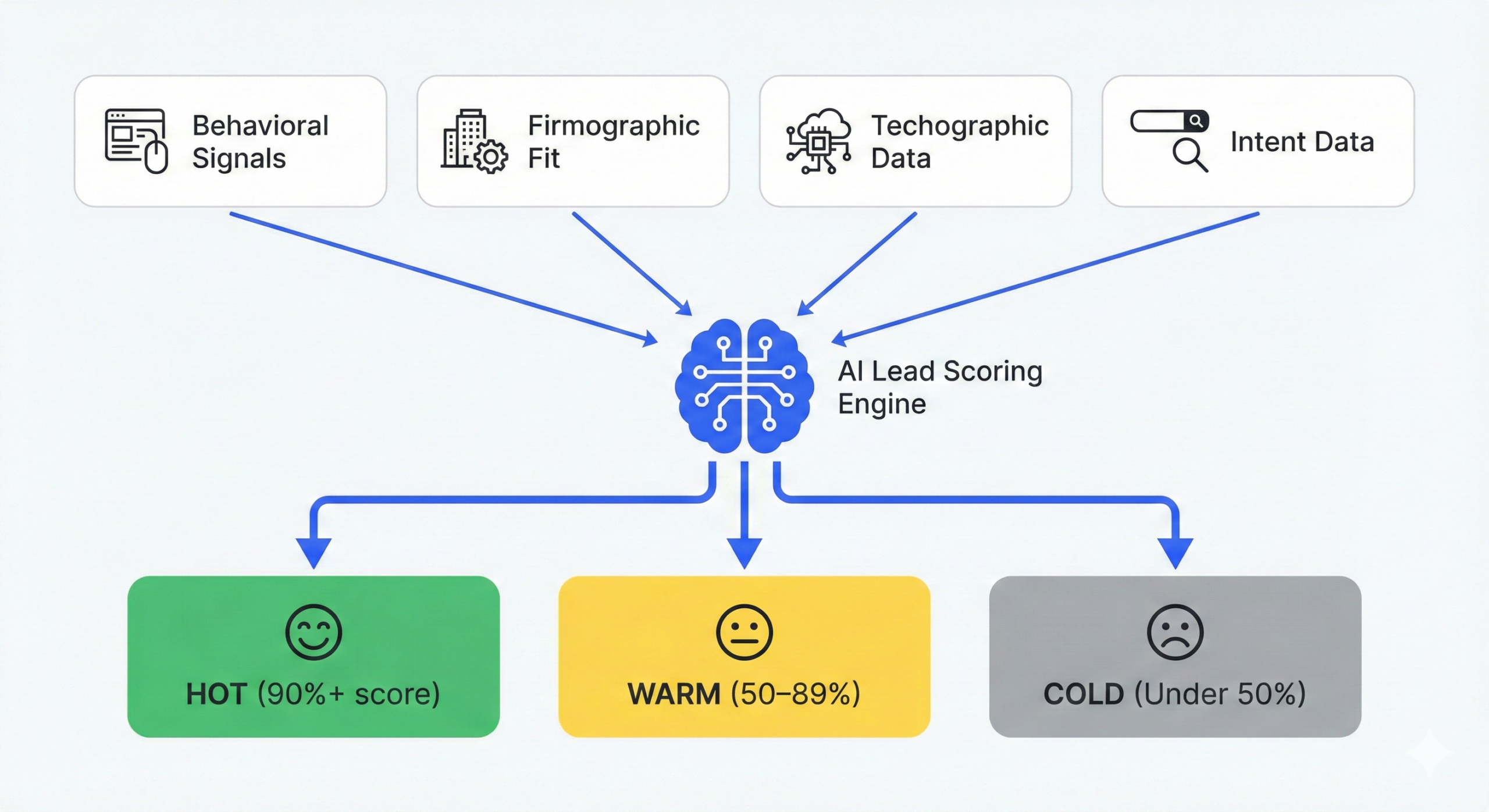
Think of it as your best salesperson’s instincts, supercharged by data. Here’s what the model actually looks at:
- Behavioral signals: Page visits, time on pricing pages, email opens, webinar attendance. Context matters — someone who visits your pricing page three times in 24 hours is different from a one-time visitor.
- Firmographic fit: Company size, industry, revenue, headcount. Does this company match your ideal customer profile?
- Technographic data: What tools are they using? Are they already using a competitor’s product? Or a complementary tool that makes your solution obvious?
- Intent data: Are they actively researching solutions like yours on comparison sites like G2? Did they just receive funding? Did their leadership change?
When all these signals combine, the AI model generates a conversion probability score — a clear, data-backed number that tells your team exactly where to focus. This is the core promise of predictive lead scoring: stop guessing, start knowing.
The best part? The model keeps learning. Every deal closed, every lost opportunity, every email response feeds back into the system, making it sharper over time.
AI vs. Manual Scoring: A Head-to-Head Breakdown
Still not sure if the upgrade is worth it? This comparison will make it clear:
Feature | Manual / Rule-Based | AI-Powered Scoring |
Core Logic | Static human-defined rules | ML algorithms + pattern recognition |
Data Scope | Basic demographic/behavioral data | 100s of signals (behavioral, firmographic, intent) |
Adaptability | Manual updates required | Continuous self-optimization |
Accuracy | 55–65% qualification accuracy | 75–90% conversion prediction accuracy |
Update Speed | Weekly or monthly | Real-time / dynamic |
Objectivity | High risk of human bias | Data-driven, quantitative |
The accuracy gap alone tells the story. Manual systems hit 55–65% qualification accuracy. AI-powered systems reach 75–90% conversion prediction accuracy. For a team of 15, that gap translates to over $480,000 in wasted salary and opportunity costs per year — pursuing leads that were never going to close.
Organizations that make the switch report an average of 40% time saved per rep and an 18% reduction in sales cycle length. Those aren’t incremental improvements — they’re compounding advantages that separate high-growth teams from the rest.
The Business Case: What the Numbers Say
Let’s talk hard numbers. AI adoption among sales teams has nearly doubled in just one year — jumping from 24% to 43% in 2024. And the performance correlation is unmistakable: reps who integrate these tools effectively are 3.7x more likely to hit quota than those using manual methods.
On the data quality side, poor CRM hygiene costs businesses an average of $12.9 million annually. AI scoring models are only as good as the data they’re trained on — which is why clean, verified contact data is non-negotiable. If you’re running cold outreach, bounce rates above 2% damage your domain reputation and blind your scoring model to the behavioral signals it needs.
Speed matters too. High-intent prospects are 47% more likely to convert when engaged with real-time assistance. AI scoring makes that speed possible by surfacing hot leads the moment they show purchase intent — not hours or days later when you manually spot it.
For more context on what drives qualified pipeline, see our breakdown of sales-qualified lead statistics for 2025 →
What Signals Actually Move the Needle
Not all signals are created equal. Here’s what moves the needle most in modern AI scoring systems:
- Pricing page visits (especially repeated, within 24–48 hours)
- Demo request clicks or form abandonment (near-bottom-of-funnel intent)
- Email replies — even short ones — especially questions about pricing or implementation
- Company milestones: new funding, leadership changes, team growth (tracked via intent platforms)
- Competitive research activity: visiting comparison pages on G2, Capterra, or similar sites
- Historical data patterns: which past customers shared similar behavior before buying
Historical data is the backbone of any good model. The more historical data you feed it — won deals, lost deals, churned customers — the more accurately it can identify the patterns that predict a close. If you’re just starting out, even six months of data is enough to get meaningful results. Enterprise-grade systems typically need 12 months and 1,000+ leads for peak accuracy.
How to Actually Implement AI Lead Scoring
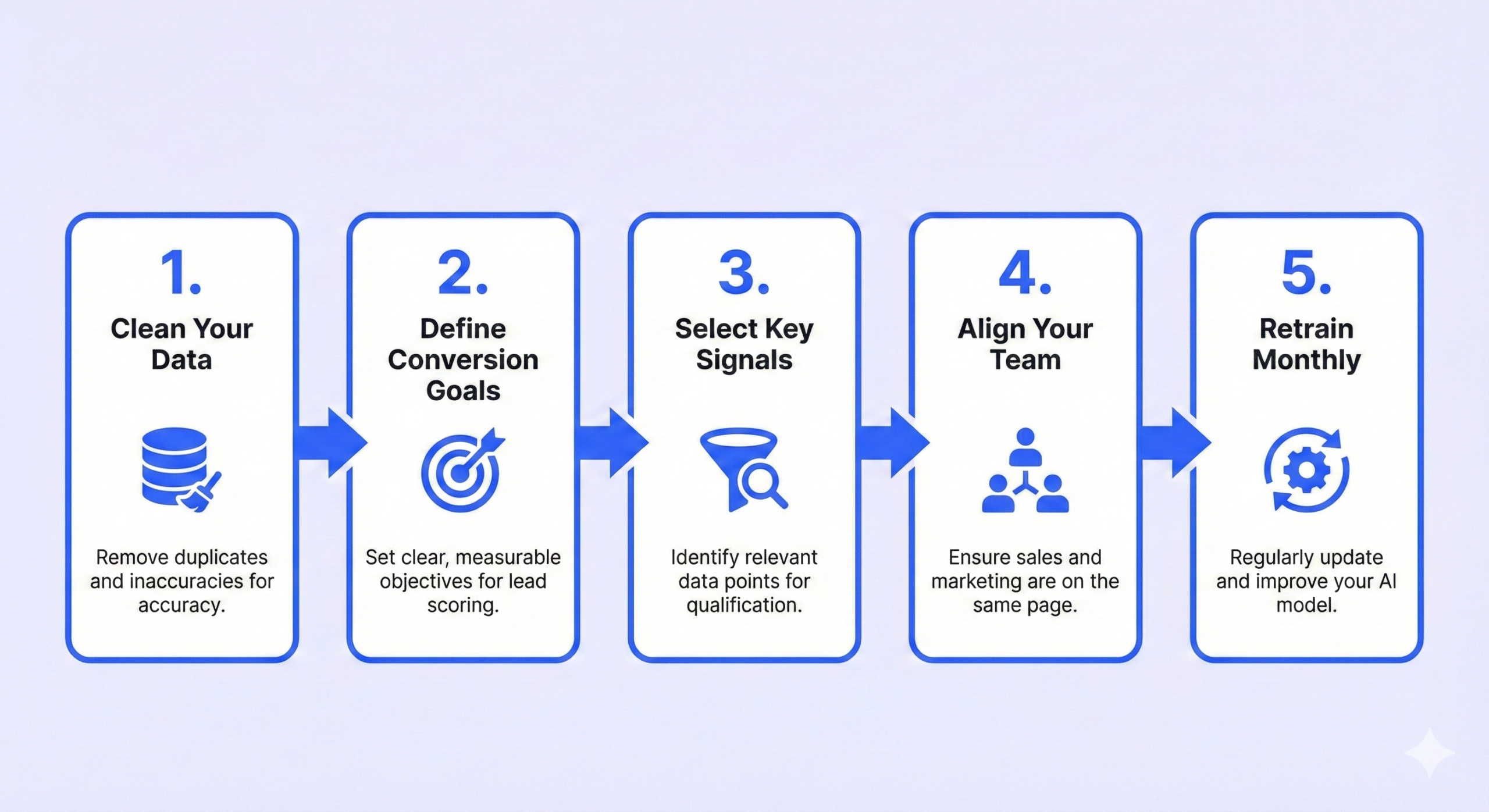
Most teams overthink this. Here’s a practical 5-step path that works:
Step 1 — Clean your data first. Audit your CRM for duplicate records, outdated contacts, and missing fields. Your AI model is only as accurate as what you feed it. For cold outreach teams, this means verifying email addresses and keeping bounce rates under 2%.
Step 2 — Define what ‘converted’ means. Is it a booked demo? A signed contract? Set clear conversion milestones so the model knows exactly what it’s optimizing for.
Step 3 — Choose the right signals. Not every data point matters equally. SaaS companies might weight product usage data heavily. Service providers might prioritize webinar attendance or content engagement. Build your feature set around what’s actually correlated with your wins.
Step 4 — Align your team around the scores. If your team doesn’t trust the AI outputs, they’ll ignore them. Show them why a lead scored high — transparency builds buy-in. Sales and marketing need to agree on what a ‘hot’ lead looks like before you deploy.
Step 5 — Review and retrain monthly. Market conditions shift. Buyer behaviors evolve. High-growth teams review their scoring logic every 30–60 days and retrain the model when patterns drift. This isn’t a set-and-forget solution — it’s a living system.
If you’re not sure where to start with data enrichment, our guide on lead enrichment for CRM walks through the exact process. And if you haven’t built your ideal customer profile yet, do that first — it directly shapes which firmographic signals your model should weight most.