🎉Find Prospects and Send Cold Emails & LinkedIn Outbound | All in One Place

AI Marketing Statistics: The Ultimate 2025 Guide for Modern Marketers

Table of Contents

AI Marketing Statistics 

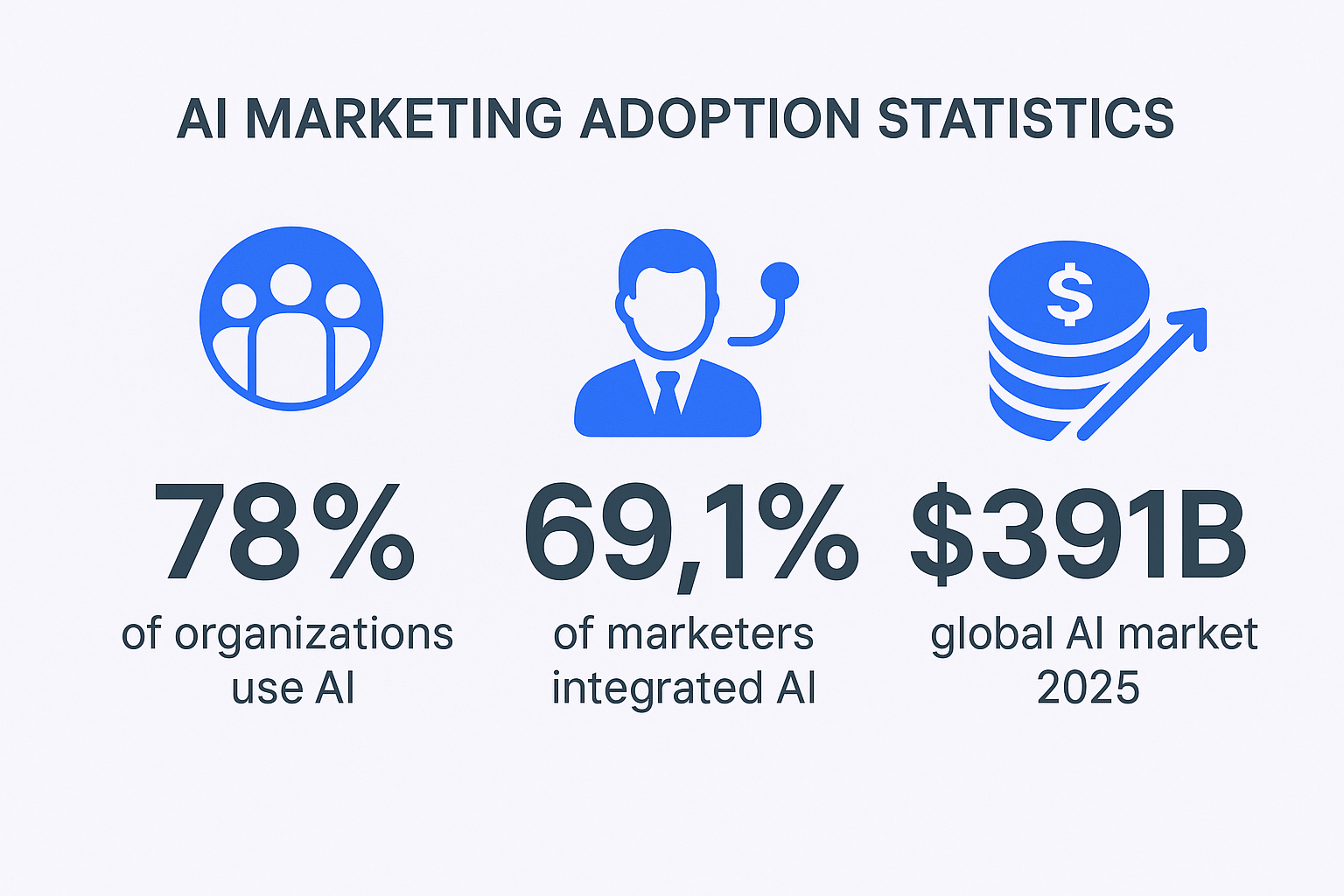
  • 78% of organizations now use AI in some capacity – showing mainstream adoption across businesses
  • Global AI market hitting $391 billion in 2025 – projected to reach $1.81 trillion by 2030
  • 69.1% of marketers have already integrated AI into their operations – AI has crossed into mainstream marketing territory
  • 85% of marketers now use AI writing tools for content creation – making it the most popular AI application in marketing
  • Companies using AI publish 42% more content per month – dramatically increasing content output
  • 73% of marketers believe AI is key for personalization – with fast-growing companies generating 40% more revenue from personalization
  • 58% of B2B companies now use chatbots on their websites – becoming standard for lead generation and support
  • AI chatbots successfully answer 79% of routine questions – while reducing customer support costs by 30%
  • Businesses using AI chatbots for lead qualification see 3x better sales conversion rates – compared to traditional web forms
  • 51% of marketers use AI to optimize website content for search engines – with AI-assisted blog writing increasing organic traffic by 120% within six months
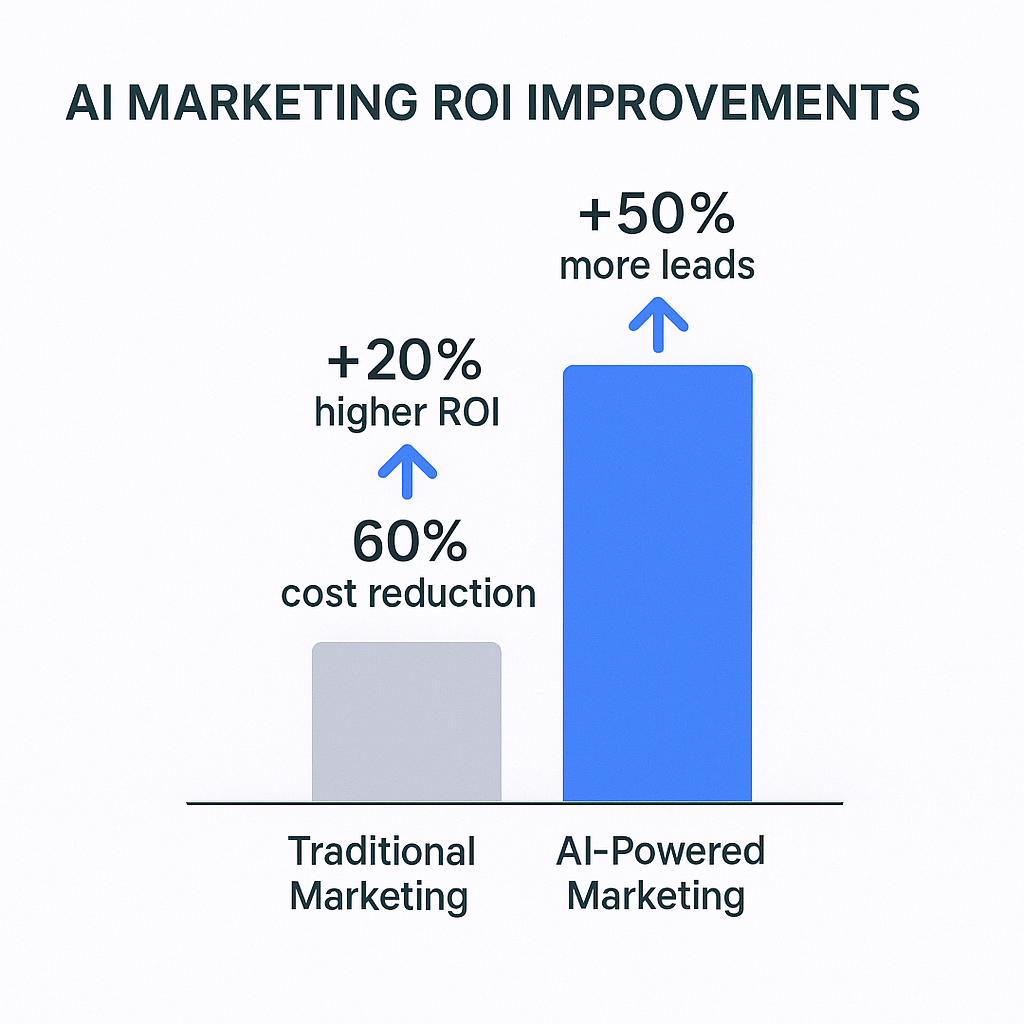
  • Companies leveraging AI in marketing see 20-30% higher ROI on campaigns – compared to traditional methods
  • 50% increase in leads for sales teams using AI – with 60% reduction in call times
  • 97% of companies edit and review AI-generated content before publishing – ensuring brand voice and accuracy despite widespread AI use
  • 70% of marketers report technical challenges with AI marketing software – showing implementation isn’t always smooth
  • Nearly 60% of marketers fear AI could replace their roles – up dramatically from 35.6% in 2023, creating anxiety around job displacement

The artificial intelligence revolution isn’t coming to marketing—it’s already here. With 78% of organizations now using AI and the global AI market hitting $391 billion in 2025, marketers who aren’t leveraging these tools are falling behind fast.

This comprehensive guide reveals the most important ai marketing statistics that will shape your strategy in 2025 and beyond. Whether you’re just starting with ai adoption or looking to optimize your existing ai tools, these data-driven insights will help you make smarter decisions.


What is AI in Marketing?

AI marketing is the process of leveraging data models, algorithms, and machine learning to produce customer insights that marketers use to optimize spending, customize content, and personalize the customer journey. It represents a fundamental shift from reactive analysis to predictive, automated engagement at unprecedented scale.

Modern artificial intelligence ai enables marketers to:

  • Automate repetitive tasks like content creation and data analysis
  • Predict customer behavior and optimize campaigns in real-time
  • Personalize experiences for individual users at scale
  • Generate insights from massive datasets that humans couldn’t process

🎯 Turn AI Data Into LinkedIn Leads

Our outbound engine combines AI-powered targeting with proven LinkedIn campaigns that scale predictably.

The technology has evolved from a “nice-to-have” experimental tool to an essential competitive advantage. 69.1% of marketers have already integrated AI into their operations, making it clear that ai adoption has crossed into mainstream territory.

10 Must-Know Marketing AI Use Cases for 2025

Content Creation Revolution

85% of marketers now use AI writing tools for content creation, making this the most popular application of artificial intelligence in marketing. Companies using AI publish 42% more content per month, while 83% of marketers report that AI frees up time for strategic work.

 📧 AI Content Meets Outbound Precision

Generate AI-optimized messages, then deploy through LinkedIn campaigns with surgical B2B targeting and scaling systems.

However, quality control remains crucial—97% of companies edit and review AI-generated content before publishing, ensuring brand voice and accuracy.

Hyper-Personalization at Scale

73% of marketers believe AI is key for personalization, and the results speak for themselves. Fast-growing companies generate 40% more revenue from personalization than slower competitors, while businesses excelling at personalization see customers spend 38% more on average.

Predictive Analytics Powerhouse

AI-powered predictive analytics helps marketers move from reactive to proactive strategies. Key applications include:

  • Customer churn prediction
  • Lead scoring optimization
  • Intelligent audience segmentation
  • Conversion probability forecasting

Conversational AI Growth

58% of B2B companies now use chatbots on their websites. Modern AI chatbots successfully answer 79% of routine questions and reduce customer support costs by 30%. Most impressively, businesses using AI chatbots for lead qualification see 3x better sales conversion rates compared to traditional web forms.

SEO Optimization

51% of marketers use AI to optimize website content for search engines. AI-assisted blog writing has been shown to increase organic traffic by 120% within six months, while AI-powered copywriting tools improve ad click-through rates by 38%.

Data Analysis & Insights

63% of marketers use AI to analyze market data, enabling them to process vast amounts of information and identify patterns that would be impossible to detect manually.

Customer Service Enhancement

AI-powered customer service tools are becoming standard, with 69% of consumers satisfied with their most recent chatbot interaction, though 60% still prefer human agents for complex issues.

Email Marketing Optimization

AI enhances email campaigns through send-time optimization, subject line testing, and content personalization at scale.

Social Media Management

Artificial intelligence automates posting schedules, analyzes engagement patterns, and suggests optimal content strategies across platforms.

Ad Targeting & Optimization

74% of agencies use machine learning for data signals in advertising, leading to more precise targeting and improved campaign performance.

Advantages of AI in Marketing

Proven ROI and Performance Gains

The financial benefits of ai marketing are substantial and well-documented. Companies leveraging AI in marketing see 20-30% higher ROI on campaigns compared to traditional methods. This translates to tangible business impact:

  • 50% increase in leads for sales teams using AI
  • 60% reduction in call times
  • Overall cost reductions of up to 60%


💰 Want 50%+ More Qualified Leads?

LinkedIn outbound delivers decision-maker access AI can’t. Complete targeting blueprints, campaign design, and scaling playbooks.

Enhanced Efficiency and Scale

AI dramatically improves operational efficiency. 34.1% of marketers report significant improvements after implementing AI tools. The technology enables marketers to work faster and smarter by automating time-consuming tasks like data analysis, content creation, and campaign optimization.

Superior Customer Insights

Artificial intelligence processes customer data at a scale and speed impossible for human teams. This leads to deeper understanding of customer behavior, preferences, and buying patterns, enabling more effective targeting and personalization strategies.

Competitive Advantage

85% of executives believe AI helps obtain and sustain competitive edge, while 75% of marketers feel AI provides them with a distinct competitive advantage.

24/7 Availability

AI-powered systems work around the clock, ensuring consistent customer engagement and lead capture even outside business hours.

Disadvantages of AI in Marketing

Implementation Challenges

Despite proven benefits, AI adoption faces significant hurdles. 70% of marketers report technical challenges with AI marketing software, while 71.7% of non-adopters cite lack of understanding as the primary barrier.

🚀 Skip AI Complexity, Go Direct

LinkedIn outbound needs no setup headaches. Done-for-you targeting, messaging frameworks, and campaign management that converts.

7-day Free Trial |No Credit Card Needed.

Data Privacy and Security Concerns

49.5% of businesses implementing AI have data privacy or ethics concerns. Navigating regulations like GDPR and CCPA while using customer data requires careful governance and compliance measures.

Cost and Resource Constraints

35% of organizations worry about high AI tool costs, while 34.1% of marketers identify budget constraints as a key adoption blocker. Initial investment includes software licensing, implementation, integration, and ongoing training costs.

Fear of Inaccuracy and Bias

43% of businesses worry about AI inaccuracies, leading many to maintain human oversight for all AI-generated content and decisions.

Skills Gap and Training Needs

A critical challenge exists in talent development. 70% of marketers report their employer provides no training for generative AI tools, creating an “Adoption-Capability Gap” where companies buy technology but fail to develop human expertise.

Job Displacement Anxiety

Nearly 60% of marketers fear AI could replace their roles, a figure that has risen dramatically from 35.6% in 2023. This anxiety can hinder adoption and team morale if not properly addressed.

5 Steps to Use AI in Your Marketing Strategy

Assess Needs & Define Clear Goals

Start by identifying specific pain points where AI can provide the most significant impact. Instead of vague objectives like “implement AI,” set measurable goals such as “reduce customer service response times by 50% and increase website lead qualification by 15% within six months.”

Start Small with Pilot Projects

Begin with focused, low-risk implementations like using AI for brainstorming blog post ideas, creating ad copy variations, or deploying a basic chatbot for frequently asked questions. Successful pilots demonstrate value and build momentum for broader adoption.

Ensure Data Readiness & Technical Infrastructure

Evaluate your data quality, accessibility, and current technology stack compatibility. Ensure clean, structured data and address security and privacy compliance from the beginning.

Build Team Expertise & Foster Champions

Invest in accessible AI training programs tailored to marketers. Identify internal “AI champions” who show enthusiasm and aptitude for the technology to drive adoption from within.

Develop a Scalable Integration Plan

Create a roadmap prioritizing future AI integration points based on impact and implementation ease. Establish clear KPIs to monitor performance and continuously refine your approach.

Key AI Marketing Statistics by Category

Market Size and Growth

  • Global AI market: $391 billion (2025)$1.81 trillion (2030)
  • AI marketing industry value: $47.32 billion (2025)
  • Projected CAGR: 35.9% (2025-2030)

Adoption Rates

  • 78% of organizations use AI in some capacity
  • 69.1% of marketers have integrated AI into operations
  • 88% of marketers rely on AI in their jobs
  • 94% of organizations use AI for marketing activities

Budget Allocation

  • 20% of marketers allocate over 40% of budget to AI campaigns
  • 47.6% spend less than 10% of budget on AI-powered campaigns

ROI and Performance

  • 20-30% higher ROI on AI-driven campaigns
  • 50% increase in leads for AI-powered sales teams
  • 120% increase in organic traffic from AI-assisted blog writing
  • 38% higher click-through rates with AI copywriting tools

Implementation Barriers

  • 71.7% of non-adopters cite lack of understanding
  • 70% face technical challenges with AI software
  • 49.5% have data privacy concerns
  • 43% worry about inaccuracies

FAQs

What percentage of marketers use AI in 2025?

69.1% of marketers have integrated AI into their operations as of 2025, with some studies showing adoption rates as high as 88% depending on how AI usage is defined.

What is the ROI of AI marketing?

Companies using AI in marketing see 20-30% higher ROI compared to traditional methods, with additional benefits including 50% more leads and up to 60% cost reductions.

What are the most popular AI marketing use cases?

The top applications are content creation (85% adoption), personalization (73%), data analysis (63%), and chatbots for customer service (58% of B2B companies).

What are the biggest challenges in AI marketing adoption?

The primary barriers are lack of understanding (71.7%), technical implementation challenges (70%), data privacy concerns (49.5%), and budget constraints (34.1%).

How much should companies budget for AI marketing?

Budget allocation varies widely—20% of marketers spend over 40% of their budget on AI campaigns, while 47.6% spend less than 10%. The optimal amount depends on company size, maturity, and strategic priorities.

LinkedIn Outbound > AI Tools Alone

Combine AI insights with precision B2B targeting. Complete campaign strategy, execution, and scaling.

Segmentation That Actually Converts

LinkedIn outbound targets precise demographics with strategic campaign design and scaling methods