
Let's Build Your First Campaign Together with our LinkedIn Expert

AI Powered Lead Generation Software

Table of Contents

Finding the right leads used to mean spending hours manually researching prospects, cold calling hundreds of numbers, and hoping something sticks.

But here’s the reality: 43% of sales professionals now use AI tools to automate their prospecting, nearly doubling from just 24% a year ago. That’s not a trend—that’s a complete transformation of how successful teams operate.

The difference? AI-powered lead generation software doesn’t just hand you a list of names. It predicts who’s ready to buy, personalizes outreach at scale, and automates follow-ups while you focus on closing deals.

Think about it. While you’re manually researching one prospect, AI is analyzing thousands of data points across hundreds of potential buyers—finding the ones showing genuine interest right now.

In this guide, we’re breaking down exactly how AI lead generation works, which tools deliver results, and how you can implement this without replacing your entire tech stack. No fluff, just the tactics that are working in 2025.

AI Powered Lead Generation Software

Here’s what most people get wrong about AI tools for prospecting—they think it’s just fancy automation. It’s not.

Real AI lead generation software makes decisions. It watches buyer behavior, scores leads based on actual intent signals, and crafts personalized messages that don’t sound like templates.

The results speak volumes. Companies using AI for predictive analytics see a 50% increase in sales-ready leads and a 60% reduction in cost-per-acquisition. But only if you’re using the right approach.

What AI Actually Does for Lead Generation

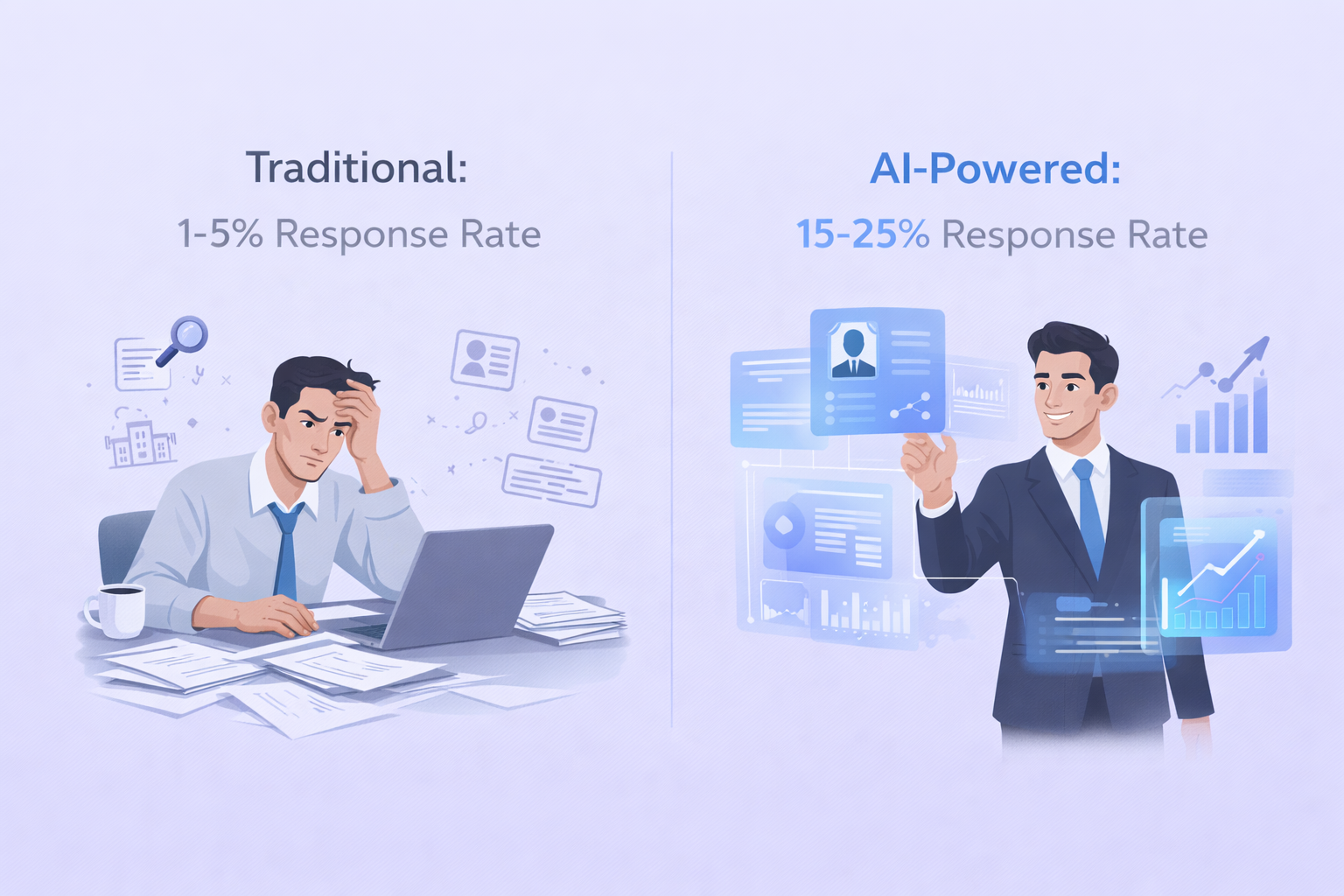
Traditional prospecting follows a linear path: find contact, write email, send, wait, follow up. Rinse and repeat until something lands.

AI flips this entirely. Instead of guessing who might be interested, it identifies prospects actively showing buying signals—website visits, competitor research, job changes, funding announcements.

Here’s the breakdown:

Identification: AI uses lookalike modeling to find prospects matching your best customers. Not just job titles—behavioral patterns, tech stack similarities, and company growth indicators.

Qualification: Predictive scoring analyzes thousands of signals instantly. It knows if a prospect is researching solutions right now or just browsing.

Engagement: Generative AI crafts personalized messages using the prospect’s recent LinkedIn activity, company news, and pain points. Not templates—actual custom outreach.

Nurturing: Automated follow-ups adjust timing and messaging based on engagement. Opened but didn’t reply? Different message. Clicked a link? Immediate relevant content.

The power move? Sales professionals using AI tools are 3.7 times more likely to hit quota compared to those still doing manual outreach. That’s not marginal improvement—that’s the difference between struggling and crushing your number.


The Platform Breakdown

Let’s cut through the noise. Here are the platforms actually delivering results in 2025.

Apollo.io dominates the mid-market with 275M+ contacts and transparent pricing starting at $49/month. Its AI writing assistant helps craft messages and test subject lines, while deal intelligence tracks job changes and buying intent signals. For the price of one enterprise tool seat, you can outfit an entire team.

ZoomInfo remains the enterprise standard with 321M+ contacts and unmatched accuracy. Their Copilot feature synthesizes thousands of data points into custom account summaries, turning hours of research into seconds. The catch? Starting around $15K annually, with advanced AI features pushing $25K-$33K. Worth it for cold emailing agencies handling high-value accounts.

Smartlead revolutionized deliverability with unlimited mailbox rotation. Connect hundreds of sender accounts, and it automatically distributes volume to protect domain reputation. The AI warm-up maintains a network that emails itself, gradually boosting sender reputation with major providers. Critical for teams sending 1,000+ emails daily.

Jeeva.ai represents the agentic future. Instead of providing data and hoping you act on it, Jeeva executes the full workflow. Waterfall enrichment checks multiple data sources automatically until it finds contact info. Multichannel sequences send emails, wait strategically, then engage on LinkedIn—completely autonomous. Users report 3x pipeline growth without adding headcount.

[IN-CONTENT BANNER #1 – PLACE AFTER “manually doing manual outreach” PARAGRAPH]

Before: “The power move? Sales professionals using AI tools are 3.7 times more likely to hit quota compared to those still doing manual outreach. That’s not marginal improvement—that’s the difference between struggling and crushing your number.”

💼 Get 15-25% Response Rates

Our LinkedIn outbound engine delivers qualified meetings through systematic prospecting. Complete targeting, campaign design, and scaling included.

How AI Predicts Buyer Intent

This is where things get interesting. Intent data changed everything about prospecting.

Old approach: Send generic messages to everyone matching a job title filter. Hope 1-2% respond.

New approach: Monitor digital signals showing active research. Engage only when prospects are actually evaluating solutions.

The signals AI tracks:

Website behavior—which pages they visit, how long they stay, which resources they download. Someone spending 10 minutes on your pricing page versus someone who bounced after 5 seconds? Completely different priorities.

Content engagement—webinar registrations, whitepaper downloads, case study views. Each action signals where they are in the buying journey.
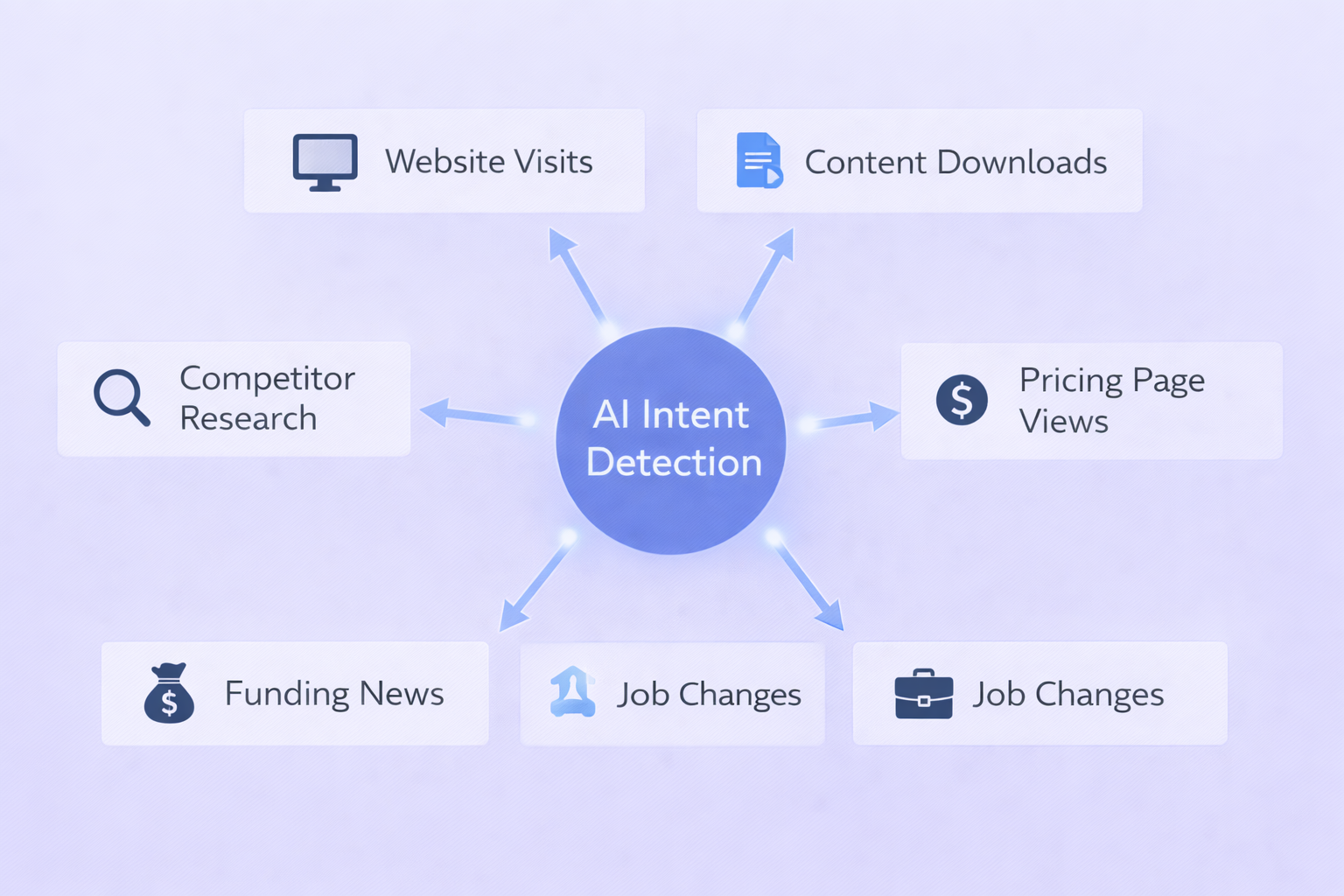


Third-party research—visiting review sites, comparing alternatives, reading competitor content. This shows active evaluation mode.

Organizational changes—new funding, leadership changes, expanding headcount, tech stack updates. These trigger buying windows.

Platforms like Factors.ai specialize in correlating anonymous website visitors with account-based marketing data. When someone from a target account visits your pricing page, you know within minutes and can trigger immediate, contextually relevant outreach through your LinkedIn automation tool.

Personalization at Scale

Here’s the paradox: buyers want personalized outreach, but manual personalization doesn’t scale.

AI solves this by creating what feels custom without manual effort for each prospect.

The mechanics:

Variable injection pulls unique data points—recent LinkedIn posts, conference speaking, company news, tech stack—and weaves them naturally into messages.

Tone matching analyzes the prospect’s communication style from their content and mirrors it. Formal executive? Professional tone. Casual startup founder? Conversational approach.

Value prop adaptation adjusts your message based on their industry, role, and company stage. The same product gets positioned differently for enterprise versus SMB.

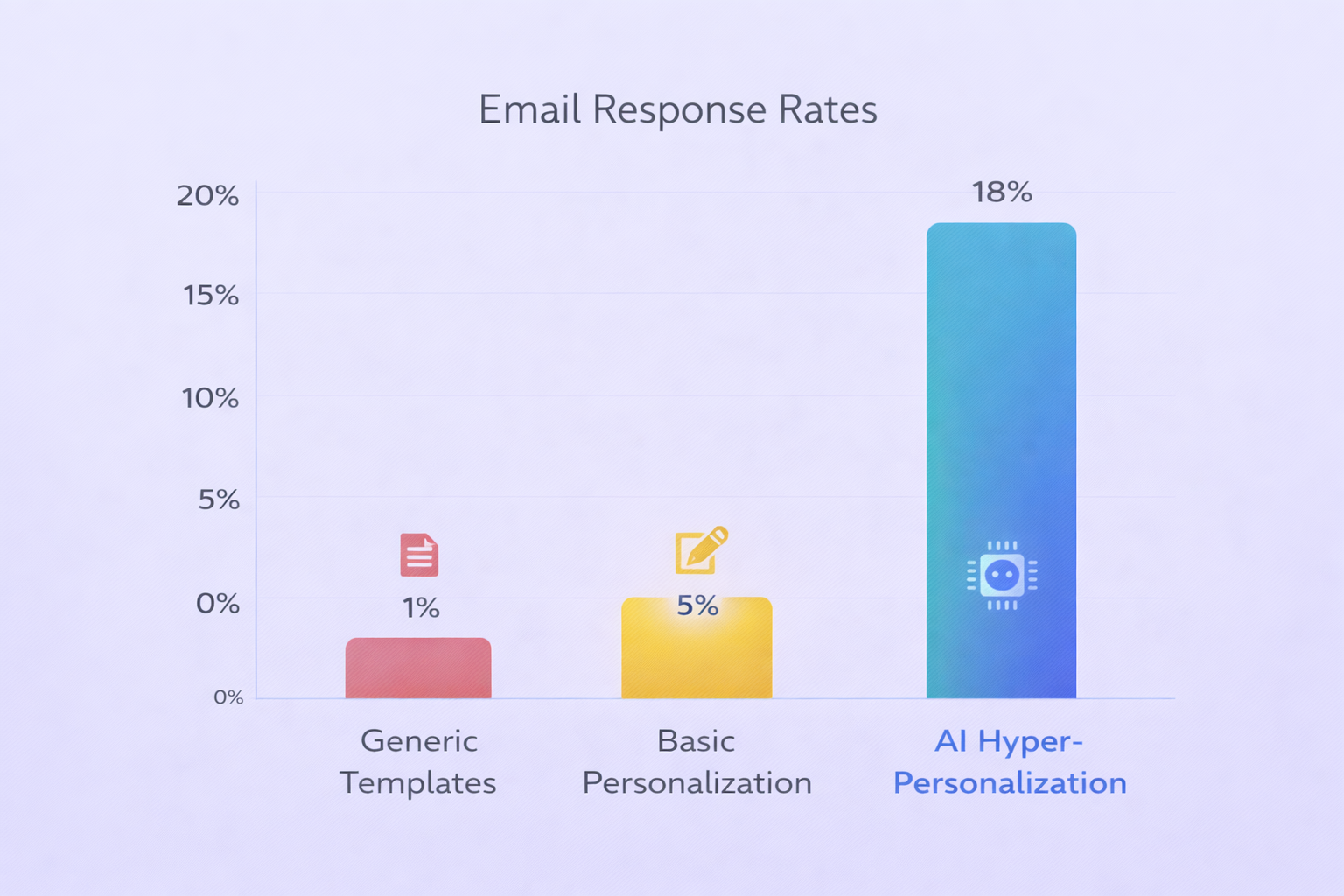
The stats prove it works. Generic templates get under 1% reply rates. AI-personalized outreach pushes this to 9-21% response rates. That’s not incremental improvement—that’s fundamentally different performance.

 

📊 15-25% Response Rates, Guaranteed

LinkedIn outbound bypasses spam filters and connects directly with decision-makers. Our complete strategy includes targeting precision and campaign optimization.

The Technical Reality of Deliverability

You can have perfect messaging and ideal targeting, but if emails land in spam, none of it matters.

Modern cold email software requires technical infrastructure most teams overlook.

DNS authentication: SPF, DKIM, and DMARC records verify your sending legitimacy. Without proper configuration, major providers automatically flag messages as suspicious.

Domain isolation: Never send cold outreach from your primary corporate domain. If you get blacklisted, your entire company’s email communication breaks. Buy secondary domains specifically for prospecting.

Warm-up protocols: New domains appear suspicious to providers. AI tools gradually increase sending volume from 1 email per day to 50+ over 2-4 weeks, proving human sending patterns.

Volume limits: Sending 200 cold emails from a single inbox triggers spam filters. The solution? Connect 20+ inboxes and rotate sending. This is why “unlimited mailbox” features matter.

Smartlead and Saleshandy excel here with automatic rotation across hundreds of connected accounts. The AI distributes volume intelligently, never overloading a single sender.

Strategic Workflows That Win

The software is only 10% of success. The workflow determines everything.

Signal-based launching means stopping generic blasts entirely. Use intent data to identify companies actively researching your category. Find decision-makers at those specific companies. Trigger sequences saying “Saw your team exploring this—here’s how we helped a similar company.”

Speed-to-lead optimization recognizes that responding in 5 minutes versus 60 minutes increases qualification rates by 7x. AI chatbots handle initial triage 24/7, asking qualifying questions and booking meetings directly when criteria match.

Hyper-personalization through advanced LinkedIn search means referencing recent posts, conference appearances, or company announcements. Tools like Clay and Smartlead’s context engineering scrape this automatically and inject it naturally into messaging.

This approach transformed prospecting from spray-and-pray to surgical precision.

🎯 Target Decision-Makers Directly

Skip email deliverability issues entirely. LinkedIn outbound reaches verified professionals with our proven targeting and campaign framework.

The ROI Reality

Let’s talk numbers because that’s what actually matters.

Time savings: AI tools reduce manual research time by 38%, saving 1.5-5 hours weekly per rep. That’s 6-20 hours monthly redirected toward high-value activities.

Cost efficiency: Traditional lead generation costs $50-200 per qualified lead depending on industry. AI-powered approaches cut this by 60% while improving lead quality.

Quota attainment: Remember that 3.7x statistic? AI users aren’t just working faster—they’re hitting their revenue targets at rates that completely dwarf manual approaches.

The math is simple. A rep earning $100K who hits 120% of quota versus 80% doesn’t just earn more commission. They keep their job, get promoted, and compound success year over year.

Choosing Your Stack

Most teams overthink this. You don’t need every tool—you need the right combination.

For small teams (1-5 reps): Apollo.io provides data, sequencing, and basic AI in one platform. Add Smartlead if sending volume exceeds 50 emails daily per person.

For mid-market (5-20 reps): Apollo for data, Smartlead for sending infrastructure, Jeeva.ai for workflow automation. This trio covers identification, engagement, and execution.

For enterprise (20+ reps): ZoomInfo for data accuracy, Salesforce Einstein for CRM intelligence, specialized tools for specific channels. Budget for $30K+ annually per platform.

The key is starting with one core platform and adding capabilities as you prove ROI. Most failures come from buying everything upfront and implementing nothing well.

Effective LinkedIn prospecting combined with AI email tools creates comprehensive coverage—reaching prospects where they’re most responsive.

🔥 Build Qualified Pipeline Fast

LinkedIn outbound delivers 15-25% response rates through systematic campaign design and scaling methods. Complete strategy included.

7-day Free Trial |No Credit Card Needed.

The Future of AI Lead Generation

The shift from tools to agents is accelerating faster than most realize.

Current reality: You operate tools. You click, configure, and review outputs.

Near future: You manage agents. You set objectives, and autonomous AI executes multi-step workflows without constant supervision.

By 2027, 95% of seller research workflows will begin with AI. The role isn’t disappearing—it’s evolving. Manual data entry, list building, and generic outreach vanish. Strategic analysis, relationship building, and complex deal navigation become the core skills.

Teams embracing this now build insurmountable advantages. Those waiting fall further behind monthly as competitors leverage LinkedIn lead generation statistics showing consistent outperformance.

The window to adapt is closing. Not because the technology will become unavailable—but because your competitors are implementing it right now, building muscle memory and refining workflows while others hesitate.

Conclusion

AI-powered lead generation isn’t about replacing human sellers—it’s about augmenting them.

The data shows this clearly: Sales professionals partnering with AI tools are 3.7 times more likely to hit quota. That’s not luck or coincidence—that’s systematic advantage.

Here’s what we covered:

AI tools identify prospects showing active buying signals instead of cold demographic targeting. Predictive scoring surfaces the 5% worth immediate attention from the 95% who aren’t ready. Generative AI personalizes outreach at scale, achieving 9-21% response rates versus under 1% for generic templates.

The platforms exist. Apollo.io for accessibility, ZoomInfo for enterprise accuracy, Smartlead for deliverability infrastructure, Jeeva.ai for autonomous execution.

The workflows work. Signal-based launching, speed-to-lead optimization, hyper-personalization through LinkedIn activity tracking.

The ROI is proven. 50% increase in sales-ready leads, 60% reduction in acquisition costs, 38% time savings weekly.

What separates teams crushing quotas from those struggling? Implementation speed. Not perfection—action. Start with one platform focused on your biggest prospecting bottleneck. Master it. Then layer in additional capabilities.

Your competitors are already doing this through LinkedIn growth hacking and AI automation. The question isn’t whether to adopt AI-powered lead generation—it’s whether you’ll lead the shift or scramble to catch up.

The autonomous revenue engine is here. Time to become the pilot instead of the passenger.

FAQs

How does AI improve lead generation compared to traditional methods?

LinkedIn outbound achieves 15-25% response rates by reaching decision-makers directly without spam filters. Our complete targeting, campaign design, and scaling strategy delivers qualified meetings systematically. Book a strategy meeting to see how.

What is the best AI tool for finding leads?

Best depends on team size and budget. Apollo.io suits most teams with 275M contacts starting $49/month. ZoomInfo serves enterprise needs with superior accuracy at $15K+ annually. Smartlead specializes in deliverability for high-volume sending.

Can AI personalize outreach at scale?

Yes. AI analyzes LinkedIn activity, company news, and tech stack to craft contextually relevant messages. This achieves 9-21% response rates versus under 1% for generic templates by matching tone and value propositions to each prospect.

How much does AI lead generation software cost?

Entry-level platforms like Apollo start at $49/month. Mid-tier tools range $100-300/month. Enterprise solutions like ZoomInfo cost $15K-33K annually. ROI comes from 50% more qualified leads and 60% lower acquisition costs.

How does a betaWill AI replace sales professionals?ter LinkedIn photo help with outreach and lead generation?

No. AI automates research, data entry, and initial outreach. Sales professionals focus on relationship building, complex deal navigation, and closing. Sellers using AI tools are 3.7x more likely to hit quota by redirecting time to high-value activities.

What to Build a High-Converting B2B Sales Funnel from Scratch on LinkedIn

Build a Full LinkedIn Pipeline in Just 30 Days—Guaranteed