
If you’ve tried lead generation in healthcare, you already know the painful truth: the rules are different here. Generic outreach gets ignored. Outdated data gets you blacklisted. And reaching the right person at the right time feels like solving a puzzle with missing pieces.
Here’s the thing — the problem isn’t your product. It’s the infrastructure behind your outreach.
Up to 40% of healthcare providers change their affiliations, specialties, or roles within just six months. That means any static contact list you’re working from is probably already stale. Add to that a 47-hour average response time for new leads, and you’ve got a conversion crisis hiding in plain sight.
The fix? AI SDRs paired with real-time data enrichment — a combination that’s quietly changing the game for teams selling into hospitals, clinics, and health systems.
This guide breaks down exactly how this works, what compliance guardrails you need, and how to build a healthcare lead generation engine that actually performs.
AI SDRs and Data Enrichment for Healthcare Leads
Why Healthcare Data Is a Different Beast
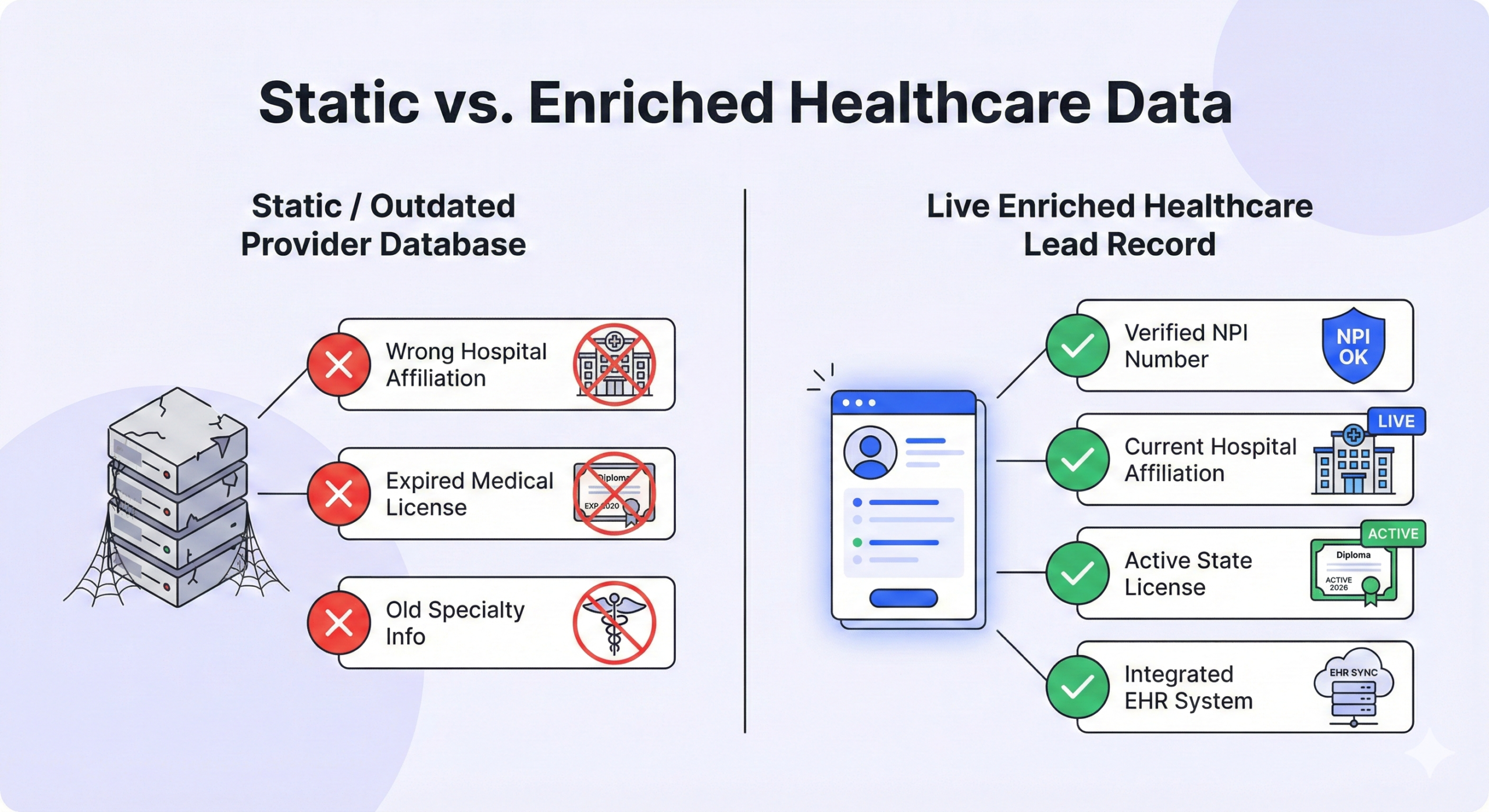
Healthcare is one of the most mobile professional environments in the world. Physicians switch hospital affiliations. Specialists change their clinical focus. Clinics get acquired. Research shows up to 40% of provider records become inaccurate within six months — making your contact list one of your biggest liabilities if it’s not maintained.
Standard B2B data doesn’t cut it here. You need healthcare-specific attributes: NPI numbers, medical licenses, board certifications, EHR systems in use, hospital affiliation, and therapeutic specialty. Without these, your outreach is generic at best and embarrassing at worst.
This is where data enrichment becomes the foundation — not a nice-to-have. It’s the difference between knowing you’re emailing a cardiologist at a 400-bed private hospital versus just having an email address and hoping for the best.
The Data Sources That Matter Most
Not all data sources are created equal in healthcare. Here’s what’s actually useful and why:
Data Type | Why It Matters | Primary Source |
NPI Number | Unique federal identifier — the most reliable way to verify a provider’s identity. | CMS NPI Registry |
Hospital Affiliation | Determines the decision-making structure (private practice vs. large health system). | Definitive Healthcare |
Therapeutic Specialty | Ensures your pitch actually aligns with what the provider does daily. | IQVIA OneKey |
Prescribing Volume | Indicates clinical activity and treatment focus — key for pharma and device reps. | LexisNexis Health Care |
Compliance Status | Screens for sanctions or expired licenses that disqualify engagement. | MedPro Systems |
The real magic happens when you layer these sources together. Waterfall enrichment — querying multiple providers in sequence — is how the best sales teams ensure they find a verified contact on the first try, rather than bouncing off stale data. This alone can save teams up to 15 hours per week in manual verification.
What AI SDRs Actually Do in Healthcare Sales
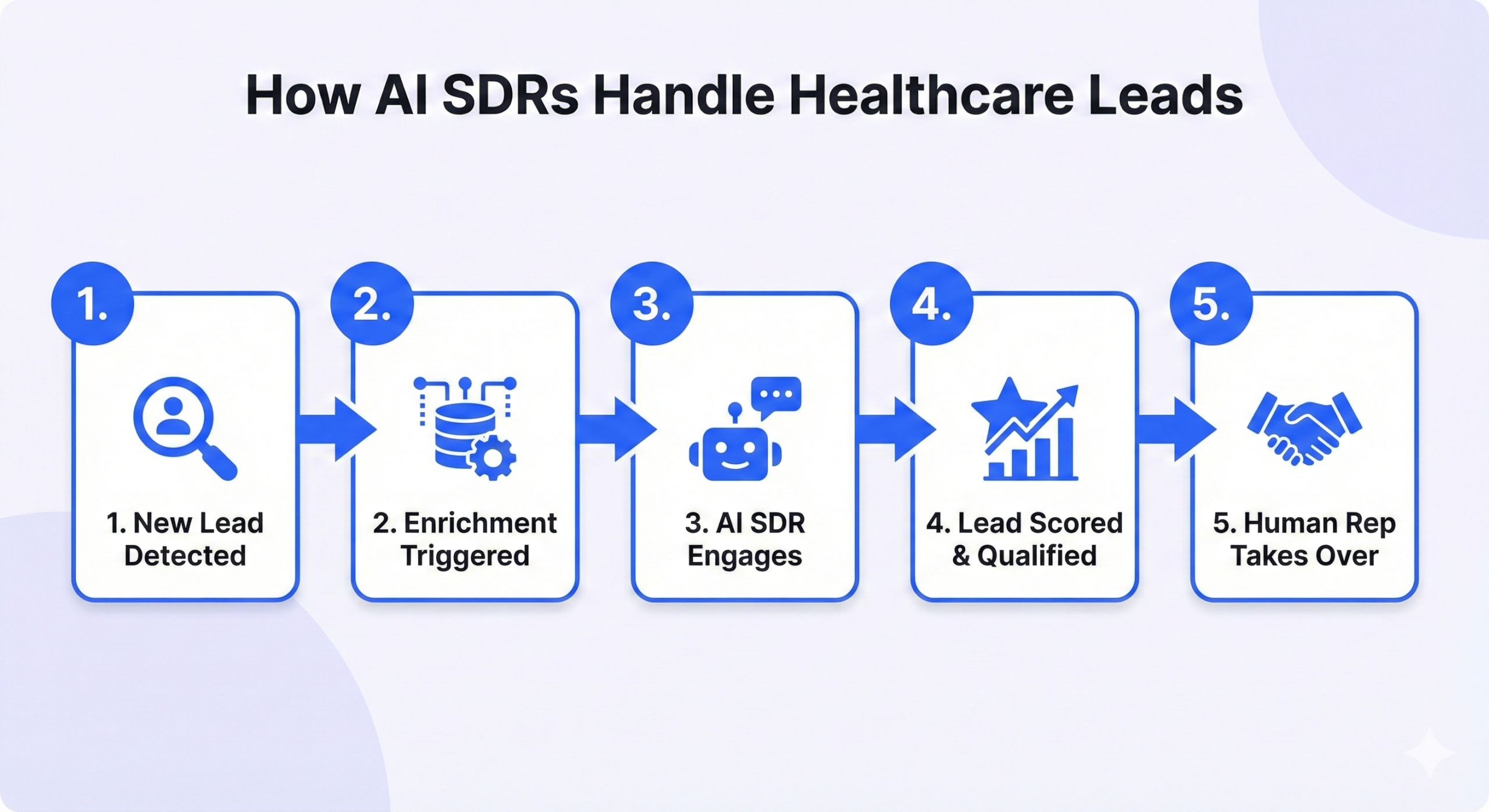
An AI SDR (Sales Development Representative) is an autonomous agent that handles the top-of-funnel work: prospecting, research, qualification, and initial engagement. Think of it as a digital teammate that never sleeps, never forgets to follow up, and doesn’t get tired of sending the 8th touch in a sequence.
Leads contacted within 5 minutes are 10x more likely to convert than those reached after just 10 minutes. No human team can hit that window consistently. AI SDRs can — at 2 PM or 2 AM.
Here’s where AI SDRs change the workflow:
Capability | What It Does | Impact on Pipeline |
24/7 Availability | Responds to new inquiries instantly, regardless of time zone or working hours. | Captures leads at peak interest — no missed windows. |
Real-Time Lead Scoring | Analyzes behavioral signals: pricing page visits, white paper downloads, form fills. | 93% faster prioritization than manual routing. |
Contextual Personalization | References specific content a prospect downloaded or a challenge their facility is facing. | Higher response rates vs. generic templates. |
CRM Orchestration | Logs every interaction automatically, keeping records clean without manual entry. | Ensures data integrity across your full pipeline. |
Frontline Qualification | Asks qualifying questions upfront — confirming timeline, authority, and need. | Reps only talk to buyers who are actually ready. |
The shift AI SDRs enable isn’t just efficiency — it’s a complete change in how sales teams operate. Instead of doing manual research, reps review pre-qualified leads and focus on conversations that matter. AI-native companies using these tools generate $500K–$1M ARR per employee, compared to $100K–$200K for traditional sales models.
The Best Data Platforms for Healthcare Lead Generation
Choosing the right data source is a critical first step in any healthcare lead generation strategy. Here’s how the major platforms compare:
Platform | Database Scale | Accuracy | Best For Healthcare |
Apollo.io | 275M+ contacts | ~91% | SMB teams needing built-in sequences and AI copy. |
ZoomInfo | 321M+ contacts | 95% | Enterprise orgs needing deep firmographic research. |
UpLead | 160M+ contacts | 95%+ | Teams where bounce rate is a primary concern — verified at point of unlock. |
Saleshandy | 700M+ contacts | High | Natural language “Lead Finder” for quick text-based queries. |
IQVIA OneKey | 25M+ HCPs | ISO Certified | Specialty segmentation and therapeutic targeting — best-in-class for HCPs. |
The most advanced teams aren’t picking just one. They’re building custom agents using orchestration layers like Clay or Lindy — pulling from UpLead for accuracy, LinkedIn for real-time updates, and IQVIA for specialty verification. This is waterfall enrichment at its best, and it reduces manual research time from hours to minutes.
Making Healthcare Outreach Actually Land
Even the best data fails if your outreach doesn’t resonate. Healthcare professionals see hundreds of vendor emails a week — most get deleted in under three seconds. Here’s what actually works:
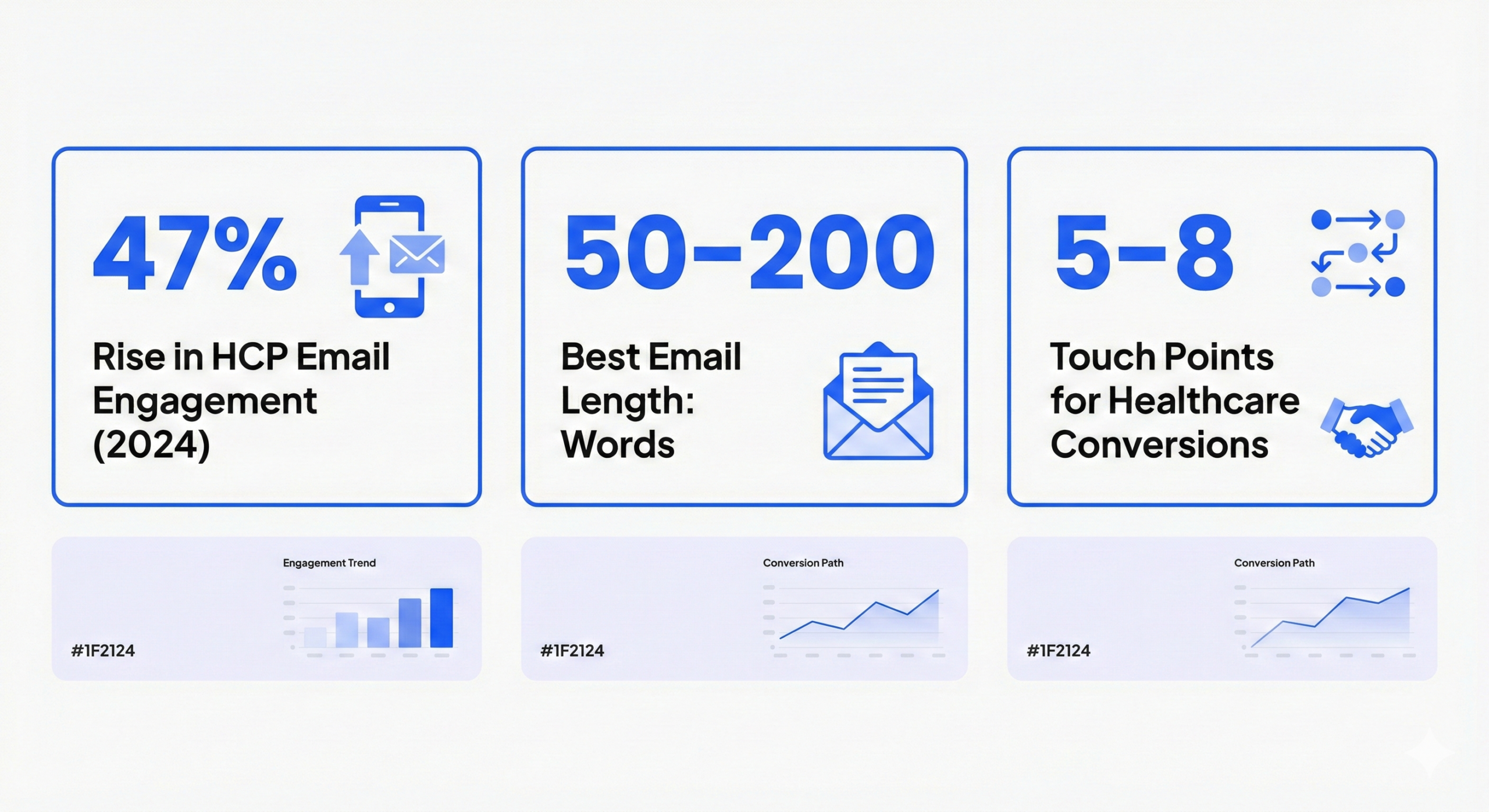
Keep it short. The sweet spot for healthcare cold emails is 50–200 words. 84% of healthcare emails are read on mobile — if it requires scrolling, you’ve already lost them.
Lead with a referral hook. “I was speaking with [colleague at similar hospital]” or referencing a shared publication dramatically increases reply rates. Social proof from peers is the fastest trust-builder in medicine.
Back everything with ROI data. Buyers in healthcare are already 70% through their decision process before they talk to a rep. Give them specific numbers: “reduce no-shows by 28%” or “cut administrative overhead by 34%.”
Go multi-touch. Conversions in healthcare often happen after the 5th or 8th outreach touch. A persistent, omnichannel approach — email, LinkedIn, and phone — is the difference between a pipeline and a dead list.
One stat that should change how you think about email deliverability: email engagement with healthcare professionals rose 47% year-over-year in 2024. The channel isn’t broken — the approach is. Fix the approach, and healthcare email outreach becomes one of the highest-ROI moves in your playbook.
Conclusion
Healthcare lead generation has always been hard. But in 2026, the gap between teams using AI SDRs and enriched data versus those still working static lists has never been wider. The math is simple: verified data + autonomous outreach + compliance = a pipeline that actually moves.
The ROI is there too — the average return on AI in healthcare sales is $3.20 for every $1 invested, with most teams seeing results within 14 months.
If you’re selling into hospitals, health systems, or clinics, the question isn’t whether to build this infrastructure — it’s how fast you can get it running. At Salesso, we specialize in exactly this: building complete outbound engines for B2B companies that need to reach healthcare decision-makers at scale. From targeting and enrichment to campaign design and scaling, we handle the full system so your team can focus on closing.

