
- blog
- Sales Development
- B2B Digital Marketing Funnel: Complete Guide to Convert Leads
Your Ultimate Guide to the B2B Digital Marketing Funnel (That Actually Helps You Sell)
Table of Contents
Ever wondered why some businesses seem to effortlessly convert prospects while others struggle with empty pipelines? The secret lies in understanding and optimizing your B2B digital marketing funnel.
But here’s the thing – most guides overcomplicate this topic with marketing jargon and theoretical concepts. What if I told you that mastering this funnel could help you understand your prospects better, know exactly what to say to them, and ultimately close more deals?
That’s exactly what this guide delivers. No fluff. No abstract theories. Just a straightforward breakdown of the B2B digital marketing funnel that actually works.
What Is a B2B Sales Funnel?
Think of a B2B sales funnel as your prospect’s GPS navigation system. It maps out the exact path potential business clients take from their first interaction with your brand to becoming loyal, paying customers.
This customer journey starts with a massive pool of potential leads at the top and filters down to a smaller group of high-value customers at the bottom. But here’s what most people miss – the modern B2B funnel isn’t a straight slide down.
Today’s buyers are more informed than ever. Research shows that the average B2B buying process involves six to 10 decision-makers, each armed with information they’ve gathered independently.

They jump between stages, move closer to a purchase decision, then step back, then move forward again.
Your job isn’t to force them down a rigid path. It’s to understand where they are and guide them to the next logical step.
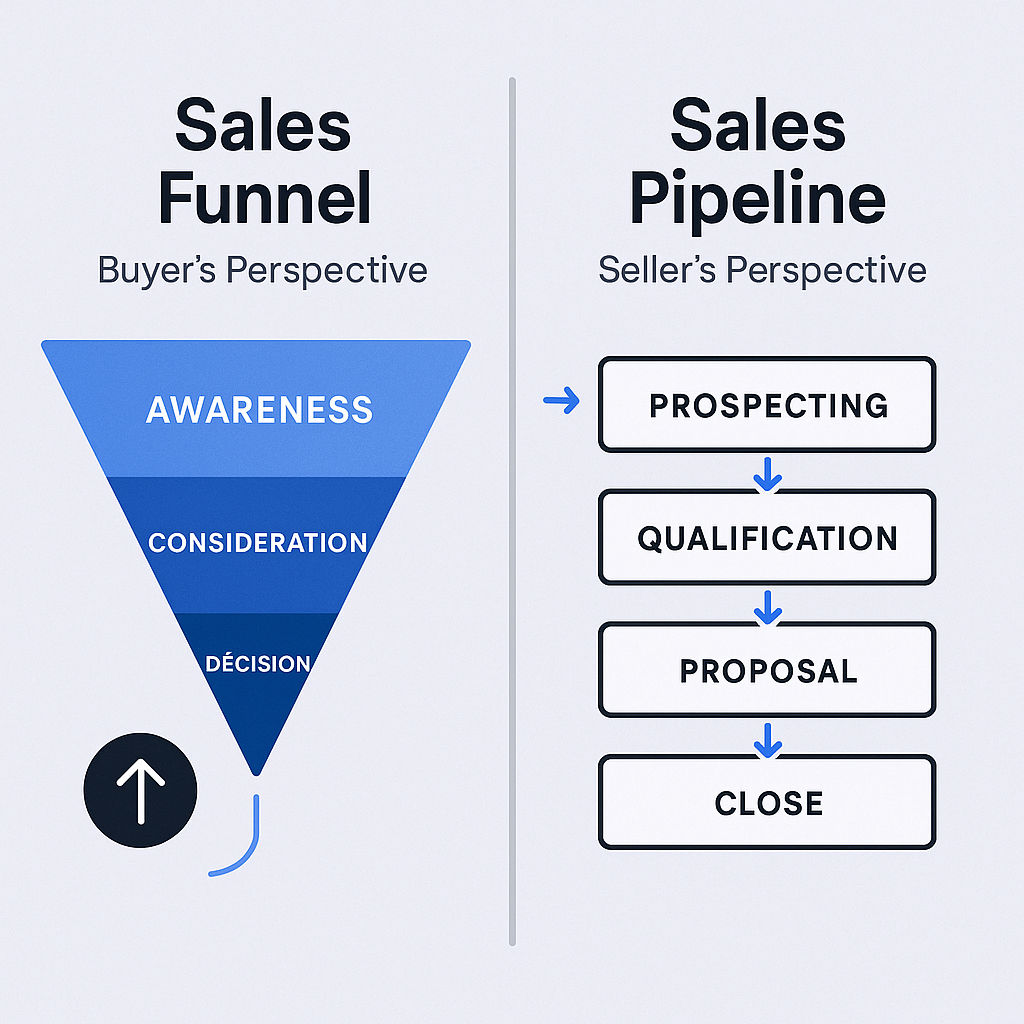
What’s The Difference Between a B2B Sales Funnel And a B2B Sales Pipeline?
This confusion costs businesses millions in misaligned efforts. The distinction is simple but crucial:
- A Sales Funnel represents the buyer’s perspective – tracking their decision-making process and measuring conversion rates between stages
- A Sales Pipeline represents your internal process – the series of actions you take to move deals from new leads to closed opportunities
Â

Â
Why does this matter? When these systems aren’t aligned, you waste time on prospects who will never buy. Marketing fills the funnel with leads while sales teams focus on converting pipeline opportunities – but without shared definitions of “qualified,” both teams work against each other.
What Is The Difference Between B2B and B2C Sales Funnel?
If you’ve ever bought something online in five minutes, you’ve experienced a B2C funnel. B2B is completely different:
Longer Sales Cycles: B2B decisions take weeks or months, not minutes. Research shows 80% of sales require at least five follow-ups to close.
Multiple Stakeholders: You’re selling to committees, not individuals – typically six to 10 decision-makers per deal.
Logic-Driven Decisions: B2B purchases are investments focused on ROI and solving business problems, not impulse buying.
Higher Value & Risk: Larger deal sizes mean more scrutiny and risk aversion from buyers.
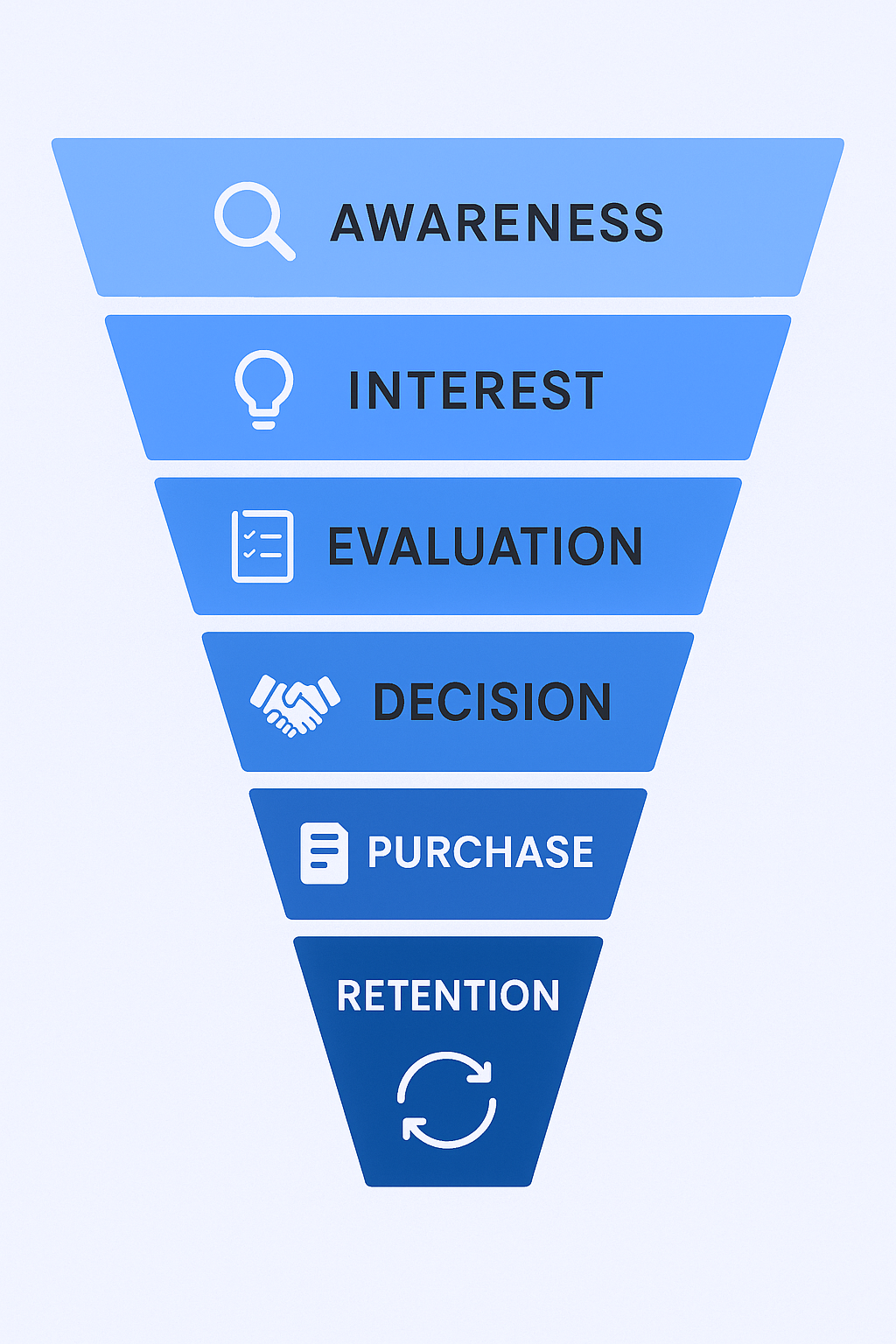
B2B Sales Funnel Stages You Must Understand
Â

Â
Let’s walk through each stage of the digital marketing funnel from your prospect’s perspective. Understanding their mindset is your competitive advantage.
Awareness
Prospect’s Mindset: “I think I have a problem, but I’m not sure what it is or how to solve it.”
Your Goal: Make potential customers aware you exist and can help.
🎯 Target Decision-Makers Directly
Skip awareness struggles. Our LinkedIn outbound reaches your ICP with precision targeting.
Key Activities:
- Prospecting: Building lists of companies that fit your ideal customer profile
- Cold Outreach: Personalized emails, calls, and social media engagement (especially LinkedIn)
- Content Marketing: Educational blog posts, industry reports, and infographics that provide value upfront
Critical Stat: 8 out of 10 buyers prefer being contacted via email at this stage.
Interest
Prospect’s Mindset: “I understand my problem better now and I’m actively researching solutions. Your company looks interesting.”
Your Goal: Qualify genuine interest and determine if this prospect is worth pursuing.
Key Activities:
- Lead Qualification: Using frameworks like BANT (Budget, Authority, Need, Timeline)
- Nurturing: Sharing targeted content like webinars and ebooks
- Appointment Setting: Booking qualified discovery calls
Evaluation
Prospect’s Mindset: “I’m seriously considering a purchase and comparing you against competitors. I need to see proof.”
Your Goal: Prove your solution is the best choice for their specific needs.
Key Activities:
- Discovery Calls: Deep-diving into pain points and success metrics
- Personalized Demos: Tailored product demonstrations focused on their problems
- Social Proof: Case studies with hard ROI numbers and competitor comparisons
Decision
Prospect’s Mindset: “I’ve narrowed it down to two or three options. I need to make a final decision and get team approval.”
Your Goal: Build consensus, handle objections, and make internal selling easy for your champion.
Key Activities:
- Objection Handling: Addressing concerns about price, contracts, and implementation
- Proposal Creation: Formal proposals with clear value propositions
- Social Validation: Customer testimonials and third-party reviews
Purchase
Prospect’s Mindset: “We’ve decided. We’re choosing you. Let’s get this done.”
Your Goal: Ensure a smooth, frictionless closing process.
Key Activities:
- Contract Management: Facilitating final contract review and signature
- Urgency Maintenance: Following up diligently because time kills deals
- Smooth Handoffs: Clean transitions to customer success teams
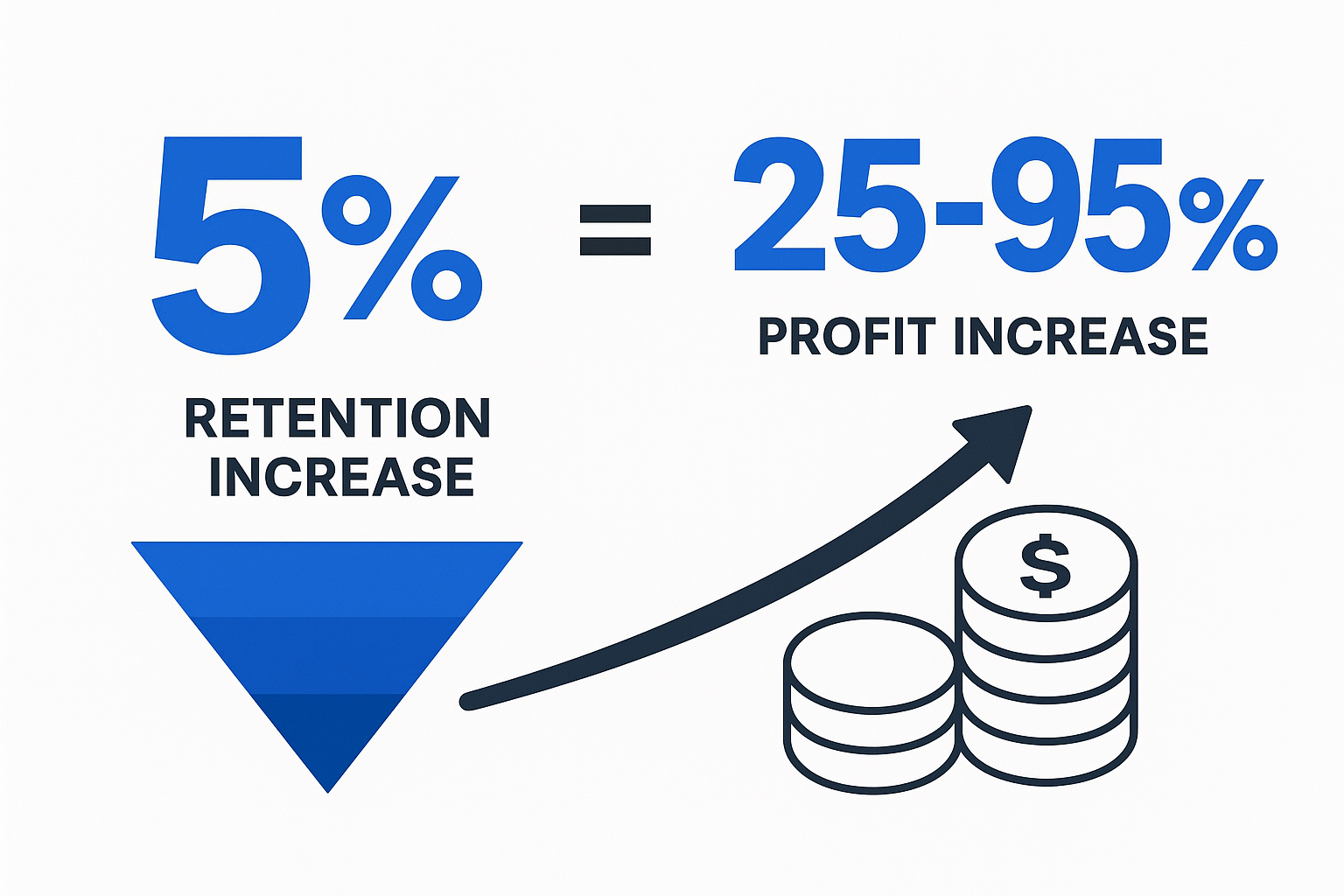
Retention
Customer’s Mindset: “Am I getting the value I paid for? Should we renew? Who else could benefit?”
Your Goal: Drive renewals, upsells, and referrals through customer success.
Key Activities:
- Post-Sale Check-ins: Ensuring successful onboarding
- Expansion Opportunities: Identifying new problems you can solve
- Referral Requests: Leveraging happy customers for new leads
💼 LinkedIn Outbound Done Right
We handle targeting, messaging, and scaling so you get booked calendars fast.
Step Guide On How To Create A B2B Sales Funnel
Building an effective marketing sales funnel requires systematic execution. Here’s your step-by-step blueprint:
Step : Set Your Goals
Start with revenue targets and work backward. If you need $1M in new revenue with $50K average deals, you need 20 closed deals. Use historical data to determine required demos, meetings, and initial conversations.
Your key performance indicators (KPIs) should include:
- Conversion rates between each stage
- Average deal size and sales cycle length
- Cost per lead and customer acquisition cost (CAC)
Step : Understanding Your Target Prospects
Define your Ideal Customer Profile (ICP) in detail: industry, company size, revenue, technology stack, and specific pain points. This focus prevents wasting time on bad-fit leads.
Research shows that companies with clearly defined ICPs achieve 68% higher account win rates.
Step : Performing Competitor Analysis
Analyze competitor content strategies, pricing pages, and customer reviews on G2 and Capterra. Understanding their weaknesses gives you ammunition for competitive situations.
Step : Aligning Sales & Marketing Teams
Establish Service Level Agreements (SLAs) defining:
- Marketing Qualified Lead (MQL) criteria
- Sales Qualified Lead (SQL) definitions
- Response time requirements
- Shared revenue goals
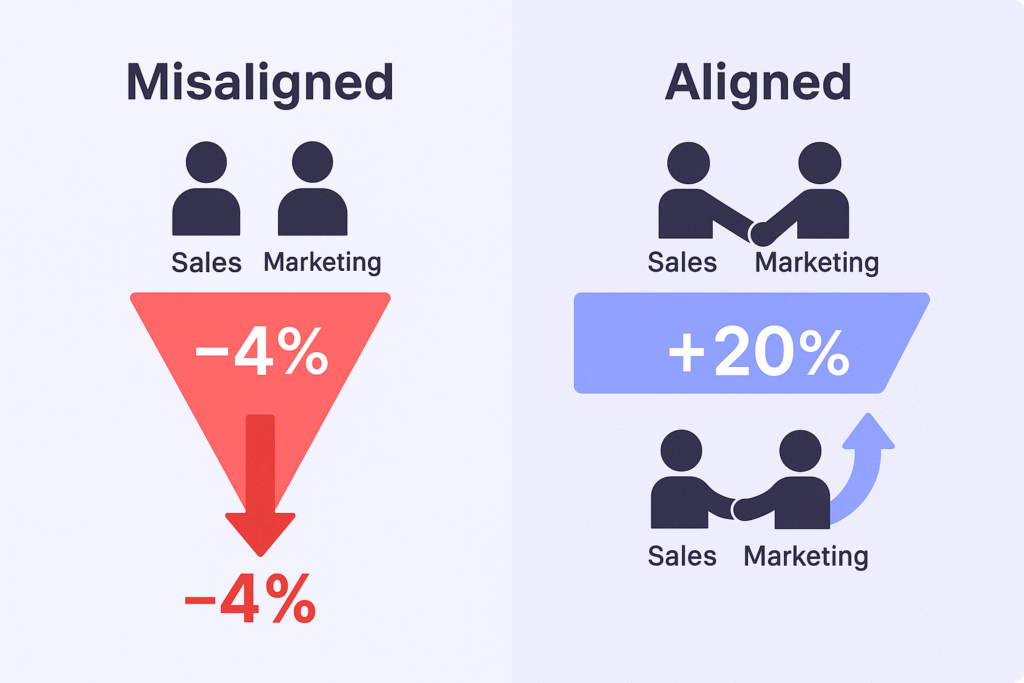
Stat Alert: Companies with aligned sales and marketing teams achieve 20% annual growth rates compared to 4% decline for misaligned teams.
Â

Step Guide On How To Create A B2B Sales Funnel
Building an effective marketing sales funnel requires systematic execution. Here’s your step-by-step blueprint:
Step : Set Your Goals
Start with revenue targets and work backward. If you need $1M in new revenue with $50K average deals, you need 20 closed deals. Use historical data to determine required demos, meetings, and initial conversations.
Your key performance indicators (KPIs) should include:
- Conversion rates between each stage
- Average deal size and sales cycle length
- Cost per lead and customer acquisition cost (CAC)
Step : Understanding Your Target Prospects
Define your Ideal Customer Profile (ICP) in detail: industry, company size, revenue, technology stack, and specific pain points. This focus prevents wasting time on bad-fit leads.
Research shows that companies with clearly defined ICPs achieve 68% higher account win rates.
Step : Performing Competitor Analysis
Analyze competitor content strategies, pricing pages, and customer reviews on G2 and Capterra. Understanding their weaknesses gives you ammunition for competitive situations.
Step : Aligning Sales & Marketing Teams
Establish Service Level Agreements (SLAs) defining:
- Marketing Qualified Lead (MQL) criteria
- Sales Qualified Lead (SQL) definitions
- Response time requirements
- Shared revenue goals
Stat Alert: Companies with aligned sales and marketing teams achieve 20% annual growth rates compared to 4% decline for misaligned teams.
Â

Â
Step : Proper Communication At Each Stage
Match your messaging to prospect mindset. Don’t push demos in awareness-stage cold emails or send basic educational content to decision-stage prospects.
Create stage-specific messaging frameworks that provide relevant value at each touchpoint.
Step : Selecting The Right Channels

For B2B, focus on multi-channel approaches emphasizing:
- LinkedIn for professional networking
- Email for direct communication
- Industry events (virtual and in-person)
- SEO-driven content for organic discovery
Step : Asset Creation
Develop stage-appropriate content:
- Awareness: Educational blog posts, industry reports
- Interest: Webinars, ebooks, checklists
- Evaluation: Case studies, ROI calculators, demos
- Decision: Customer testimonials, competitor comparisons
- Purchase: Implementation guides, onboarding materials
Step : Automate Where Possible
Implement technology solutions:
- CRM systems for lead tracking
- Email automation for follow-up sequences
- Lead scoring for prioritization
- Analytics for performance measurement
Step : Follow-Up
Create persistent, value-driven follow-up sequences. Research indicates most prospects need 5-12 touchpoints before making purchase decisions, yet most sales people give up after 2-3 attempts.
Step : Progress Tracking
Monitor conversion rates between stages to identify bottlenecks. Use CRM dashboards to track:
- Lead-to-opportunity conversion
- Demo-to-proposal rates
- Proposal-to-close percentages
- Overall funnel velocity
Mistakes To Avoid When Creating B2B Sales Funnel
Even perfect strategies can fail due to common execution errors. Here are the biggest pitfalls:
Vague Targeting
Trying to appeal to everyone means appealing to no one. Generic messaging leads to low-quality leads and wasted time on prospects who can’t or won’t buy.
Solution: Obsess over your ICP. Every piece of outreach should feel personally crafted for them.
Inefficient Lead Qualification
Treating every form submission as a “hot lead” clogs pipelines with unqualified prospects and burns out sales teams on pointless demos.
Solution: Implement lead scoring systems and qualification frameworks before leads reach sales teams.
📊 Pre-Qualified Meetings Only
Our LinkedIn campaigns deliver sales-ready conversations, not cold leads needing nurturing.
7-day Free Trial |No Credit Card Needed.
Sales and Marketing Misalignment
When teams operate separately, the funnel breaks in the middle. Marketing sends “leads” that sales considers junk, creating mutual blame for missed targets.
Solution: Establish shared SLAs with common definitions and revenue-focused goals.
Premature Follow-Up Abandonment
This kills more deals than any other mistake. Most reps give up after 1-2 attempts while competitors who follow up consistently win the business.
Solution: Build systematic, multi-channel follow-up sequences that add value with every touchpoint.
Ignoring Performance Data
68% of companies admit they don’t measure their sales funnel performance. Without tracking conversion rates, you’re flying blind.
Solution: Live in your analytics. Track every metric religiously and use data to illuminate improvement opportunities.
Conclusion
The B2B marketing funnel isn’t just a theoretical framework – it’s your roadmap to understanding customer psychology and building predictable revenue growth.
By mapping each stage to your prospect’s mindset, you can deliver relevant messages at the right time, build trust systematically, and guide potential customers toward choosing your solution. Master this approach, and you’ll transform from chasing random leads to operating a predictable revenue engine.
Remember: successful funnels require continuous optimization. Track your metrics, test different approaches, and refine your process based on real performance data. The companies that consistently win are those that turn funnel optimization into a systematic competitive advantage.
FAQs
What is the B2B marketing and sales funnel?
What are the key stages of a sales funnel in digital marketing?
What are some B2B digital marketing examples for the funnel?
What is B2B digital marketing, simply explained?
What is the "attract convert close delight" model?
Segmentation That Actually Converts
LinkedIn outbound targets precise demographics with strategic campaign design and scaling methods