
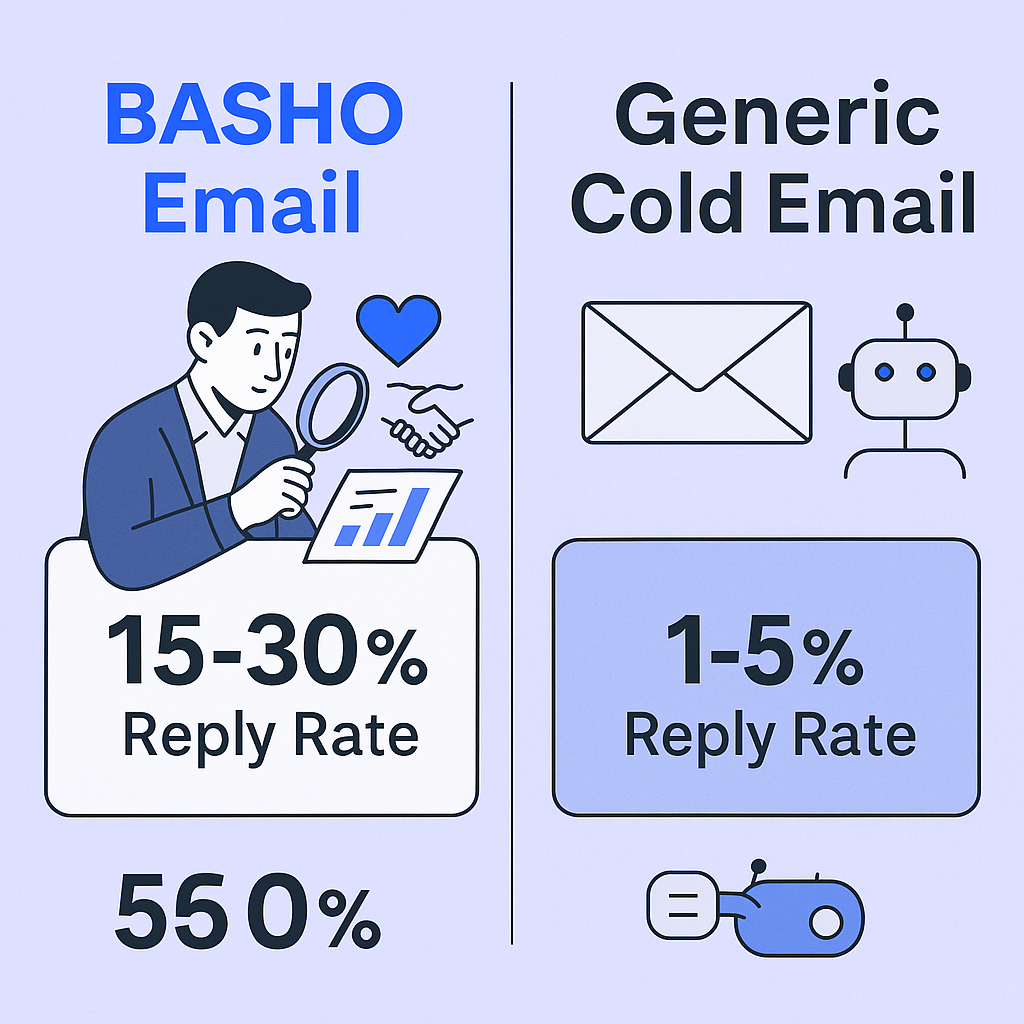
BASHO emails are hyper-personalized cold outreach messages that achieve 15-30% reply rates compared to generic emails’ 1-5% average. The strategy requires deep research into prospects’ specific business challenges, crafting messages under 200 words that demonstrate genuine understanding, and following up strategically. Key elements include an unignorable subject line, relevant opening hook, value proposition bridge, and low-friction call-to-action.
What is a BASHO Email? (Definition + Why It Works)
A BASHO email is a hyper-personalized, deeply researched cold outreach message sent to high-value decision-makers. Unlike generic cold emails that rely on templates and basic personalization, BASHO emails demonstrate profound understanding of the recipient’s specific business context, challenges, and priorities.
The methodology was developed by Jeff Hoffman through Basho Strategies Inc. The name draws inspiration from Japanese poet Matsuo Bashō, master of haiku – reflecting the technique’s core philosophy of maximum impact with minimal words.
Why BASHO Emails Work
The data tells a compelling story:
- Standard cold email reply rates: 1-5% on average
- BASHO email reply rates: 15-30% or higher
- Personalized subject lines: Generate up to 50% higher open rates
- Hyper-personalized copy: Increases reply rates by 142%
The modern B2B buyer’s inbox is a battlefield. With 54% of salespeople reporting that selling has become more difficult, generic “spray and pray” approaches are failing. Only 8.5% of cold emails receive responses, while average open rates hover around 23.9%.
BASHO emails cut through this noise by treating each prospect as a unique individual rather than a database entry.
BASHO vs. Generic Cold Emails: The Key Differences
Feature | BASHO Email | Generic Cold Email |
Research | In-depth, consultative research into company initiatives and executive priorities | Minimal; relies on basic firmographic data |
Personalization | Hyper-personalized; entirely unique to recipient | Templated with basic mail-merge fields |
Target Audience | High-value decision-makers (C-suite, VPs, Directors) | Broad list of contacts, often lower-level employees |
Core Goal | Start strategic conversation; build rapport | Generate high volume of leads; immediate demo booking |
Typical Response Rate | 15-30% or higher | 1-5% on average |
How to Write a BASHO Email (Step-by-Step)
Step 1: Deep Research – The Foundation of Success
BASHO emails live or die by the quality of your research. This isn’t about scanning a LinkedIn profile – it’s about becoming a temporary business consultant for your prospect.
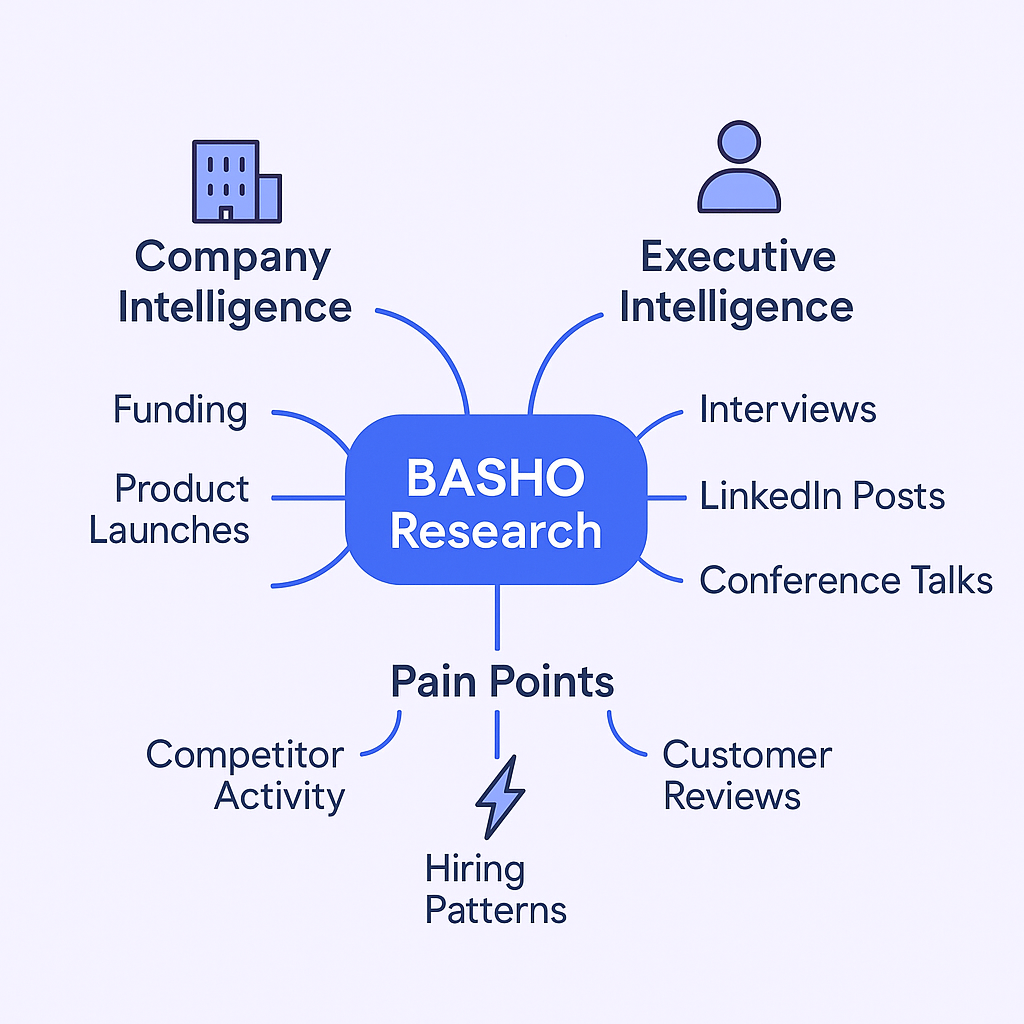
Essential Research Categories:
Company-Level Intelligence:
- Strategic initiatives and stated goals
- Recent funding rounds or acquisitions
- New product launches or market expansions
- Challenges mentioned in earnings calls
- Competitive pressures in their industry
Executive-Level Intelligence:
- Direct quotes from interviews or articles
- Conference talks or podcast appearances
- LinkedIn posts and engagement patterns
- Professional background and expertise areas
- Stated KPIs or department priorities
Pain Point & Opportunity Identification:
- Competitor activity (acquisitions, new products)
- Hiring patterns indicating strategic priorities
- Customer reviews highlighting service gaps
- Industry-wide challenges affecting their sector
Step 2: The 4-Part BASHO Email Structure

1. The Unignorable Subject Line (10-50 characters)
Your subject line must instantly prove relevance while piquing curiosity. 47% of people open emails based on subject line alone.
Best Practices:
- Personalize beyond just their name
- Reference specific, recent events or achievements
- Keep under 50 characters for mobile visibility
- Focus on their world, not your product
Winning Examples:
- “Sarah, thoughts on your Forbes feature?”
- “Inspired by your Denver Tech Summit talk”
- “Quick question about your Q3 expansion plans”
2. The Hyper-Relevant Opening Hook (1-2 sentences)
Your opening must immediately validate the subject line’s promise. This is where deep research pays dividends.
Execution Tips:
- Reference specific quotes from recent content
- Mention strategic initiatives from company reports
- Connect to industry-specific challenges they’ve discussed
- Aim for a “How did they know that?” reaction
Example: “Your insights on implementing ethical AI frameworks at the Denver Tech Summit really resonated—especially your point about the challenges of data bias in machine learning.”
3. The Value Proposition Bridge (2-3 sentences)
Connect your research insight to the value you provide. This isn’t a feature list – it’s a strategic connection.
Framework:
- Acknowledge their challenge/goal
- Share social proof from similar company
- Focus on business outcomes, not product features
Example: “That challenge is something we hear often from tech leaders. We recently helped [Similar Company] tackle the exact issue of data bias by implementing a validation layer that increased their model accuracy by 18% while ensuring regulatory compliance.”
4. The Low-Friction Call-to-Action
Make saying “yes” easy with a specific, time-bound, interest-based CTA.
Effective Approaches:
- Offer specific time slots: “Tuesday at 2 PM or Thursday at 10 AM?”
- Frame as mutual exploration: “Worth exploring for 15 minutes?”
- Keep it simple: “Worth a chat?”
Step 3: Pre-Send Quality Control
Before hitting send, verify:
- [ ] Prospect’s name spelled correctly
- [ ] Subject line under 50 characters
- [ ] Email body under 200 words
- [ ] Opening contains specific, unautomatable research
- [ ] Value proposition focuses on their benefits
- [ ] Single, clear call-to-action
- [ ] Professional sender address (john@company.com, not sales@company.com)
BASHO Email Examples
Template 1: The “Recent Achievement” Opener
When to use: Prospect or their company recently hit a milestone
Subject: Congrats on the Series B, Michael!
Body: Hi Michael,
Congratulations to you and the team at [Company] on closing your Series B funding. Scaling post-funding often brings new challenges around maintaining customer support quality while handling increased volume.
We helped [Similar Company] navigate this exact phase by reducing their support ticket resolution time by 30% without adding headcount.
Is this a priority for you in the coming months?
Best, [Your Name]
Template 2: The “Quote Their Own Words” Angle
When to use: Prospect has published content or given interviews
Subject: Your quote on AI implementation
Body: Hi Jennifer,
I recently read your interview in TechCrunch where you said, “The biggest hurdle isn’t AI adoption—it’s ensuring our team can actually use these tools effectively.”
Helping leaders like you bridge that exact gap is precisely what we do. We provide hands-on AI training that increased productivity by 40% at companies like [Similar Company].
If you have 15 minutes next week, I’d love to share a few ideas on how you can put that vision into action.
Best, [Your Name]
Template 3: The “Pain Point Resolver”
When to use: You’ve identified a specific challenge based on their role/industry
Subject: A potential solution for cloud cost optimization
Body: Hi David,
Given your role leading engineering at [Company], I imagine reducing cloud infrastructure costs without impacting performance is a constant priority.
My team specializes in this exact challenge. We recently helped [Competitor] achieve a 25% reduction in their AWS spend by implementing our optimization platform.
Worth a brief chat to explore if a similar outcome is possible for [Company]?
Regards, [Your Name]
How to Follow Up After Sending a BASHO Email
80% of sales require at least five follow-ups, making a strategic sequence essential. Here’s the proven 4-step framework:
Email 2: The Value-Add Follow-Up (2-3 days later)
Purpose: Build trust by providing value without asking for anything
Approach:
- Share relevant third-party article or case study
- Brief message referencing original email theme
- Soft CTA: “Thought this might be useful for your team”
Email 3: The “1-2-3” Re-Engagement (4-5 days later)
Purpose: Make responding incredibly easy
Structure:
- Brief restatement of core challenge
- Present three numbered areas of potential interest
- Simple CTA: “If any of these are a priority, just reply with the number”
Email 4: The Professional “Breakup” (7 days later)
Purpose: Create final urgency through loss aversion
Framework:
- Politely close the loop
- Briefly recap potential value
- Leave door open for future contact
- “I’ll assume this isn’t a priority and close your file”
Common Mistakes to Avoid When Writing and Sending BASHO Email
1. The Generic Message Trap
Using BASHO “templates” without specific research. If your personalization could apply to any executive in that role, it’s not a BASHO email.
2. Research Shortcuts
Skimming LinkedIn profiles isn’t research. This superficiality is transparent to executives and shows lack of genuine effort.
3. Feature-Focused Value Props
Talking about your “AI-powered dashboard” instead of “reducing reporting time by 10 hours monthly.” Prospects care about outcomes, not features.
4. The Overly Long Email
Data shows reply rates drop sharply for emails over 200 words. Respect their time with concise, impactful messaging.
5. Weak or Demanding CTAs
“Let me know your thoughts” puts burden on prospect. “When are you free for a 30-minute demo?” is too aggressive for first touch.
6. Follow-up Failures
Investing hours in research and crafting, then giving up after no immediate response. The value comes through strategic sequences.
7. Technical Setup Neglect
Perfect emails mean nothing in spam folders. Ensure proper SPF and DKIM records for deliverability.

