Here’s the truth nobody wants to admit: your inbox is a warzone. Everyone’s getting buried under automated emails that all sound the same. But there’s one channel that still cuts through the noise like nothing else—the phone.
Professional cold calling services aren’t the outdated telemarketing operations your parents dealt with. They’re precision-engineered conversation engines that consistently deliver 15-25% response rates while traditional cold email struggles at 1-5%. The phone remains the second most effective prospecting method after referrals, and 55% of high-growth companies still rely on it as their foundation.
The difference between amateur dialing and professional cold calling services comes down to methodology. It’s not about making more calls—it’s about making better ones. And that’s exactly what we’re breaking down today.
Why Cold Calling Services Still Dominate in 2025
Let’s get one thing straight: the phone isn’t dead. It’s evolved.
While everyone rushed to automation, something interesting happened. Decision-makers started answering their phones again because so few people actually call anymore. The irony is beautiful—everyone abandoned the channel, which made it more effective for those who stayed.
Here’s what the data shows: 82% of buyers are receptive to proactive outreach when it’s done with relevance and respect. The average call duration has increased to 93 seconds in 2025, proving these aren’t quick hangups—they’re real conversations.
But here’s where it gets interesting. The gap between average performance and elite execution is massive. Top-performing teams achieve 20%+ connection rates while average operations hover around 15-16%. That 5% difference might sound small, but it’s the difference between a pipeline that converts and one that bleeds money.
Why Cold Calling Services Still Dominate in 2025
Let’s get one thing straight: the phone isn’t dead. It’s evolved.
While everyone rushed to automation, something interesting happened. Decision-makers started answering their phones again because so few people actually call anymore. The irony is beautiful—everyone abandoned the channel, which made it more effective for those who stayed.
Here’s what the data shows: 82% of buyers are receptive to proactive outreach when it’s done with relevance and respect. The average call duration has increased to 93 seconds in 2025, proving these aren’t quick hangups—they’re real conversations.
But here’s where it gets interesting. The gap between average performance and elite execution is massive. Top-performing teams achieve 20%+ connection rates while average operations hover around 15-16%. That 5% difference might sound small, but it’s the difference between a pipeline that converts and one that bleeds money.

The real power isn’t just getting someone on the phone—it’s what happens in those first 10 seconds. Modern calling services have cracked the neurobiology of permission-based opening. Instead of the cringe-worthy “How are you today?” they use pattern interrupts: “I know I’m interrupting your day, can I take 30 seconds to tell you why I called?”
This simple shift grants the prospect control, which lowers their defensive cortisol levels and increases the likelihood of a “yes” by 2.1x. That’s not sales theory—that’s brain science.
The Persistence Problem Most Companies Can’t Solve
Here’s the brutal math: 80% of successful outcomes require five or more follow-up attempts. But 48% of sales professionals abandon their efforts after just one rejection.
Professional calling services solve this by institutionalizing persistence. They don’t get discouraged. They don’t take rejections personally. They simply execute the cadence because that’s what the data demands.
Think about it this way—every “no” isn’t a rejection, it’s a data point. The eighth dial might be the one that catches someone right after their competitor failed them. You just have to be there when that moment happens.
How Professional Calling Services Actually Work
Let’s pull back the curtain on what separates professional operations from the “smile and dial” approach that died in 2010.
Modern calling services operate on a three-pillar methodology:
Deep Research and Targeting Before a single dial happens, professional teams spend hours building your Ideal Customer Profile (ICP). They’re not calling random contacts from a purchased list. They’re identifying decision-makers who match specific criteria: company size, recent funding events, technology stack, hiring patterns, and pain point indicators.
This is where the magic of b2b prospecting methods comes into play. The best services layer multiple data sources—LinkedIn Sales Navigator, intent data platforms, and company research—to build lists that are 98% accurate instead of the industry average of 73%.
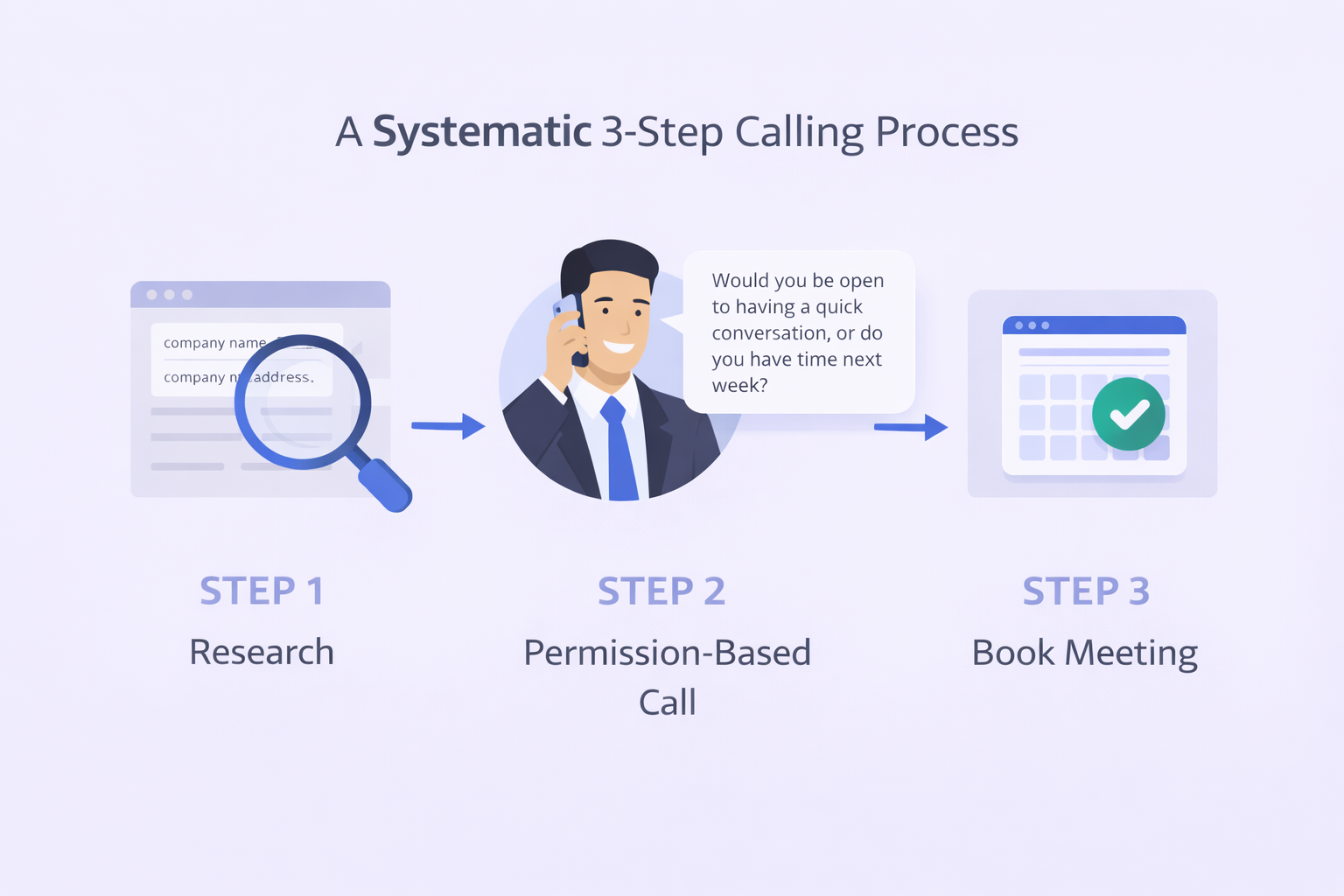
ermission-Based Communication The “Reason Statement” has become the gold standard opener. Simply stating “The reason for my call is…” results in 2.1x higher success rates because the human brain is wired to seek justification for interruptions.
Elite teams also use the “Tactical Apology”—acknowledging the unannounced nature of the call establishes professional respect. “I know I’m catching you off guard” isn’t weakness, it’s empathy. And empathy builds trust faster than any value proposition.
Discovery-Focused Dialogue Here’s where most amateurs fail: they pitch too early. Professional services know the goal isn’t to sell on the first call—it’s to facilitate discovery where the prospect speaks 70% of the time.
Research from top-performing teams shows that asking between 11-14 targeted questions results in a 70% higher success rate. These aren’t random questions—they’re designed to uncover process inefficiencies, resource drain, or vendor failure points.
This is exactly what effective sales prospecting looks like in practice: controlled conversations that qualify intent before consuming your team’s calendar.
The Technology Stack That Multiplies Results
Professional calling operations don’t succeed on effort alone—they succeed on technology multiplication.
The modern tech stack includes:
- Phone-Verified Data: Human-verified or AI-verified mobile numbers increase accuracy to 98%
- Parallel Dialers: Advanced systems that dial up to 10 lines simultaneously, achieving 3-5x more live conversations per hour
- Conversation Intelligence: Real-time AI coaching that analyzes prospect tone and prompts representatives with optimal responses
- CRM Synchronization: Automated logging that ensures every interaction becomes part of the pipeline story
This isn’t optional infrastructure anymore. Services using outdated single-line dialers waste 27% of their time on disconnected numbers. The data decay problem is real—2.1% of contact information becomes inaccurate every single month, costing businesses up to 12% of potential revenue.
ermission-Based Communication The “Reason Statement” has become the gold standard opener. Simply stating “The reason for my call is…” results in 2.1x higher success rates because the human brain is wired to seek justification for interruptions.
Elite teams also use the “Tactical Apology”—acknowledging the unannounced nature of the call establishes professional respect. “I know I’m catching you off guard” isn’t weakness, it’s empathy. And empathy builds trust faster than any value proposition.
Discovery-Focused Dialogue Here’s where most amateurs fail: they pitch too early. Professional services know the goal isn’t to sell on the first call—it’s to facilitate discovery where the prospect speaks 70% of the time.
Research from top-performing teams shows that asking between 11-14 targeted questions results in a 70% higher success rate. These aren’t random questions—they’re designed to uncover process inefficiencies, resource drain, or vendor failure points.
This is exactly what effective sales prospecting looks like in practice: controlled conversations that qualify intent before consuming your team’s calendar.
The Technology Stack That Multiplies Results
Professional calling operations don’t succeed on effort alone—they succeed on technology multiplication.
The modern tech stack includes:
- Phone-Verified Data: Human-verified or AI-verified mobile numbers increase accuracy to 98%
- Parallel Dialers: Advanced systems that dial up to 10 lines simultaneously, achieving 3-5x more live conversations per hour
- Conversation Intelligence: Real-time AI coaching that analyzes prospect tone and prompts representatives with optimal responses
- CRM Synchronization: Automated logging that ensures every interaction becomes part of the pipeline story
This isn’t optional infrastructure anymore. Services using outdated single-line dialers waste 27% of their time on disconnected numbers. The data decay problem is real—2.1% of contact information becomes inaccurate every single month, costing businesses up to 12% of potential revenue.
Cold Calling Services for Real Estate: A Specialized Vertical
Real estate represents one of the most mature applications of professional calling services. For property investors, the phone is a precision tool for identifying motivated sellers—people whose circumstances make them likely to sell below market value.
In 2024, real estate investors using specialized calling platforms generated over $15.7 million in revenue. The strategy isn’t random dialing—it’s targeting high-motivation triggers:
- FSBO (For Sale By Owner): Homeowners frustrated with self-marketing
- Expired Listings: Properties that didn’t sell through traditional channels
- Absentee Owners: Landlords dealing with management burdens
- Pre-Foreclosure: Owners facing financial urgency
The mathematical reality: A standard campaign of 1,000 dials yields approximately 200 contacts, leading to 40 qualified leads and closing 5 deals. While the conversion rate from dial to deal is just 0.5%, the high average transaction value makes this extremely profitable.
Circle Prospecting has emerged as a particularly effective technique. Representatives target specific neighborhoods where properties recently sold, calling surrounding neighbors to discuss how the sale might affect their property values. This transforms cold outreach into warm neighborhood updates, leveraging social proof and local market dynamics.
This specialized approach to lead generation shows how targeting precision beats volume every time.
The Economics: In-House vs. Outsourced Calling Services
Here’s where the conversation gets real for business leaders: what’s the actual ROI?
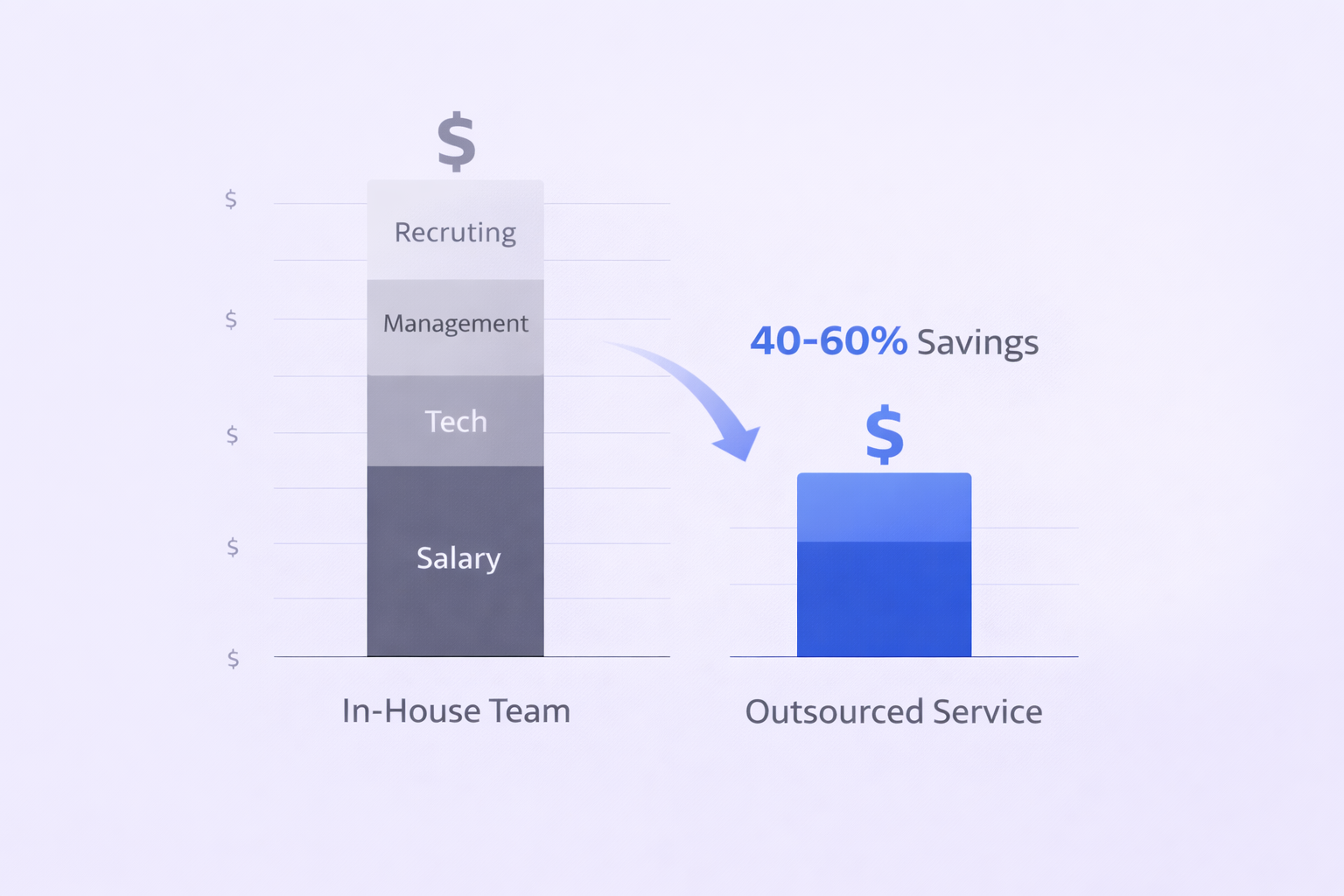
The fully-loaded cost of an internal team includes far more than salary. You’re paying for recruiting fees, benefits, management overhead, technology stack, training programs, and the opportunity cost of 3-4 month ramp time.
Let’s compare:
In-House Team (2 Representatives):
- Monthly compensation: $12,000-$20,000
- Tech stack & tools: $3,000-$5,000
- Management overhead: $3,000-$10,000
- Recruiting (one-time): $20,000+
- Annualized total: $240,000-$420,000
Outsourced Agency:
- Monthly service: $6,000-$15,000
- Tech stack: Included
- Management: Included
- Recruiting: Zero
- Annualized total: $72,000-$180,000
That’s 40-60% cost savings. But the real advantage isn’t just money—it’s speed and flexibility.
Professional calling services companies can launch campaigns in 14-30 days. Building an internal team takes 3-4 months minimum. That’s a 90-day empty pipeline representing potentially millions in lost opportunities.
The flexibility advantage is equally compelling. Internal teams are fixed costs that can’t easily scale down without layoffs. Agency models offer “capacity as a service”—expand for seasonal demand, contract during slow periods, all with 30 days’ notice.
For more context on how this compares to other development approaches, check out sales development services and their various models.
Cold Calling Services for Real Estate: A Specialized Vertical
Real estate represents one of the most mature applications of professional calling services. For property investors, the phone is a precision tool for identifying motivated sellers—people whose circumstances make them likely to sell below market value.
In 2024, real estate investors using specialized calling platforms generated over $15.7 million in revenue. The strategy isn’t random dialing—it’s targeting high-motivation triggers:
- FSBO (For Sale By Owner): Homeowners frustrated with self-marketing
- Expired Listings: Properties that didn’t sell through traditional channels
- Absentee Owners: Landlords dealing with management burdens
- Pre-Foreclosure: Owners facing financial urgency
The mathematical reality: A standard campaign of 1,000 dials yields approximately 200 contacts, leading to 40 qualified leads and closing 5 deals. While the conversion rate from dial to deal is just 0.5%, the high average transaction value makes this extremely profitable.
Circle Prospecting has emerged as a particularly effective technique. Representatives target specific neighborhoods where properties recently sold, calling surrounding neighbors to discuss how the sale might affect their property values. This transforms cold outreach into warm neighborhood updates, leveraging social proof and local market dynamics.
This specialized approach to lead generation shows how targeting precision beats volume every time.
The Economics: In-House vs. Outsourced Calling Services
Here’s where the conversation gets real for business leaders: what’s the actual ROI?
The fully-loaded cost of an internal team includes far more than salary. You’re paying for recruiting fees, benefits, management overhead, technology stack, training programs, and the opportunity cost of 3-4 month ramp time.
Let’s compare:
In-House Team (2 Representatives):
- Monthly compensation: $12,000-$20,000
- Tech stack & tools: $3,000-$5,000
- Management overhead: $3,000-$10,000
- Recruiting (one-time): $20,000+
- Annualized total: $240,000-$420,000
Outsourced Agency:
- Monthly service: $6,000-$15,000
- Tech stack: Included
- Management: Included
- Recruiting: Zero
- Annualized total: $72,000-$180,000
That’s 40-60% cost savings. But the real advantage isn’t just money—it’s speed and flexibility.
Professional calling services companies can launch campaigns in 14-30 days. Building an internal team takes 3-4 months minimum. That’s a 90-day empty pipeline representing potentially millions in lost opportunities.
The flexibility advantage is equally compelling. Internal teams are fixed costs that can’t easily scale down without layoffs. Agency models offer “capacity as a service”—expand for seasonal demand, contract during slow periods, all with 30 days’ notice.
For more context on how this compares to other development approaches, check out sales development services and their various models.