
Cold Email Agency: Your Complete Guide to Scaling Outbound in 2026
- Sophie Ricci
- Views : 28,543
Table of Contents
The digital inbox has become a battleground. With 392 billion messages sent daily in 2026, standing out feels impossible.
Yet some companies consistently book 15-25 qualified meetings per month through cold outreach. Others burn through domains and see nothing but crickets.
The difference? Professional execution.
A cold email agency handles everything from technical setup to campaign optimization, letting you focus on closing deals instead of wrestling with spam filters. But with pricing ranging from $1,500 to $15,000+ per month, knowing what you’re actually paying for matters.
This guide breaks down how these agencies work, what results you can expect, and the red flags that separate professionals from amateurs. Whether you’re evaluating your first agency or switching from a disappointing partner, you’ll learn exactly what to look for.
What Is a Cold Email Agency?
A cold email agency specializes in designing, executing, and optimizing outbound email campaigns that land in the primary inbox and drive responses.
These aren’t marketing agencies dabbling in lead generation. They’re specialists who understand the technical infrastructure, targeting precision, and messaging frameworks that make cold outreach work in 2026’s sophisticated filtering environment.
The core services include:
Technical Infrastructure Setup – Creating secondary domains, configuring authentication protocols (SPF, DKIM, DMARC), and warming up inboxes over 4-8 weeks to build positive sender reputation.
Prospect Research & Targeting – Identifying decision-makers who match your ideal customer profile, verifying contact data across multiple sources, and tracking trigger events that signal buying intent.
Campaign Design & Copywriting – Crafting message sequences that address specific pain points rather than generic personalization. The average decision-maker receives 100+ sales pitches monthly, so relevance beats familiarity.
Deliverability Management – Monitoring bounce rates, engagement metrics, and sender reputation. Keeping daily volume at 15-25 messages per inbox to mimic human patterns and avoid spam flags.
Performance Optimization – Testing subject lines, adjusting sequences based on response data, and moving prospects between campaigns based on engagement signals.
The industry has evolved dramatically. What used to be “spray and pray” has become a sophisticated orchestration of technology and strategy.
🚀 Ready to Scale Your Pipeline?
Stop Wrestling with Cold Email Setup
We handle the complete outbound system: targeting precision, campaign design, and technical infrastructure that consistently delivers 15-25% response rates.
How Cold Email Agencies Actually Work
Most agencies follow a similar operational framework, though execution quality varies wildly.
The Technical Foundation
Success starts with infrastructure. Agencies use 14 separate domains per 1,000 daily sends, distributing volume to protect sender reputation. Each domain hosts maximum 3 inboxes, preventing entire domain blacklisting if one account gets flagged.
Authentication is non-negotiable. SPF authorizes sending servers, DKIM provides digital signatures, and DMARC tells receiving servers how to handle failed checks. A strict DMARC policy has become a trust signal that can improve conversion rates by 10%.
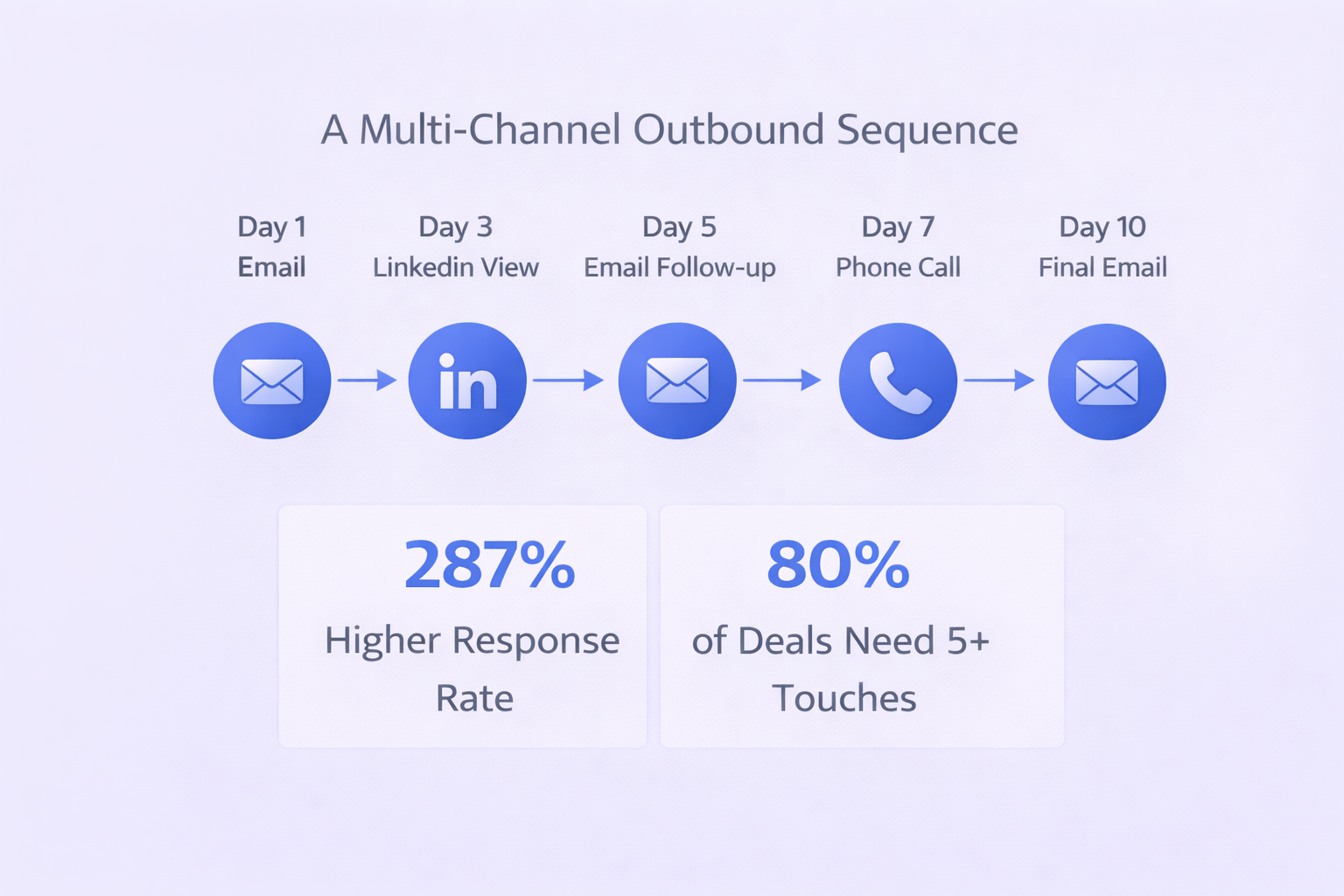
Smart agencies design campaigns where each touchpoint builds on the last, creating multiple chances to connect across different environments.
Cold Email Agency Pricing Models
The cost structure varies significantly based on service depth and whether you’re paying for execution, results, or dedicated resources.
Pure Execution (Email-Only)
Monthly Cost: $1,500 – $5,000
These agencies handle campaign creation, technical setup, and ongoing optimization. You get professional infrastructure and copywriting, but they’re not managing LinkedIn or phone follow-up.
Best for companies with simple offers where email alone drives sufficient volume, or teams who handle other channels internally.
Omnichannel Campaigns
Monthly Cost: $5,000 – $15,000
These programs combine email, LinkedIn engagement, and phone outreach in coordinated sequences. Higher investment, but the targeted outreach across multiple channels significantly improves response rates.
Ideal for complex enterprise sales where building trust requires sustained, multi-touch engagement.
Dedicated Sales Development
Monthly Cost: $4,200 – $9,500
Some agencies provide dedicated representatives who function as an extension of your team. They manage the entire top-of-funnel motion: research, outreach, qualification, and meeting scheduling.
This model works well for high-growth companies that need immediate capacity without the 3-month ramp time and $127,000 annual cost of in-house hires.
Pay-Per-Result
Cost Per Meeting: $250 – $1,000
Performance-based pricing eliminates upfront risk but typically comes with higher per-meeting costs. The average cost per meeting in B2B ranges from $100-$500 when paying monthly retainers.
Best for companies with validated offers seeking predictable scaling without fixed overhead.
Let Experts Handle Your Infrastructure
From domain configuration to email deliverability management, we build systems that scale without burning sender reputation.
What Results Should You Expect?
Healthy benchmarks help separate realistic promises from red flags.
Response Rate Benchmarks
Cold email campaigns typically achieve 1-5% response rates. Agencies promising 20%+ response rates should raise immediate skepticism – those numbers suggest unverified data or misleading metrics.
However, highly targeted campaigns with strong offer-market fit can reach 15-25% response rates when combining email with other channels and focusing on prospects showing active buying signals.
The cold email outreach ROI remains one of the highest in digital marketing: studies consistently show returns of $36-$42 for every dollar spent, or roughly 3600-4200% ROI.
Meeting Volume Expectations
A professional campaign sending 1,000 emails monthly should generate 10-50 qualified meetings, depending on target persona complexity and offer strength.
Agencies using AI-orchestrated workflows report 90% reduction in research time and 35% improvement in engagement rates, allowing them to maintain higher quality while scaling volume.
Ramp Time Reality
Most agencies need 60-90 days to show consistent results. The first 30 days focus on technical setup and testing, weeks 5-8 involve optimization based on initial data, and month 3 typically represents stabilized performance.
Companies switching from in-house programs to agencies often see immediate improvements simply because professional infrastructure prevents the deliverability death spiral that plagues amateur setups.
Red Flags When Evaluating Agencies
The cold email space attracts both professionals and opportunists. Watch for these warning signs:
Pricing Red Flags
High Upfront Setup Fees – Legitimate agencies might charge modest setup fees ($500-$1,500), but anything exceeding $3,000 before demonstrating results deserves scrutiny.
Unrealistic Guarantees – No professional can guarantee specific response rates before testing your offer. Market dynamics, competitive landscape, and offer strength all impact performance.
Lack of Pricing Transparency – Agencies refusing to discuss pricing ranges or hiding costs behind mandatory sales calls often signal poor service-to-cost ratios.
Technical Red Flags
Sending from Agency Domains – Reputable providers send from domains you own and control, not their infrastructure. This protects your data and prevents being locked into their platform.
No Infrastructure Details – Professional agencies openly discuss domain ratios, warm-up processes, and authentication protocols. Vague answers suggest inexperience with deliverability fundamentals.
Single Data Source – Agencies relying on one database (Apollo, ZoomInfo, etc.) see higher bounce rates. Quality providers use waterfall enrichment across multiple sources.
Service Red Flags
Pure Volume Focus – Agencies obsessed with email quantity rather than response quality typically burn through lists without driving actual meetings.
No Qualification Process – The best way to send cold emails involves strategic targeting, not mass blasting. Agencies that don’t discuss your ideal customer profile probably won’t deliver qualified leads.
Lack of Reporting – Weekly or bi-weekly performance reports should be standard. Transparency in metrics builds trust and allows collaborative optimization.
The AI Transformation of Cold Outreach
Artificial intelligence has fundamentally changed what’s possible in cold email operations.
Automation Capabilities
Predictive Send-Time Optimization analyzes recipient behavior patterns to deliver messages when they’re most likely to be opened, rather than arbitrary scheduling.
Dynamic Audience Segmentation automatically moves prospects between campaigns based on real-time behavior, ensuring follow-up sequences match engagement levels.
Automated Research Agents scrape LinkedIn, news sites, and financial reports to identify specific triggers for outreach, eliminating hours of manual research.
Smart Reply Detection categorizes responses (interested, out of office, wrong person) to prioritize human follow-up appropriately.
These capabilities allow AI-native agencies to achieve the same pipeline results as traditional firms with 70% less human headcount, reducing go-to-market costs from 36% of new revenue down to 23%.
The Human Element Remains Critical
Despite automation advances, human oversight drives campaign success. AI generates options; humans select the strategic direction based on market understanding, competitive positioning, and offer evolution.
The most effective agencies use AI for scalable research and optimization while maintaining human control over targeting decisions, campaign strategy, and relationship-building moments.ime and $127,000 annual cost of in-house hires.
💡 Tired of Mediocre Results?
Partner with Specialists Who Understand Modern Deliverability
We combine AI-powered research with human strategic oversight, delivering campaigns that book meetings instead of triggering spam filters.
Building Your Agency Evaluation Checklist
When comparing providers, assess these critical factors:
Technical Competence – Ask about domain infrastructure, authentication setup, and warm-up processes. Specific answers indicate expertise; vague responses suggest inexperience.
Data Quality Approach – How do they source and verify contact information? Multi-source verification prevents the high bounce rates that kill deliverability.
Campaign Philosophy – Do they emphasize volume or relevance? Quality agencies discuss targeting precision, trigger events, and problem-specific messaging.
Reporting Cadence – Weekly reports should cover sends, opens, replies, meetings booked, and deliverability metrics. Transparency enables collaborative optimization.
Industry Experience – Agencies with experience in your vertical understand buyer psychology, competitive landscape, and effective messaging frameworks.
Contract Flexibility – Month-to-month or quarterly contracts demonstrate confidence. Annual commitments with no performance guarantees favor the agency, not you.
Technology Stack – Which platforms do they use for sending, data enrichment, and email warm-up tools? Modern tools indicate investment in infrastructure.
In-House vs Agency: The Economic Reality
The total cost of building internal capabilities often exceeds agency partnerships.
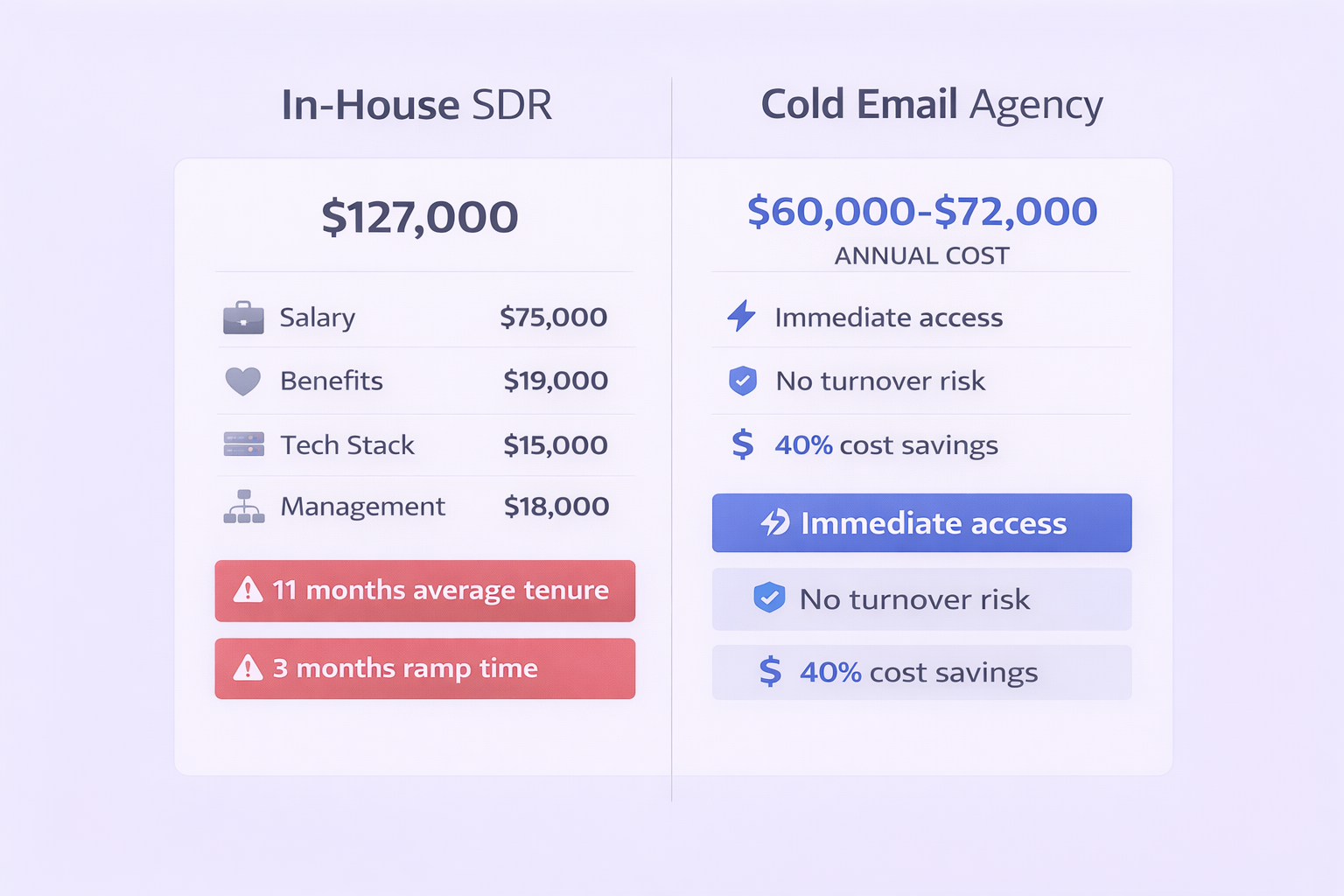
A fully-loaded sales development representative costs approximately $127,000 annually when factoring salary, benefits, technology stack (ZoomInfo, Apollo, CRM), equipment, and management overhead.
Average tenure for junior sales reps is 11 months, and they require roughly 3 months of ramp time before becoming productive. This means companies spend $31,750 on a learning period, only to have the employee leave shortly after achieving peak efficiency.
Specialized agencies provide immediate access to refined systems, typically at costs 40% lower than full-time hires while eliminating turnover risk and maintaining consistent performance.
For many companies, the decision isn’t purely financial – it’s about focusing internal resources on high-value closing activities while outsourcing technical setup and top-of-funnel volume generation.
What to Ask During Agency Consultations
These questions reveal operational maturity:
“How many domains will you use for our volume?” – The answer should reference the 14-domains-per-1,000-sends standard.
“What’s your email warm-up process?” – Expect specifics about timing (4-8 weeks), automated engagement networks, and gradual volume increases.
“How do you handle data verification?” – Multi-source validation should be standard to keep bounce rates under 2%.
“What’s your typical response rate range?” – Honest agencies cite 1-5% for cold campaigns, with higher rates possible through multi-channel coordination.
“How do you measure success?” – Beyond opens and clicks, they should track replies, meeting bookings, and ultimately closed revenue.
“What happens if deliverability degrades?” – Professional response includes monitoring protocols, remediation steps, and domain rotation strategies.
“Who owns the domains and data?” – You should own all assets, preventing vendor lock-in.
“What’s your ramp timeline?” – Realistic expectations span 60-90 days from start to stabilized performance.
🎯 Not Sure Where to Start?
Get a Custom Outbound Strategy for Your Market We analyze your ideal customer profile, competitive landscape, and offer positioning to design campaigns that convert prospects into meetings.
7-day Free Trial |No Credit Card Needed.
The Future of Professional Outreach
As we move through 2026 and toward 2027, inbox providers increasingly function as gatekeepers rather than passive receivers.
Google and Apple now summarize, prioritize, or hide messages based on recipient behavior patterns and perceived relevance. Email no longer exists in a vacuum – it’s evaluated as part of the broader customer journey across all touchpoints.
This evolution favors sophisticated operators. Companies demonstrating technical trust, verified data provenance, and genuine value delivery will outperform those relying on automated shortcuts.
The competitive advantage will come from agencies that treat every outreach attempt as the start of a professional relationship rather than a number in a database. Those that integrate email with LinkedIn, phone, and content marketing create the orchestrated journeys that break through noise.
Organizations prioritizing data quality over database size, relevance over volume, and multi-channel coordination over single-touch attempts will dominate pipeline generation.
Conclusion
The cold email agency landscape has matured into a sophisticated industry where technical expertise, strategic messaging, and multi-channel orchestration separate winners from wasters of budget.
Professional execution consistently delivers 3600-4200% ROI when agencies focus on infrastructure fundamentals, problem-specific relevance, and ethical data practices. The average meeting cost of $100-$500 makes outbound one of the most efficient growth channels available.
Success requires partnering with agencies that demonstrate technical competence in deliverability management, strategic sophistication in targeting and messaging, and operational transparency through regular reporting and collaborative optimization.
For companies ready to scale pipeline without building expensive internal teams, the right agency partnership accelerates growth while maintaining cost efficiency. The key is evaluating providers against the technical, strategic, and operational criteria outlined in this guide.
When choosing a partner, prioritize those who own their infrastructure, verify data across multiple sources, design campaigns around trigger events rather than personalization theater, and coordinate multi-channel touchpoints that respect prospect intelligence.
Ready to build a systematic outbound engine? At Salesso, we specialize in the complete lead generation stack: precision targeting, campaign design that drives responses, and technical infrastructure that scales without burning domains. Book a strategy meeting to discuss how we can fill your pipeline with qualified meetings.
FAQs
What does a cold email agency actually do?
How much does a cold email agency typically cost?
What response rates should I expect from cold email?
How much does a cold email agency typically cost?
Why do people say cold email is dead?
We deliver 100–400+ qualified appointments in a year through tailored omnichannel strategies

- blog
- Sales Development
- Cold Email Agency Guide 2026 | Salesso Lead Generation
