
Sending cold emails without understanding the laws? You’re playing with fire that could cost you $53,000 per violation.
The reality check hits hard: 46% of all electronic outreach in 2023 was flagged as non-compliant, triggering massive regulatory responses worldwide. By 2026, the rules have gotten stricter, the penalties steeper, and the technical requirements more complex.
But here’s the good news: compliant cold email campaigns deliver an average ROI of $42 for every $1 spent in 2026. Organizations that prioritize legal compliance aren’t just avoiding fines—they’re seeing 15-25% response rates while competitors struggle at 1-5%.
This guide cuts through the legal complexity. You’ll understand exactly what you can and can’t do when sending cold emails in the US, Canada, Europe, and Australia. No legal jargon. No confusion. Just clear, actionable compliance that protects your business and improves your results.
Let’s make sure every outreach message you send is both legal and effective.
Understanding Cold Email Laws Across Major Jurisdictions
Why Cold Email Laws Matter More Than Ever
The stakes have never been higher. Global email users hit 4.73 billion in 2026, and regulators worldwide are cracking down hard on unsolicited outreach.
The financial risk is dual-faceted. Beyond immediate regulatory fines, there’s the “infrastructure tax” of domain damage. Once your domain gets blacklisted by Google or Microsoft, recovery costs often exceed the legal penalties. Organizations see their email deliverability rates drop below 50%, effectively killing their outbound strategy.
But compliance isn’t just about avoiding penalties. The data proves that legal, well-targeted cold email outreach generates 35% higher engagement rates because recipients actually want to hear from you.
United States: The CAN-SPAM Act Framework
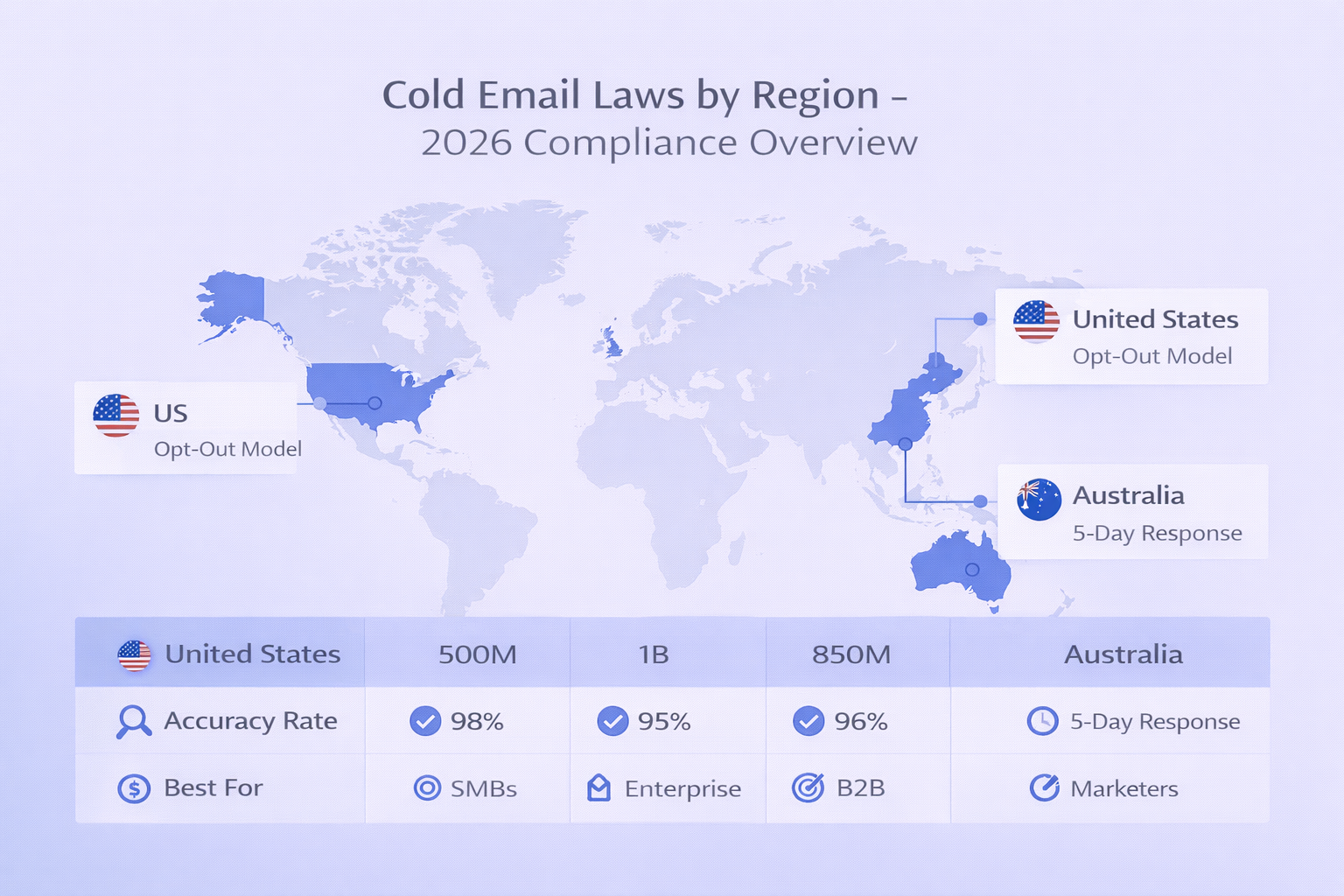
The US takes an “opt-out” approach rather than requiring prior consent. This makes cold email legal, but only if you follow specific rules.
The Controlling the Assault of Non-Solicited Pornography and Marketing (CAN-SPAM) Act sets clear boundaries. Violations can result in fines of $53,088 per individual email as of 2026, so understanding these requirements isn’t optional.
Core CAN-SPAM Requirements:
Accurate Header Information: Your “From,” “To,” and “Reply-To” fields must truthfully identify who’s sending the message. No deception, no spoofing, no exceptions.
Honest Subject Lines: Your subject line must reflect the actual content of your message. Using clickbait subject lines that don’t match your message body is a direct legal violation and tactical suicide for your sender reputation.
Clear Identification: Every message must include a valid physical postal address. P.O. boxes work if they’re registered under your business name.
Visible Opt-Out Mechanism: You need a clear, conspicuous unsubscribe link. No fees, no extra information required, and it must work for 30 days after sending.
Fast Fulfillment: Once someone opts out, you have 10 business days maximum to honor their request. Period.
Third-Party Responsibility: If someone sends cold emails on your behalf, both you and the sender are legally liable. You can’t outsource your legal responsibility.
The CAN-SPAM framework is relatively permissive compared to other regions, but 57% of messages still land outside the primary inbox if technical authentication isn’t properly configured. Legal compliance and technical deliverability are inseparable in 2026.
Europe and UK: GDPR’s Informed Consent Model
Europe represents the strictest environment for cold outreach. The General Data Protection Regulation (GDPR), alongside the UK’s Privacy and Electronic Communications Regulations (PECR), shifts from opt-out to “informed consent” or “legitimate interest.”
Under GDPR, professional email addresses like name@company.com count as personal data, requiring a valid legal basis for processing.
For B2B outreach, “legitimate interest” is your primary justification. But this requires a rigorous Legitimate Interest Assessment (LIA) proving your commercial interests don’t override individual privacy rights.
The communication must be highly relevant to the recipient’s professional role. Sending cloud infrastructure pitches to HR managers? That fails the legitimate interest test and constitutes a violation.
Key GDPR Compliance Factors:
Lawful Basis: You need either explicit consent or a documented legitimate interest assessment. Penalties reach up to €20 million or 4% of global annual turnover—whichever is higher.
Transparency Requirements: You must explain how you obtained the data and how you’ll use it. Vague privacy policies don’t cut it anymore.
Right to Erasure: When someone requests data deletion, you must comply promptly. This extends across all your systems, not just your primary outreach tool.
Tracking Disclosure: Here’s where 2026 gets tricky. The French regulator CNIL now classifies tracking pixels as data processing tools requiring explicit consent. Those invisible 1×1 images monitoring open rates? You need specific permission to use them for individual tracking.
Organizations are shifting to aggregate, anonymized metrics to maintain both compliance and useful analytics. If you’re operating in European markets, understanding GDPR compliance in AI sales tools becomes critical as automation increases.
Canada: CASL’s Strict Opt-In Requirements
Canada’s Anti-Spam Legislation (CASL) is the world’s strictest cold email law. It applies to any message sent using a computer system located in Canada, meaning global organizations must comply when targeting Canadian prospects.
CASL distinguishes between “express consent” (affirmative agreement) and “implied consent” (time-bound, relationship-based).
Understanding CASL’s Implied Consent:
Purchase-Based: If someone buys from you, you have 24 months of implied consent for related messages.
Inquiry-Based: When a prospect inquires about your services, you get 6 months to send relevant follow-ups.
Business Card Exchange: Receiving a business card at networking events creates 6 months of implied consent—but only for role-relevant messages.
Public Information: If someone’s email is publicly listed (company website, LinkedIn), you have implied consent until they say “no contact.” But the message must be directly relevant to their professional role.
Here’s the catch: All implied consent is fragile and expires. You need to transition to express consent for long-term engagement, or you’re violating CASL when those time windows close.
Violations carry fines up to $10 million CAD for organizations and $1 million CAD for individuals. This makes Canada a high-risk zone for non-compliant automation.
But there’s an upside: Data shows CASL-compliant lists generate 35% higher engagement rates because recipients actually have interest in your communication. Quality over quantity wins in Canada.
For effective targeted outreach that respects CASL requirements, precision in audience selection becomes your competitive advantage.
Australia: The Spam Act’s Three Pillars
Australia’s Spam Act 2003 governs any commercial message with an “Australian link”—messages originating from or accessed within Australia.
The law focuses on three core requirements: consent, sender identification, and functional unsubscribe mechanisms.
Australian Consent Categories:
Express Consent: The recipient has explicitly agreed to receive your messages.
Inferred Consent: Typically arises from ongoing business relationships like active memberships or accounts.
Published Information: While Australia allows inferred consent from published email addresses, there’s a strict prohibition against address-harvesting software or scraped lists.
Critical Compliance Details:
Identity Disclosure: Include your legal business name or Australian Business Number (ABN) in every message.
Contact Information: Provide valid contact details that remain active for at least 30 days post-send.
Unsubscribe Speed: You must honor opt-out requests within 5 working days—faster than the US standard of 10 days.
The penalties are severe: Repeat corporate offenders face fines up to $1.1 million AUD per day. This underscores the necessity of using verified, compliant data providers rather than scraped lists.
Technical Infrastructure: Where Law Meets Deliverability
The intersection of legal compliance and technical deliverability has become the most critical frontier for cold email in 2026. Major email service providers now enforce technical authentication as a proxy for legal compliance.
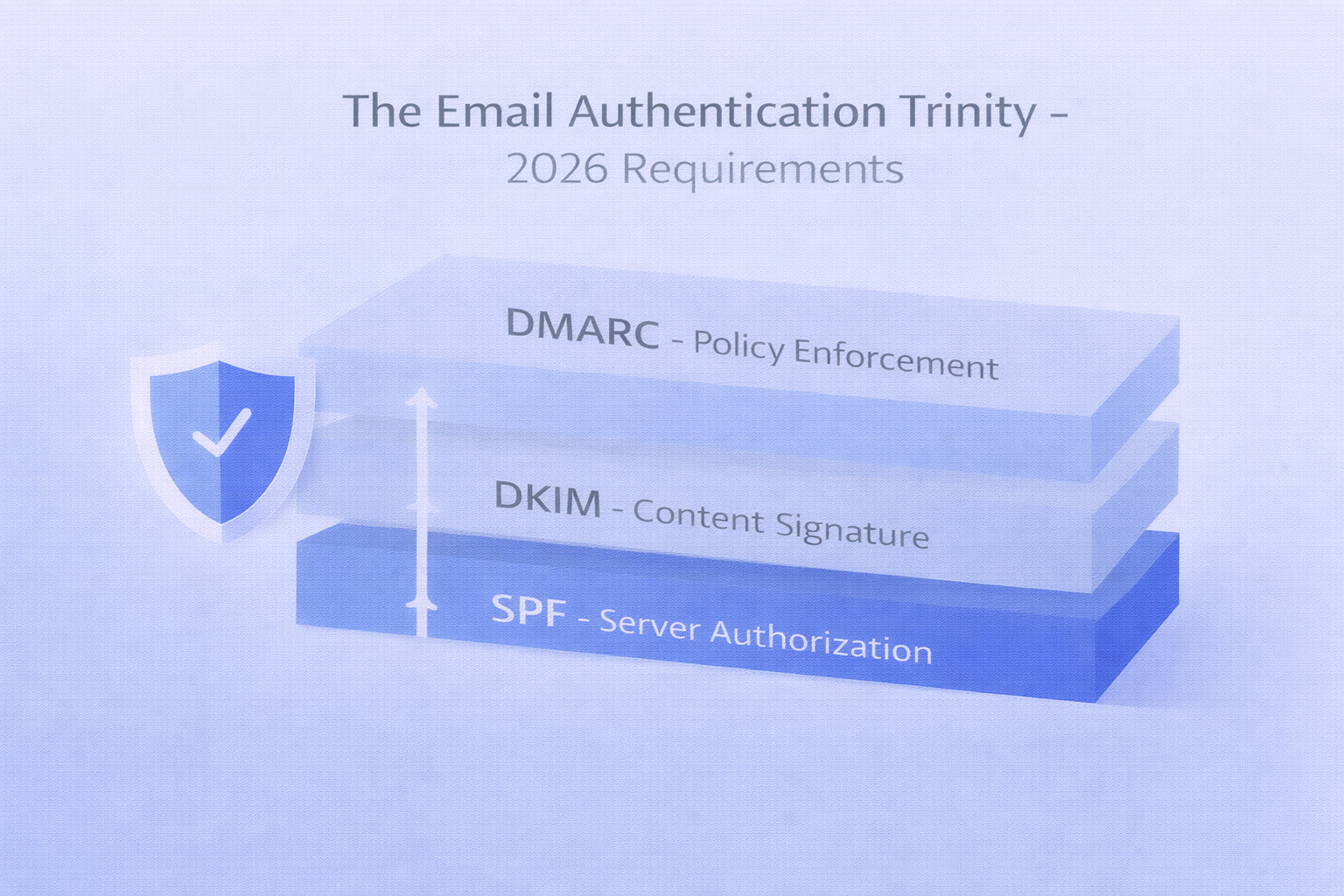
Organizations failing to set up SPF, DKIM, and DMARC are automatically flagged as high-risk, regardless of content quality.
Essential Technical Protocols:
SPF (Sender Policy Framework): Authorizes specific servers to send on your domain’s behalf, preventing spoofing and unauthorized use.
DKIM (DomainKeys Identified Mail): Adds a cryptographic signature to your message body, ensuring content hasn’t been tampered with in transit.
DMARC (Domain-based Message Authentication, Reporting, and Conformance): Instructs receiving servers on how to handle SPF/DKIM failures. This is essential for protecting your primary domain authority.
Domain Warm-Up: Gradual volume increases (15-20 emails/day per inbox) over 4-8 weeks build “human-like” reputation with Google and Microsoft algorithms.
Here’s the brutal reality: 57% of messages land outside the primary inbox without proper warm-up periods. Additionally, including links in your initial cold email can increase spam detection by up to 35%, leading successful outreach teams to favor plain-text messages for first touchpoints.
Understanding what is BIMI (Brand Indicators for Message Identification) gives you another layer of sender verification that builds trust and improves inbox placement.
These technical requirements aren’t optional extras—they’re the foundation of legal, effective cold email outreach. For comprehensive guidance, check out our ultimate guide to email compliance for cold outreach.
Personalization: Your Legal Defense and Performance Multiplier
A significant theme in 2026 is using personalization as your primary defense against legal challenges, particularly under GDPR’s “legitimate interest” clauses.
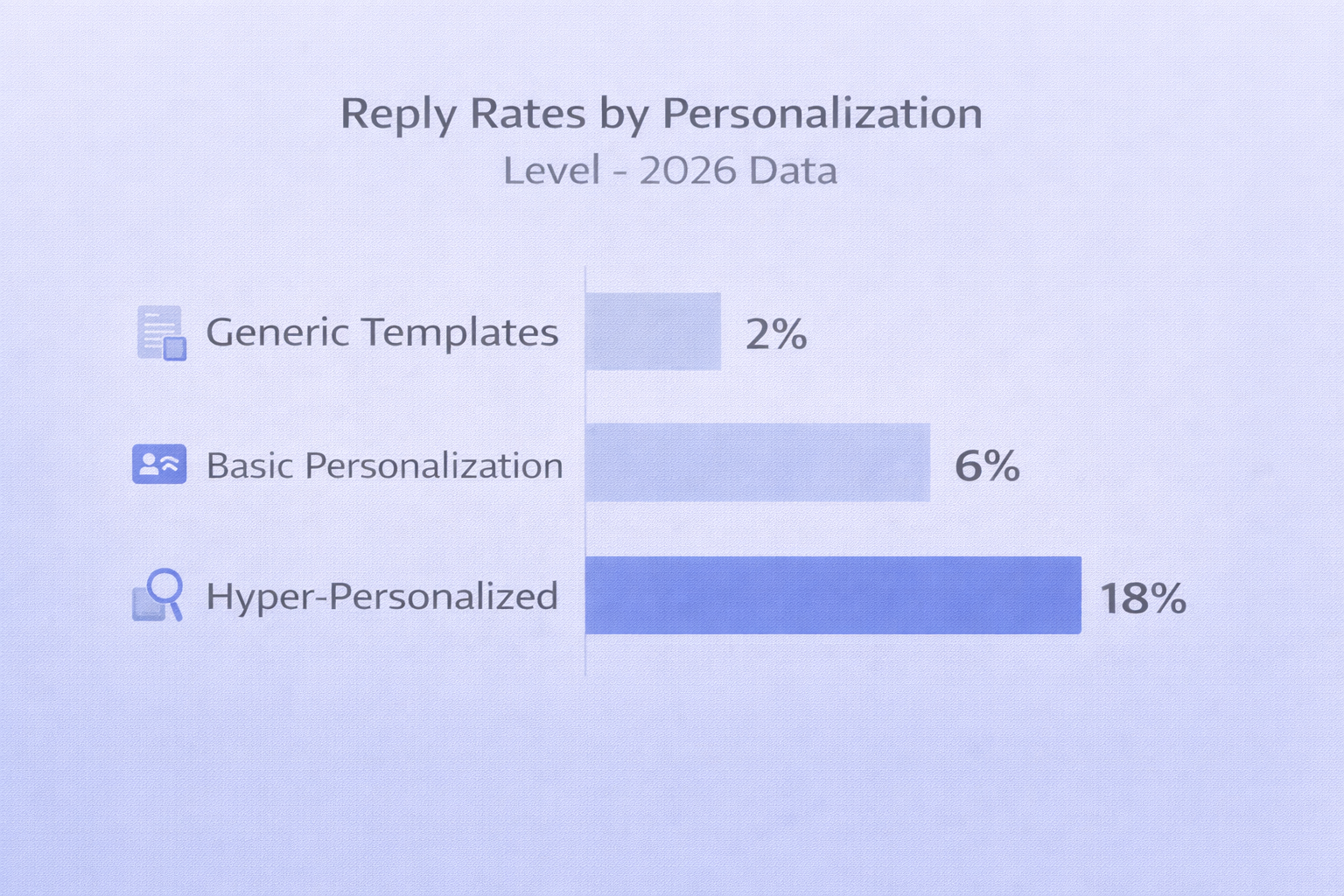
The data is compelling: Organizations using advanced personalization see 18% reply rates—more than triple the industry average of 5.1%. Legally, this personalization serves as proof of research and relevance, demonstrating you’re not engaged in “spray and pray” blasting.
Personalization Performance Benchmarks:
Generic Templates: 15-25% open rate, 1-5% reply rate, high risk of spam reports.
Basic Personalization (First Name): 27.7% open rate, 5-7% reply rate, marginal compliance.
Hyper-Personalized: 43-70% open rate, 15-25% reply rate, strong “legitimate interest” defense.
Research shows 79% of customers expect companies to understand their specific needs before contact. In a legal context, this expectation aligns perfectly with GDPR’s requirement that outreach must be something the recipient would “reasonably expect.”
When you demonstrate genuine research into a prospect’s business challenges, industry trends, and professional role, you’re building both a compliance defense and a conversion strategy. Understanding the difference between cold email vs spam comes down to relevance and personalization.

