
Let's Build Your First Campaign Together with our LinkedIn Expert

Cold Email Marketing Statistics That Will Change How You Prospect in 2026

Table of Contents

Cold Email Marketing Statistics

  • Average cold email response rate: 5.1-5.8% but top performers hitting 15-25% – massive performance gap separating winners from rest based on methodology not luck, precision beating quantity
  • 17% of cold emails never reach inbox – caught by spam filters or bouncing before anyone sees them, requiring deliverability foundation before content quality matters
  • Average bounce rate 7.5% for B2B cold emails (alarmingly high) – killing sender reputations daily with 0-2% optimal, 3-5% warning zone, 6-7% critical, above 7.5% blacklist territory
  • 0.3% spam complaint threshold (3 out of 1,000) triggers immediate domain penalties – Google and Yahoo enforcing ruthlessly, one bad campaign destroying months of reputation building
  • Senders with full authentication (SPF, DKIM, DMARC) see 40% better deliverability – custom domain with proper authentication achieving 3.5-5.9% reply rate vs generic webmail 1.2-2.1%
  • B2B contact data decays at 23% per year – people changing jobs, companies merging, email addresses expiring making list cleaning before every send survival not optional
  • Average open rate 27.7% but increasingly unreliable – Apple Mail Privacy Protection artificially inflating opens, actual 25% might be 15% real human opens
  • Takes 464-500 emails to generate one won deal (0.2-1% conversion) – ultimate conversion rate making manual personalization at scale economically impossible, requiring automation
  • Industry response rates: Non-Profit 16.5%+, Legal 10.2%, SaaS 1.9% – massive spread showing “good” reply rate depends entirely on who you’re targeting, SaaS facing extreme saturation
  • C-level executives: CEOs 1.7%, CTOs 2.9%, Founders 5.3% response – founders responding 3x more than professional CEOs, mid-level directors showing 6.2% making bottom-up often outperform top-down
  • Subject lines: 2-4 words achieve 46% open rate vs 9+ words 34% – 61% of emails opened on mobile requiring 30-50 characters for full visibility, sentence case bypassing mental spam filters
  • Email length: 50-125 words achieve ~50% reply rate vs 200+ words plummeting to ~2% – modern executives scanning in F-pattern, every unnecessary word opportunity to lose them
  • Timeline hooks: 10.01% reply rate, Numbers hooks: 8.57%, Problem hooks: 4.39% – proving you’re watching specific story not broadcasting to list, problem hooks now baseline everyone assumes
  • 1st follow-up increases reply rate by ~50%, 2nd adds ~25%, 3rd adds ~10% – optimal “3-7-7” sequence capturing 93% of total potential replies, 4th+ effectiveness dropping 30% with rising spam risk
  • Multi-channel synergy: Email only 4-6%, Email + LinkedIn 8-10%, Email + LinkedIn + Phone 10-12% – validating “Allbound” strategy with LinkedIn profile view before email acting as warm-up making name familiar

Cold email marketing is brutally honest. Either your message resonates and gets a reply, or it disappears into the void.

The difference between success and failure? Understanding what actually works based on real data, not guesswork.

In 2025, the average cold email response rate sits between 5.1% and 5.8%. But here’s what most people miss: top performers are crushing these averages with response rates hitting 15-25%.

What separates the winners from the rest? They’ve stopped spraying generic messages and started using data to guide every decision—from subject lines to send times to follow-up cadences.

This guide breaks down 50+ cold email marketing statistics that matter. You’ll discover what’s actually working, what’s killing campaigns, and how to apply these insights to your own outreach.

Let’s dig into the numbers.

The Current State of Cold Email Marketing

Cold email isn’t dead. It’s evolved. And the statistics paint a clear picture: volume no longer equals success.

The “spray and pray” era is over. 17% of cold emails never reach the inbox, getting caught by spam filters or bouncing before anyone sees them.

Here’s the reality: sending more emails without relevance actively damages your results. High-volume campaigns with generic templates see response rates plummet to under 1%, while targeted campaigns to fewer than 50 recipients regularly achieve 15-25% response rates.

The math is simple. Would you rather send 10,000 emails and get 50 replies, or send 500 emails and get 100 replies? Same effort, double the results.

Modern cold email software prioritizes quality over quantity, helping you target the right people with the right message at the right time.

Deliverability Statistics: Your Foundation for Success

Before anyone reads your brilliant pitch, your email needs to survive the gatekeepers: spam filters and inbox algorithms.

Bounce Rates: The Silent Campaign Killer

The average bounce rate for B2B cold emails is 7.5%. That’s alarmingly high—and it’s killing sender reputations daily.

Here’s what bounce rates really mean for your campaigns:

  • 0-2% bounce rate: Optimal. Your sender reputation stays intact.
  • 3-5% bounce rate: Warning zone. Acceptable but needs improvement.
  • 6-7% bounce rate: Critical. Email providers start throttling your delivery.
  • Above 7.5%: Domain blacklist territory. Your outreach capabilities are effectively neutralized.

Why do bounces matter so much? B2B contact data decays at 23% per year as people change jobs, companies merge, and email addresses expire. Without real-time verification, you’re essentially burning your domain’s reputation with every campaign.

The solution? List cleaning before every send isn’t optional—it’s survival.

The Spam Complaint Threshold

This statistic should scare you: if just 0.3% of recipients mark your email as spam (3 out of 1,000 people), your domain faces immediate penalties.

Google and Yahoo enforce this threshold ruthlessly. One bad campaign can destroy months of reputation building.

What triggers spam complaints? Generic pitches to broad audiences. When your message lacks relevance, recipients don’t just ignore it—they actively punish it.

Authentication: The Price of Inbox Admission

Senders with full authentication (SPF, DKIM, DMARC) see 40% better deliverability compared to those who skip these technical setups.

Even your email account type matters:

  • Custom domain with proper authentication: 3.5-5.9% reply rate
  • Generic webmail (@gmail.com, @yahoo.com): 1.2-2.1% reply rate

Using a generic email address signals amateur hour to prospects—even if your message is brilliant.

Skip Email Altogether—Go Straight to Decision-Makers

Cold email deliverability is a constant battle. LinkedIn outbound puts your message directly in front of verified professionals—no spam filters, no bounce rates, no domain reputation worries. Our complete outbound lead generation system handles targeting, campaign design, and scaling for 15-25% response rates.

Open Rate and Reply Rate Benchmarks

Open Rates: The Vanity Metric

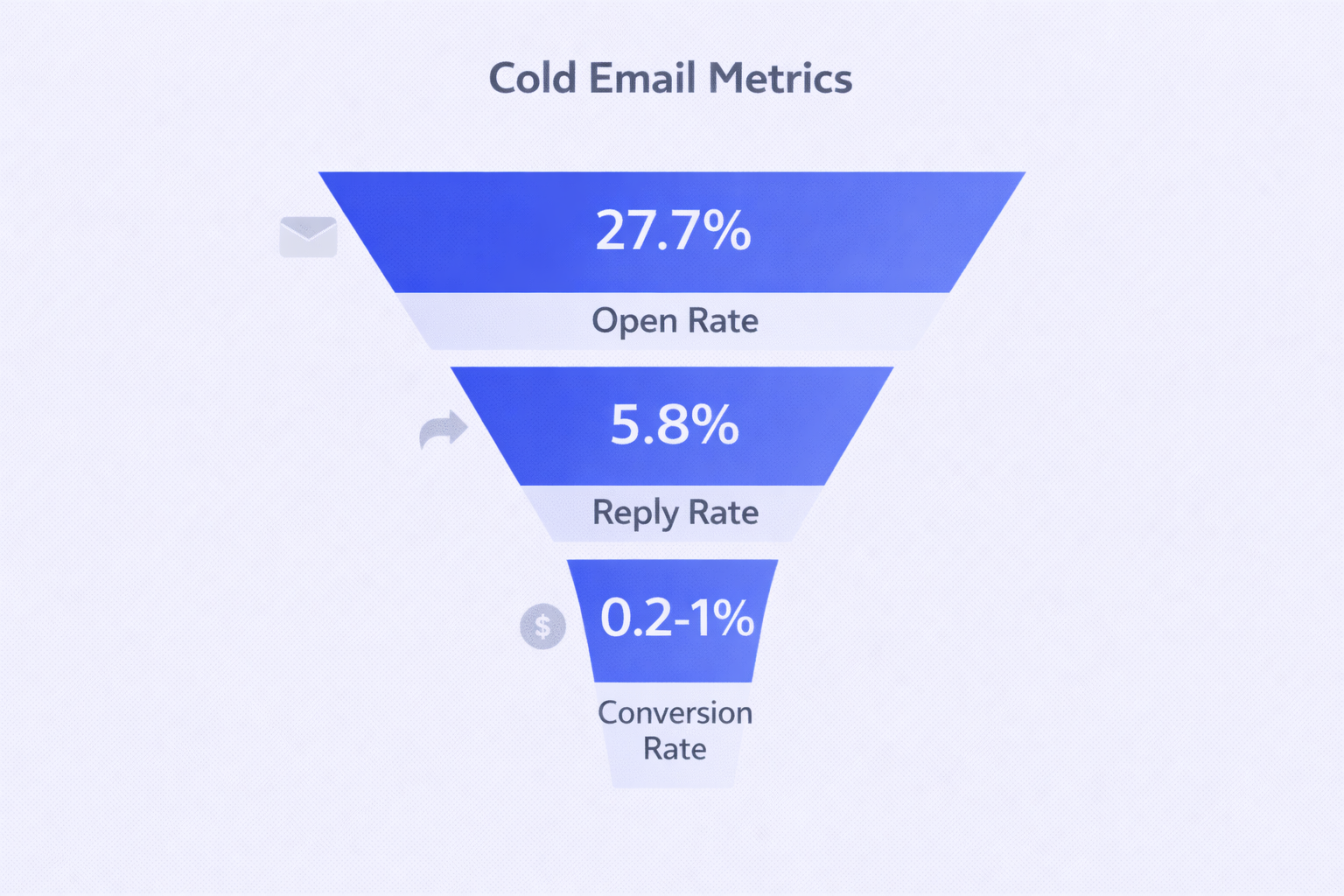
The average open rate for B2B cold emails hovers around 27.7%, but this number is increasingly unreliable.

Why? Privacy features like Apple’s Mail Privacy Protection artificially inflate opens. Your 25% open rate might actually be 15% real human opens.

Here’s where open rates get interesting by context:

  • Standard cold outreach: 23.9-27.7%
  • Marketing campaigns with warmed domains: 39-40%
  • Elite campaigns with deep personalization: 45-50%+

But smart marketers have stopped obsessing over opens. They’ve shifted focus to the metric that actually matters: replies.

Reply Rates: The Truth Teller

Reply rates don’t lie. The average cold email reply rate sits at 5.1-5.8%, but this average conceals a massive performance gap:

  • Bottom tier (generic templates): Under 1%
  • Average performer (basic personalization): 1-5%
  • Strong performer (segmented lists, relevant hooks): 8-12%
  • Elite performer (deep personalization, intent data): 15-25%

Notice the spread? The top performers get 5x more replies than the average sender. This isn’t luck—it’s methodology.

The conversion math gets leaner further down the funnel: it takes approximately 464-500 emails to generate one won deal, with an ultimate conversion rate of 0.2-1% from sent email to closed opportunity.

This ratio is why manual personalization at scale is economically impossible. The solution? Automate the research and delivery, but keep the content authentic.


Industry-Specific Response Rates

Not all industries respond to cold outreach equally. Your “good” reply rate depends entirely on who you’re targeting.

Here’s how response rates break down by sector:

High-Response Industries:

  • Non-Profit/Religious: 16.5%+ (mission-driven alignment creates high trust)
  • Legal Services: 10.2% (relationship-based, high-value clients)
  • E-Learning/EdTech: 7.8% (strong demand for professional development)
  • Chemical Industry: 7.3% (niche market, less inbox noise)

Moderate-Response Industries:

  • Real Estate: ~5.8% (transaction-heavy, networking-focused)
  • Marketing & Advertising: 4.4% (skeptical, familiar with sales tactics)
  • Finance/Banking: 3.39-4.8% (regulatory barriers, conservative culture)

Low-Response Industries:

  • IT Consulting: 3.5-3.7% (highly competitive, pitch-saturated)
  • SaaS/Software: 1.9% (extreme saturation, decision-makers drowning in vendor emails)

The insight? If you’re selling to SaaS companies, a 2% reply rate is actually normal. Breaking that ceiling requires pattern interrupts like video personalization or timeline-based hooks.

Conversely, targeting Legal or Manufacturing? Your standard professional pitch still works because these audiences face less digital noise.

Interestingly, SaaS sectors maintain 47% open rates despite low reply rates. Tech buyers are curious enough to scan emails but ruthless about disqualifying generic content. They open the door, glance inside, and slam it shut.

Role-Based Response Rates: Who Actually Replies?

Here’s a truth that challenges conventional wisdom: targeting the C-suite isn’t always the winning strategy.

The C-Suite Paradox

C-level executives have buying power but show the lowest engagement rates:

  • CEOs: 1.7% response rate
  • CTOs: 2.9% response rate
  • CIOs/Founders: 5.3% response rate

Notice the founder exception? Founders respond 3x more than professional CEOs because they maintain a growth mindset and stay closer to operational challenges.

The Middle Management Sweet Spot

Mid-level decision-makers show significantly higher engagement:

  • Marketing Directors: 6.2% response rate
  • Sales Managers: 5.9% response rate
  • HR Managers: 5.4% response rate

Why? These roles feel pain daily and actively seek solutions. The C-suite only sees problems quarterly in reports.

The strategy shift: Start with Directors to build internal champions, then leverage that support to reach executives. Bottom-up often outperforms top-down in 2025.

💼 Target Decision-Makers Directly on LinkedIn

Stop Guessing Who Opens Emails—Know Exactly Who You’re Reaching

While cold emails disappear into crowded inboxes, LinkedIn gives you direct access to 65+ million verified decision-makers. No gatekeepers, no wondering if your message was seen. Our targeting and campaign strategies get you in front of the exact people who can say yes. Advanced LinkedIn search techniques make all the difference.

Subject Line Performance Data

Between 33% and 64% of people decide whether to open an email based solely on the subject line. It’s your 3-second audition.

Length Matters (Especially on Mobile)

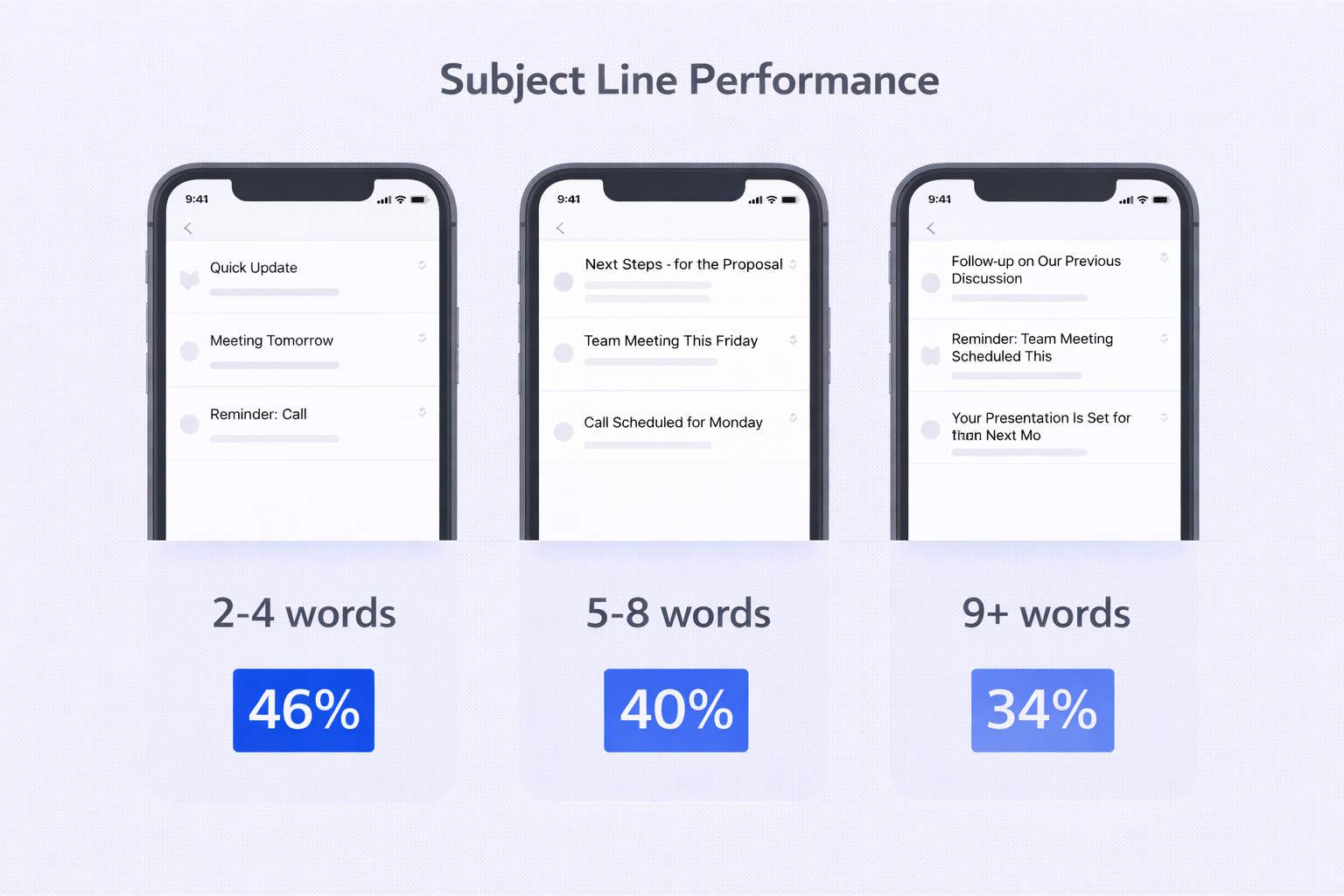
61% of emails are now opened on mobile devices, making subject line length critical.

  • 2-4 words: 46% open rate (optimal)
  • 30-50 characters: Full visibility on mobile screens
  • 9+ words: 34% open rate (looks cluttered, triggers marketing filters)

Short subject lines mimic internal communications. They look like emails from colleagues, not vendors. “Quick question” outperforms “Increase your Q4 revenue by 20% with our platform.”

Syntax and Personalization Impact

Specific tactics that move the needle:

  • Questions increase opens by 44-48% (triggers psychological need for closure)
  • Personalizing with prospect’s name boosts opens by 26-32.7%
  • Including company name increases response likelihood by 22-28%
  • Numbers slightly underperform (28% without numbers vs. 27% with numbers—listicles signal marketing newsletters)

Surprisingly, ALL CAPS subject lines showed 30% open rates vs. 29% for Title Case in some studies. But tread carefully—spam filters penalize aggressive formatting.

The winning formula? Sentence case (lowercase with first letter capitalized) creates a casual, conversational tone that bypasses mental spam filters.


Email Content and Structure Insights

The Brevity Premium

Word count directly impacts reply rates:

  • 50-125 words: ~50% reply rate (relative to other lengths)—the sweet spot for reading in under 20 seconds
  • 200+ words: Reply rates plummet to ~2% (signals “work” to recipients)
  • Under 50 words: Effective for follow-ups but may lack context for initial outreach

Modern executives scan emails in an F-pattern. Every unnecessary word is an opportunity to lose them.

Hook Performance: What Actually Opens Conversations

Not all email hooks perform equally. Here’s the data on opening premises:

Timeline Hook (referencing specific events/changes)

  • Reply rate: 10.01%
  • Meeting rate: 2.34%
  • Example: “Noticed you just expanded to three new offices…”

Numbers Hook (referencing quantified outcomes)

  • Reply rate: 8.57%
  • Meeting rate: 1.86%
  • Example: “We helped a competitor save 20% on their…”

Social Proof Hook (referencing clients)

  • Reply rate: 6.53%
  • Meeting rate: 1.25%
  • Example: “We work with Google and Amazon to…”

Problem Hook (referencing generic pain points)

  • Reply rate: 4.39%
  • Meeting rate: 0.69%
  • Example: “Are you struggling with lead generation?”

The insight: Problem hooks are now baseline—everyone assumes prospects have problems. Timeline hooks work because they prove you’re watching their specific story, not broadcasting to a list.

Understanding the psychology behind follow-up timing can dramatically improve your campaign performance.

The Link Trap

Including 1-3 links can increase CTR by 15%, but it raises spam flagging risk by 27-35%.

Best practice for 2025: zero links in first emails. The goal is a reply, not a click. Save links for the second or third touch after initial engagement.

Video personalization (under 60 seconds) can increase response rates by 2-3x—but only if genuinely personalized. Generic videos sent to thousands perform worse than plain text.

⏰ Tired of the Email Timing Game?

LinkedIn Messages Land When They’re Online

Stop obsessing over “best send times” and deliverability windows. LinkedIn messages arrive in real-time notifications when prospects are actively using the platform—the ultimate perfect timing. Our proven campaign frameworks combine messaging, connection requests, and engagement for systematic results that email can’t match.

Timing and Cadence Statistics

Best Days to Send

Aggregate data reveals clear patterns in B2B engagement:

  • Wednesday: Highest response rates at 5.8-7.56% (peak of the working week productivity curve)
  • Tuesday/Thursday: Second-best performers (mid-week engagement window)
  • Monday: Worst day (inboxes flooded with internal queries and weekend backlog)
  • Friday: Underperforms (decision-makers in weekend mode, deprioritize new vendors)

Optimal Send Times

The Golden Window (8 AM – 11 AM): Primary engagement window. 9-11 AM specifically peaks at 43.5% open rates, aligning with the core work block start.

Early Bird (5 AM – 8 AM): Effective specifically for executives who triage mobile inboxes before the operational day begins.

Post-Lunch Lull (1 PM – 3 PM): Secondary window for catching prospects clearing non-urgent tasks.

The efficacy of early morning windows is driven by mobile behavior. Executives commuting or grabbing coffee scan headlines on phones—reinforcing why 30-50 character subject lines are non-negotiable.

Personalization Impact and ROI

Personalization has evolved from clever tactic to fundamental prerequisite.

The Numbers Don’t Lie

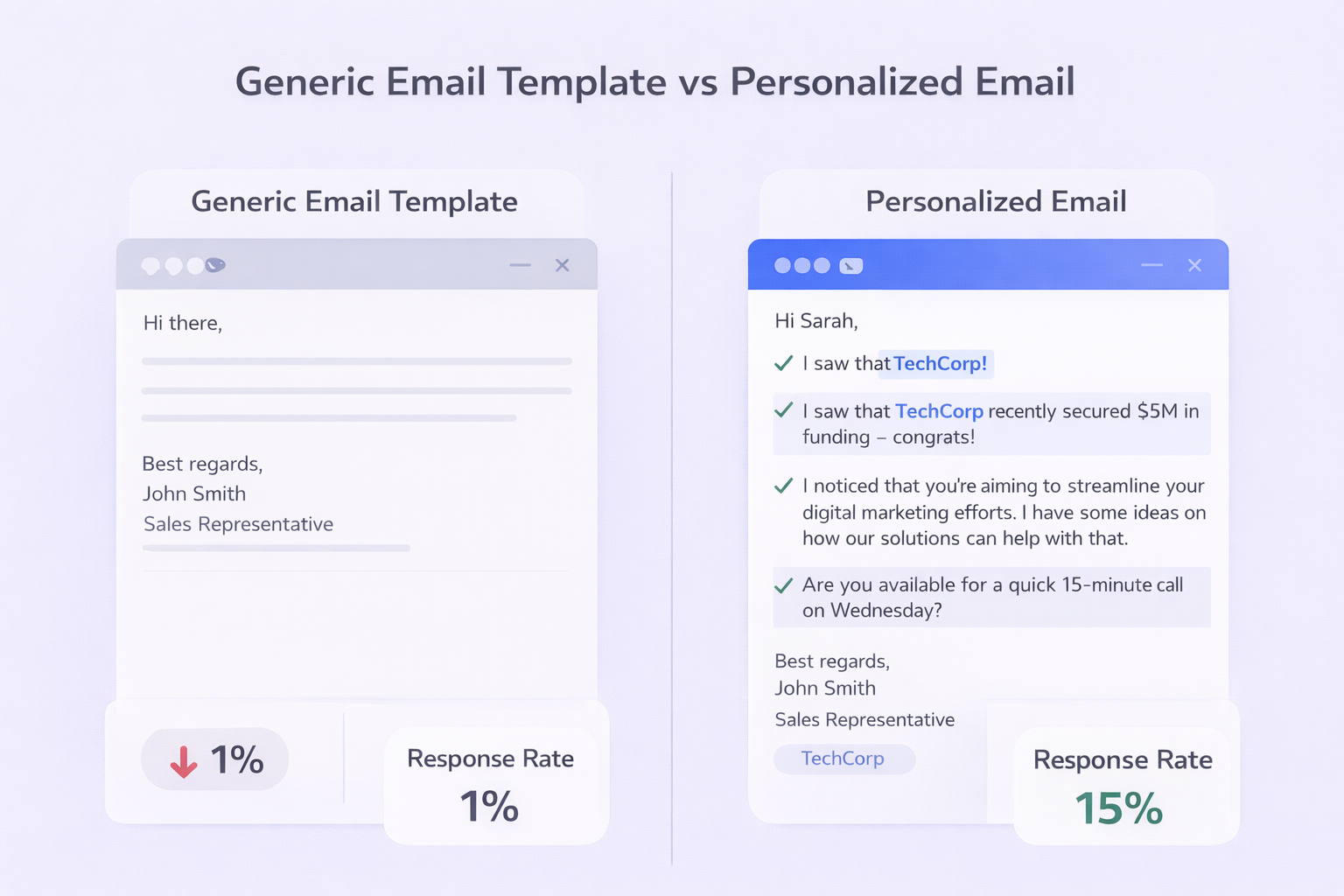
  • Advanced personalization improves reply rates by 142% compared to non-personalized templates
  • Fully personalized campaigns generate 2-3x better response rates overall
  • Only 5% of senders personalize every message—creating massive competitive advantage for the diligent minority

Tiers of Personalization

Not all personalization is equal:

Shallow Personalization (First Name/Company Name)

  • Reply lift: +20-25%
  • Status: No longer actual personalization—just mail merge

Deep Personalization (Research/Context/Timeline Triggers)

  • Reply lift: +52%
  • Status: True differentiation—proves you understand their specific situation

The formula: {{First_Name}} is table stakes. Real personalization requires {{Observation}} + {{Relevance}}.

The AI Double-Edged Sword

AI tools have become essential for research and list building—but prospects are getting better at spotting “AI voice.”

Generic AI-written emails see 90% lower response rates when characterized by perfect grammar, lack of idiom, and overly enthusiastic tone.

The winning approach: AI for research, humans for writing. Use AI to find the hook, but write the email yourself. A typo in a human email is forgivable; robotic perfection is fatal.


Follow-Up Sequence Statistics

Most sales reps quit too early. Single-touch campaigns leave the majority of revenue on the table.

The Follow-Up Multiplier Effect

  • 1st Follow-Up: Increases reply rate by ~50% relative to first email
  • 2nd Follow-Up: Adds another ~25% lift
  • 3rd Follow-Up: Adds ~10% lift
  • 4th+ Follow-Up: Effectiveness drops by 30%, spam complaint risk rises significantly

Optimal Cadence: A “3-7-7” sequence (Email 1 on Day 1, Email 2 on Day 3, Email 3 on Day 10, Email 4 on Day 17) captures 93% of total potential replies while respecting prospect time.

Multi-Channel Synergy

Cold email shouldn’t exist in isolation:

  • Email only: 4-6% response rate
  • Email + LinkedIn: 8-10% response rate
  • Email + LinkedIn + Phone: 10-12% response rate

This validates the “Allbound” strategy. A LinkedIn profile view or connection request before your email acts as a warm-up, making your name familiar when the email lands.

Many successful cold emailing agencies now integrate LinkedIn outreach as a core component of their strategy.

📊 Get Higher Response Rates Without More Follow-Ups

LinkedIn Outbound: 15-25% Response Rates vs. Email's 5% Stop chasing prospects through endless email sequences. LinkedIn outbound consistently delivers 15-25% response rates because you're reaching verified professionals in their preferred business environment. We handle complete campaign strategy—from targeting the right people to designing messages that convert to scaling systems that generate consistent pipeline. For additional profile optimization, check LinkedIn Premium benefits.

7-day Free Trial |No Credit Card Needed.

Conclusion

The cold email statistics for 2025 tell a clear story: the barrier to entry has lowered, but the barrier to success has risen dramatically.

Generic, high-volume campaigns aren’t just ineffective—they’re dangerous to your sender reputation. The “spray and pray” approach is mathematically unviable when factoring in data costs, tool expenses, and domain reputation damage.

The elite performers achieving 15-25% reply rates share common traits:

Technical rigor: Bounce rates under 2%, full authentication protocols
Psychological astuteness: Short, mobile-optimized subject lines that spark curiosity
Process discipline: Timeline-based hooks, multi-channel follow-ups, persistent sequences

The future belongs to precision. Invest in data hygiene, prioritize deep personalization over broad reach, and view cold email as a mechanism for initiating one-to-one conversations at scale—not a broadcast channel.

The statistics don’t lie. Quality has definitively defeated quantity.

Want to see how modern outreach strategies can transform your pipeline? The data shows LinkedIn outbound consistently outperforms traditional email with 15-25% response rates by accessing verified decision-makers directly—no spam filters, no deliverability battles, no wondering if your message was seen.

Explore current LinkedIn user statistics to understand the platform’s reach and potential for your business.

FAQs

How can I improve my cold email open rates?

Keep subject lines to 2-4 words, personalize with names/company, use questions, and optimize for mobile (30-50 characters).

Why do my emails go to spam?

High bounce rates (>7%), spam complaints (>0.3%), or missing authentication (SPF/DKIM/DMARC) trigger spam filters. Verify lists before sending.

Should I include links in my first cold email?

No. Links increase spam flagging risk by 27-35%. Focus on getting a reply first, share links in follow-ups.

How many follow-up emails should I send?

3-4 follow-ups capture 93% of potential replies. After the 4th, effectiveness drops 30% and spam risk increases.

What's the best time to send cold emails?

Wednesday mornings 8-11 AM perform best (43.5% open rates). Avoid Mondays (inbox overload) and Fridays (weekend mode).

What to Build a High-Converting B2B Sales Funnel from Scratch on LinkedIn

Build a Full LinkedIn Pipeline in Just 30 Days—Guaranteed