
Cold email is changing fast. What worked last year won’t work today.
The inbox of 2025 is tougher than ever. AI spam filters are smarter. Major providers like Google and Yahoo enforce stricter rules. Decision-makers have seen thousands of generic pitches and ignore most of them.
But here’s the good news: cold email still works. When you do it right, it’s one of the most effective ways to generate leads and book meetings.
The difference? You need precision over volume. You need verified data over cheap lists. You need personalization over templates.
This guide gives you the real numbers from 2025. You’ll see what’s working, what’s dying, and exactly what benchmarks you should aim for. Whether you’re a beginner checking if your campaigns are on track or an expert looking to optimize further, these statistics will help you make better decisions.
Let’s dive in.
Cold Email Outreach Statistics
Open Rates: The Vanity Metric
Open rates used to be the go-to metric. Everyone watched them. But in 2025, they’re not as reliable as they once were.
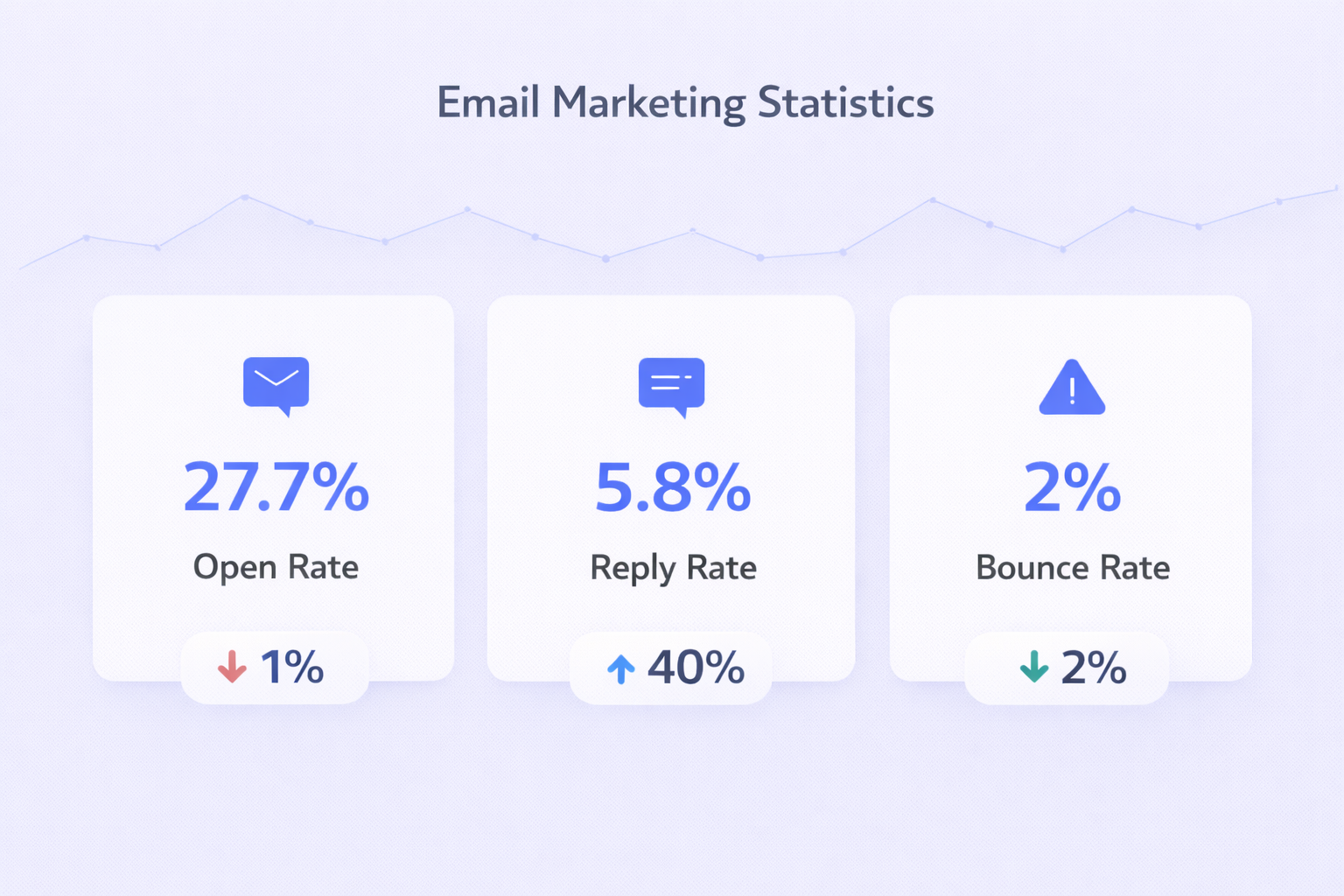
The average cold email open rate is 27.7%. This is down from around 36% just two years ago. But here’s the catch: this number doesn’t always mean what you think it means.
Why? Two big reasons:
Privacy features like Apple’s Mail Privacy Protection automatically load email images even if no one reads your message. This registers as an “open” when no human actually looked at it.
Security bots in companies scan emails for threats. They “open” and “click” your emails before delivering them to the real person. This inflates your numbers artificially.
So what does this mean for you? Use open rates to test subject lines against each other. If one subject line gets 35% and another gets 20%, the first one is clearly better. But don’t use open rates to predict revenue or assume people are actually reading your message.
A good open rate in 2025 is above 45%. Top performers hit 50%+ through excellent sender reputation and compelling subject lines. If you’re below 20%, you likely have a deliverability problem and your emails are landing in spam.
Here’s another stat: 24% to 61% of emails are opened on mobile devices. This means your subject lines need to be short and your emails need to look good on small screens.
Deliverability and Bounce Rates: The Technical Gauntlet
This is where most campaigns die in 2025.
The acceptable bounce rate is around 7.5%, but you shouldn’t settle for that. High-performing teams keep bounce rates under 2%.
Why does this matter so much? Because bounce rates above 5% destroy your domain reputation. Once your reputation tanks, even your perfectly written messages to valid prospects get routed to spam. Using quality <a href=”https://salesso.com/blog/cold-email-software/”>cold email software</a> with built-in verification helps avoid this.
Here’s the critical number: 0.3%.
This is Google and Yahoo’s spam complaint threshold. If just 3 out of 1,000 recipients mark your email as spam, your future deliverability is compromised.
Think about that. You have almost zero margin for error.
The financial cost of bad data is real. Inaccurate data costs organizations an average of $12.9 million annually. B2B contact data decays at approximately 30% per year (or 2-3% monthly) as people change jobs, companies merge, or email addresses change.
The solution? Use verified contact lists. It’s not optional anymore. It’s infrastructure. Building a clean <a href=”https://salesso.com/blog/sales-prospecting-list/”>sales prospecting list</a> should be your first priority.
Industry Performance: The Sector Divide
Not all industries respond to cold email the same way.
Some sectors are highly responsive. Others are completely saturated and ignore most outreach.
High-response sectors:
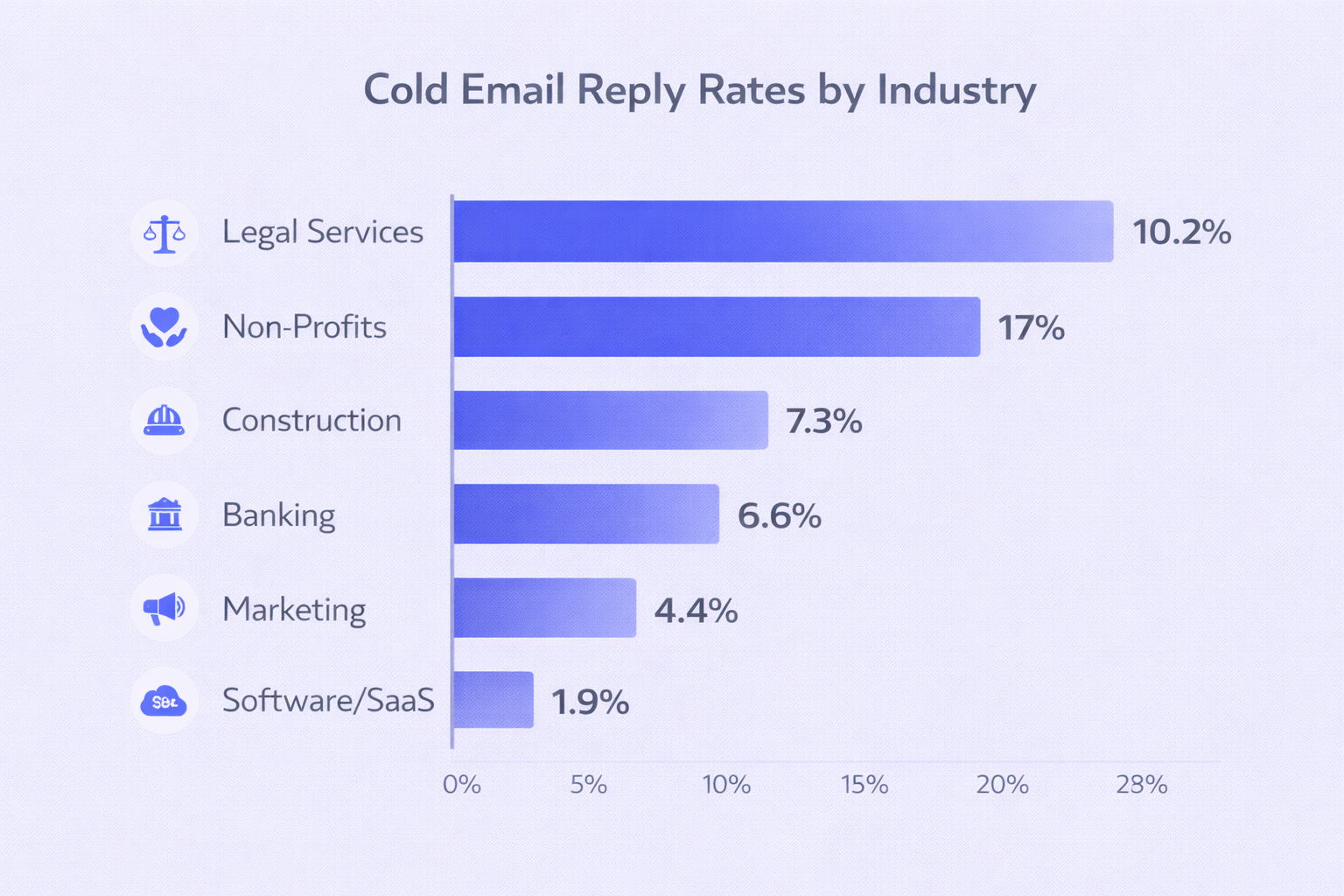
Legal Services tops the chart with a 10.2% reply rate. Lawyers are accustomed to professional correspondence and often monitor their inboxes personally.
Non-Profits show incredible engagement, with reply rates reaching up to 17%. They’re mission-driven and open to partnerships.
Construction and Chemicals have lower inbox competition, with reply rates around 7.3%.
Low-response sectors:
Software/SaaS has the highest open rates (47.1%) but the lowest reply rates at 1.9%. Decision-makers here are bombarded with automated outreach. They know the templates. They ignore them.
IT Consulting sees a reply rate of 3.5%. These buyers are technical and skeptical.
Marketing/Advertising professionals get a 4.4% reply rate. They spot templates instantly because they use them too.
What does this mean for you?
If you’re targeting SaaS or tech companies, you can’t use the standard playbook. You need extreme personalization. Generic “I help SaaS companies scale” messages get ignored immediately.
If you’re targeting construction, legal, or non-profits, a straightforward, respectful approach still works well without needing extreme customization.
What Actually Drives Replies
Understanding statistics is one thing. Understanding why certain numbers perform better is what separates good campaigns from great ones.
Personalization depth matters
Basic personalization is the baseline now, not a differentiator. Here are the tiers:
Tier 1 (Basic): Name and company. This is standard. Everyone does this.
Tier 2 (Trigger-based): Referencing recent funding, new hires, or specific industry problems. This drives reply rates up to 15-25%.
Tier 3 (Trust-based): Mentioning mutual connections or competitors you’ve helped. Trust signals boost response rates by an additional 10-25%.
Soft CTAs outperform hard asks
This is huge. The psychology of asking matters.
Hard CTA: “Can you meet Tuesday at 2 PM for a demo?”
Soft CTA: “Is this a priority for you right now?” or “Worth a quick chat?”
Soft CTAs increase reply rates by 10-20%. Why? Because asking for a meeting is high-commitment. Asking if something is relevant is low-commitment. People can engage without feeling trapped in a sales cycle.
Brevity wins
With 24-61% of emails opened on mobile devices, your formatting must work on small screens.
Keep messages under 100 words. Emails between 50 and 125 words achieve response rates approximately 50% higher than long messages.
Use short sentences. Frequent line breaks. Clear value propositions. Large blocks of text kill conversion. When implementing your <a href=”https://salesso.com/blog/outbound-lead-generation-process/”>outbound lead generation process</a>, always optimize for mobile.
Readers skim. They look at the subject line, the first sentence, and the CTA. If your key information is buried in the middle of a dense paragraph, it doesn’t exist.
Timing: When to Send for Maximum Impact
Is there a perfect time to send cold emails? Yes and no.
Individual results vary, but millions of data points show specific patterns.
Best days of the week:
Wednesday is the champion. Reply rates hit 5.8% to 7.56%. By mid-week, prospects have cleared their Monday backlog but haven’t checked out for the weekend yet.
Tuesday follows closely and often gets the highest open rates.
Friday sees the lowest engagement. Professionals are winding down. Avoid Fridays unless you’re in a very casual industry.
Best times of day:
7:00 AM to 11:00 AM is the prime window. This aligns with the start of the workday when inboxes get triaged.
6:00 AM to 7:00 AM works well for executives. They check email on mobile before their first meeting, and your message sits at the top.
1:00 PM to 3:00 PM creates a secondary spike. People return from lunch and check messages.
[IN-CONTENT BANNER #3] [Place after “1:00 PM to 3:00 PM creates a secondary spike” paragraph]
The Power of Follow-Ups
Most people give up too early. Big mistake.
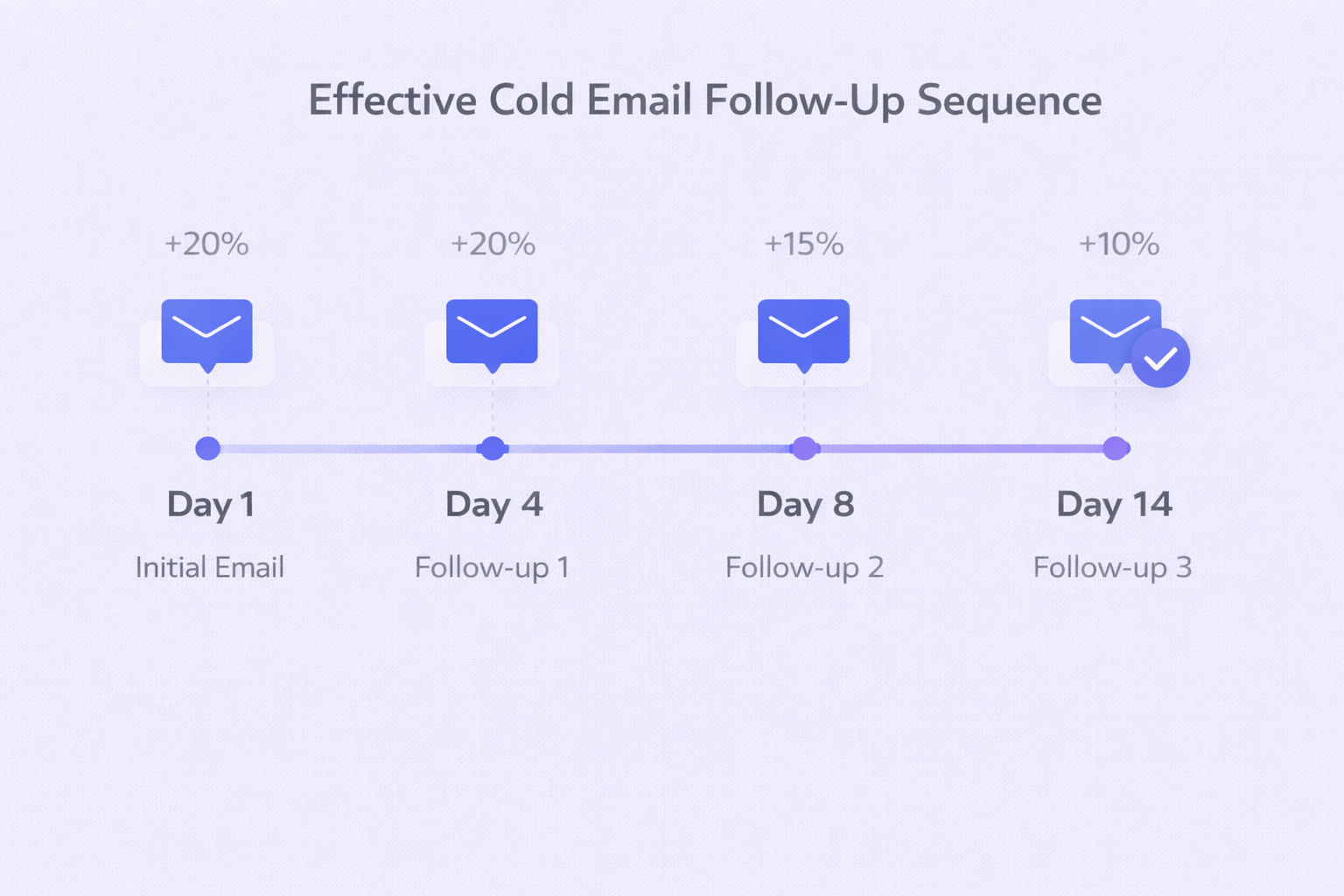
A single follow-up email increases your total response rate by 20-50% compared to sending just one message.
Here’s the thing: 80% of sales require 5 to 12 touchpoints. Yet 44% of salespeople give up after one follow-up. This gap represents a massive opportunity.
But there’s a limit. Effectiveness drops by about 30% after the third or fourth follow-up. Best practice is a sequence of 3-5 emails spaced out over 2-3 weeks.
Waiting 3 days before your first follow-up boosts reply rates by 31% compared to following up immediately or waiting too long.
Don’t think of follow-ups as annoying. Think of them as persistent. Most decision-makers are busy. Your first email might have gotten buried. A polite follow-up isn’t rude—it’s professional. Tools using <a href=”https://salesso.com/blog/advanced-linkedin-search/”>advanced LinkedIn search</a> can also help you identify the best prospects for follow-up.
Tools and Technology Stack
To execute on these statistics—personalization at scale, strict deliverability compliance, and optimized timing—you need the right tools.
Popular platforms:
Apollo.io offers a massive database (275M+ contacts) with integrated sending capabilities. It’s ideal for teams who want to source and send from the same interface.
Instantly.ai / Smartlead specialize in deliverability. They offer inbox rotation, automated warm-up, and sender reputation protection. Perfect for the 2025 compliance environment.
ZoomInfo remains the gold standard for enterprise data accuracy and intent signals. Users report a 91% improvement in connect rates with ZoomInfo’s data quality.
Saleshandy & Woodpecker excel in agency workflows and advanced personalization features.
The trend for 2025 is the “Decoupled Stack”: Use one tool for data sourcing to ensure verification, and a separate specialized tool for sending to maximize inbox placement and protect your domain.

