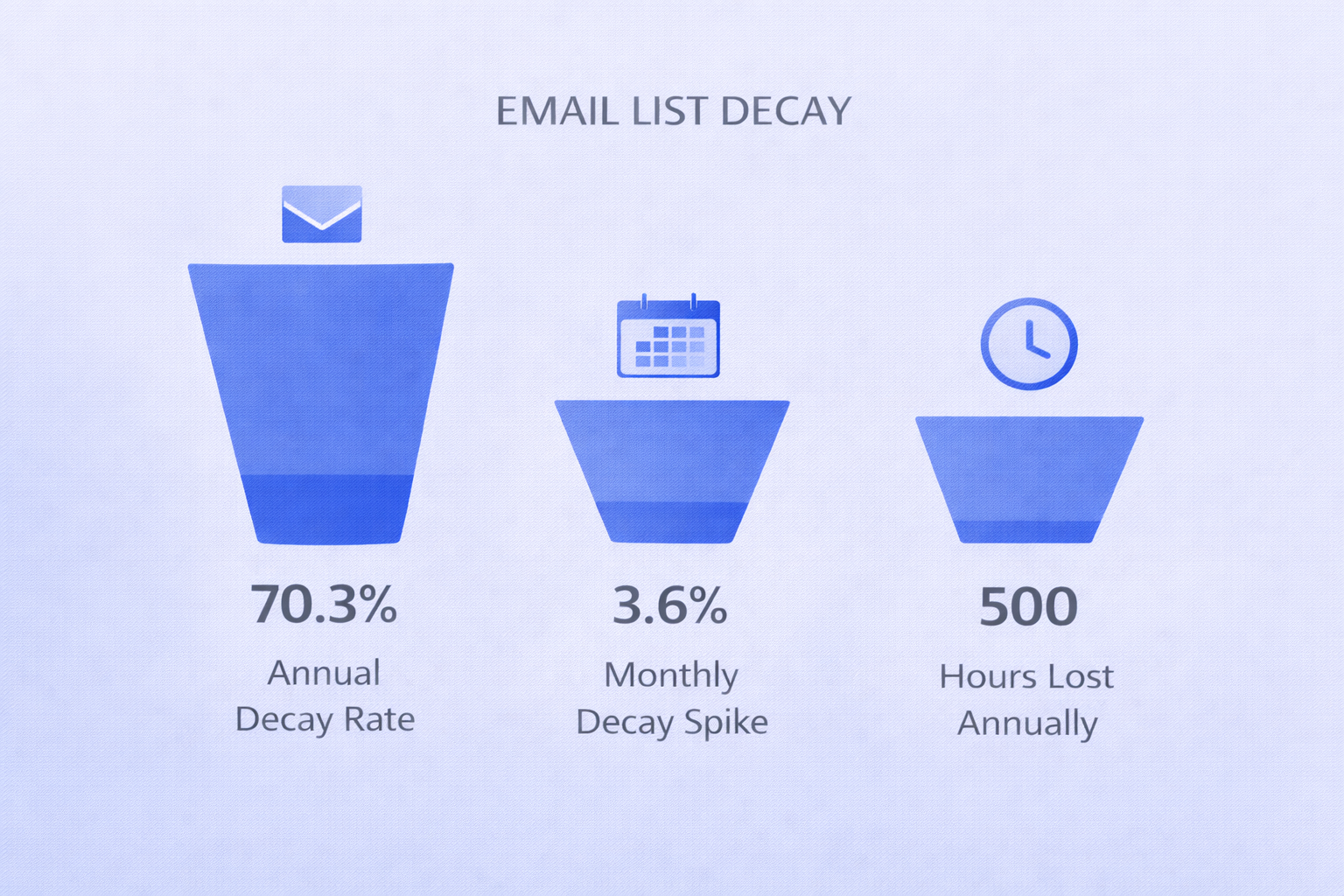
Your contact database is quietly destroying your outreach results. Right now, your carefully built email list is decaying at 70.3% per year—meaning most of your contacts will be outdated within 12 months. For anyone running cold outreach campaigns, this invisible data rot is costing you meetings, revenue, and sender reputation.
Email scrubbing services have evolved from a “nice-to-have” tool into a mandatory part of any serious outreach strategy. With over 361 billion emails sent daily and 85% of marketing messages failing to reach the inbox, the difference between success and failure often comes down to data hygiene.
This guide breaks down everything you need to know about email list scrubbing services—how they work, why they matter, and how to implement them for maximum ROI.
Why Email List Cleaning Matters More Than Ever
The modern inbox is a battlefield. Providers like Google and Microsoft have deployed AI-powered filters that analyze sender patterns in real-time, making email verification more critical than ever before.
Here’s what poor list hygiene costs you:
Companies lose an average of $15 million annually due to bad data quality. This includes wasted hours, missed targets, and permanent damage to brand reputation. When you reach out to someone who left their company six months ago, trust evaporates instantly.
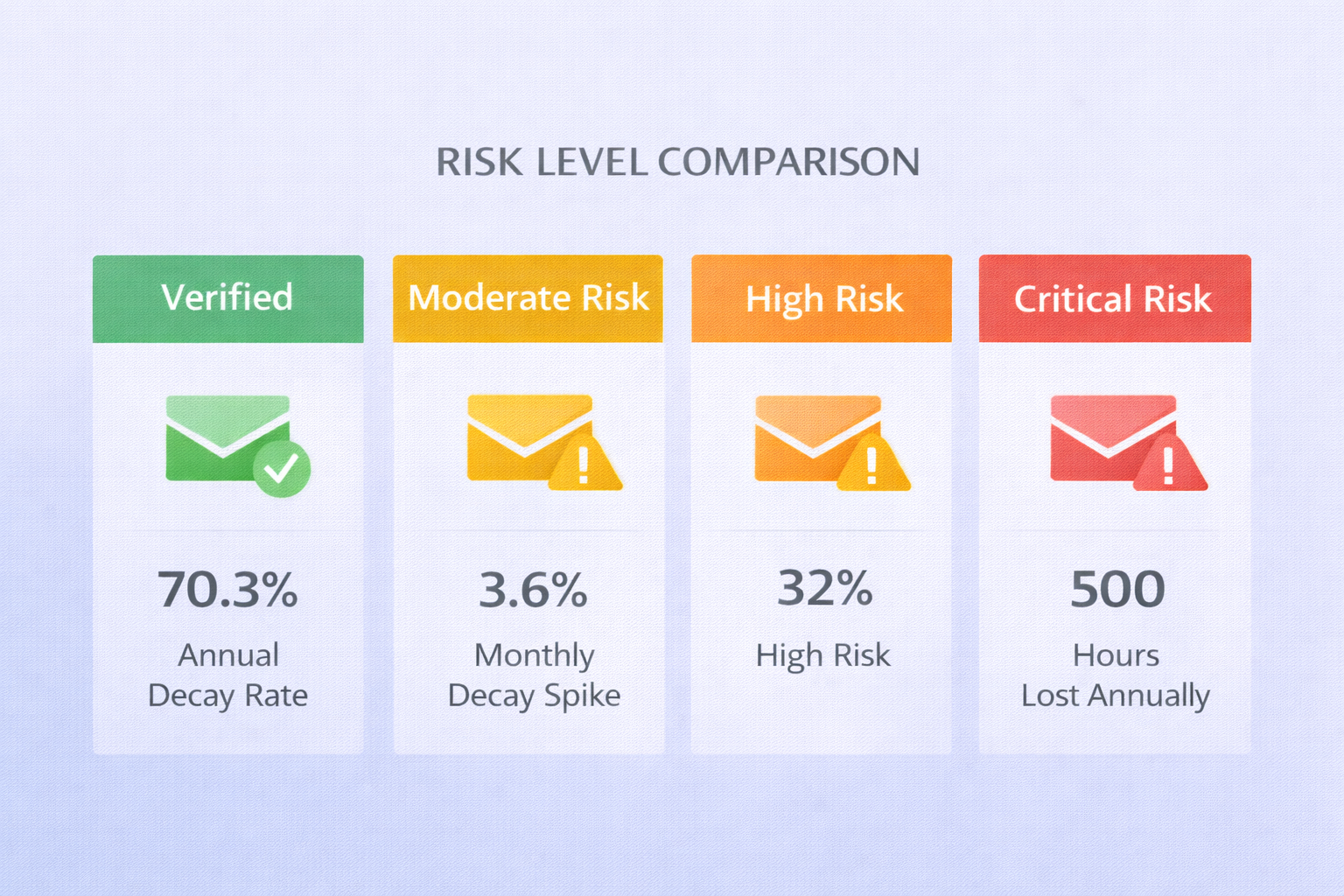
The decay happens faster than most people realize. During economic volatility, business contact decay can spike to 3.6% monthly—nearly double the normal 1.5% average. Sales teams waste approximately 500 hours every year dealing with bad prospect data, which translates to over 60 working days of lost productivity.
Current Deliverability Standards You Must Meet
As of 2024, Google and Yahoo require all bulk senders to implement SPF, DKIM, and DMARC authentication. Missing these technical standards means your messages get rejected at the SMTP level—they never even reach the spam folder.
The “zero-tolerance” policy makes regular list cleaning essential. High bounce rates signal low-quality sending to ISPs, triggering immediate throttling or blacklisting.
The 2026 Metrics That Actually Matter
Forget vanity metrics. Here’s what elite senders track:
Bounce Rate: Keep it below 2%. Anything higher is a red flag to email service providers.
Spam Complaint Rate: ISPs require rates below 0.1%—meaning only one complaint per 1,000 emails. Hit 0.3% and your domain gets blacklisted overnight.
Reply Rate: Top performers achieve 15-25% reply rates versus the industry average of 5-6%.
Meeting Booking Rate: Elite teams book meetings from 5%+ of outreach versus the 1-2% average.
Open rates have stabilized around 38-52% for well-segmented lists but are increasingly unreliable due to Apple’s Mail Privacy Protection and similar privacy features.
One-click unsubscribe headers are now mandatory for all bulk senders. Google requires unsubscribe requests to be processed within two days. Failure to provide easy opt-out leads frustrated recipients to mark you as spam, which damages your domain reputation far more than a simple unsubscribe.
Comparing Email Scrubbing and Prospecting Tools
The market offers diverse solutions ranging from massive contact databases to surgical verification tools. Understanding the tradeoffs helps you choose the right fit.
Database-First Platforms
Apollo.io provides a vast database of 275 million profiles with integrated sequencing. However, users report that up to 50% of “verified” emails can be outdated, requiring manual cleaning before use.
ZoomInfo excels at company insights and buyer intent data, making it the enterprise gold standard for identifying ideal customer profiles. Its high pricing often limits it to larger organizations, and maintaining accuracy still requires rigorous internal hygiene.
Scalability Specialists
Saleshandy offers unlimited sending accounts with automated sender rotation and AI-powered personalization. Its pricing model attracts agencies with unlimited clients and mailboxes without per-seat charges.
Snov.io provides a comprehensive CRM with 7-step email verification and LinkedIn automation. Its “forever-free” plan appeals to startups, though advanced personalization features require higher-tier subscriptions.
Accuracy-Focused Solutions
UpLead stands out with a 95% accuracy guarantee and “preview before you pay” credit system. It focuses strictly on clean data rather than outreach automation.
Wiza optimizes specifically for LinkedIn-based prospecting, turning Sales Navigator searches into verified contact lists with “Triple-Verified” status for near-zero bounce rates.