

The job market for executives just got flipped upside down.
For decades, being a CEO meant one thing: full-time commitment to a single company. You were all in, or you were out. But here’s what’s actually happening right now in 2026—companies are realizing they don’t need a full-time chief executive officer to solve their biggest problems. They need expertise. They need strategy. They need leadership. But they only need it for a fraction of the time.
This is the rise of fractional work, and it’s creating massive opportunities for seasoned leaders.
According to recent data, the number of fractional leaders doubled from 60,000 in 2022 to over 120,000 in 2024. That’s not a trend—that’s a movement. And 72.8% of these fractional executives have 15+ years of experience, meaning this isn’t some side hustle for junior managers. This is where top talent is heading.
Think about it. A startup just raised Series A funding. They’ve got $5 million in the bank and big growth targets. They need someone who’s scaled companies before. But hiring a full-time CEO costs $300,000 to $500,000+ annually when you factor in salary, equity, and benefits. That’s 6-10% of their entire runway.
What if they could get 80% of that strategic value for 30% of the cost? That’s the fractional CEO model. And it’s why Deloitte projects that by end of 2025, over 35% of all U.S. companies will have at least one fractional executive on their team.
If you’re a seasoned leader looking to escape the politics of full-time corporate life, diversify your income, or build a portfolio career on your terms, this guide breaks down everything you need to know about fractional CEO jobs—from where to find them to how to price your services and build a sustainable practice.
Let’s get into it.
What Makes Fractional CEO Jobs Different
Here’s where most people get confused. A fractional CEO is not a consultant. Not a coach. Not an interim placeholder.
You’re an actual operating executive. You have decision-making authority. You manage people. You own outcomes. The only difference is you do it part-time, typically 1-2 days per week, and you serve multiple companies simultaneously.
Traditional consultants give advice and walk away. Fractional ceos execute. You’re in the trenches. You’re running board meetings, hiring VP-level talent, and making the hard calls on budget allocation. You just do it across 3-5 companies instead of one.
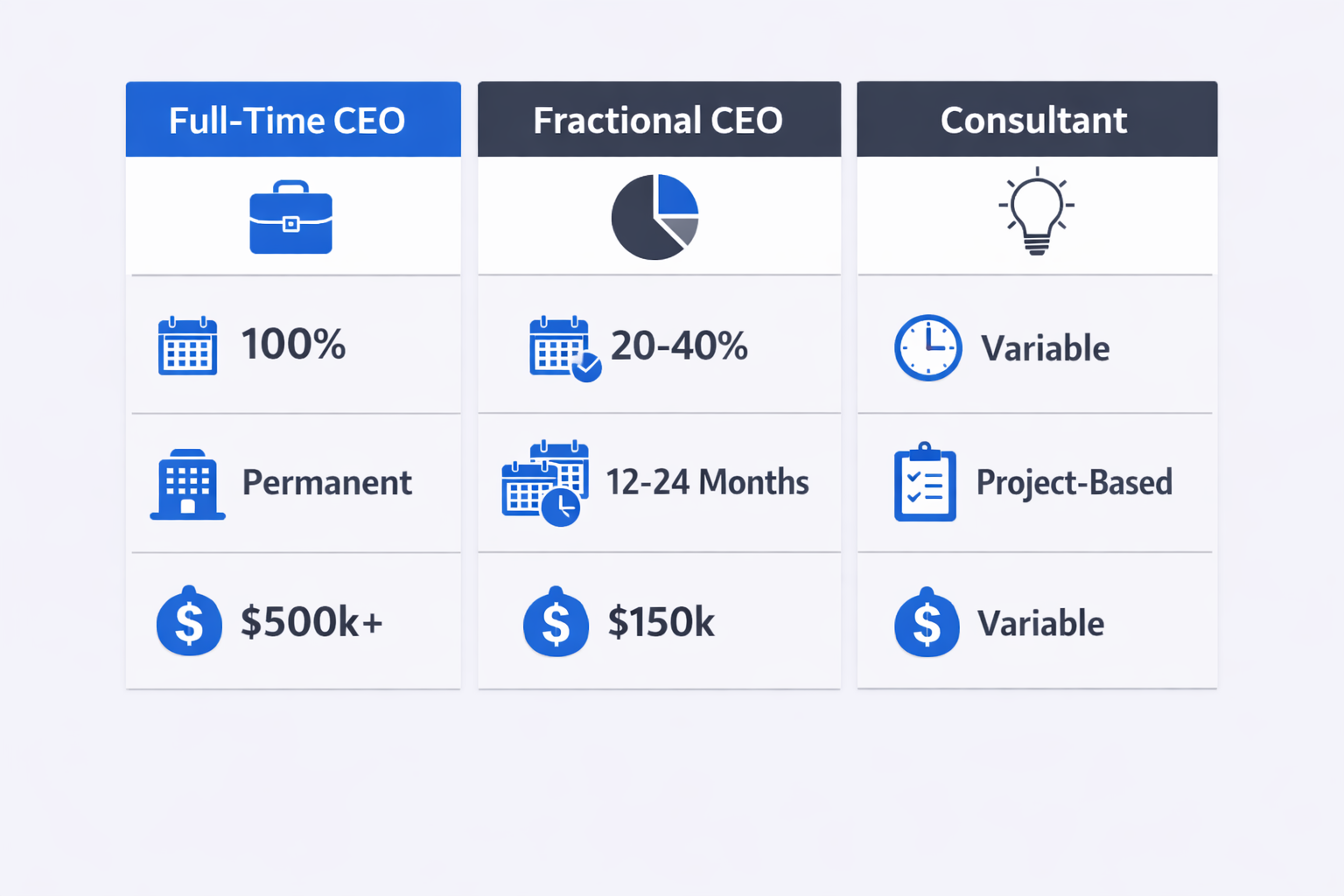
The beauty of this model? Income diversification. If one client ends their contract, you still have three others generating revenue. Compare that to a full-time role where one layoff means zero income overnight.
And the companies hiring? They’re not looking for part-time commitment—they’re looking for full-time impact in condensed timeframes. According to industry data, fractional engagements typically last 12-24 months, giving you the stability of ongoing work without the golden handcuffs of permanent employment.
Where the Fractional CEO Jobs Actually Are
Let’s talk platforms. Yes, there are marketplaces where companies post fractional executive roles. But here’s the truth—the best opportunities aren’t posted publicly.
They’re created through relationships and direct outreach.
That said, platforms are a good starting point for deal flow. Here are the major players:
Top Platforms for Fractional Roles:
- Fractional Jobs: The largest network with 20,000+ members. No fee on your income (they use a direct referral model). Great for getting started, but highly competitive.
- Toptal: Premium positioning with global reach. They handle all billing and admin. But they’re extremely selective—only top 3% get in—and they take a cut of your fees.
- Shiny: Fast-growing platform focused on tech startups. Active community and handles invoicing. Newer player, so there’s often a waitlist.
- Interim Executives: Specializes in turnaround and crisis management roles. Often skews toward full-time interim versus true fractional.
Industry data shows the highest demand in these sectors:
- Technology/SaaS: High demand driven by rapid scaling needs and comfort with remote work
- Healthcare/HealthTech: Complex regulatory requirements need senior expertise
- Marketing Agencies: Use fractional leaders to strengthen client service offerings
- Manufacturing: Growing need for operational efficiency and supply chain modernization
Within these industries, Marketing roles represent 30.4% of fractional positions, Operations 16%, and Sales/Business Development 9.6%. But here’s the interesting part—the Sales and Strategy roles are growing fastest because companies are increasingly trusting fractional leaders with their revenue engines.
Who actually hires fractional executives? Not HR departments. 85.2% of fractional hires are initiated by founders or business owners, and 74% are made by sitting CEOs. This matters for your outreach strategy—you’re selling peer to peer, not submitting applications to talent acquisition teams.
According to market research, most LinkedIn automation tools can help you identify and reach decision-makers who are actively looking for executive leadership. The key is targeting companies at specific trigger events—recent funding rounds, rapid headcount growth, or leadership gaps signaled by long-open job posts.
When you’re researching potential clients, understanding advanced LinkedIn search techniques helps you filter for companies matching your expertise. You can identify startups that just raised Series A funding, businesses scaling from 10 to 50 employees, or companies in specific industries where you have deep domain knowledge.
The Money: What Fractional CEO Jobs Actually Pay
Let’s cut through the fluff and talk numbers.
The golden rule: never bill by the hour. Hourly billing commoditizes your expertise and punishes efficiency. If you can solve a $10 million problem in 10 minutes because of your 20 years of experience, you should be paid for the value, not the minutes.
Monthly retainer is the industry standard. You charge a flat fee for a defined scope of value. Here’s the market breakdown for 2024-2025:
- Entry Level/Small Business: $3,000 – $5,000/month
- Mid-Market Standard: $5,000 – $10,000/month
- Premium/Enterprise: $10,000 – $20,000+/month
Do the math. If you secure three clients at $8,000/month, you’re generating $24,000 monthly or $288,000 annually. This is achievable with a 25-30 hour work week, leaving time for business development and actual life balance.
Some executives prefer day rates, particularly for interim-style work. The range is $1,500 to $5,000 per day. This model offers cleaner scope control (if they’re not paying for the day, you’re not working), but lacks the recurring revenue stability of retainers.
What about equity? For early-stage startups (Pre-Seed to Series B), cash is tight. They’ll often offer equity to offset lower retainers. View equity as bonus, not base compensation. Startups are risky—that equity can easily go to zero.
Standard advisory equity benchmarks:
- Pre-Seed/Seed: 0.25% – 1.0% with low cash retainer
- Series A: 0.1% – 0.5% with moderate cash
- Series B+: <0.1% or cash only at market rates
Here’s the arbitrage pitch to sell your services: A full-time CEO costs $300,000 salary + 20% bonus + $50,000 benefits + 2% equity = ~$500,000+ first year. Your fractional package: $12,000/month = $144,000/year. No benefits. No severance. 0.5% equity. They get 80% of strategic value for 30% of the cost, extending their runway by 4+ months. For a startup, those extra months could mean the difference between survival and shutdown.
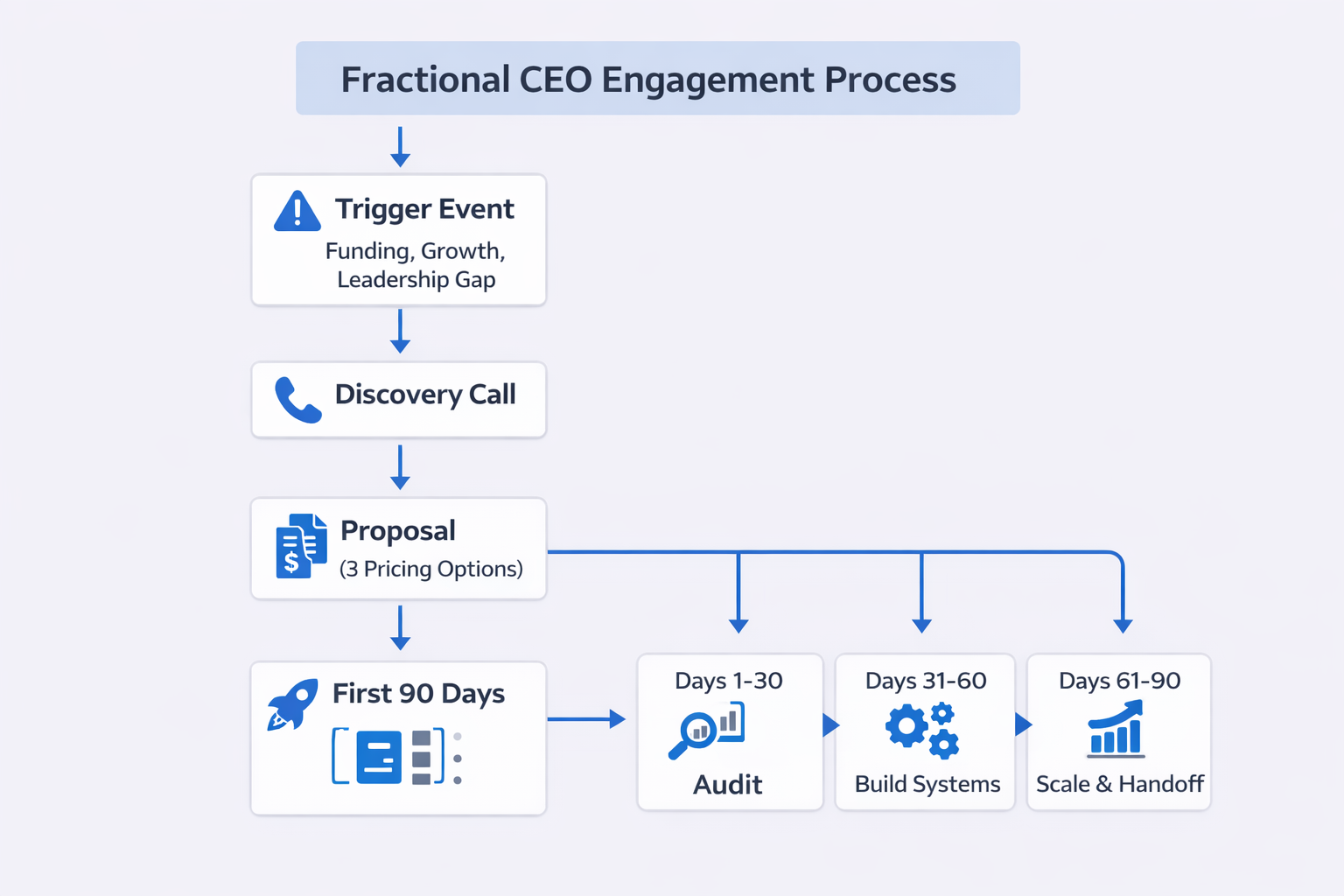
How to Actually Land Fractional CEO Jobs (The Outbound Strategy)
Here’s the hard truth most executives don’t want to hear: You need to become a salesperson.
Your product is Leadership. Your daily job is Sales.
Most executives are used to recruiters calling them. In the fractional world, you must be the hunter. You need the mindset of a business development professional: aggressive, structured, and data-driven.
Step 1: Build Your Target List
You can’t sell to everyone. Define your “Buy Box”—your ideal client profile.
Example: “B2B SaaS companies, Seed to Series A funded, 10-50 employees, based in the US.”
Look for trigger events that signal they need help:
- Just raised funding (they have budget to spend)
- Hiring struggles (VP of Sales role open 60+ days = they’re struggling to fill it)
- Rapid growth (headcount grew 20% in 6 months = growing pains)
To build this list, you need data tools. Apollo.io is the gold standard for individual practitioners. Starting at ~$50/month, it has excellent startup data, built-in email sequencing, and filters for funding rounds and job postings. You can build a list of 100 targeted founders/CEOs in under an hour.
For those exploring comprehensive lead generation approaches, many executives find success combining LinkedIn growth hacking techniques with direct outreach. The strategy involves identifying decision-makers, engaging with their content strategically, and then initiating personalized conversations.
Step 2: Write Cold Emails That Actually Work
Don’t send a resume. Don’t send a cover letter. Send a business proposition. You’re writing peer-to-peer.
Keep subject lines casual: “Quick question”, “Growth at [Company Name]”, “The VP Sales role”. Avoid “Fractional CEO Services”—that screams spam.
Pattern interrupt: Start with an observation about them, not a pitch about you. “Saw you just closed your Series A—congrats.”
Lead with value: Pitch the fractional arbitrage advantage.
Low-friction CTA: “Open to a chat?” “Worth a conversation?”
Example Template:
Subject: The VP Sales search
Hi [Founder Name],
Saw you’ve been looking for a VP of Sales for a few months. It’s a brutal market—most Series A founders struggle to find someone who has actually built a playbook from scratch.
I work as a Fractional CRO. I typically come in, build the sales playbook, hire the team, and set up the CRM for about 40% of the cost of a full-time hire. Once the engine is running, I help you hire the permanent VP to take over.
I did this for [Competitor] and we added $2M ARR.
Open to a different approach to filling this gap?
Best,
[Your Name]
Step 3: The Follow-Up System
Most meetings are booked after the 3rd email. 80% of deals happen in the follow-up.
Here’s a simple sequence:
- Day 1: Initial email
- Day 4: Bump – “Just floating this to the top of your inbox”
- Day 8: Value add – “Saw this article about [topic] and thought of your strategy”
- Day 15: Break-up – “Assuming this isn’t a priority. I’ll cross it off my list”
Use automation tools to run this sequence. Write it once, and it runs forever.
Many successful fractional executives treat their outreach like a workflow automation system—setting up sequences that systematically work through their target list while they focus on delivering value to current clients.
Your Personal Brand Matters More Than Your Resume
When a founder receives your cold email, the first thing they do is Google you.
If your LinkedIn profile looks like a generic resume (“Seeking new opportunities”), you lose credibility. It must look like a landing page for your services.
LinkedIn Optimization Essentials:
Headline: Ditch the job title. Use a value statement.
❌ Bad: “Former CEO | Executive Consultant”
✅ Good: “Fractional CEO for Series B HealthTech | Scaling Revenue from $10M to $50M | Fundraising Strategy”
About Section: Write in first person. Tell a story.
“I’ve sat in the CEO seat 5 times. I know the loneliness of that role. I partner with founders to…”
Experience Section: Group your fractional work.
Instead of listing 10 short stints (looks like job hopping), create one entry: “Principal at [Your Advisory Firm]”. List clients as “Projects” underneath. This frames you as a stable business owner, not a flighty employee.
Understanding LinkedIn profile statistics can help you optimize for maximum visibility. Profiles with clear value propositions in headlines get 40% more profile views than those with just job titles.
If you’re looking to expand your reach efficiently, exploring LinkedIn Sales Navigator alternatives can give you cost-effective options for advanced search and lead filtering capabilities.
The Reality of Fractional Work: Challenges to Expect
Let’s be honest about the downsides.
Context switching fatigue is real. Jumping from a healthcare strategy meeting to a fintech fundraising call in one hour is cognitively expensive. Solution: Day batching. Dedicate Mondays to Client A, Tuesdays to Client B. Don’t fragment your days.
The “outsider” status can be challenging. Teams may treat you like a temporary mercenary. They may withhold information or resist your recommendations. Solution: Over-invest in relationships early. Show up to informal Slack channels. Have coffee chats with junior staff. Be visible and human.
Feast or famine cycles happen. You might have 4 clients one month and 0 the next. Solution: Always be prospecting. Dedicate 15% of your week to business development, even when fully booked. Your automated outreach sequences are insurance against dry spells.
Conflicts of interest must be managed. Working for direct competitors is a major issue. Solution: Be transparent. Disclose your client list (under NDA) to ensure no conflicts before signing contracts.
What Makes Someone Successful in Fractional CEO Jobs
Not everyone thrives in this model. The best fractional executives share specific traits:
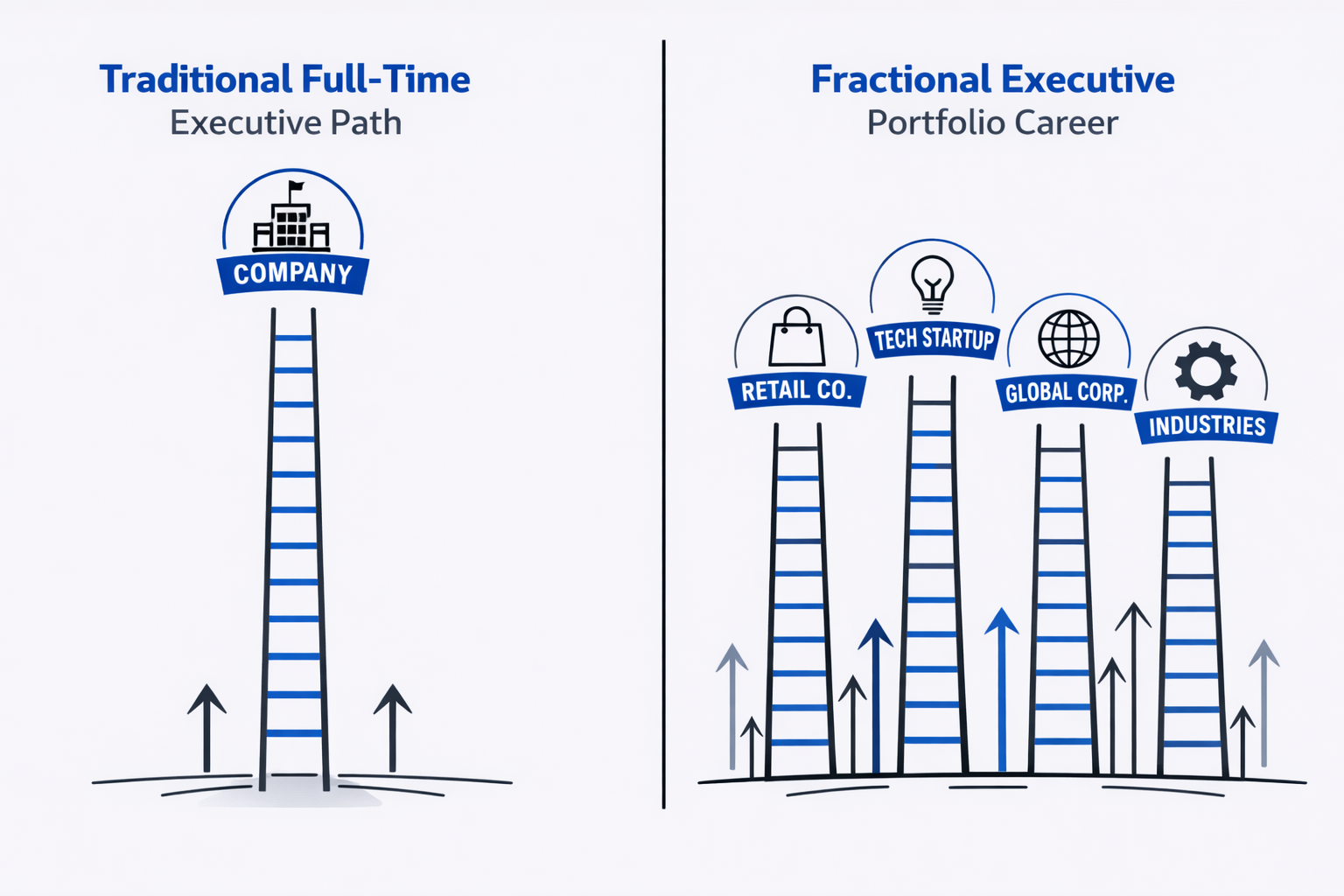
Deep domain expertise. You can’t be a generalist. If you spent 20 years in Retail, be a fractional CEO for retail brands. Specialists command premium rates. Generalists struggle to differentiate.
Comfort with autonomy. There’s no corporate structure supporting you. No HR department. No IT helpdesk. You’re a business owner, not an employee. This freedom is exhilarating for some, terrifying for others.
Sales mindset. You must be comfortable with business development and self-promotion. If the idea of cold outreach makes you uncomfortable, this path will be challenging.
Systems thinking. You’re often parachuting into chaotic environments. Your superpower is bringing structure quickly—implementing OKRs, building dashboards, establishing operating rhythms. Companies hire you to create order from chaos.
Emotional resilience. You’ll face rejection from prospects. You’ll have clients who don’t renew. You’ll deal with difficult personalities. Success requires thick skin and persistence.
According to industry research, fractional executives with technical backgrounds in specific industries (fintech, healthcare, manufacturing) command 25-40% higher rates than generalist business leaders. Specialization pays.
Conclusion
The future of executive work isn’t about climbing one corporate ladder anymore.
It’s about building a portfolio of high-impact roles where you control your time, diversify your income, and work on problems that actually energize you. The fractional CEO model offers exactly that—but only if you’re willing to evolve from employee mindset to entrepreneur mindset.
The market is exploding. Companies need your expertise more than ever. They just can’t afford (or don’t need) you full-time. The tools are ready. The demand is proven. The platforms are growing.
The only variable left is your willingness to step off the traditional path and build something on your terms.
If you’re ready to escape corporate politics, take control of your schedule, and get paid what you’re actually worth, the opportunities in fractional executive work are massive. But they won’t come find you. You have to go create them.
Time to start building.

