

The fractional executive market has exploded. Between 2022 and 2024, the number of fractional leaders doubled from 60,000 to 120,000 professionals. That’s not a trend—it’s a revolution.
Here’s what makes fractional CHRO roles different. You’re not a consultant dropping recommendations. You’re not an interim placeholder keeping the seat warm. You’re an embedded executive who owns the people function completely, just for a fraction of the workweek.
Think of it this way: one company gets you Monday and Tuesday. Another gets you Wednesday and Thursday. A third gets you Friday. Each pays between $3,000 and $10,000 monthly. Do the math—that’s $100,000 to $150,000 annually with zero benefits overhead, no office politics, and complete schedule control.

What Makes Fractional CHRO Jobs Unique
Traditional full-time roles lock you into one company. Fractional CHRO jobs give you portfolio diversity.
You might serve three or four companies simultaneously. Each engagement runs 1-2 days weekly or 10-20 hours monthly. You’re building comp plans Monday, handling terminations Tuesday, and designing onboarding Wednesday—all for different clients.
The pay structure shifts everything. Research from fractional talent platforms shows average rates of $100-140 per hour for US-based roles. That translates to $50,000-$150,000 annually per client engagement.
But here’s the real advantage: your income isn’t capped by one salary band. Take on more clients when you want growth. Scale back when you need breathing room. That flexibility doesn’t exist in traditional employment.
The companies hiring fractional leaders aren’t struggling. They’re strategic. They’re typically Series A or Series B startups that need Fortune 500-grade HR thinking but can’t justify $400,000+ for a full-time executive when salary, bonuses, equity, and benefits factor in.
Finding Fractional CHRO Jobs Remote Opportunities
Most fractional roles operate 100% remotely. Data from FlexJobs confirms over 70% of fractional CHRO listings explicitly state “remote,” “work from anywhere,” or “telecommute.”
This opens the entire world as your job market. You could live in Austin while serving clients in San Francisco, London, and Singapore. LinkedIn automation tools make it easier than ever to reach global hiring managers without geographic constraints.
The platforms connecting fractional talent with companies include:

US-Focused Platforms:
- Fractional People People (specialized for HR executives)
- FlexJobs (filters for fractional and contract roles)
- LinkedIn (using advanced search with keywords like “fractional HR” or “interim CHRO”)
Global Marketplaces:
- Shiny (connects fractional executives across functions)
- CoEmerge (focuses on C-suite fractional placements)
- FlexingIt (India and Asia-Pacific fractional market)
The hidden strategy? Don’t wait for job posts. Use cold outreach to CEOs whose companies just raised funding but lack HR leadership. That’s your golden opportunity. Tools for LinkedIn growth hacking can help you identify these targets systematically.
Studies show 70% of fractional engagements start through direct outreach, not job applications. When you proactively solve a CEO’s problem before they post the role, you eliminate competition entirely.
What Companies Actually Want
Chief human resources strategy matters more than daily HR tasks. Companies hiring fractional executives don’t need someone to process payroll. They need someone to design the compensation philosophy that will attract top talent despite limited cash.
Here’s what lands you engagements:
You’ve scaled culture before. Saying “I helped a company grow from 20 to 150 employees while maintaining 95% retention” beats “I have 10 years of HR experience.”
You own the compliance minefield. Startups live in fear of lawsuits. When you can audit their I-9 files, fix their contractor misclassification, and implement proper termination procedures, you become essential immediately.
You speak CEO language. They care about runway extension. When you explain “hiring a fractional CHRO saves $300,000 annually compared to a full-time executive, extending your runway by 4 months,” you’re speaking their language.
Employee relations skills prevent disasters. One bad termination can cost six figures in legal fees. Fractional executives often get hired after a company has already experienced an HR disaster.
Research from HR consulting firms shows companies typically hire fractional CHROs at three trigger points: right after a funding round (need to scale), right after an employee lawsuit (need to fix things), or right after losing their full-time HR leader (need immediate coverage).
Your job search should target companies at these inflection points. LinkedIn job statistics show companies with 25-100 employees that recently raised funding are 4x more likely to engage fractional executives than other company profiles.
The Compensation Reality
Let’s be direct about money. Fractional CHRO roles typically pay:
Hourly Rates: $100-$250 per hour depending on experience and geography
Monthly Retainers: $3,000-$10,000 per client for defined hour blocks
Project Rates: $15,000-$50,000 for specific initiatives (building comp framework, M&A HR integration, compliance audit)
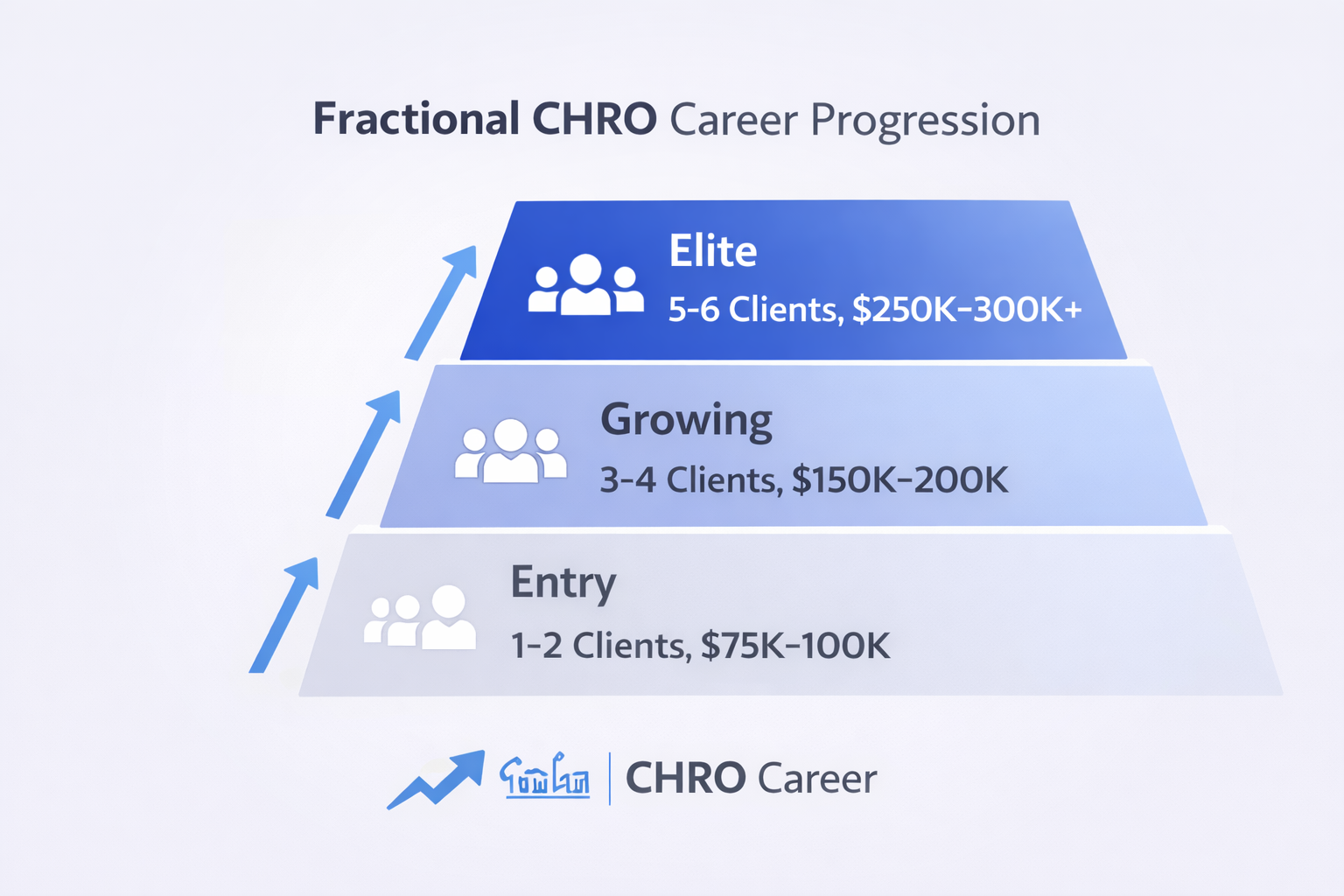
Annual Income Potential: $75,000-$250,000+ depending on how many clients you serve
The top 10% of fractional executives earn over $300,000 annually by serving 5-6 clients simultaneously. The math works because you’re not trading time for money on a 1:1 basis—you’re creating systems and frameworks that deliver disproportionate value.
Here’s the catch: you need strong systems to manage multiple clients. Tools like Mailreach alternatives help maintain relationships across your portfolio without drowning in admin work.
Many fractional leaders underprice early. Don’t. Your value lies in preventing disasters and accelerating growth. Price accordingly.

