

The tech leadership game just changed completely.
You don’t need to choose between a $250,000 full-time commitment and being stuck on the sidelines anymore. There’s a third option that’s exploding right now, and honestly, most tech leaders still don’t know about it.
We’re talking about fractional CTO jobs—where experienced tech executives work with multiple companies simultaneously, earning serious money while maintaining complete control over their schedule. The market has literally doubled from 60,000 professionals in 2022 to 120,000 in 2024, creating a $5.7 billion industry that’s just getting started.
This isn’t some gig-economy hustle. It’s a legitimate career path where seasoned CTOs leverage their expertise across a portfolio of clients, often earning more than their full-time counterparts while working fewer hours.
In this guide, you’ll discover exactly what fractional CTO jobs involve, how much you can realistically earn, where to find the best opportunities, and how to position yourself to land your first (or next) fractional role. Whether you’re a tech leader exploring options or someone building toward this career path, you’re about to see why fractional work is the future of tech leadership.
Let’s dive in.
What Exactly Is a Fractional CTO Job?
A fractional CTO is an experienced technology leader who provides part-time or contract Chief Technology Officer services to companies. Instead of dedicating 40+ hours weekly to one organization, you split your expertise across multiple clients—typically 2-4 companies simultaneously.
Think of it like this: A startup needs strategic tech leadership but can’t justify (or afford) a full-time executive. They need someone 10-15 hours per week to define their tech strategy, manage their development team, and make critical architecture decisions. That’s where you come in.
Here’s what makes fractional different from consulting: You’re not just advising from the sidelines. You’re an embedded executive with real decision-making authority. You attend leadership meetings, own the technology budget, and hold accountability for execution. You’re the CTO—just not five days a week.
Your typical responsibilities include:
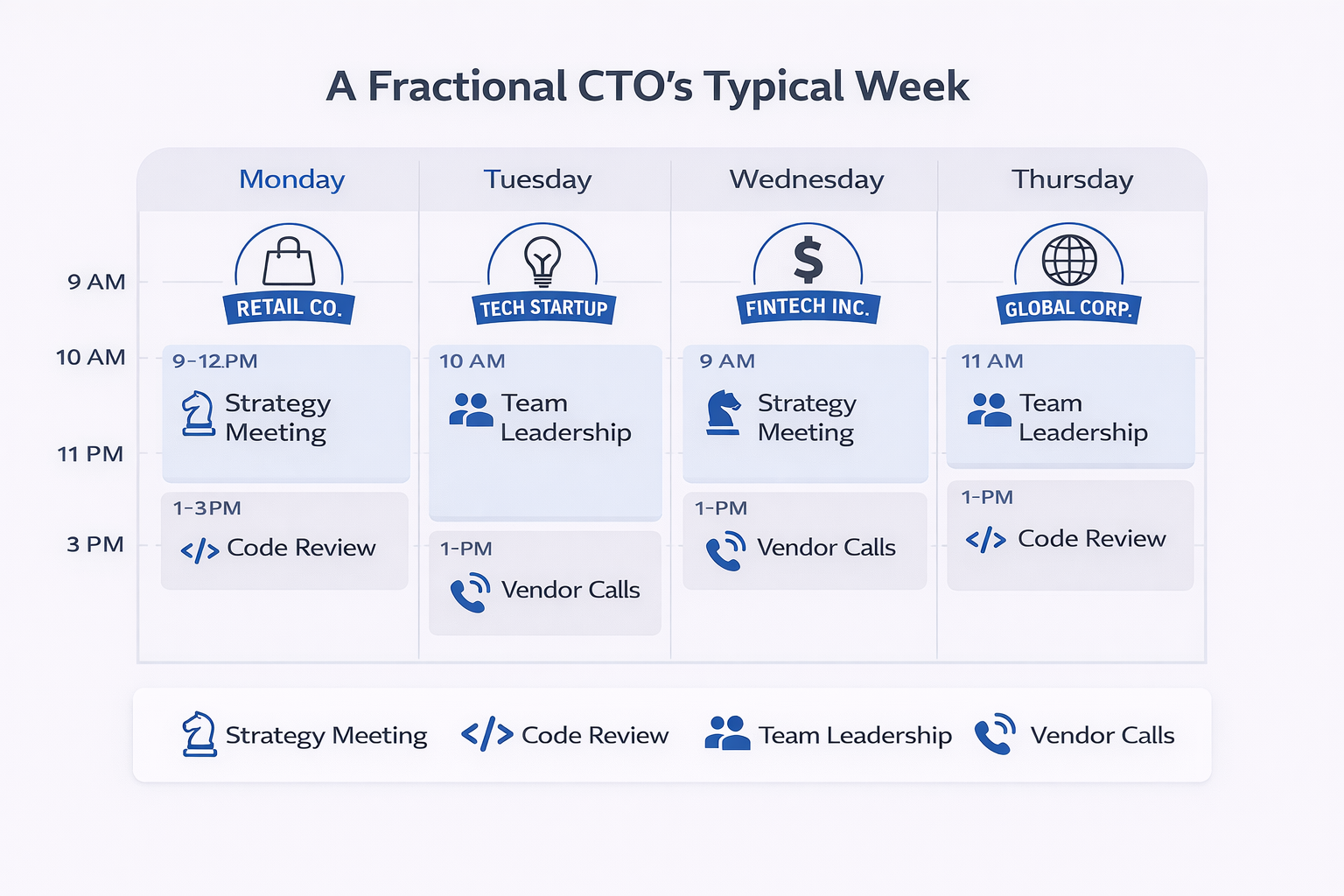
Strategic Planning: Developing technology roadmaps aligned with business goals Team Leadership: Managing engineering teams, hiring developers, mentoring tech talent
Architecture Decisions: Choosing tech stacks, overseeing cloud migrations, ensuring scalability Vendor Management: Evaluating and managing relationships with technology partners Budget Oversight: Managing tech spending and ensuring ROI on technology investments
The arrangement works beautifully for early-stage startups, small-to-medium businesses, and companies undergoing digital transformation who need executive-level guidance without the full-time cost.
The Booming Market for Fractional CTOs
The numbers don’t lie—fractional work is having a serious moment.
The fractional leadership market has seen explosive growth, with the number of professionals doubling in just two years. But it’s not just about quantity—the quality of opportunities is skyrocketing too.
Here’s what the data shows:
78% of fractional professionals expect increased opportunities in 2025, up from 67% the previous year. For tech leadership specifically, demand is even stronger because companies desperately need guidance on cloud infrastructure, cybersecurity, and AI implementation.
Why are companies hiring fractional CTOs like crazy?
First, the cost savings are massive. A full-time CTO in major tech hubs commands $200,000 to $300,000 annually, plus benefits, equity, and recruitment fees. The total cost of ownership easily exceeds $400,000 when you factor everything in.
By contrast, a fractional CTO working 15 hours per week at a $10,000 monthly retainer costs $120,000 annually—that’s a 70% savings. For cash-strapped startups trying to extend their runway, this math is impossible to ignore.
Second, companies gain access to senior expertise they couldn’t otherwise afford. That Series A startup can suddenly leverage the same strategic playbook as a Fortune 500 company because they’re hiring someone who’s actually built systems at scale.
Third, the risk is lower. Hiring a full-time executive is a massive commitment with painful severance scenarios if it doesn’t work out. Fractional engagements typically have 30-day notice periods, allowing companies to “try before they buy” without long-term commitment.
Which industries are hiring the most?
Technology and SaaS dominate, but e-commerce sits at 21.6% of fractional engagements—a huge opportunity given the complexity of modern digital commerce. Healthcare, fintech, and companies in regulated industries also actively seek fractional CTOs who understand compliance requirements.
The best part? Once professionals go fractional, they rarely return to full-time employment. The combination of flexibility, income potential, and work diversity creates a career path that’s simply too compelling to give up.
Money Matters: What You’ll Actually Earn
Let’s talk real numbers because this is probably what you’re most curious about.
The average fractional CTO in the United States earns $166,511 annually according to 2025 ZipRecruiter data. But here’s where it gets interesting—that’s just the average. The range is massive.
Hourly rates typically fall between $150 to $500 depending on your expertise, specialization, and geographic market. If you’re bringing AI/ML expertise or working in highly regulated industries like fintech or healthcare, you can command rates at the top end or even higher.
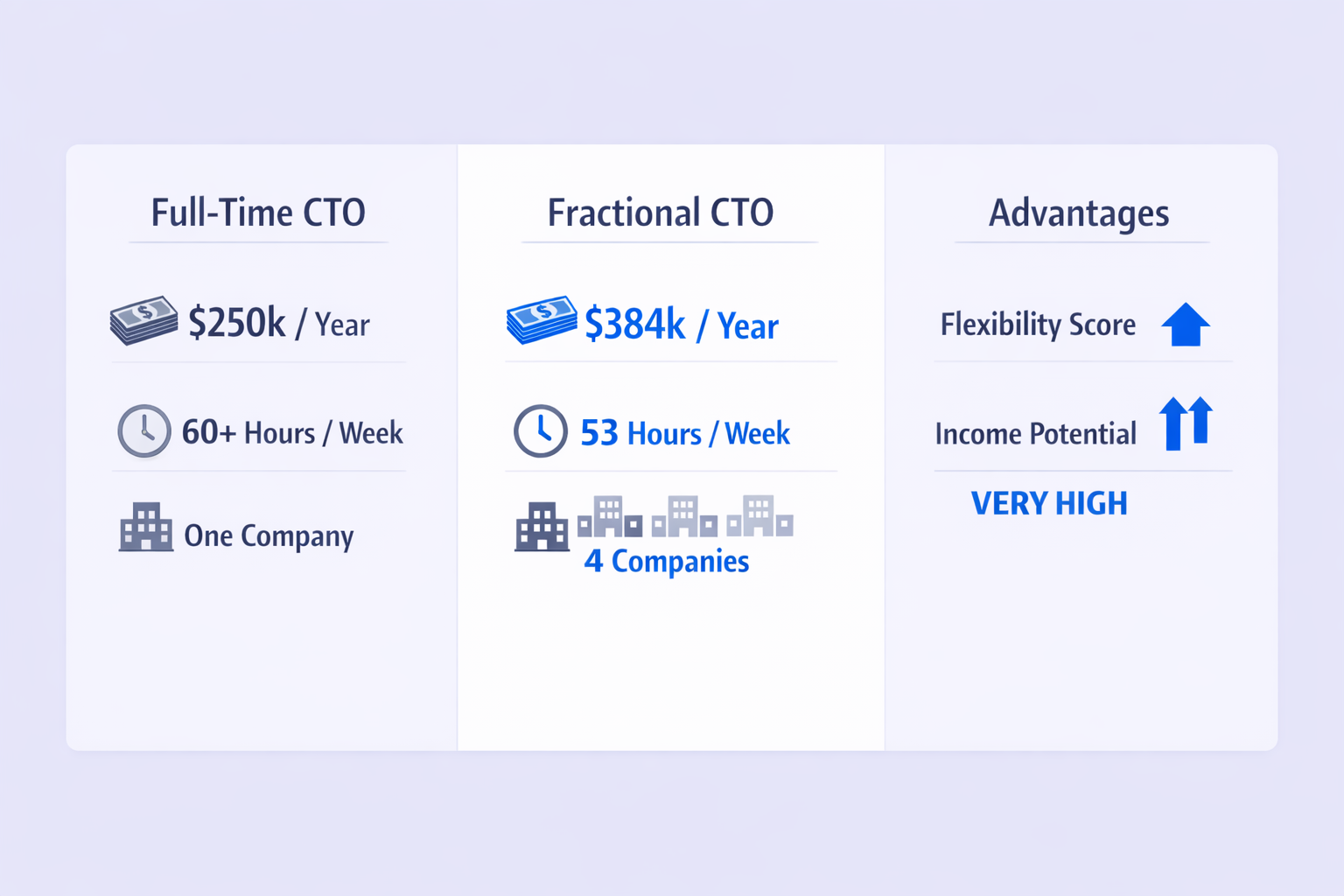
Monthly retainers are where most experienced fractional CTOs operate. These typically range from $2,000 to $25,000 per client based on scope and time commitment. A fractional CTO managing four clients at $8,000 monthly generates $384,000 annually—that’s executive-level compensation with a diversified risk profile.
Here’s the portfolio model math that makes this so attractive:
- Client 1 (Series A SaaS): $10,000/month, 15 hours/week
- Client 2 (E-commerce): $8,000/month, 12 hours/week
- Client 3 (HealthTech): $12,000/month, 18 hours/week
- Client 4 (Consulting projects): $5,000/month, 8 hours/week
Total monthly income: $35,000
Annual income: $420,000
Total weekly hours: ~53 hours (you control the schedule)
Compare that to a full-time CTO earning $250,000 who’s locked into one company, working 60+ hour weeks with zero flexibility. The fractional model gives you higher earnings potential AND better work-life balance.
Research shows 52.8% of fractional professionals earn over $100,000 annually, and 72.8% have 15+ years of experience—proving this isn’t entry-level work. You’re trading your pattern recognition and proven playbooks for premium compensation.
Geographic considerations matter too. While rates in major tech hubs like San Francisco and New York command premiums, remote work is shrinking the “location discount.” Cities showing lower average salaries (like Michigan at ~$157k) represent arbitrage opportunities for companies willing to hire outside coastal markets.
The compensation models are evolving too. Beyond straight salary or hourly rates, many fractional CTOs negotiate equity compensation in startups, creating potential long-term upside alongside immediate income security.
Where to Find Fractional CTO Jobs
You’re not going to stumble into fractional work—you need to know where companies are actually looking for tech leadership.
Top Platforms and Marketplaces:
Upwork remains the largest marketplace with thousands of fractional CTO opportunities. Companies post everything from short-term consulting projects to long-term retainer arrangements. The platform shows hourly rates and allows you to showcase certifications like AWS Solutions Architect to build credibility. You can receive proposals within 24 hours of posting your profile.
Toptal caters to the premium end of the market, connecting top-tier tech talent with high-budget clients. Their vetting process is rigorous, but acceptance means access to companies willing to pay $200-$500+ hourly for proven expertise.
FlexJobs specializes in remote, part-time, and flexible opportunities. Founded in 2007, they screen every listing for quality and legitimacy—no spam, no scams. If you’re prioritizing remote work and lifestyle flexibility, this platform delivers.
Job Boards to Check Daily:
Indeed and ZipRecruiter list hundreds of fractional CTO positions right now. Search “fractional CTO” or “part-time CTO” and you’ll find everything from 3-month interim roles to multi-year engagements. Set up job alerts so opportunities hit your inbox automatically.
Wellfound (formerly AngelList Talent) connects you directly with startups. They have 10 million+ tech-ready candidates and have made 8 million placements. The platform lets you set up job posts and company branding within 10 minutes, making it startup-friendly.
Specialized Fractional Networks:
Go Fractional was founded in 2021 specifically for executive-level fractional work. They have access to thousands of multi-exited executives and focus on quality matching—taking time to understand your needs and pair you with companies where you’ll thrive.
MentorCruise takes a unique approach, combining fractional CTO work with mentorship. You create packages around your expertise, and clients book you for ongoing advisory relationships. The platform has paid out $10 million+ to fractionals and you keep 80% of earnings.
CTO Academy is both a job board and professional community. Join their network to access job postings while participating in discussions with peers. In their experience, personal referrals from community members remain the fastest path to new opportunities.
The Power of LinkedIn:
Here’s what most people miss—LinkedIn is your most powerful tool for landing fractional work. But you can’t just update your profile to “Available for Fractional Work” and wait.
You need to actively engage. Use <a href=”https://salesso.com/blog/advanced-linkedin-search”>advanced search</a> to identify founders and executives at companies in your target size range (typically 10-100 employees). Study their <a href=”https://salesso.com/blog/linkedin-profile-statistics”>profile activity</a> to understand their challenges. Comment thoughtfully on their posts about tech challenges.
Many successful fractional CTOs use <a href=”https://salesso.com/blog/linkedin-automation-tool”>automation tools</a> to scale their outreach while keeping it personalized. The goal isn’t to spam connection requests—it’s to build genuine relationships with decision-makers who need exactly what you offer.
Direct Outreach Works:
Don’t underestimate the power of reaching out directly to companies. Identify startups that recently raised seed or Series A funding—they’re prime candidates for fractional leadership. Send personalized messages (not templates) explaining how you’ve solved similar challenges for other companies.
The companies hiring fractional CTOs aren’t always posting jobs publicly. Sometimes they don’t even know they need a fractional CTO until you explain how the model works.
Skills Companies Actually Want
Experience matters more than anything else in fractional work.
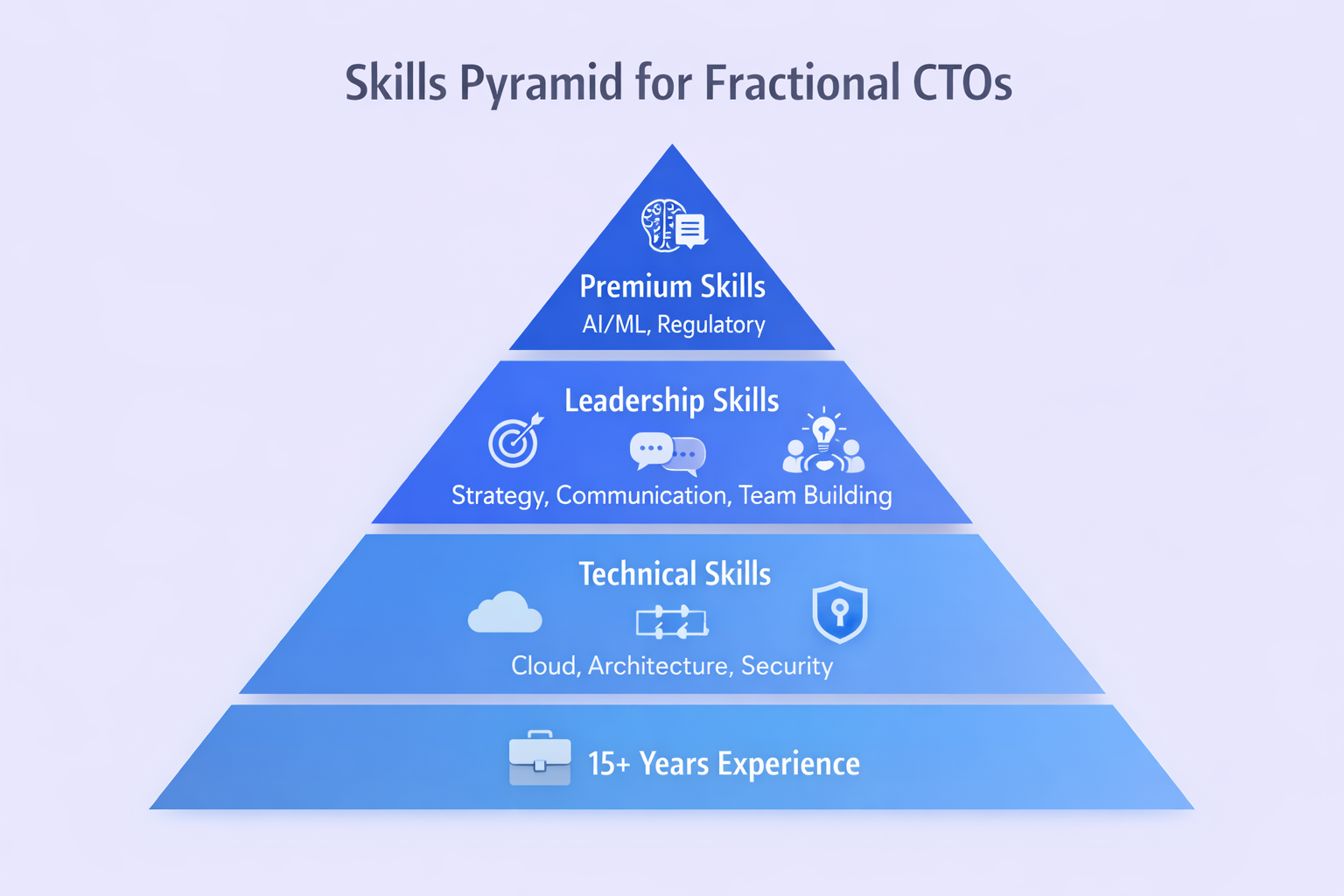
The data is crystal clear: 72.8% of fractional professionals have 15+ years of experience. This isn’t entry-level work. Companies hire fractional executives for pattern recognition—you’ve seen the movie before and know how it ends.
Technical Skills That Open Doors:
Cloud Architecture is non-negotiable. You need deep expertise in AWS, Azure, or Google Cloud Platform. Companies aren’t hiring you to learn on the job—they need someone who can design scalable infrastructure from day one.
Software Architecture expertise means you can evaluate tech stacks, make build-vs-buy decisions, and architect systems that won’t collapse under growth. You should understand microservices, APIs, databases, and how to structure code for maintainability.
Cybersecurity knowledge is increasingly critical. With data breaches costing companies millions, fractional CTOs who understand security protocols, compliance requirements (SOC2, HIPAA, GDPR), and can implement proper safeguards command premium rates.
DevOps and CI/CD knowledge allows you to establish efficient development processes. Companies need you to set up testing frameworks, deployment pipelines, and monitoring systems that let small teams move fast without breaking things.
Leadership Skills That Make You Irreplaceable:
Strategic Planning is your core value proposition. You’re not there to write code—you’re there to align technology decisions with business objectives. Can you create a 12-month roadmap that balances technical debt, new features, and infrastructure investments?
Communication separates good CTOs from great ones. You need to explain complex technical concepts to non-technical founders, translate business requirements into technical specifications, and mentor junior developers. If you can’t communicate clearly, technical brilliance doesn’t matter.
Team Building means knowing how to assess talent, conduct technical interviews, structure compensation, and create engineering culture. Your clients often need help scaling from 2 developers to 15—you should have done this before.
Risk Management expertise helps companies avoid costly mistakes. New technology is inherently risky. You need to accurately gauge risk, implement industry best practices, and navigate situations where there aren’t off-the-shelf answers.
Emerging Skills That Command Premium Rates:
AI and Machine Learning expertise is creating a new premium tier. Research shows a 2,000% rise in job posts referencing generative AI skills. Fractional CTOs who can guide AI strategy, evaluate LLM implementations, and navigate data privacy concerns command 30%+ premium rates over standard offerings.
Regulatory Compliance knowledge for fintech, healthcare, or other regulated industries makes you invaluable. If you understand PCI compliance, HIPAA requirements, or financial services regulations, you can charge top-tier rates and face less competition.
The Business Side:
You need basic financial literacy—understanding P&L statements, calculating ROI on technology investments, and managing budgets. You should be comfortable presenting to boards or investors when needed.
Project management using tools like <a href=”https://salesso.com/blog/top-workflow-automation-software”>workflow automation</a> keeps multiple clients organized. You’ll need systems to track deliverables, manage timelines, and ensure nothing falls through the cracks when juggling multiple engagements.
Certifications That Help (But Aren’t Required):
While experience matters most, certifications demonstrate commitment to learning and provide credible signals:
- AWS Certified Solutions Architect
- Google Professional Cloud Architect
- Certified Information Security Manager (CISM)
- Certified ScrumMaster (CSM) for agile environments
Don’t wait to get certified before starting fractional work—but do consider adding credentials as you build your practice.
How to Land Your First Fractional CTO Role
Getting started requires a different approach than traditional job hunting.
Build Your Foundation First:
You can’t shortcut this—you need years of tech leadership experience before going fractional. If you’re currently a senior engineer or engineering manager, focus on getting promoted to CTO or VP Engineering at a full-time role first. Build that track record. Ship products. Scale teams. Make mistakes and learn from them.
The minimum viable experience is usually 10-15 years in tech with at least 3-5 years in leadership roles. Companies hire fractional CTOs specifically because they’ve “been there, done that” and can help them avoid expensive mistakes.
Create Your Positioning:
You need a compelling profile that showcases results, not just responsibilities. Instead of “Managed development team,” write “Scaled engineering team from 3 to 22 developers while reducing infrastructure costs by 40%.”
Focus on specific outcomes:
- “Led cloud migration that improved uptime from 97% to 99.9%”
- “Implemented CI/CD pipeline that reduced deployment time from 2 weeks to 2 hours”
- “Architected system that scaled from 10K to 500K users with no downtime”
Numbers and results sell. Vague descriptions don’t.
Build Your Network Strategically:
Join communities where your ideal clients hang out. If you want to work with SaaS startups, participate in SaaS-focused Slack channels and forums. If healthcare interests you, attend HealthTech conferences and join relevant LinkedIn groups.
Use LinkedIn effectively through <a href=”https://salesso.com/blog/linkedin-growth-hacking”>growth strategies</a> that actually work. Share insights about tech leadership challenges. Comment on posts from founders discussing technical problems. Demonstrate expertise publicly so when someone needs help, they think of you.
The <a href=”https://salesso.com/blog/linkedin-sales-navigator-alternatives”>research tools</a> available make it easier than ever to identify and connect with decision-makers at companies in your sweet spot.
Start with One Client:
Don’t try to build a full portfolio overnight. Land one fractional engagement and do exceptional work. That first client becomes your case study, testimonial source, and referral engine.
Offer to start at a slightly lower rate to get that crucial first engagement. Once you have one success story, the second client is easier. By client three or four, you can command premium rates.
Create a Simple Service Offering:
Define clear packages so prospects understand what they’re buying:
Starter Package: $5,000/month for 10 hours weekly – strategy and roadmap
Growth Package: $10,000/month for 20 hours weekly – strategy + team leadership
Scale Package: $15,000/month for 30 hours weekly – full executive engagement
Packages make pricing conversations easier and help clients self-select the right engagement level.
The Cover Letter That Gets Responses:
When applying to fractional opportunities, your cover letter matters more than your resume. The formula that works:
- Open with their problem: “I saw you’re scaling from 5 to 20 developers…”
- Share relevant experience: “I’ve done this three times, most recently at [Company]…”
- Provide specific value: “Here’s how I’d approach your challenge…”
- Include results: “Previous clients saw [specific outcome]…”
- Make it easy: “Available for a 30-minute conversation this week…”
Keep it under 250 words. Make it about them and their needs, not your career history.

