

Here’s the reality: most cold outreach is invisible. It lands in the inbox, gets clocked as a template in 0.3 seconds, and gets deleted before it’s even read.
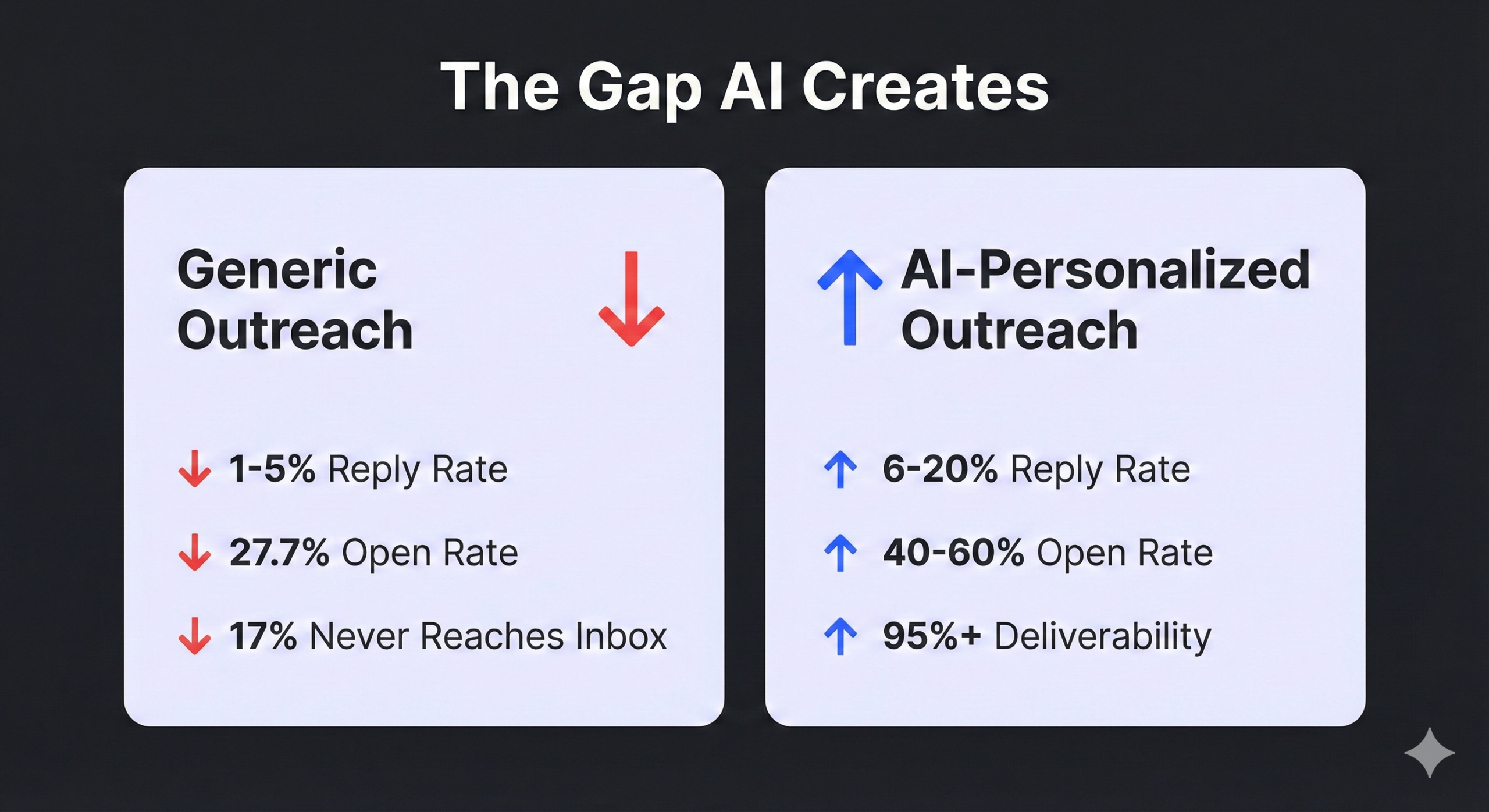
The average cold email reply rate has dropped to somewhere between 0.5% and 2%. Open rates sit around 27.7% — and roughly 17% of emails never even reach the primary inbox in the first place. Meanwhile, your prospects are getting smarter, their inboxes are getting more protected, and the bar to get a response keeps rising.
📊 Generic campaigns: 0.5–2% reply rate. AI-personalized campaigns: 6–20%+ — a nearly tenfold jump.
That gap isn’t luck. It’s the result of one thing: dynamic content.
Dynamic content is what happens when your outreach stops saying “Hi [First Name]” and starts saying something that makes a prospect think “wait, this person actually did their homework.” And the only way to do that at scale — without your team working 80-hour weeks — is AI.
This article breaks down exactly how to use AI for dynamic content in outreach: what it means, how the logic works, and what tools and tactics are actually moving the needle in 2025 and 2026. If you’re spending more than 10 minutes personalizing a single email, there’s a faster way. Let’s get into it.
How to Use AI for Dynamic Content in Outreach
What “Dynamic Content” Actually Means
Dynamic content isn’t just swapping out a first name or company name. That’s personalization 1.0 — and it stopped working years ago.
Real dynamic content treats every message as a modular asset — built from live data, contextual signals, and individual insights. The AI doesn’t just fill in blanks. It chooses which narrative to tell based on who’s reading, what they care about, and what’s happening in their world right now.
Think of it this way: instead of writing one email and blasting it to 1,000 people, you’re writing a framework — and the AI writes 1,000 slightly different, highly relevant versions of that email automatically.
The result? Campaigns that hit 6–20%+ reply rates, compared to the industry average of 1–5% for generic outreach. When you give people a message that feels like it was written for them, they respond.
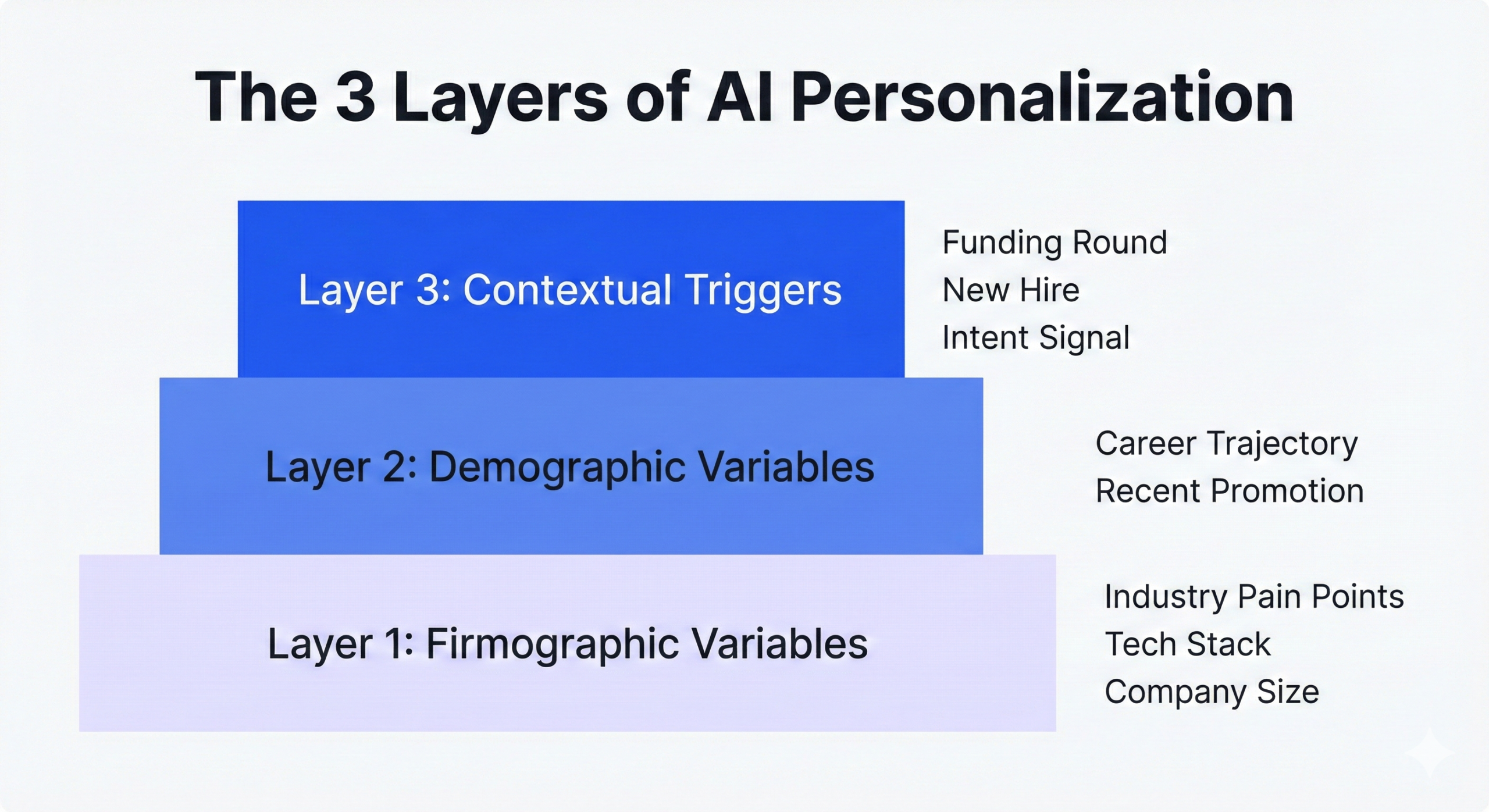
Layer 1 — Firmographic Variables: This is the baseline — industry, company size, revenue range, and technology stack. AI can detect if a prospect is using a legacy CRM and automatically pivot the value proposition to lead with migration ease instead of new features. Same message, delivered differently.
Layer 2 — Demographic Variables: This layer focuses on the individual — their career trajectory, recent promotions, skills they’ve listed, and shared educational backgrounds. A new VP of Sales who just got promoted six months ago has very different priorities than someone who’s been in the role for three years.
Layer 3 — Contextual Triggers: This is the most powerful layer, and the one most campaigns ignore entirely. Contextual triggers are real-time events that signal a change in the prospect’s situation:
- Recent funding rounds — signals budget availability and growth pressure
- New leadership hires — signals a change in strategy and openness to new vendors
- Competitor job postings — signals pain points and opportunity for displacement
- Intent signals from their website — signals active research and buying intent
The logic behind it is almost mathematical: the likelihood of getting a response is a function of how relevant your trigger is, how clear your value proposition is, and how low-friction your ask is. AI optimizes all three simultaneously.
For a deeper dive on writing messages that actually land, see our post on personalised cold email.
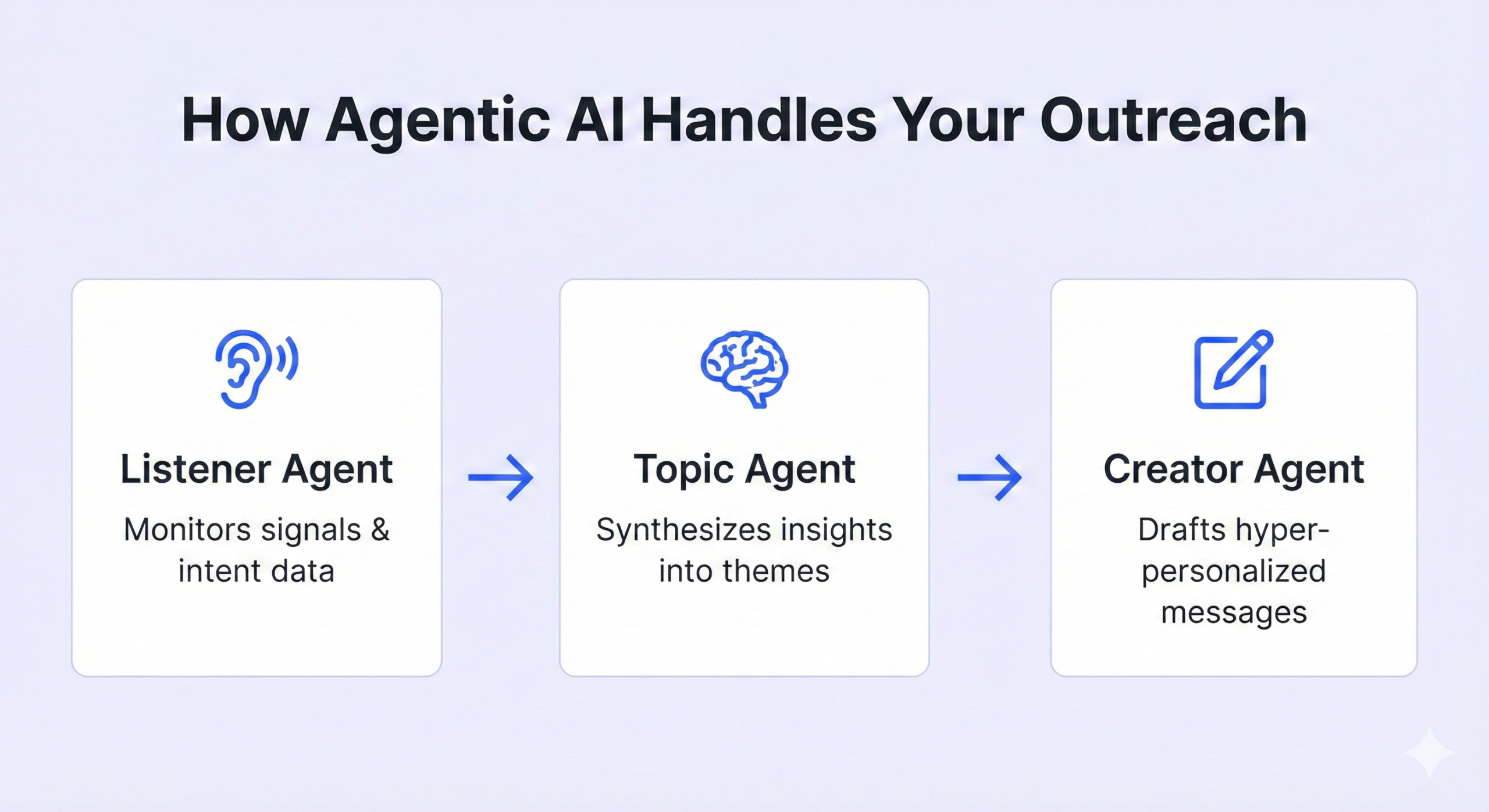
For sales teams, this means a rep who used to spend 8–10 hours per week on research and admin can now reclaim most of that time and redirect it toward live conversations. The AI handles the latest product news monitoring, trigger detection, and first-draft writing. The human handles the nuance, empathy, and relationship-building that closes deals.
Explore how the right AI sales tools stack compares to manual processes in our full breakdown.
Multi-Channel Outreach: LinkedIn, Email, and Video
Running a single-channel campaign in 2025 is like fishing in one spot and wondering why you’re not catching anything. Multi-channel outreach — combining email, LinkedIn, and video — can boost response rates by up to 287% compared to email alone.
On LinkedIn, dynamic content works differently than email. Instead of mass connection requests, AI identifies prospects who have recently commented on specific industry posts and drafts a connection message that references exactly what they said. This feels personal because it is — and it generates 30–35% acceptance rates instead of the 10–15% that generic requests get.
Once connected, the follow-up sequence stays dynamic. AI tracks profile updates, company news, and engagement patterns to choose the right moment and the right angle for each follow-up message.
Video is the third pillar. AI video tools let you send a personalized 60-second introduction that uses the prospect’s name and references their specific business context. For follow-ups, an AI agent can summarize a discovery call, generate a video recap, and send it with relevant resources — a process that takes seconds instead of an hour.
For a complete breakdown of how to structure your multi-channel approach, our guide to targeted outreach walks through the full sequencing logic.
The Technical Foundation: Warm-Up, Rotation, and Deliverability
None of this works if your emails land in spam. Dynamic content is as much a deliverability strategy as it is a personalization strategy.
Here’s why: spam filters look for patterns. When thousands of identical messages go out from the same domain, filters flag it. Dynamic content — using Spin Syntax and AI-generated variable combinations — ensures that every message in a campaign is technically unique. No two emails share the same digital fingerprint, which makes it dramatically harder for filters to identify and block your outreach.
The best practices for high-volume outreach in 2025–2026:
- Intelligent Warm-Up: Gradually increase sending volume and simulate human engagement (opens, replies, clicks) before scaling. Modern AI tools automate this entirely.
- Multi-Inbox Rotation: Distribute sending volume across multiple email addresses to stay under sending thresholds without sacrificing reach.
- Domain Authentication: SPF, DKIM, and DMARC are non-negotiable. Without them, even great content ends up in spam.
- Real-Time Verification: Every email address should be verified before sending. Tools with 95%+ accuracy guarantees prevent bounces that damage sender reputation.
📊 AI-optimized campaigns achieve 95%+ deliverability, compared to the ~83% industry average for unoptimized outreach.
Teams using dedicated cold email outreach ROI tracking consistently find that deliverability improvements compound over time — better inbox placement means more opens, which means better sender reputation, which means even better placement.
For more on building your entire outbound foundation from the ground up, our lead generation guide covers the full funnel strategy.
Conclusion
AI for dynamic content in outreach isn’t a future trend — it’s the current standard for teams that are actually winning pipeline.
The data is clear: personalized, contextually relevant messages achieve 6–20%+ reply rates while generic outreach flatlines at 0.5–2%. The difference isn’t effort — it’s intelligence. AI handles the research, the enrichment, the content variation, and the timing. You handle the relationships.
The teams pulling ahead right now are the ones who’ve stopped treating outreach as a volume game and started treating it as a relevance game. They’re using semantic data extraction to find real talking points, layering firmographic, demographic, and contextual variables into every message, deploying AI agents that act on live signals without manual intervention, and running multi-channel sequences that meet prospects wherever they are.
If your current outreach still relies on a first name and a generic value prop, you’re leaving a significant portion of your pipeline on the table. The tools exist, the frameworks are proven, and the results speak for themselves.
The question isn’t whether to adopt AI for dynamic content. It’s how fast you can make it happen.
The Technical Foundation: Warm-Up, Rotation, and Deliverability
None of this works if your emails land in spam. Dynamic content is as much a deliverability strategy as it is a personalization strategy.
Here’s why: spam filters look for patterns. When thousands of identical messages go out from the same domain, filters flag it. Dynamic content — using Spin Syntax and AI-generated variable combinations — ensures that every message in a campaign is technically unique. No two emails share the same digital fingerprint, which makes it dramatically harder for filters to identify and block your outreach.
The best practices for high-volume outreach in 2025–2026:
- Intelligent Warm-Up: Gradually increase sending volume and simulate human engagement (opens, replies, clicks) before scaling. Modern AI tools automate this entirely.
- Multi-Inbox Rotation: Distribute sending volume across multiple email addresses to stay under sending thresholds without sacrificing reach.
- Domain Authentication: SPF, DKIM, and DMARC are non-negotiable. Without them, even great content ends up in spam.
- Real-Time Verification: Every email address should be verified before sending. Tools with 95%+ accuracy guarantees prevent bounces that damage sender reputation.
📊 AI-optimized campaigns achieve 95%+ deliverability, compared to the ~83% industry average for unoptimized outreach.
Teams using dedicated cold email outreach ROI tracking consistently find that deliverability improvements compound over time — better inbox placement means more opens, which means better sender reputation, which means even better placement.
For more on building your entire outbound foundation from the ground up, our lead generation guide covers the full funnel strategy.
Conclusion
AI for dynamic content in outreach isn’t a future trend — it’s the current standard for teams that are actually winning pipeline.
The data is clear: personalized, contextually relevant messages achieve 6–20%+ reply rates while generic outreach flatlines at 0.5–2%. The difference isn’t effort — it’s intelligence. AI handles the research, the enrichment, the content variation, and the timing. You handle the relationships.
The teams pulling ahead right now are the ones who’ve stopped treating outreach as a volume game and started treating it as a relevance game. They’re using semantic data extraction to find real talking points, layering firmographic, demographic, and contextual variables into every message, deploying AI agents that act on live signals without manual intervention, and running multi-channel sequences that meet prospects wherever they are.
If your current outreach still relies on a first name and a generic value prop, you’re leaving a significant portion of your pipeline on the table. The tools exist, the frameworks are proven, and the results speak for themselves.
The question isn’t whether to adopt AI for dynamic content. It’s how fast you can make it happen.

