
🎉Find Prospects and Send Cold Emails & LinkedIn Outbound | All in One Place

LinkedIn Content Statistics: The Complete Guide for 2025

Table of Contents

LinkedIn Content Statistics

Multi-image carousels dominate with 6.60% average engagement rate – requiring active swiping through slides that creates multiple micro-interactions the algorithm loves

Native documents achieve 6.10% engagement – PDFs uploaded directly to LinkedIn, perfect for repurposing presentations and guides into social-friendly formats

Native video hits 5.60% engagement – but must be uploaded directly to LinkedIn, as external video links get 5x less engagement

Posts with external links get just 1.2% engagement – LinkedIn’s algorithm actively suppresses them to keep users on the platform

Only 1% of LinkedIn users share content weekly – meaning 99% less competition than oversaturated platforms like Instagram or TikTok

134.5 million professionals log in every single day – consuming 138 hours of learning content every minute and generating opportunities

12 billion interactions occur monthly – showing massive engagement potential for content creators who understand the algorithm

80% of users access LinkedIn via mobile devices – requiring vertical-friendly content design and thumb-stopping hooks

Vertical videos receive 58% more engagement on mobile – compared to landscape formats, by occupying more screen real estate

Videos under 60 seconds retain 87% of viewers – while longer content sees dramatic drop-offs requiring front-loaded hooks

Videos with captions retain viewers 32% longer – as many professionals browse with sound off in office environments

LinkedIn Live generates 24x the engagement of pre-recorded video – through real-time push notifications creating artificial traffic spikes

Multichannel campaigns generate 287% higher purchase rates – than single-channel approaches combining LinkedIn and email

LinkedIn DMs achieve 10.3% average response rates – double cold email’s typical 1-5% range, without aggressive spam filtering

AI-generated posts get 5x less engagement – as users develop “synthetic blindness” to perfect grammar and generic structure favoring authentic content


Let’s be honest—you’re probably posting content on LinkedIn and wondering if it’s even worth it.

Here’s the thing: LinkedIn isn’t just another social media platform where you toss content into the void and hope someone notices. It’s the world’s largest professional network with over 1.2 billion professionals, and the right content strategy can transform your entire approach to reaching decision-makers.

But here’s where most people go wrong. They create content based on gut feeling rather than data. They post randomly, use formats that don’t perform, and wonder why their engagement is flat.

The numbers tell a different story. Multi-image carousels get 6.60% engagement while posts with external links barely scrape 1.2%. Videos under 60 seconds retain 87% of viewers, but most people still create long-form content that nobody finishes watching.

This guide cuts through the noise. You’ll discover exactly which content formats work, when to post, how the LinkedIn algorithm actually makes decisions, and most importantly—how to turn your LinkedIn presence into a lead generation machine that actually delivers results.

Let’s dive into the data that separates top performers from everyone else.

Why LinkedIn Content Statistics Matter Right Now

The platform has evolved dramatically. 134.5 million professionals log in every single day, and they’re not just browsing job listings anymore. They’re consuming 138 hours of learning content every minute and generating 12 billion interactions monthly.

This creates an unprecedented opportunity. While other social media platforms are oversaturated with creators, only 1% of LinkedIn users share content weekly. Think about that for a second. You have 99% less competition than on platforms like Instagram or TikTok.

The algorithm is hungry for fresh content to feed those 134 million daily users. That means higher organic reach without paying for ads. But only if you understand what content actually performs.

Here’s what changed in 2025: LinkedIn’s algorithm now heavily favors “dwell time”—the actual seconds someone spends consuming your content. A quick scroll past your post? That’s a signal to suppress it. Someone reading your entire post or watching your full video? That’s gold.

The professionals winning on LinkedIn right now understand these mechanics. They’re not posting more—they’re posting smarter.

The Content Format Performance Hierarchy

Not all content is created equal on LinkedIn. The data reveals a clear winner-takes-all hierarchy.
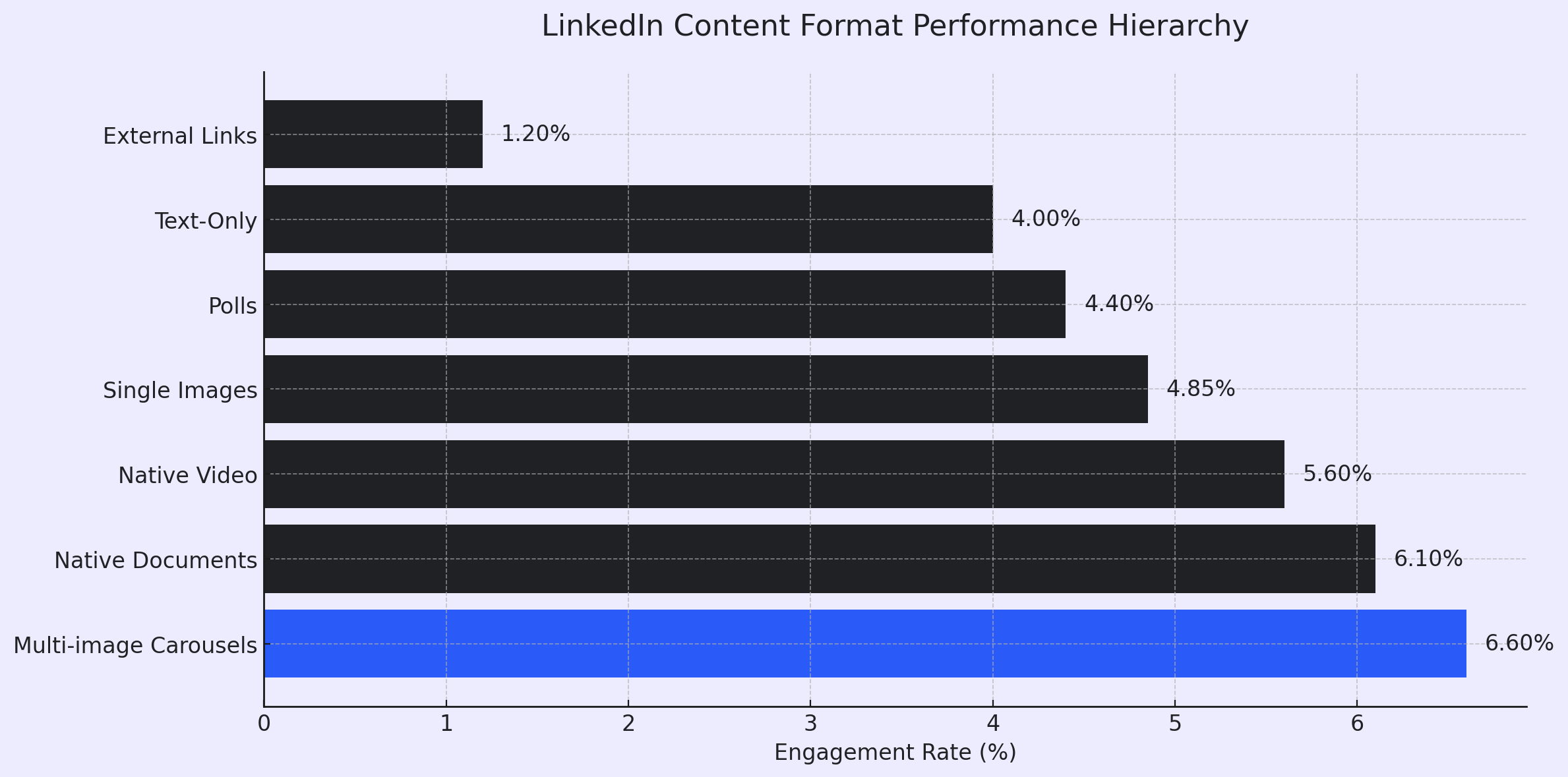


Multi-image carousels dominate with a 6.60% average engagement rate. Why? They require active participation—swiping through slides creates multiple micro-interactions that the algorithm loves. Each swipe signals engagement. Plus, they naturally inflate dwell time because users spend 30-60 seconds consuming your 7-10 slides.

Native documents come in second at 6.10% engagement. These are PDFs uploaded directly to LinkedIn, perfect for repurposing presentation decks, guides, or case studies into social-friendly formats.

Native video hits 5.60% engagement, but here’s the catch: it must be uploaded directly to LinkedIn. Sharing a YouTube link? You’re looking at a massive performance drop. Native video gets 5x the engagement of external video links.

Single images perform solidly at 4.85%, especially when paired with strong copy. The visual catches the eye while scrolling, and if your first two lines hook them, they’ll click “see more.”

Text-only posts maintain 4.00% engagement. They look authentic and conversational, not like ads. The key? Your hook—those first two lines visible before the “see more” cutoff—determines everything.

Polls are experiencing a resurgence at 4.40% engagement. They’re low-friction (one click to engage) and give you valuable intent data. Smart professionals use poll voters as outreach triggers.

Then there’s the graveyard: Posts with external links get just 1.2% engagement. LinkedIn’s algorithm actively suppresses them because the platform wants to keep users on LinkedIn, not send them elsewhere.

The strategic implication? Deliver value within the LinkedIn feed, not behind a click. Put your insights in the post itself, not on your blog.

 📊 Skip Content Creation Altogether

Why post content hoping for leads when you can message 65M+ decision-makers directly with 15-25% response rates?

Understanding the LinkedIn Algorithm in 2025

The LinkedIn algorithm operates like a ruthless gatekeeper using a three-step filtering process that determines your content’s fate in seconds.


Quality filtering happens instantly. The moment you hit publish, automated classifiers scan your post and categorize it as “Spam,” “Low Quality,” or “High Quality.” Poor grammar, excessive hashtags (more than 3-5 hurts you), multiple links, or tagging random people you don’t know? You’re suppressed immediately with near-zero visibility.

The “Golden Hour” testing phase comes next for content that passes quality filters. LinkedIn shows your post to a small, statistically significant sample of your network. What happens in this first hour is critical. Does your audience pause to read? Click “see more”? React or comment? If this sample group engages within 60 minutes, the algorithm interprets this as a signal of broad relevance.

Network amplification follows successful testing. The algorithm opens the floodgates, distributing your content to wider circles including second and third-degree connections. It uses “lookalike” modeling to find users with similar interests to those who already engaged. This is how posts “go viral” beyond your immediate network.

Dwell time has become the dominant ranking factor. The algorithm measures actual seconds users spend with your content on screen. A quick click-and-back signals poor quality. Someone stopping their scroll to read your entire post or watch your full video? That’s the ultimate green light.

This explains why document carousels and long-form text posts perform so well—they physically require time to consume. You’re not just catching attention; you’re holding it.

Engagement quality matters more than quantity. A comment with 10+ words generates 2x more algorithmic boost than generic “Great post!” comments. The algorithm can differentiate between thoughtful engagement and empty interactions.

Here’s what kills your reach: posting and immediately logging off. The algorithm monitors creator behavior. Engaging with 10-20 other posts on the day you publish can increase your exposure by 50%. You must give engagement to get engagement—it’s the social contract LinkedIn enforces.

🎯 Or Just Message Them Directly

 Fighting algorithms is exhausting. Our LinkedIn outbound system bypasses content entirely—targeting, campaigns, and scaling done-for-you.

AI-generated content faces a penalty. As generative AI floods the platform, the algorithm has adjusted to deprioritize obviously synthetic content. Reports indicate AI-generated posts get 5x less engagement. Users have developed “synthetic blindness” to perfect grammar and generic structure. Authenticity, personal stories, and even minor imperfections signal human origin.

The Mobile-First Reality

Here’s a stat that should change everything about how you create LinkedIn content: 80% of users access the platform via mobile devices.


This isn’t a preference—it’s the dominant behavior pattern. Yet most people still create content optimized for desktop viewing. That’s a critical mistake.

On mobile, your content appears in a vertical feed on a small screen. Long paragraphs become intimidating walls of text. Users scan feeds rapidly, spending an average of just 8.33 minutes per session. If your hook doesn’t land within seconds, the opportunity vanishes.

Vertical video outperforms horizontal on mobile by a significant margin. Reports show vertical videos receive 58% more engagement on mobile compared to landscape formats. Vertical video occupies more screen real estate, commanding attention.

For carousels and images, keep text large and legible on small screens. Test your content on your phone before publishing. If you have to zoom to read it, your audience won’t bother.

The “thumb-stopping” power of your content is the primary success metric. Design for the scroll, not the desktop experience.

💼 Stop Chasing Algorithm Changes

LinkedIn outbound lands directly in decision-maker inboxes. No content creation, no algorithm games, just qualified meetings.

Strategic Timing and Posting Frequency

Timing isn’t everything, but it’s a multiplier on already-good content.

Tuesday through Thursday between 8-11 AM or 1-4 PM consistently show the highest engagement rates. Why? These are the windows when professionals check LinkedIn during their workday—morning routine and post-lunch catch-up.

Mondays are chaotic catch-up days. Fridays are mentally checked-out days. Weekends see dramatically lower professional engagement.

Posting 3-5 times weekly hits the sweet spot for growth. Less than that, and you fade into algorithmic obscurity. More than that, and you risk audience fatigue without proportional returns.

But here’s what matters more than posting frequency: daily engagement. Commenting on others’ content is actually more important than your own posting schedule. The algorithm rewards active community participants.

Consistency beats intensity. One solid post per week for 52 weeks outperforms five posts one week and then radio silence.

Company Profile Optimization

Your LinkedIn company profile isn’t just a digital business card—it’s a conversion tool that needs optimization.

Image specifications matter. Your company logo should be 300×300 pixels minimum, remaining legible when displayed at 60×60 pixels in feeds. Your company cover image needs to be 1128×191 pixels—an extremely wide aspect ratio. Keep critical text centered to avoid mobile cropping.

Personal profile banners are 1584×396 pixels—prime real estate for your value proposition. Most people waste this space with generic designs. Use it to communicate exactly what you do and for whom.

URL optimization is an overlooked SEO opportunity. By default, LinkedIn assigns random alphanumeric URLs. Customize your company profile URL to something clean and keyword-rich like “linkedin.com/company/your-business-name.” This improves search engine indexing and looks professional.

You can typically change company URLs once every 30 days, so choose strategically. For personal profiles, navigate to “Edit Public Profile & URL” and click the pencil icon to customize.

Keyword injection in your headline and about section determines search visibility. Your headline has 220 characters—use them to describe not just your title, but the value you provide. Instead of “Marketing Manager,” try “Marketing Manager | Helping SaaS Companies Scale | Content Strategy Specialist.”

Your about section’s first 150 characters act as the meta-description for Google searches. Pack this space with high-intent keywords relevant to your target audience’s pain points.

Video Content Strategy

Video viewership on LinkedIn is up 36% year-over-year, but most professionals still aren’t leveraging it effectively.

Rule one: Upload native video files directly to LinkedIn. Sharing YouTube or Vimeo links kills your reach—native video gets 5x the engagement of external video links. The algorithm actively suppresses content that drives users off-platform.

Keep videos under 60 seconds. This format retains 87% of viewers on average. Longer content sees dramatic drop-offs. Hook viewers in the first 3 seconds—this single element increases retention by 23%.

Captions are non-negotiable. Videos with captions/subtitles retain viewers 32% longer. Many professionals browse with sound off in office environments. Accessibility features are also engagement features.

Thumbnails with human faces improve click-through rates by 28%. People connect with people, not abstract concepts or product shots.

LinkedIn Live generates 24x the engagement of pre-recorded video. That staggering multiplier stems from real-time notifications. When you go live, your network often receives push notifications, creating an artificial traffic spike. For product launches or Q&A sessions, live video is the most potent reach tool available.

Combining LinkedIn with Email Outreach

Here’s where strategy gets interesting. LinkedIn performs best when integrated with email outreach, not as a replacement for it.

The data reveals multichannel campaigns generate 287% higher purchase rates than single-channel approaches. Why? You’re creating “surround sound” presence that builds familiarity and trust through multiple touchpoints.

LinkedIn direct messages achieve 10.3% average response rates—double that of cold email’s typical 1-5% range**. LinkedIn lacks the aggressive spam filtering that email servers deploy. A DM lands directly in the recipient’s LinkedIn inbox with their full profile immediately visible for credibility verification.

But email still scales better and offers more sophisticated automation. The winning strategy combines both: use LinkedIn for relationship building and trust establishment, then use email for structured follow-up sequences.

A proven cadence looks like this:

Day 1: View their LinkedIn profile (creates awareness) and send a personalized email
Day 2: Send LinkedIn connection request with personalized note
Day 4: Send voice note or video DM on LinkedIn (high-engagement format)
Day 6: Follow up via email with case study or data point
Day 10: Engage with their recent LinkedIn post (stay top-of-mind)

Adding LinkedIn touches to email sequences increases connection rates by 16% and overall response rates by 128%. You’re not choosing between channels—you’re orchestrating them.

For teams serious about systematic outreach combining email and social engagement, tools like Salesso offer integrated solutions for managing verified email addresses, inbox warming, and automated campaigns while maintaining deliverability. This infrastructure lets you focus on strategy rather than technical email management.

The professionals crushing their outreach targets in 2025 aren’t relying on just LinkedIn or just email. They’re using both in coordinated sequences that build trust through multiple touchpoints while advanced search filters help identify the right prospects. If you’re in lead generation for B2B SaaS, this multichannel approach using both social media platforms and email creates the consistent pipeline growth that single-channel strategies simply can’t match.

âš¡ Get This Done-For-You

Complete LinkedIn outbound system: precision targeting of decision-makers, proven campaign sequences, full execution and scaling.

7-day Free Trial |No Credit Card Needed.

Conclusion

LinkedIn content statistics reveal a clear truth: the platform rewards those who understand its mechanics.

Multi-image carousels at 6.60% engagement outperform every other format. Native video crushes external links. Dwell time matters more than vanity metrics. Mobile-first design is non-negotiable with 80% of users on phones. Posts with external links barely scrape 1.2% engagement while content that delivers value in-feed dominates.

The opportunity exists because only 1% of LinkedIn users post weekly—giving you 99% less competition than saturated platforms. Those 134.5 million daily active users are hungry for quality content, and the algorithm is designed to amplify it.

Success on LinkedIn in 2025 isn’t about posting more—it’s about posting smarter. Use the formats that perform. Optimize for the algorithm’s ranking signals. Design for mobile. Combine with email for multichannel impact.

The data is clear. The strategy is proven. All that’s left is execution.

FAQs

What is the best content format on LinkedIn in 2025?

Multi-image carousels (uploaded as PDFs) deliver the highest engagement at 6.60%. They require active interaction through swiping, naturally inflate dwell time as users consume 7-10 slides, and force you to break complex ideas into digestible chunks that improve comprehension.

How often should I post on LinkedIn?

Posting 3-5 times per week hits the optimal balance for growth. Less frequency causes algorithmic invisibility. More frequency risks audience fatigue without proportional returns. Consistency matters more than intensity—one solid post weekly for a year beats sporadic posting bursts.

Why do posts with links perform so poorly?

Posts with external links get just 1.2% engagement because LinkedIn's algorithm actively suppresses them. The platform's business model depends on keeping users on LinkedIn to serve ads. Links that drive traffic elsewhere are penalized. Use the "zero-click" content strategy: deliver value within the LinkedIn feed.

Does LinkedIn still work for B2B lead generation?

Absolutely. LinkedIn direct messages achieve 10.3% average response rates versus cold email's 1-5% range. The platform provides direct access to 134.5 million daily active decision-makers without email deliverability issues. When combined with email in multichannel sequences, purchase rates increase 287%.

How important is video on LinkedIn?

Video viewership is up 36% year-over-year. Native video (uploaded directly) gets 5x the engagement of external video links. Keep videos under 60 seconds (87% retention rate), add captions (32% longer viewer retention), and include human faces in thumbnails (28% better click-through). LinkedIn Live generates 24x the engagement of pre-recorded content.

How to Build a High-Converting B2B Sales Funnel from Scratch on LinkedIn

How to Build a High-Converting B2B Sales Funnel from Scratch on LinkedIn ​