
LinkedIn Proxy: The Complete Guide to Scaling Your Outreach Safely
- Sophie Ricci
- Views : 28,543
Table of Contents
LinkedIn Lead Generation Statistics
LinkedIn has over 1 billion members across 200+ countries – providing massive scale for B2B prospecting and lead generation
65 million are decision-makers, and 61 million hold senior-level positions – offering direct access to people who can approve purchases
4 out of 5 LinkedIn users directly influence business decisions – meaning 80% of the platform consists of people who can say “yes” to deals
LinkedIn delivers 113% return on ad spend (ROAS) – compared to Google Search at 78% and Facebook at only 29%
85% of B2B marketers say LinkedIn delivers better value than Facebook or YouTube – confirming its dominance for B2B lead generation
40% rate LinkedIn as the most effective channel for high-quality leads – not just leads, but qualified prospects that actually convert
LinkedIn’s Lead Gen Forms convert at 13% – five times higher than the 2.35% industry average for standard landing pages
Visit-to-lead conversion rate on LinkedIn is 2.74% – compared to Facebook at 0.77% and Twitter at 0.69%, making visitors 3-4x more likely to convert
89% of B2B marketers use LinkedIn for lead generation – making it the dominant platform for B2B prospecting
Cold email open rates dropped from 36% to 27.7% year-over-year – showing increasing deliverability challenges and inbox saturation
95% of cold emails generate zero engagement – highlighting the massive inefficiency of traditional cold email approaches
LinkedIn InMail response rates consistently hit 10-25% – with top performers achieving 18-25%, literally 5-10x better than cold email
Voice notes on LinkedIn see 30-40% response rates – because almost nobody uses them, creating a pattern interrupt advantage
Multichannel outreach increases engagement by 287% – combining LinkedIn and email compared to single-channel approaches
175 million Premium subscribers on LinkedIn – with Premium subscriptions increasing 50% in the past two years, showing serious professional investment
Here’s the brutal truth about lead generation: most people are doing it wrong.
They’re burning money on cold emails that get 1-2% response rates. They’re chasing vanity metrics. They’re wondering why their outreach feels like shouting into the void.
Meanwhile, a small group of professionals is quietly generating 18-25% response rates using LinkedIn. They’re booking qualified meetings. They’re actually talking to decision-makers.
The difference? They understand what the numbers actually mean.
This guide breaks down the LinkedIn lead generation statistics that separate the top performers from everyone else. No fluff. Just the data that tells you where to focus your energy—and what to ignore.
LinkedIn Lead Generation Statistics
The Platform Reach: Where Your Prospects Actually Are
Let’s start with the obvious question: Is LinkedIn even worth your time?
The answer is a resounding yes. LinkedIn now has over 1 billion members across 200+ countries. But here’s what matters more: 65 million of them are decision-makers, and 61 million hold senior-level positions.
Think about that for a second. When you prospect on LinkedIn, you’re not sifting through gatekeepers. Four out of five LinkedIn users directly influence business decisions. You’re literally in a room with the people who sign checks.
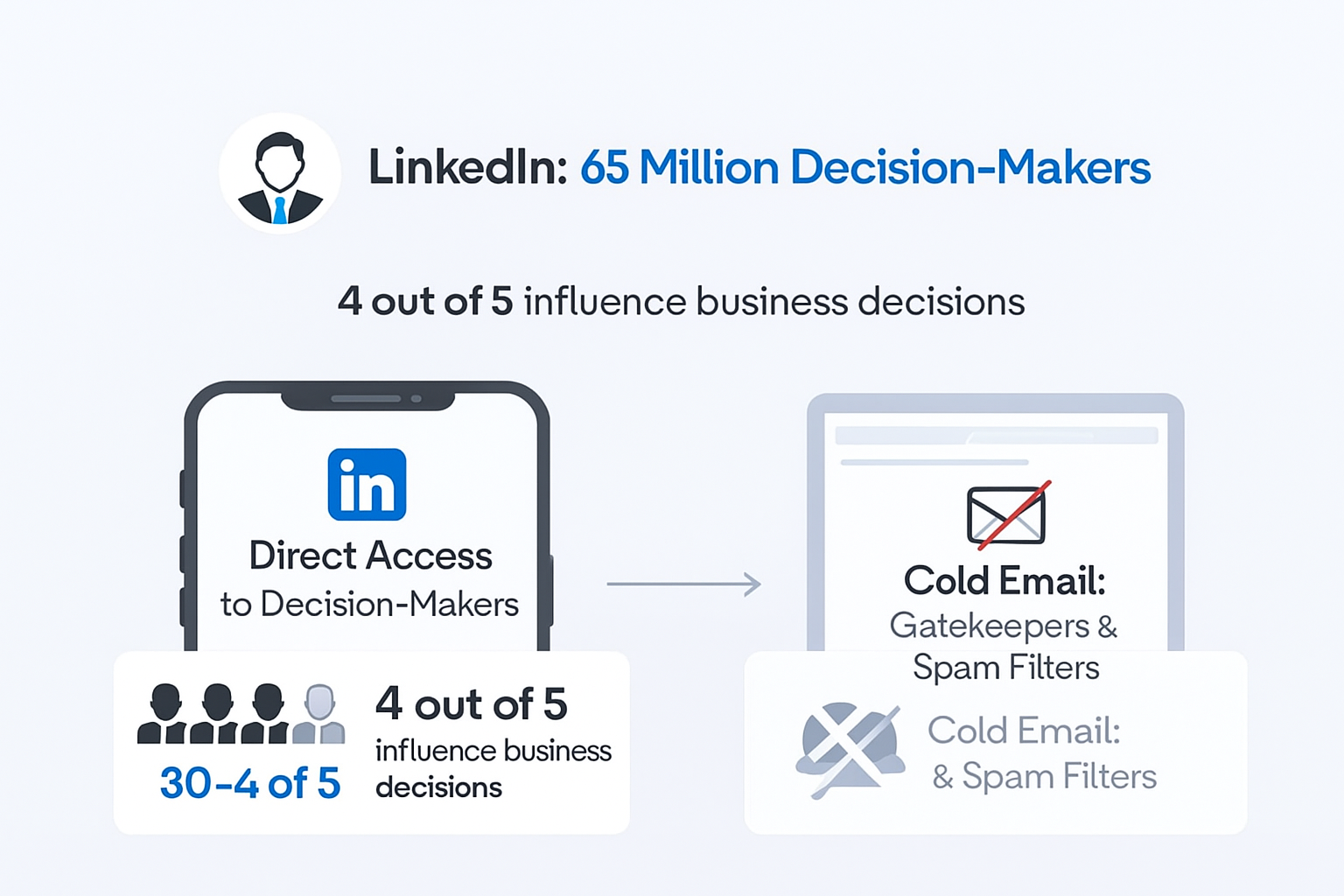
Compare that to cold email, where you’re hoping your message doesn’t get buried in someone’s spam folder. On LinkedIn, you have direct access to the exact people who can say “yes” to your offer.
The ROI Reality: Why Smart Businesses Choose LinkedIn
💰 Turn Statistics Into Strategy Meetings
We deliver 18-25% response rates reaching 65M+ decision-makers—complete targeting, campaign design, and scaling
Here’s where things get interesting.
Everyone complains that LinkedIn is expensive. And they’re right—LinkedIn ads have a median cost per lead of $75-$408. Cold email? Maybe $53. Facebook? Around $142.
But here’s the number that changes everything: LinkedIn delivers a 113% return on ad spend (ROAS). Google Search? 78%. Facebook? A measly 29%.

ranslation: For every dollar you spend on LinkedIn, you’re getting back more than double. The leads cost more because they’re worth more. They convert better. They close faster. They stick around longer.
85% of B2B marketers say LinkedIn delivers better value than Facebook or YouTube. And 40% rate it as the most effective channel for high-quality leads. This isn’t hype—it’s what actually works when you need revenue, not just traffic.
Conversion Rates: The Metrics That Actually Matter
Let’s talk about what happens after someone clicks your ad or sees your message.
LinkedIn’s Lead Gen Forms convert at 13%. That’s not a typo. Five times higher than the industry average of 2.35% for standard landing pages. Why? Because LinkedIn auto-fills the form with profile data. Less friction. Fewer clicks. More conversions.
The visit-to-lead conversion rate on LinkedIn? 2.74%. Facebook struggles at 0.77%. Twitter limps in at 0.69%. When you bring someone to LinkedIn, they’re 3-4x more likely to become a lead than on any other social platform.
And here’s the kicker: 89% of B2B marketers use LinkedIn for lead generation. If you’re not using it, you’re literally leaving money on the table while your competitors scoop it up.
The InMail Advantage: Response Rates That Actually Move the Needle
H1: 📈 We Generate 113% ROAS Daily
H2: Our clients get decision-maker meetings, not spam folders—complete done-for-you LinkedIn outbound engine
CTA: Book Strategy Meeting
Cold email is dying. Let’s just say it.
Average cold email response rates sit between 1-5%. Sometimes you’ll hit 8% if you’re really good. Open rates? They’ve collapsed from 36% to 27.7% year-over-year. And 17% of emails never even reach the inbox thanks to aggressive spam filters.
95% of cold emails generate zero engagement.
Now look at LinkedIn InMail: Response rates consistently hit 10-25%. Top performers? 18-25% response rates. You’re literally 5-10x more likely to get a reply compared to cold email.

The secret? LinkedIn InMail is guaranteed to be delivered. No spam folders. No domain reputation issues. No blacklists. The message lands in someone’s LinkedIn inbox and triggers a notification. They see it. They respond. It’s that simple.
For voice notes on LinkedIn? We’re seeing 30-40% response rates. Why? Because almost nobody does it. It’s a pattern interrupt. It shows you’re human. It works.
Social Selling: The Stats Behind Modern Prospecting

🎯 Stop Reading, Start Booking Meetings
We handle targeting, campaigns, and scaling—you focus on closing deals from qualified LinkedIn conversations
Here’s something most people miss: LinkedIn isn’t just for sending messages. It’s about building presence, trust, and relationships before you even reach out.
This is called social selling, and the numbers don’t lie:
- 78% of social sellers outsell their peers who don’t use social media
- Professionals with strong Social Selling Index (SSI) scores are 51% more likely to hit quota
- They create 45% more sales opportunities than those who ignore it
What does social selling look like? It’s engaging with prospects’ posts before you connect. It’s sharing valuable insights instead of just pitching. It’s building familiarity so when you finally send a message, you’re not a stranger—you’re someone they’ve seen before.
96% of B2B buyers research before engaging with sales, and 71% prefer doing it independently rather than talking to a rep. Your LinkedIn profile and content? That’s where they’re making their decision about you before you even know they exist.
The Multi-Channel Effect: Why Hybrid Approaches Win
🚀 287% Better Results Start Here
We combine LinkedIn and email outreach—complete multichannel strategy without the technical complexity or deliverability issues
Here’s the move that separates amateurs from pros: Don’t just use LinkedIn. Use LinkedIn and email together.
Multichannel outreach sequences that combine LinkedIn and email increase engagement by 287% compared to single-channel approaches. Let that sink in. Nearly three times the response.
The strategy? Start with a soft LinkedIn touch (view their profile, like a post), then send a connection request, follow up with InMail, and reinforce with email. Each touchpoint warms them up for the next one.
People need to see your name multiple times before they trust you enough to respond. LinkedIn makes that easy because you can engage without being “salesy.” You’re not a random cold emailer—you’re someone who’s part of their professional network.
Content That Converts: What Gets Attention on LinkedIn
Not all LinkedIn content is created equal. If you’re going to use content marketing to generate leads, here’s what actually performs:
Video content generates 3x more engagement than text posts. LinkedIn Live? Even better—7x more reactions and 24x more comments than standard video.
But here’s the nuance: Text posts still get the most interactions overall. Why? Because video requires commitment (turning on sound, watching). Text can be scanned in 10 seconds. Most busy professionals prefer it.
Best posting times? Tuesday, Wednesday, and Thursday between 8-11 AM or 4-5 PM. Avoid Mondays (everyone’s in meetings) and Fridays (everyone’s checked out). Messages under 300-400 characters get roughly 20% higher response rates than longer ones. Brevity wins.
The Premium Advantage: Why Paid Features Matter
Should you pay for LinkedIn Premium? Here’s what the data says:
There are 175 million Premium subscribers on LinkedIn—that’s one in five users. Premium subscriptions have increased by 50% in the past two years. People are paying because it works.
Why does Premium matter for lead generation? Unlimited profile views. InMail credits. Advanced search filters. You can find people who changed jobs in the last 90 days or posted in the last 30 days—signals that they’re active and open to conversations.
Think of it this way: Premium users are already investing in their careers. They’re more active, more engaged, more likely to respond. They’re also more likely to have budget authority because they’re serious about professional growth.
Cost vs. Value: The Real Economics of LinkedIn
Let’s be honest about pricing.
LinkedIn ads cost $6-$15+ per click. Google Ads? Around $2.69. It’s expensive. But remember the ROAS: 113% compared to Google’s 78% and Facebook’s 29%.
Cost per lead might be $75-$408, but those leads close at higher rates. The visit-to-lead conversion is 2.74%—nearly four times better than Facebook. You’re not paying for clicks. You’re paying for qualified conversations with people who can actually buy.
If you’re running a B2B business with an average deal size over $5,000, the economics make perfect sense. One closed deal pays for 50-100 leads. And because LinkedIn leads convert better, you need fewer of them to hit your revenue goals.
What These Statistics Mean for Your Strategy
Here’s the bottom line: LinkedIn works when you understand what the numbers are telling you.
High costs, high returns. LinkedIn isn’t for businesses that need thousands of cheap leads. It’s for businesses that need dozens of high-quality conversations with decision-makers.
Quality beats quantity. Would you rather send 1,000 cold emails and get 10 replies? Or send 100 LinkedIn InMails and get 20 responses from actual buyers? The math is obvious.
Multichannel is mandatory. Don’t abandon email. Use LinkedIn to warm up prospects, then follow up via email. The combined approach is 287% more effective than either channel alone.
Content matters. You can’t just spam connection requests. You need to be visible, valuable, and trustworthy. That means posting, engaging, and building a presence before you ask for anything.
Conclusion
LinkedIn lead generation isn’t about tricks or hacks. It’s about understanding the playing field.
The statistics are clear: LinkedIn has the decision-makers you need, the highest ROAS in B2B marketing, and response rates that blow cold email out of the water. 113% return on ad spend. 18-25% InMail response rates. 2.74% visit-to-lead conversion.
But here’s the catch: It costs more. Both in dollars and in effort. You can’t automate your way to success. You need to personalize. Engage. Build relationships.
If you’re serious about generating qualified pipeline, LinkedIn isn’t optional anymore. It’s the platform where your prospects are making decisions—about you, your competitors, and who they trust.
The question isn’t whether LinkedIn works. The question is whether you’re willing to do what it takes to make it work for you.
🚀 Advanced LinkedIn Targeting
Strategic demographic segmentation delivers personalized campaigns with systematic scaling approaches
7-day Free Trial |No Credit Card Needed.
FAQs
What is LinkedIn lead generation?
How do you generate leads on LinkedIn?
Is LinkedIn better than cold email for lead generation?
What's a good response rate for LinkedIn InMail?
Is the "Who's Viewed Your Profile" feature truly useful?
- blog
- Statistics
- LinkedIn Lead Generation Stats That Drive Real Results