That silent inbox after your perfectly crafted cold email? It’s not rejection—it’s opportunity waiting to be unlocked.
Most sales professionals send one cold email and wonder why their inbox stays empty. Here’s the reality: 80% of sales require at least five follow-ups to close, yet 44% of salespeople give up after just one attempt. This gap reveals a massive opportunity for those who understand the psychology behind persistent outreach.
Your first email isn’t a failure if it goes unanswered. It’s the opening act. The real magic happens in your follow-up sequence, where psychological principles transform you from a random stranger into a trusted voice worth responding to.
What Psychological Factors Make Cold Email Follow-ups Successful?
Understanding why people respond to follow-ups isn’t about sales tricks—it’s about leveraging fundamental human psychology. When you align your cold email campaign with how the brain actually works, you stop fighting for attention and start earning it.
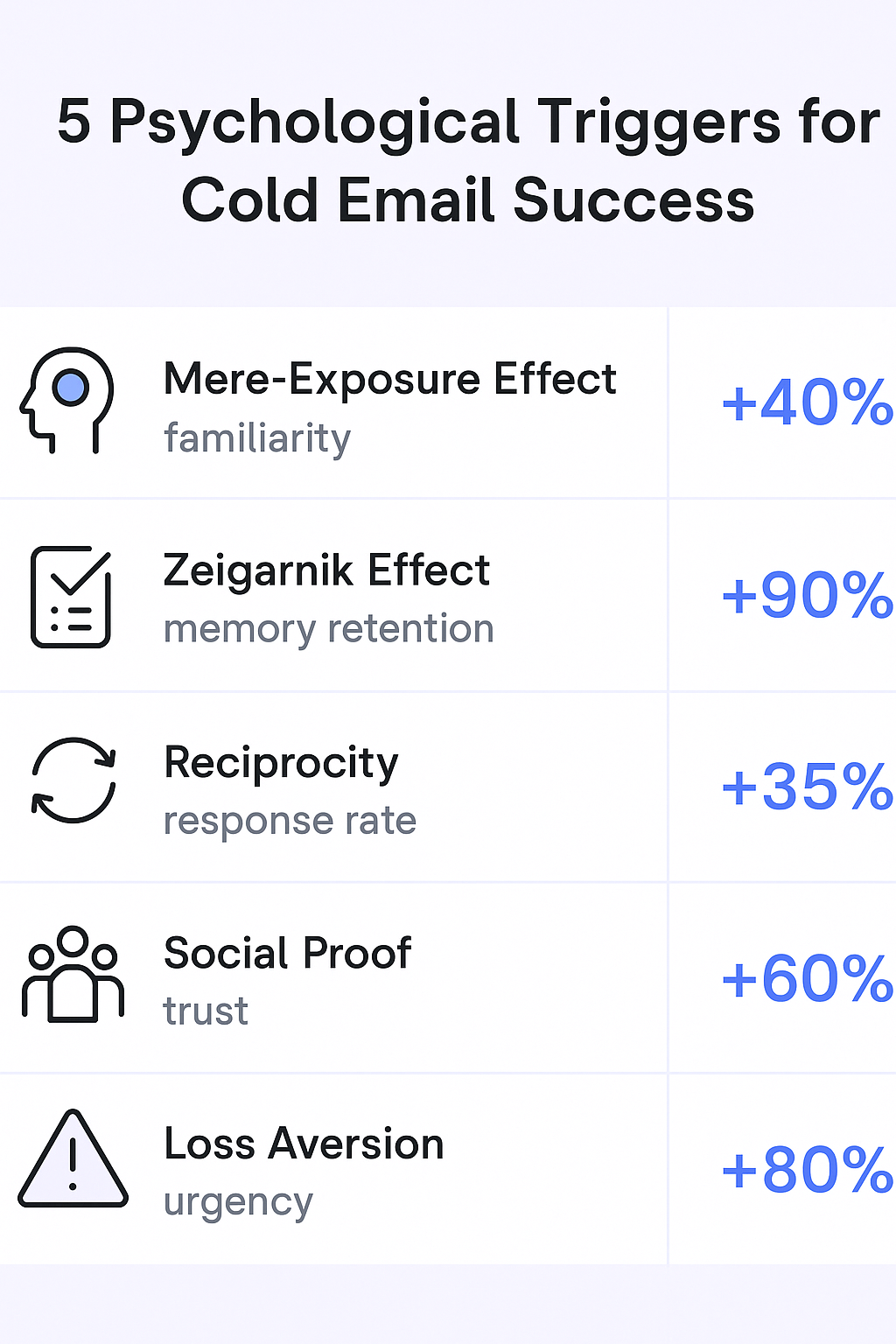
The Mere-Exposure Effect: Building Trust Through Familiarity
The Mere-Exposure Effect, discovered by psychologist Robert Zajonc, reveals a simple truth: people develop preferences for things they encounter repeatedly. Each time your name appears in someone’s inbox, it becomes more familiar and trustworthy.
Think about your favorite song—you probably didn’t love it on first listen. The same principle applies to cold emails. Your first message comes from a complete stranger. Your second creates recognition. By the third, you’ve graduated from “random email” to “familiar name.”
This psychological shift is crucial because familiarity breeds trust. When prospects see your name again, their brain processes it with less effort—a state called cognitive fluency. This ease of processing translates into positive feelings about you and your messag

How to Use Customer Psychology for Cold Email Follow-Up Success
Understanding the psychology is step one. Now let’s build a systematic approach that transforms these insights into replies and meetings.
The Strategic Follow-Up Sequence
Rather than random timing, each follow-up should serve a specific psychological purpose:
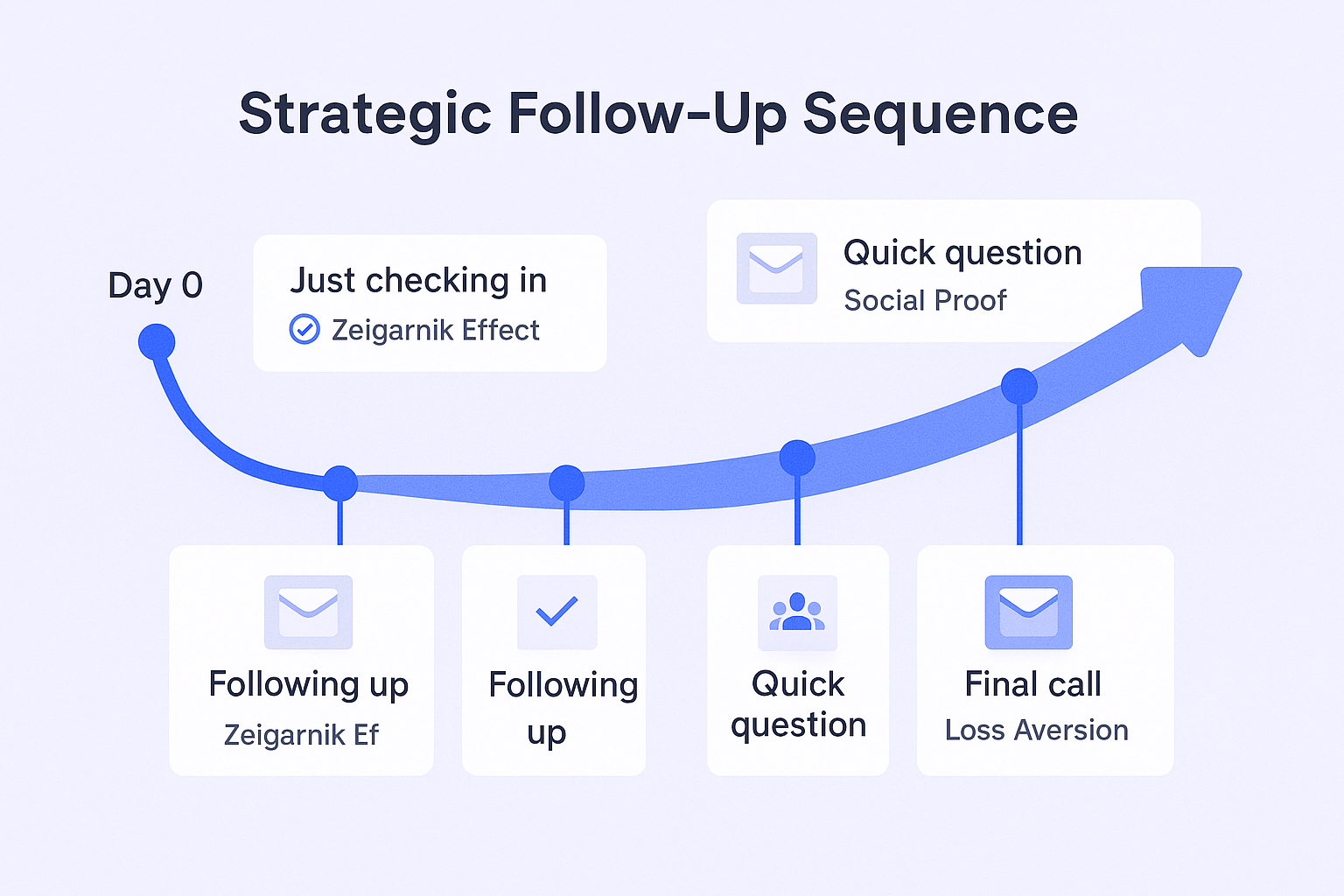
Email 1 (Day 0): The Open Loop
- Primary Trigger: Zeigarnik Effect
- Goal: Create compelling curiosity without revealing everything
- Example: Present a relevant problem and hint at a unique solution
Email 2 (Days 2-3): The Value Add
- Primary Trigger: Mere-Exposure + Reciprocity
- Goal: Build familiarity while providing unexpected value
- Example: Share a relevant insight or observation specific to their situation
Email 3 (Days 4-5): The Credibility Builder
- Primary Trigger: Social Proof
- Goal: Reduce risk through relevant success stories
- Example: Brief case study of similar company achieving specific results
Email 4 (Day 7): The Breakup
- Primary Trigger: Loss Aversion
- Goal: Create urgency through potential loss of opportunity
- Example: Politely state this is your final outreach
This sequence transforms random emails into a strategic psychological journey.
Follow-Up Templates That Actually Work
The Gentle Nudge (Follow-up #1)
Subject: Re: [Original Subject] OR Quick thought on [Their Goal]
Hi [Name],
Following up on my last email.
I was reading this article on [relevant topic] and thought of you, especially given [specific goal/challenge they mentioned]. This insight on page 3 particularly stood out.
No need to reply—just thought it might be useful for your next team meeting.
Best, [Your name]
Psychology at Play: The “no need to reply” removes pressure while the specific, relevant value triggers reciprocity. Your name appears again, building familiarity.
The Credibility Builder (Follow-up #2)
Subject: How [Similar Company] solved [Pain Point]
Hi [Name],
I know you’re busy, so I’ll be brief.
When I reached out last week about [pain point], I mentioned we help teams like yours with this challenge. We recently helped [Similar Company], also in [their industry], achieve [specific result].
There’s a one-paragraph summary of their approach here if you’re curious: [link]
Worth a quick look?
Best, [Your name]
Psychology at Play: Specific social proof answers the unspoken question “Has this worked for someone like me?” The quantified result makes your solution feel proven rather than experimental.
The Professional Breakup (Follow-up #3)
Subject: Permission to close your file?
Hi [Name],
I’ve reached out a few times about [goal/challenge] but haven’t heard back. This usually means either the timing isn’t right or this isn’t a current priority.
Either way, I won’t follow up again to respect your inbox.
I’ll leave you with this final thought: [one sentence about what they’re losing by maintaining status quo].
If you ever decide this is worth exploring, you know where to find me.
All the best, [Your name]
Psychology at Play: Loss aversion creates urgency while maintaining professionalism. Prospects often respond to avoid missing out on a potentially valuable solution.
Advanced Psychological Techniques
Pattern Interrupts in Subject Lines Break expected patterns to capture attention:
- Instead of “Following up on my email”
- Try “Quick question about [their specific challenge]”
Temporal Anchoring Reference specific timeframes to create urgency:
- “Most companies see results within 60 days”
- “The window for Q4 implementation is closing”
Cognitive Ease Make your emails scannable:
- Use bullet points for key information
- Keep paragraphs to 2-3 lines maximum
- Bold important phrases for easy scanning
Ready to Create More Effective Cold Email Follow-Ups?
The psychology behind effective follow-ups isn’t magic—it’s science. By understanding how the human brain processes familiarity, values reciprocity, seeks closure, trusts social proof, and fears loss, you can craft sequences that feel natural rather than pushy.
Your Action Plan
Stop “just checking in.” Every follow-up must offer new value or a fresh angle. If it doesn’t add something meaningful, don’t send it.
Plan your sequence strategically. Use the 4-step psychological framework: Open Loop → Add Value → Build Proof → Create Urgency. This brings purpose to every touchpoint.
Reframe around loss, not gain. Focus on what prospects are actively losing by maintaining their current situation, not just what they could gain by switching.
Personalize with precision. One highly relevant insight from 5 minutes of research outperforms any generic resource in psychological impact.
The Foundation That Makes Everything Work
Even the most psychologically sophisticated cold email followup strategy fails without one critical element: deliverability. The best follow-up sequence in the world is worthless if it lands in spam folders or bounces back entirely.
Email service providers like Gmail and Outlook use bounce rates as a primary signal for sender reputation. Anything above 5% damages your ability to reach inboxes. This is why starting with verified, accurate contact data isn’t just helpful—it’s essential for the psychology to work at all.
When your emails consistently reach the right inboxes, you can focus on what matters most: building relationships and starting valuable conversations through psychologically-informed outreach.
Other Useful Resources
To overcome the 80% requiring 5+ follow-ups and 44% giving-up-after-one challenge while achieving the 15-25% LinkedIn response rates without psychological complexity, explore these complementary resources:
Lead Generation & Email Tools (If Using Cold Email Psychology):
- Compare lead finder alternatives to avoid the 5% bounce rate threshold damaging sender reputation across multi-touch sequences
- Read lead finder reviews to evaluate prospecting tools supporting the 4-7 email optimal range without deliverability risks
LinkedIn Outbound Strategy (Superior to Cold Email Psychology):
- Master LinkedIn Sales Navigator integration with Salesforce for direct messaging eliminating the 2-3 day follow-up timing complexity
- Learn to cancel LinkedIn Sales Navigator if switching from the Mere-Exposure Effect and Zeigarnik Effect psychological frameworks
- Explore the LinkedIn Sales Navigator API for automation without crafting breakup emails or reciprocity triggers
- Discover how to remove a LinkedIn connection for relationship management beyond loss aversion tactics
- Leverage LinkedIn hiring statistics for targeting achieving results without social proof case study requirements
These resources help you achieve superior results without multi-touch psychology, spam folders, or the 5-8% cold email response ceiling.

