

Recruitment Referral Statistics: The Numbers Behind Your Best Hires
- Sophie Ricci
- Views : 28,543
Table of Contents
Recruitment Referral Statistics
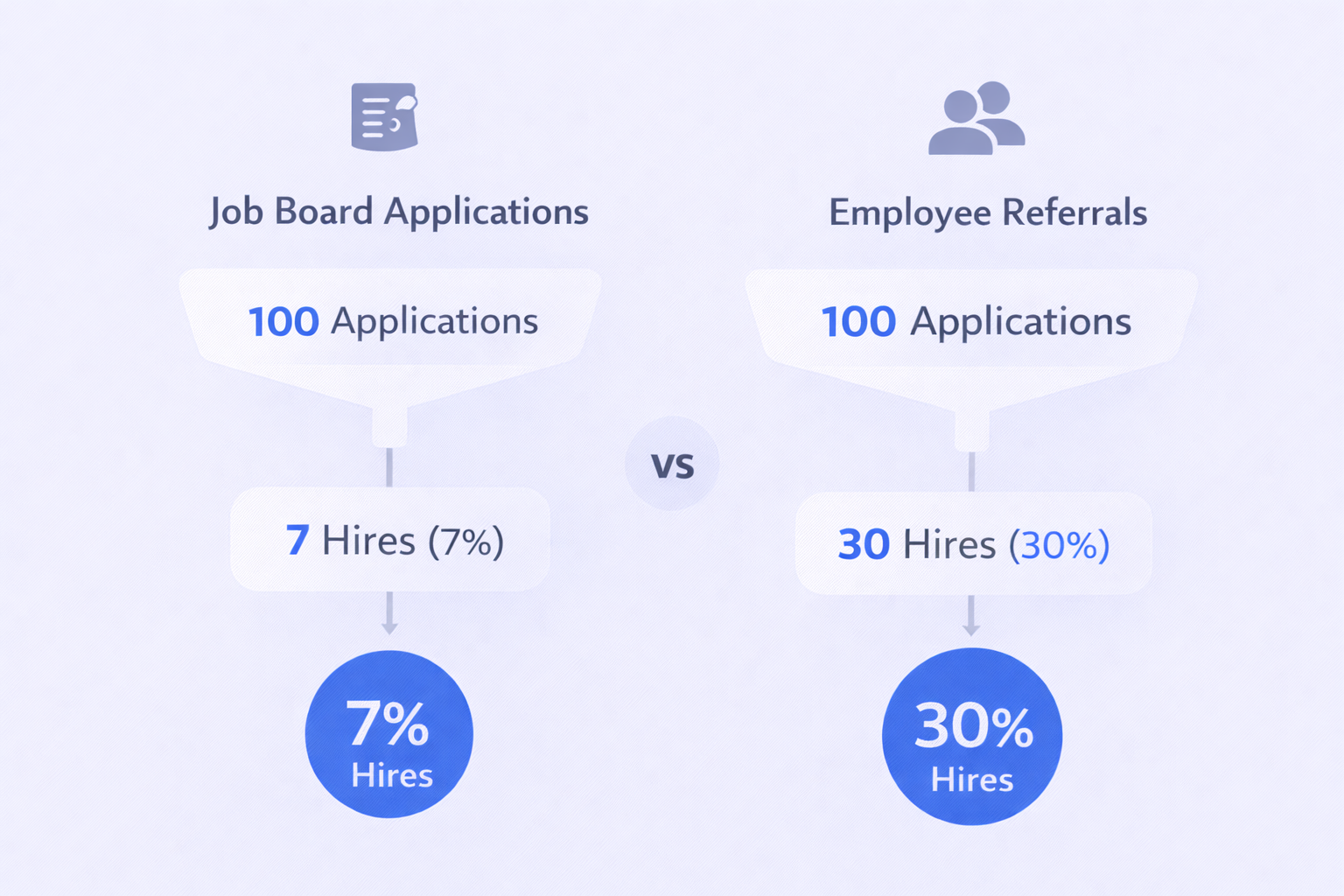
- Referred candidates hired 30% of time vs 7% for job board applicants – not slight edge but complete game-changer, same job posting and requirements but source multiplying success rate dramatically
- Referrals make up only 2-7% of applications but account for 30-50% of successful hires – massive disproportionate impact showing quality over quantity in talent acquisition effectiveness
- Referred candidate 4x more likely to receive job offer vs company website – for roles requiring specific expertise conversion advantage reaching up to 10x higher success rate
- Referred candidates move through hiring process in 29 days vs 44 days general applicants, 55 days job boards – speed advantage compounding in competitive markets, healthcare platforms reducing from 89 days to 21 days
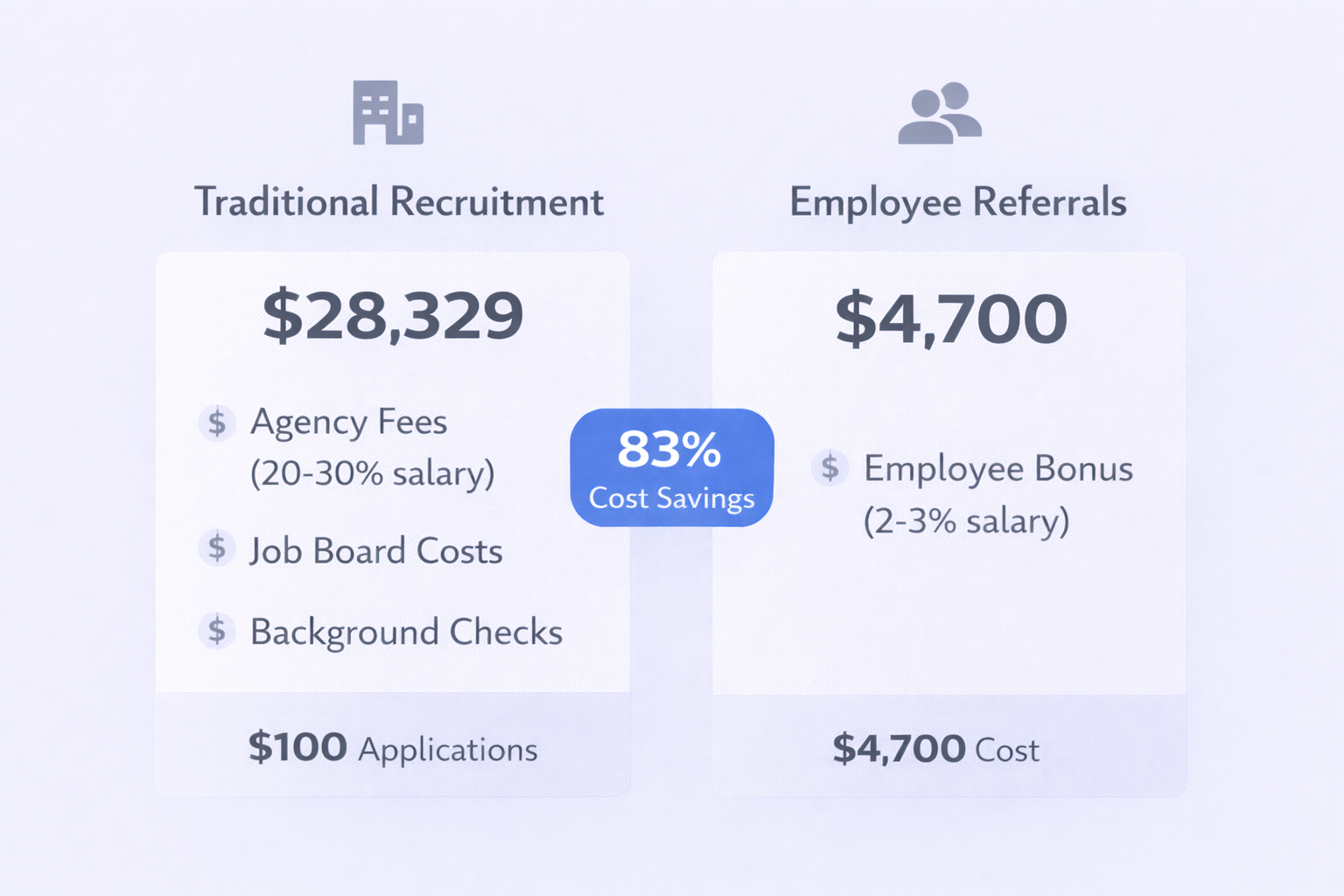
- Average cost-per-hire $4,700, executive roles $28,329 – factoring agency fees, extensive background checks, multiple interview rounds creating significant financial burden
- Referrals save $3,000-$7,500 per successful hire – dramatically slashing costs by leveraging internal networks instead of external recruiters charging 20-30% of annual salary
- Referral bonuses typically 2-3% of new hire’s yearly salary vs agencies 20-30% – primary expense being employee bonus rather than massive agency fees, premium listings, lead enrichment tools
- Referred employees generate 25% more profit vs traditional sources – some studies showing profit margins per referred employee increasing 24-135% depending on industry
- 33% increase in job performance for referred employees vs non-referred peers – not just adequate but top performers with built-in cultural understanding eliminating friction
- Referred employees: 46% retention after 1 year vs 33% job board, 14-22% career site – over 3 years 42-47% retention for referrals vs 14% career site hires, dramatic difference
- Replacing employee costs 1.5-2x annual salary – making retention directly translate to institutional knowledge, team stability, reduced turnover costs as most profitable strategy
- Only 6% of employees refer candidates solely for monetary reward – 35% referring to help friend find opportunities, 32% wanting to help company grow, 26% seeking professional recognition
- 75% of companies use automated systems managing entire referral lifecycle – reducing administrative workload by 45%, integrating with ATS for real-time pipeline visibility
- AI-powered screening + referrals can reduce time-to-hire by up to 75% – 47% of frontline employees learning about hiring needs through SMS making mobile-first platforms increasingly important
• 70% of organizations have formal diversity-focused referral initiatives by 2025 – companies like Intel offering double bonuses for referring women/minorities, internal networks contributing to 45% of diversity hiring in financial services
You’re looking at two candidates. Same skills, same experience. But one came through your employee’s network, and the other applied through a job board.
Which one would you bet on?
The data isn’t even close. Referred candidates get hired 30% of the time compared to just 7% for job board applicants. They stay longer, perform better, and cost less to hire.
If you’re serious about building a high-performing team, understanding recruitment referral statistics isn’t optional anymore. It’s the difference between spending months filling a role and having your next great hire walk through the door in weeks.
Let’s break down the numbers that matter.
Recruitment Referral Statistics
The Conversion Reality Check
Here’s what most hiring managers don’t realize: your current recruitment strategy is probably leaving money on the table.
Employee referral programs consistently outperform every other hiring channel. While referred candidates make up only 2-7% of total applications, they account for 30-50% of all successful hires. That’s not a slight edge—that’s a complete game-changer.
The conversion numbers tell the full story. A referred candidate is four times more likely to receive a job offer compared to someone applying through your company website. For roles requiring specific expertise, that conversion advantage can reach up to 10 times higher.
Think about that. Same job posting, same requirements, but the source of the candidate multiplies your success rate by 10x.
🎯 Target Decision-Makers Directly
LinkedIn outbound bypasses job boards and reaches passive talent
Speed Wins in Competitive Markets
Time-to-hire isn’t just an HR metric. Every day a position stays open, you’re losing pipeline, delaying projects, and watching competitors hire the talent you need.
Referred candidates move through your hiring process in an average of 29 days. Compare that to 44 days for general applicants or 55 days for job board candidates. In specialized industries like healthcare, some platforms have reduced hiring cycles from 89 days down to just 21 days using referral-focused strategies.
That speed advantage compounds. When you’re competing for top talent in tight markets, being able to make an offer 15-25 days faster than your competition isn’t just nice to have—it’s often the difference between landing someone and losing them.
The Real Cost of Hiring
Let’s talk money. The average cost-per-hire in 2025 sits at $4,700. For executive roles, that number climbs to $28,329 when you factor in agency fees, extensive background checks, and multiple interview rounds.
Employee referrals slash those costs dramatically. Companies save an average of $3,000 to $7,500 per successful hire by leveraging internal networks instead of external recruiters.
Here’s why: traditional recruitment relies heavily on agencies that charge 20-30% of the new hire’s annual salary. Job board ads, premium listings, and lead enrichment tools add up quickly. With referrals, your primary expense is the employee bonus—typically just 2-3% of the new hire’s yearly salary.

💰 Cut Recruitment Costs by 60%
Our complete campaign design eliminates expensive job boards and agencies
Performance and Profitability
The financial impact doesn’t stop at hiring costs. Referred employees generate 25% more profit for their organizations compared to hires from traditional sources. Some studies show profit margins per referred employee increasing by 24-135% depending on the industry.
Why the massive performance gap? Referred candidates enter your company with built-in cultural understanding. They know what to expect because someone they trust already works there. This insider knowledge eliminates the “cultural friction” that causes 90% of hiring failures.
The performance boost is measurable: referred employees show a 33% increase in job performance compared to non-referred peers. They’re not just adequate—they’re your top performers.
Retention That Actually Sticks
Here’s where employee referrals really separate from the pack.
Referred employees have a 46% retention rate after one year, compared to 33% for job board hires and only 14-22% for career site applicants. Over three years, those retention rates look even better: 42-47% for referrals versus 14% for career site hires.
Let’s put that in perspective. If you hire 10 people through your career site, only 1-2 will still be with you in three years. Hire through referrals? You’ll retain 4-5 of them.
That retention translates directly to institutional knowledge, team stability, and reduced turnover costs. When you consider that replacing an employee costs 1.5-2x their annual salary, keeping people around becomes your most profitable strategy.
📈 Scale Your Hiring Pipeline
Systematic targeting and automated follow-ups reach hundreds of candidates monthly
Industry-Specific Insights
Different industries see different results with referral programs, but the trend is universal: referrals outperform.
Technology: With a projected talent shortage of 85 million people by 2030, 88% of tech companies rely on employee referrals as their most vital hiring source. Average referral bonus: $5,000.
Healthcare: Facing a shortage of 18 million workers by 2030, healthcare organizations see 46% higher retention for referred hires in high-stress roles. Average bonus: $2,500.
Financial Services: Where 64% of firms struggle to find qualified talent, referred candidates are 55% more likely to stay long-term. Average bonus: $2,500.
Retail: In an industry where turnover exceeds 60%, referred candidates are 32% more likely to complete their first year. Average bonus: $500.
Manufacturing: 74% of manufacturers use integrated HR technology to manage internal referral pipelines. Average bonus: $1,000.
What Actually Motivates Referrals?
Here’s something most companies get wrong: they think bigger bonuses drive more referrals.
The data says otherwise. Only 6% of employees refer candidates solely for the monetary reward. So what actually drives referrals?
35% refer to help a friend find better opportunities. 32% want to help their company grow. 26% seek professional recognition and reputation building.
Smart companies combine employee referrals with data-driven prospecting using UpLead alternatives to build comprehensive talent pipelines that feed both internal networks and external outreach.
This means your referral “ask” needs to focus on company culture, team impact, and professional growth—not just the payout. Employees view referrals as personal endorsements. They’re staking their own reputation on the candidate they recommend.
Understanding this psychology changes how you schedule appointments with potential referrers and frame your internal campaigns.
🤝 Build Real Connections
Move beyond cold applications with warm LinkedIn introductions and referrals
7-day Free Trial |No Credit Card Needed.
The Technology Multiplier
Modern referral programs aren’t just about asking employees to forward job descriptions. 75% of companies now use automated systems to manage the entire referral lifecycle—from submission to tracking to bonus payout.
Conclusion
The numbers don’t lie. Recruitment referral programs aren’t just “nice to have”—they’re the most effective, cost-efficient, and performance-driven hiring strategy available in 2025.
Referred candidates get hired 30% of the time versus 7% for job boards. They’re hired 15 days faster, stay 70% longer, and generate 25% more profit for your organization. They cost $3,000-$7,500 less to acquire and perform 33% better than non-referred peers.
But here’s the reality: most companies still treat referrals as an afterthought. They post jobs, hope employees share them, and wonder why their referral pipeline stays empty.
The winners in 2025 will be the organizations that build systematic referral engines—combining employee engagement, technology automation, and strategic network expansion to create a continuous flow of high-quality candidates.
Your next great hire is probably one connection away. The question is: are you making it easy for them to find you?
These systems integrate with Applicant Tracking Systems (ATS) and reduce administrative workload by 45%. They ensure referrers get credit, candidates get prioritized, and hiring managers get real-time visibility into their referral pipeline.
AI-powered screening tools can reduce time-to-hire by up to 75% when combined with referral programs. 47% of frontline employees learn about hiring needs through SMS campaigns, making mobile-first referral platforms increasingly important.
For professionals building their networks through LinkedIn B2B marketing, these technology integrations mean referrals can be sourced, qualified, and submitted faster than ever.
Diversity Through Referrals
There’s a common concern: won’t referral programs just create echo chambers where everyone hires people who look and think like them?
Not if you design them correctly. By 2025, 70% of organizations have formal diversity-focused referral initiatives. Companies like Intel offer double bonuses for successfully referring women or minorities.
In financial services, internal networks already contribute to 45% of diversity hiring. Organizations with diverse referral pipelines experience 41% higher employee engagement rates because team members feel greater representation and belonging.
Making Referrals Work for Recent Grads
For professionals just entering the workforce, referral programs can feel inaccessible. After all, what if your network is small?
The truth is, even a LinkedIn title for recent graduates can open doors when combined with strategic networking. 82% of employers rate employee referrals as the best source for ROI, and that preference extends to entry-level roles.
Recent grads who actively build connections through industry groups, alumni networks, and professional associations create their own referral opportunities. The key is starting early and being systematic about relationship-building.
The Tuesday Pattern
Here’s an interesting operational detail: Tuesday is the most active day for employee referral submissions, with peak hours at 7 AM and 12 PM EST.
Why does this matter? If you’re running internal referral campaigns or using B2B prospecting tools to source candidates, timing your outreach for maximum visibility becomes crucial.
Organizations that align their referral program communications with these peak activity windows see significantly higher engagement rates.
FAQs
What are the top recruitment referral statistics for 2025?
How much do referral programs reduce hiring costs?
Do referred employees stay longer?
What motivates employees to refer candidates?
How fast are referred candidates hired?
- blog
- Statistics
- Recruitment Referral Statistics 2026 | Top Hiring Metrics