
Sales Development Conversion Statistics: 2026 Benchmarks That Drive Revenue Growth
- Sophie Ricci
- Views : 28,543
Table of Contents
Sales Development Conversion Statistics
- Call connect rates sit between 15-25%, meaning only 15-25 actual conversations happen per 100 dials made
- It takes an average of 18 dials just to connect with a single prospect in modern sales development
- Cold email open rates are around 53%, with highly targeted campaigns pushing this as high as 90%
- Most cold email campaigns see reply rates of just 1-5%, requiring 100 emails for just 1-5 responses
- Hyper-personalized subject lines boost open rates by 30%+ compared to generic subject lines
- Advanced personalization can more than double reply rates—from 7% to 17% when done properly
- Campaigns with 4-7 follow-up emails achieve a 27% reply rate, triple the 9% rate of campaigns with 1-3 touches
- Industry benchmark for lead-to-meeting conversion is 2-5%, with 4-10 meetings from 200 qualified leads
- About 80% of booked meetings actually happen, meaning a ~20% no-show rate is normal in sales development
- About 53% of meetings should convert to qualified opportunities that account executives accept and move forward
- 22% of opportunities sourced by sales development teams close as won deals, showing downstream impact
- Top performers contact an average of 10.1 people per opportunity, while average performers contact only 8.8
- 90% of high performers now use multi-threading, up from 83% just last year for engaging buying committees
- 60% of reps are now using AI tools, and 62% say it enhances their productivity significantly
- Poor data quality can kill 30-40% of emails before they even send due to bounce rates and deliverability issues
Perfect! I’ve now extracted statistics from all the articles you’ve shared. Would you like me to continue with more articles, or would you like me to compile all the statistics into a single organized document?
Introduction
Here’s the truth nobody talks about: most sales development teams are flying blind.
They make 50+ calls a day. Send dozens of emails. Book some meetings. But ask them what “good” actually looks like? Crickets.
The reality is harsh. Only 15-25% of your calls will even connect. Your cold emails? They’ll get opened 53% of the time, but only 1-5% will reply. And here’s the kicker—even when you book that meeting, 20% of prospects won’t show up.
Sound familiar?
But here’s the good news: top performers are crushing it. They’re exceeding quota. Booking quality meetings. Creating real pipeline. And the difference between them and everyone else? They know the numbers. They know what works. They optimize relentlessly.
In this guide, you’ll get the exact benchmarks that separate winners from everyone else. No fluff. No theory. Just the conversion rates, statistics, and insights you need to know if you’re ahead of the curve—or falling behind.
Let’s dive in.
The Sales Development Funnel: What Actually Matters
Before we get into the numbers, let’s get crystal clear on what we’re measuring. The typical funnel looks like this:
Activities → Connects → Meetings Booked → Meetings Held → Qualified Opportunities → Closed Deals
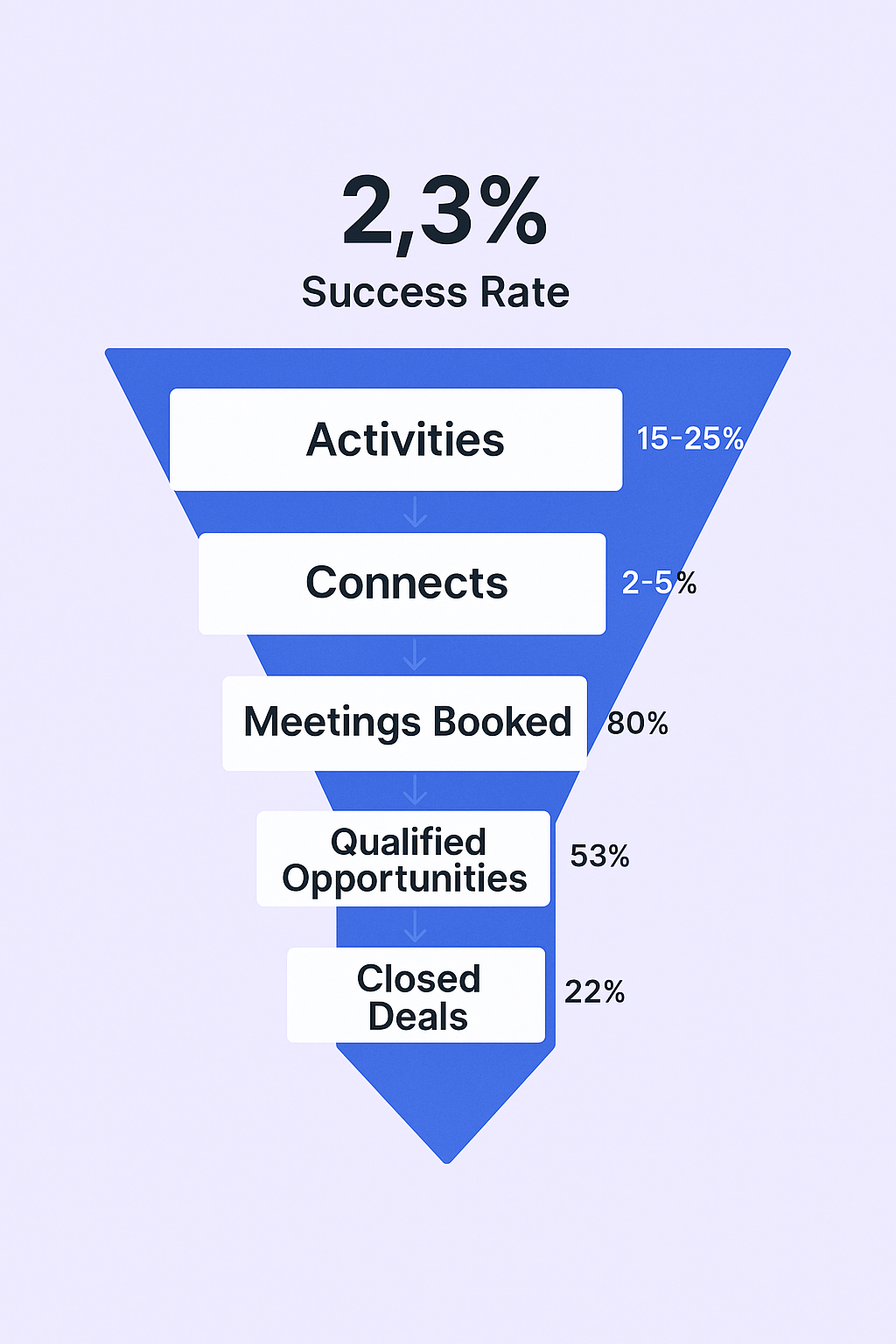
Each stage has its own conversion rates. Each stage reveals something different about your performance. And understanding this progression is how you diagnose what’s actually broken (or what’s working).
Now let’s break down the benchmarks for each stage.
Top-of-Funnel: The Volume Game
Call Connect Rates
Let’s start with the reality check: most of your calls won’t connect.
The industry standard for call connect rates sits between 15-25%. That means out of 100 dials, you’re looking at roughly 15-25 actual conversations with a decision-maker.
📞 Skip the 18-Dial Marathon
LinkedIn InMail gets 3x higher response rates than cold calls with zero dial frustration
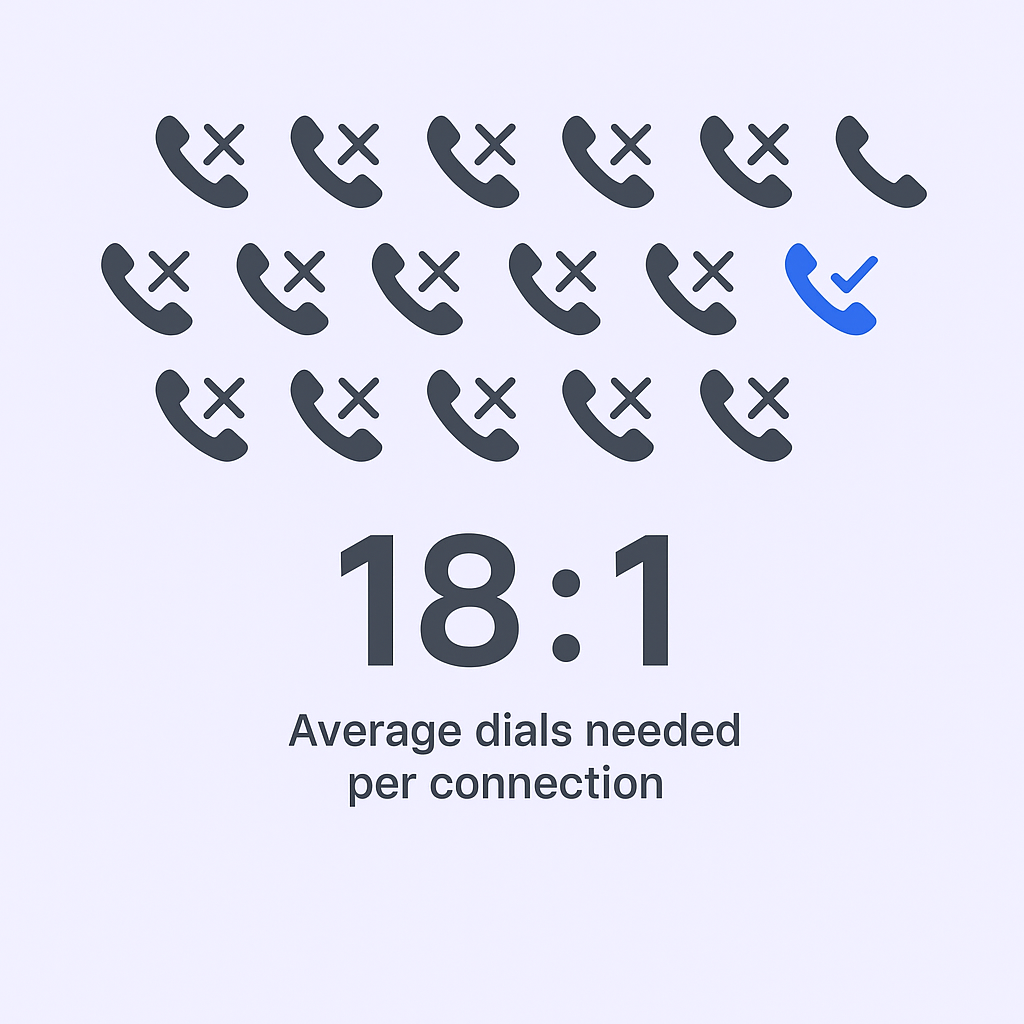
But here’s what makes this even harder: it takes an average of 18 dials just to connect with a single prospect. Yeah, you read that right.
What this means for you: If you’re making 65 calls a day (a common benchmark), you should expect 10-16 meaningful conversations. Not calls answered. Not voicemails. Actual conversations where information is exchanged.
Email Open and Reply Rates
Cold email is a different beast. The good news? Open rates are relatively strong at around 53%. With highly targeted campaigns, you can push this as high as 90%.
The bad news? Getting a reply is brutally hard.
Most cold email campaigns see reply rates of just 1-5%. That’s 1-5 responses for every 100 emails sent. Ouch.
💬 Double Your Reply Rates
Our LinkedIn targeting and personalization framework consistently achieves 8-12% response rates across industries
But here’s where strategy enters the game:
- Hyper-personalized subject lines boost open rates by 30%+
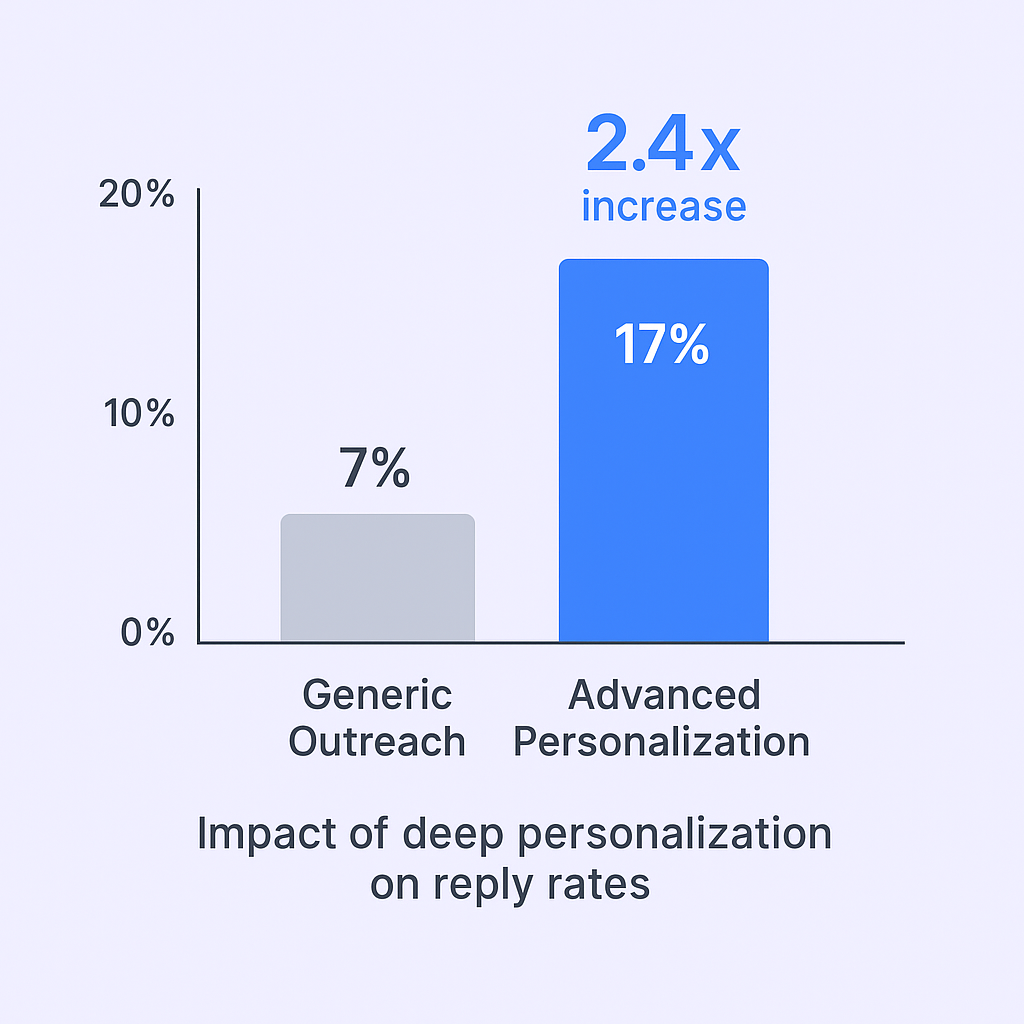
- Advanced personalization (beyond just {{FirstName}}) can more than double your reply rate—from 7% to 17%
- Follow-up sequences work: Campaigns with 4-7 follow-up emails achieve a 27% reply rate, triple the 9% rate of campaigns with only 1-3 touches
The takeaway? Volume without strategy is just noise. Personalization and strategic follow-up are what separate average from exceptional.
Mid-Funnel: From Conversation to Calendar
Lead-to-Meeting Conversion
This is the big one. After all your activity, how many leads actually turn into meetings?
Industry benchmark: 2-5%.
Let me put that in perspective. If you’re working 200 qualified leads through your sequence, you should be booking 4-10 meetings.
🎯 Get 8-15% Meeting Conversion
LinkedIn’s precision targeting eliminates data quality issues and connects you with verified decision-makers
Text #4
Below 2%? You likely have a data quality problem, messaging problem, or targeting problem.
Above 5%? You’re either crushing it, or your definition of “qualified” is too loose.
Meeting Show-Up Rate
You booked the meeting. High five! But don’t celebrate yet.
On average, about 80% of booked meetings actually happen. That means ~20% no-show rate is normal.
If your no-show rate is higher than 20%, look at:
- How you’re qualifying prospects during the initial conversation
- The value proposition you’re setting for the meeting
- Your confirmation and reminder process
The brutal truth? If someone doesn’t show up, they probably weren’t that interested in the first place. Better qualification at the top saves everyone time.
Bottom-of-Funnel: Turning Meetings into Pipeline
Meeting-to-Qualified-Opportunity Rate
So the meeting happened. Great! But was it valuable?
The benchmark: About 53% of meetings should convert to qualified opportunities that your account executives accept and move forward with.
Translation: Roughly 1 in 2 meetings you book should be real, actionable opportunities.
If your meeting-to-SQL rate is lower than 50%, you’re either:
- Booking meetings with the wrong people
- Not qualifying properly during your first conversation
- Over-promising what the meeting will deliver
Opportunity-to-Closed-Won Rate
Here’s where we see the downstream impact of quality top-of-funnel work.
22% of opportunities sourced by sales development teams close as won deals.
Think about that. More than 1 in 5 opportunities you create will actually drive revenue growth for your company.
This stat proves something critical: the quality of work at the very beginning of the funnel directly impacts what comes out at the end. Good prospecting and proper qualification isn’t just about hitting activity numbers—it’s about creating real business value.
What Separates Elite Performers from Average Reps
Okay, so now you know the benchmarks. But what about the top 10%? What are they doing differently?
They Multi-Thread Everything
Here’s the game-changer: top performers contact an average of 10.1 people per opportunity. Average performers? Only 8.8 contacts per opportunity.
That might not sound like a huge difference, but it is. Here’s why:
Modern business development isn’t about finding “the decision-maker.” It’s about engaging multiple stakeholders within an account. Because most buying decisions involve 3-5 decision-makers.
🔗 Master Multi-Threading on LinkedIn ]
Our campaign design identifies and engages all buying committee members in one coordinated outbound motion
7-day Free Trial |No Credit Card Needed.
90% of high performers now use multi-threading, up from 83% just last year. They’re not betting everything on a single contact. They’re building relationships across the buying committee.
Bottom line: Stop single-threading. Go wide to go deep.
They Use AI as a Co-Pilot, Not a Replacement
Forget the hype. AI isn’t replacing sales development teams. It’s making the best ones even better.
60% of reps are now using AI tools, and 62% say it enhances their productivity.
But here’s the key: elite performers aren’t using AI to replace human work. They’re using it to eliminate low-value tasks:
- Drafting initial emails
- Transcribing calls
- Auto-logging activity
This frees them up for the high-value work that actually requires a human: deep research, genuine personalization, and strategic conversations.
The future belongs to reps who embrace AI and machine learning as productivity multipliers, not those who resist it.
They Lead with Value, Not a Pitch
Let’s be real: nobody wants another sales pitch in their inbox.
Top performers get this. They don’t open with “I’d love to show you our product.” They lead with:
- Relevant insights about the prospect’s industry
- A pain point they’ve identified through research
- A specific example of how they’ve helped similar companies
They sell the meeting, not the solution. The goal isn’t to close a deal on the first call—it’s to earn 20 minutes of the prospect’s time by proving you’re worth listening to.
Your Playbook: How to Actually Improve These Numbers
Knowing the benchmarks is step one. Improving them is step two. Here’s what actually works:
Fix Your Data First
Before you optimize anything else, fix your data quality.
Poor data can kill 30-40% of your emails before they even send (bounce rates). In one case study, a team switched to a better data provider and saw their deliverability jump from 65% to 96%. That change alone let them book 5x more demos.
High-quality, verified email addresses are the foundation everything else is built on. Don’t skip this step.
Build Multi-Touch Sequences
Single touchpoints don’t work. Period.
Remember: campaigns with 4-7 follow-up touches get 3x the reply rate of campaigns with only 1-3 touches.
Your sequence should include:
- Multiple emails (spaced appropriately)
- Phone calls
- LinkedIn touches
- Value-driven content
Orchestrate these across channels. Create multiple impressions. Be persistent (but not annoying).
Personalize Beyond {{FirstName}}
Basic mail merge doesn’t cut it anymore.
Advanced personalization—using specific, researched details about a prospect or their company—can more than double your reply rates (from 7% to 17%).
This means:
- Reference a recent company announcement
- Mention a mutual connection
- Call out a specific challenge you noticed
- Share a relevant case study from their industry
Yes, this takes more time. But the conversion rates speak for themselves.
Qualify Ruthlessly
Not every response needs to become a meeting. Be selective.
Use a qualification framework (like BANT: Budget, Authority, Need, Timing) to assess if a prospect is actually worth your team’s time.
Better qualification at the top = higher meeting-to-SQL conversion rates = less wasted time for everyone.
Conclusion: Turn Data into Your Competitive Advantage
Here’s what matters: every number in this guide represents a decision point.
When you know that 15-25% call connect rate is normal, you stop panicking when most calls don’t pick up. When you know that 2-5% lead-to-meeting is the benchmark, you can properly evaluate if your team is performing or underperforming.
But more importantly, you now know what the top performers are doing differently:
- They’re contacting 10+ people per account
- They’re using AI to eliminate busywork
- They’re leading with value, not pitches
- They’re obsessed with data quality
The teams that stay ahead of the curve aren’t just working harder—they’re working smarter. They’re measuring what matters. They’re learning from the benchmarks. They’re optimizing relentlessly.
Want to improve your conversion rates? Start with the foundation. Get high-quality data. Build smarter sequences. Personalize deeply. Qualify properly.
Because in business development, knowing the numbers isn’t enough. You have to act on them.
Other Useful Resources
To understand how to systematically achieve top-performer conversion rates through LinkedIn outbound eliminating cold calling’s 18-dial burden, explore these resources:
Data Quality & Deliverability:
- Compare Glockapps alternative options for email deliverability monitoring preventing 30-40% bounce rate losses
- Compare UpLead alternatives understanding data solutions jumping deliverability from 65% to 96%
Lead Generation Infrastructure:
- Review lead generation companies USA understanding outsourced alternatives to in-house conversion challenges
LinkedIn Workflows:
- Learn LinkedIn Sales Navigator export leads for systematic prospect management across 10+ contacts per opportunity
- Understand LinkedIn Sales Navigator cancel for platform management decisions
- Review LinkedIn graduation post for content engagement fundamentals
Platform Intelligence:
- Review LinkedIn learning usage statistics showing platform professional development engagement
BDR conversion statistics document the systematic efficiency crisis across every funnel stage—15-25% call connect rates requiring 18 dials per prospect connection, 53% email opens collapsing to brutal 1-5% reply rates, 2-5% lead-to-meeting conversion benchmark, 20% meeting no-shows reducing 80% show rate, 53% meeting-to-qualified-opportunity progression, and 22% opportunity-to-closed-won revealing compound funnel leakage where poor data kills 30-40% of emails before sending and each stage attrition prevents most teams from generating consistent pipeline. The optimization opportunities documented prove difficult to execute: advanced personalization delivers 7% to 17% reply rate doubling yet requires deep research most reps making 40-80 calls + 25-65 emails daily lack bandwidth for, 4-7 follow-up sequences achieve 27% reply (3x the 9% from 1-3 touches) yet orchestrating multi-channel coordination challenges teams, hyper-personalized subject lines boost opens 30%+ yet systematic application remains inconsistent, and 90% of high performers multi-thread (contacting 10.1 people per opportunity versus 8.8 average) engaging buying committees yet identifying and coordinating outreach across all stakeholders demands infrastructure most teams executing single-threaded approaches cannot implement. AI adoption addresses some challenges (60% of reps use AI, 62% report enhanced productivity eliminating low-value tasks like drafting emails, transcribing calls, auto-logging activity) yet conversion improvements require quality data foundation—sophisticated AI sending perfectly crafted emails to bad data just automates failure with deliverability jumping from 65% to 96% through better providers enabling 5x more demo bookings proving data quality as conversion multiplier not AI sophistication alone. The multi-stage funnel complexity compounds execution burden: maintaining 15-25% connect rates through 18-dial persistence, achieving 1-5% reply rates through advanced personalization beyond {{FirstName}}, converting 2-5% leads to meetings through value-not-pitch messaging, managing 20% no-shows through qualification and confirmation processes, progressing 53% meetings to qualified opportunities through proper BANT framework application, and ultimately closing 22% of opportunities through quality top-of-funnel work creating downstream revenue—all while coordinating multi-channel sequences (email + phone + LinkedIn), multi-threading 10+ contacts per account, leveraging AI for productivity multiplication, and maintaining data quality preventing 30-40% bounce losses requires systematic infrastructure most teams flying blind without benchmark knowledge cannot execute consistently. The article’s repeated banner positioning addresses the fundamental conversion solution: “Beat Industry Benchmarks With LinkedIn” achieving 3-5x higher conversion than cold calling, “Skip the 18-Dial Marathon” getting 3x higher response than cold calls with zero dial frustration, “Double Your Reply Rates” achieving 8-12% response through targeting and personalization, “Get 8-15% Meeting Conversion” through precision targeting eliminating data quality issues, and “Master Multi-Threading on LinkedIn” engaging all buying committee members coordinately. Our complete LinkedIn outbound system eliminates the conversion crisis systematically—delivering 15-25% response rates through done-for-you targeting, campaign design, and scaling that achieves 3-5x better conversion than cold calling’s 18-dial 15-25% connect burden, doubles reply rates to 8-12% versus email’s 1-5% baseline through native LinkedIn personalization accessing profiles/activity/connections, converts 8-15% to meetings versus 2-5% industry benchmark through verified decision-maker targeting eliminating data quality issues causing 30-40% bounce losses, maintains 80%+ show rates through pre-qualified prospect engagement, progresses meetings to opportunities systematically through built-in context, and multi-threads 10+ stakeholders per account automatically through campaign design rather than requiring manual coordination preventing the compound funnel leakage (18 dials → 15-25% connects → 1-5% replies → 2-5% meetings → 20% no-shows → 53% opportunities → 22% closed) documented throughout conversion statistics where even perfect optimization of each stage still battles cold calling inefficiency, email reply rates, data quality battles, no-show waste, qualification gaps, and single-threading limitations preventing most teams from achieving top-performer benchmarks (10.1 contacts per opportunity, 90% multi-threading, AI-enhanced productivity, advanced personalization, 4-7 touch sequences, quality-over-volume focus) through systematic execution converting conversion knowledge into actual pipeline generation and revenue growth eliminating the flying-blind activity without benchmark optimization preventing consistent performance across entire sales development funnel from initial outreach through closed-won deals.
FAQs
What's a good conversion rate from leads to meetings?
How many calls and emails should reps make per day?
What's the most important metric to track?
How can I improve my email reply rates?
Is multi-threading really that important?

- blog
- Cold Emailing
- Sales Development Conversion Stats: 2025 Benchmarks
