

You’re staring at another quarter where your pipeline looks emptier than you’d like. Your team is burning out on manual prospecting. You’ve heard about SalesHive, but here’s the real question: Is it actually worth the $4,000 to $12,000 monthly price tag?
Here’s what’s happening in 2026: sales quotas jumped 37% over the past two years, but quota attainment is stuck at 50%. The gap between what companies expect and what teams deliver has never been wider.
This SalesHive review cuts through the marketing fluff. We’ll cover what they actually do, what it costs, how their deliverability stacks up, and whether you should write that check—or look at alternatives that might work better for your situation.
SalesHive Review
What SalesHive Actually Does
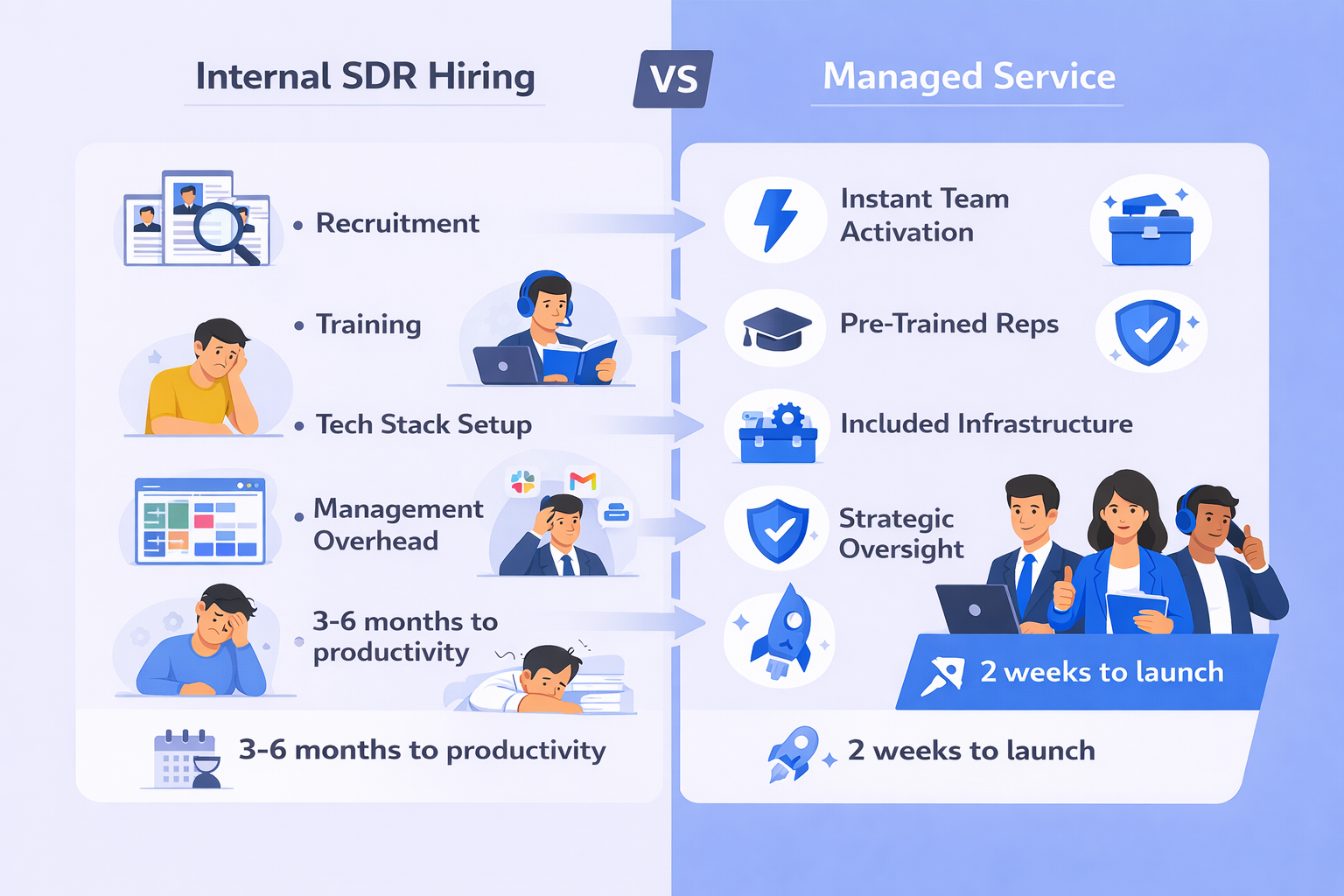
SalesHive isn’t software you buy and manage yourself. It’s a managed service that handles your entire outbound sales operation.
Think of it like this: instead of hiring, training, and managing SDRs internally, SalesHive provides dedicated reps who work your campaigns. They handle the tech stack, the domain setup, the scripts, the follow-ups—everything.
Here’s what you get:
- Dedicated SDRs (either US-based or Philippines-based)
- Proprietary AI personalization engine (called “eMod”)
- Email deliverability infrastructure (MaxBox system)
- Power dialer for cold calling
- CRM integration and activity tracking
- US-based strategist managing your account
The model is “Revenue as a Service.” You’re essentially renting a fully-equipped prospecting team without the hiring headaches.
The Technical Infrastructure That Actually Matters
Let’s talk about what separates a legitimate managed service from a glorified call center.
The Deliverability Problem
In 2026, getting emails into inboxes is harder than ever. Industry averages show 85-95% deliverability, but one wrong move tanks your domain reputation for months.
SalesHive’s MaxBox system addresses this through:
Lookalike Domain Deployment – They don’t send from your main company domain. They set up lookalike domains that redirect to your site, creating a firewall between prospecting and your internal communications.
The SHWARMING Protocol – Before any campaign launches, new domains undergo “warming.” They send thousands of emails to internal seed lists to build sender reputation. This can improve inbox placement by 5-10 percentage points.
Authentication Guardrails – Strict SPF, DKIM, and DMARC policies ensure major email providers (Google, Microsoft) recognize the domain as legitimate.
Volume Throttling – The system prevents the sudden traffic spikes that trigger spam filters.
Why this matters: 71% of ignored B2B emails lack relevance. But if your emails never reach the inbox, relevance doesn’t matter.
The eMod Personalization Engine
Generic templates are dead. Decision-makers receive an average of 15 cold emails per week. Standing out requires personalization—not just first name tokens, but actual research.
SalesHive’s eMod AI researches individual prospects and companies to rewrite templates. The result? Open rates around 68% compared to industry averages of 15-25%.
The system pulls company news, pain points, and recent initiatives to make each email feel handwritten. It’s not perfect, but it’s miles ahead of “Hi {First Name}, I noticed your company…” templates.

Cold Calling Infrastructure
For teams that need voice outreach, SalesHive provides a Power Dialer platform.
Industry baseline: Most manual dialers hit 50-100 calls per day.
SalesHive capacity: 150-500+ touches per day depending on the tier.
When a call connects, the AI displays relevant company news and pain points to the rep. This matters because the average live B2B call lasts 93 seconds. You need to make those seconds count.
The system maximizes live conversation volume, which is critical for appointment setting at scale.
US-Based vs Philippines-Based SDRs
SalesHive offers two personnel tiers, and your choice significantly impacts both cost and campaign resonance.
US-Based SDRs:
- Trained on US-market persuasion tactics
- Better for senior executive outreach
- Stronger cultural alignment for North American campaigns
- Higher monthly cost
Philippines-Based SDRs:
- Optimized for high-volume outreach
- Budget-efficient for early-stage companies
- Managed by US-based strategists
- Lower monthly cost
The reality: offshore reps can be excellent when properly trained and managed. The key differentiator is the quality of their US-based strategic oversight.
Pricing Breakdown: What You Actually Pay
SalesHive uses flat-rate monthly pricing, not pay-per-meeting. Here’s why that matters.
Pay-per-meeting models sound low-risk, but they incentivize quantity over quality. Reps book unqualified meetings just to hit targets.
Flat-rate models align the agency’s success with yours. They want to book meetings that actually close.
2026 Pricing Tiers:
Package | US-Based Monthly | Philippines Monthly | What You Get |
Starter | $6,300-$7,000 | $4,000-$4,500 | 1 SDR, Phone, 150+ touches/day |
Growth | $7,200-$8,000 | $4,500-$5,000 | 1 SDR, Phone + Email, 250+ touches/day, eMod AI |
Crush | $10,800-$12,000 | $6,500-$7,000 | 2 SDRs, Phone + Email, 500+ touches/day, eMod AI |
Risk-Free Onboarding: No billing until you approve the final strategy and lead lists. This protects you during the initial setup phase.
The Real Cost Comparison
Let’s talk about what an internal SDR actually costs versus a managed service.
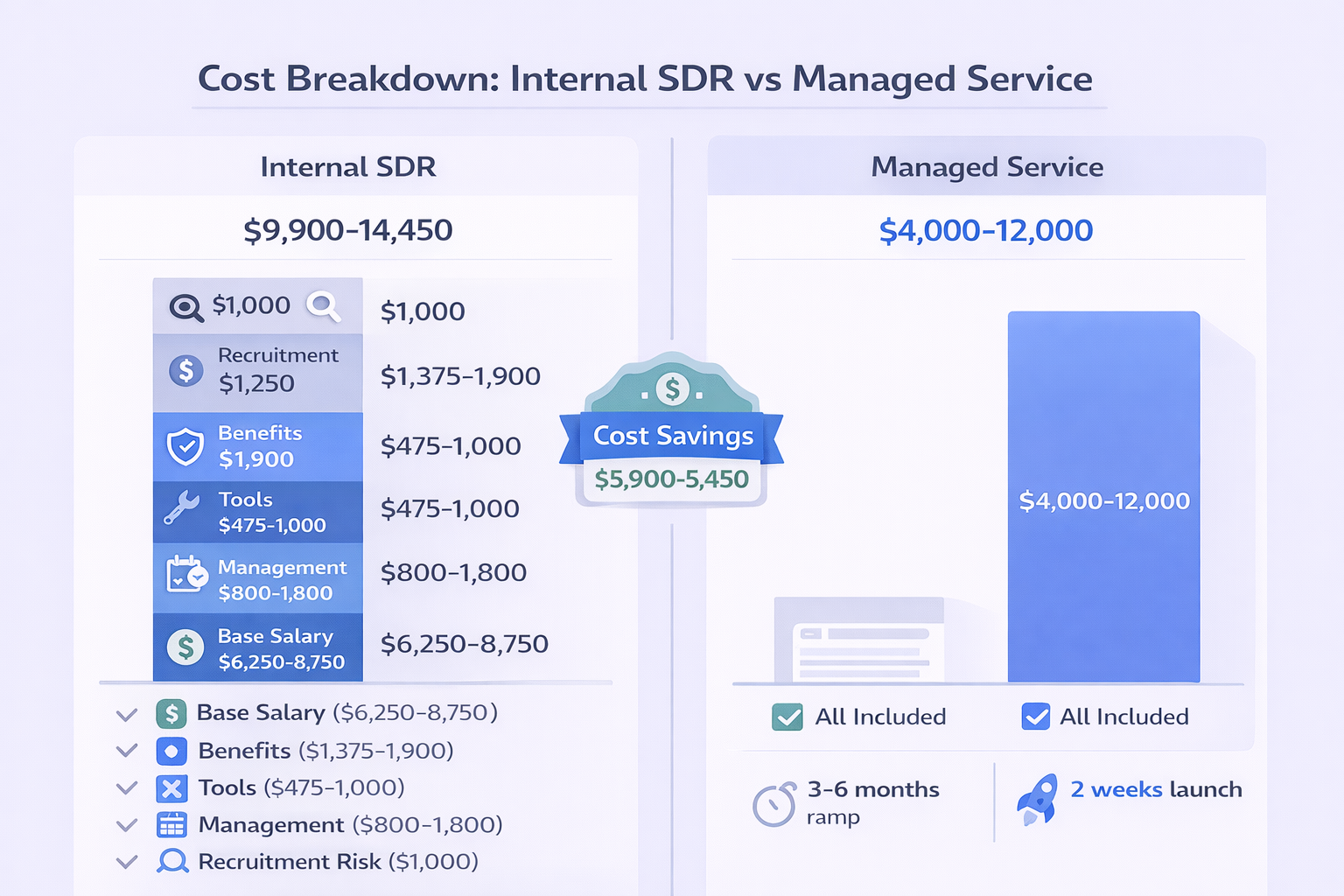
Monthly Cost of Internal SDR (2026 Averages):
- Cash compensation: $6,250-$8,750
- Employer taxes & benefits: $1,375-$1,900
- Tool stack (CRM, ZoomInfo, etc.): $475-$1,000
- Management time: $800-$1,800
- Recruitment & severance risk: ~$1,000 (amortized)
Total: $9,900-$14,450 per month
And here’s the kicker: the average SDR tenure is 11 months, with 3-4 months ramp time. You get about 7 months of productive output before starting over.
SalesHive’s model: $4,000-$12,000 monthly, with 2-week launch time and no recruitment risk.
Cost per held meeting:
- Internal SDR: ~$1,000
- SalesHive: $375-$600
The speed-to-market advantage alone justifies the cost for many companies.
How SalesHive Compares to Alternatives
The competitive landscape breaks into three categories: data providers, automation software, and other managed services.
vs Data Providers (ZoomInfo, Apollo, UpLead, Wiza)
Platforms like ZoomInfo give you access to contact data, but you still need to write campaigns, manage domains, and execute outreach. SalesHive consumes this data as part of their managed service.
Platform | Primary Use | Lead Accuracy | Pricing Model |
ZoomInfo | Enterprise database | 75-85% | Custom quotes ($15k+) |
Apollo | SMB database + sequencing | 65-80% | Monthly per-user |
UpLead | Real-time verification | 95% guarantee | Credit-based |
SalesHive | Managed SDR teams | Waterfall verification | Flat monthly per rep |
The difference: data providers require internal execution. SalesHive provides both data and execution.
vs Automation Platforms (Woodpecker, SalesHandy, Snov.io, GrowMeOrganic)
Email automation tools like Woodpecker and SalesHandy let you send campaigns at scale. But you’re still responsible for strategy, copywriting, and deliverability management.
GrowMeOrganic positions itself as an affordable option for startups, but G2 reviews note significant issues with data accuracy and platform stability.
SalesHive’s pitch: they’re the “professional upgrade” to DIY tools where strategy is handled by experienced professionals.

