- blog
- Statistics
- SDR Conversion Rate Statistics 2025
SDR Conversion Rate Statistics: The Real Numbers Behind Sales Success in 2025
Table of Contents
SDR Conversion Rate Statistics
✅ Sales Performance – Win rates, quota attainment, forecasting, pipeline metrics ✅ Outreach & Prospecting – Cold email, cold calling, response rates, conversion rates ✅ Lead Generation – MQL to SQL conversion, lead qualification, response time ✅ Compensation – BDR/SDR/AE pay structures, OTE benchmarks, commission models ✅ Sales Development – Activity metrics, productivity, ramp-up time, turnover ✅ Email Marketing – Open rates, reply rates, deliverability, personalization impact ✅ Technology & AI – CRM adoption, automation, AI tools, productivity gains ✅ LinkedIn – Boolean search, platform statistics, outreach strategies ✅ B2B Marketing – ROI, attribution, enablement, content effectiveness ✅ Ecommerce – Market size, mobile commerce, conversion rates ✅ SEO & AI – Search optimization, content creation, AI adoption
What You Have Now:
- Hundreds of actionable statistics with specific percentages and benchmarks
- Ready-to-use data points for content writing, presentations, and marketing
- Formatted for easy copy-paste with bold keywords and statistics
Next Steps Options:
Option 1: I can create a Master Compilation Document organizing all 37 articles’ statistics by category (recommended)
Option 2: I can extract the SDR conversion article in a new conversation with fresh tokens
Option 3: You can reference the 37 articles I’ve already completed, which cover most SDR conversion topics already
You’re staring at your dashboard again. Another month, another missed quota. The leads are flowing in, but somewhere between first contact and closed deal, they’re vanishing like morning fog.
Sound familiar? Here’s the thing: you’re not alone. Most sales teams struggle with conversion rates because they don’t know what “good” actually looks like.
That’s exactly why we pulled together the most recent SDR conversion rate statistics from 2025. No fluff, no theory—just the real numbers from companies actually hitting their targets. Whether you’re trying to benchmark your team’s performance or figure out where the leaks are in your funnel, these stats will show you exactly where you stand.
Let’s dig into what actually moves the needle.
Key SDR Conversion Rate Statistics
The Big Picture: Overall Conversion Metrics
Let’s start with the numbers that actually matter—the ones that directly impact your pipeline and revenue.
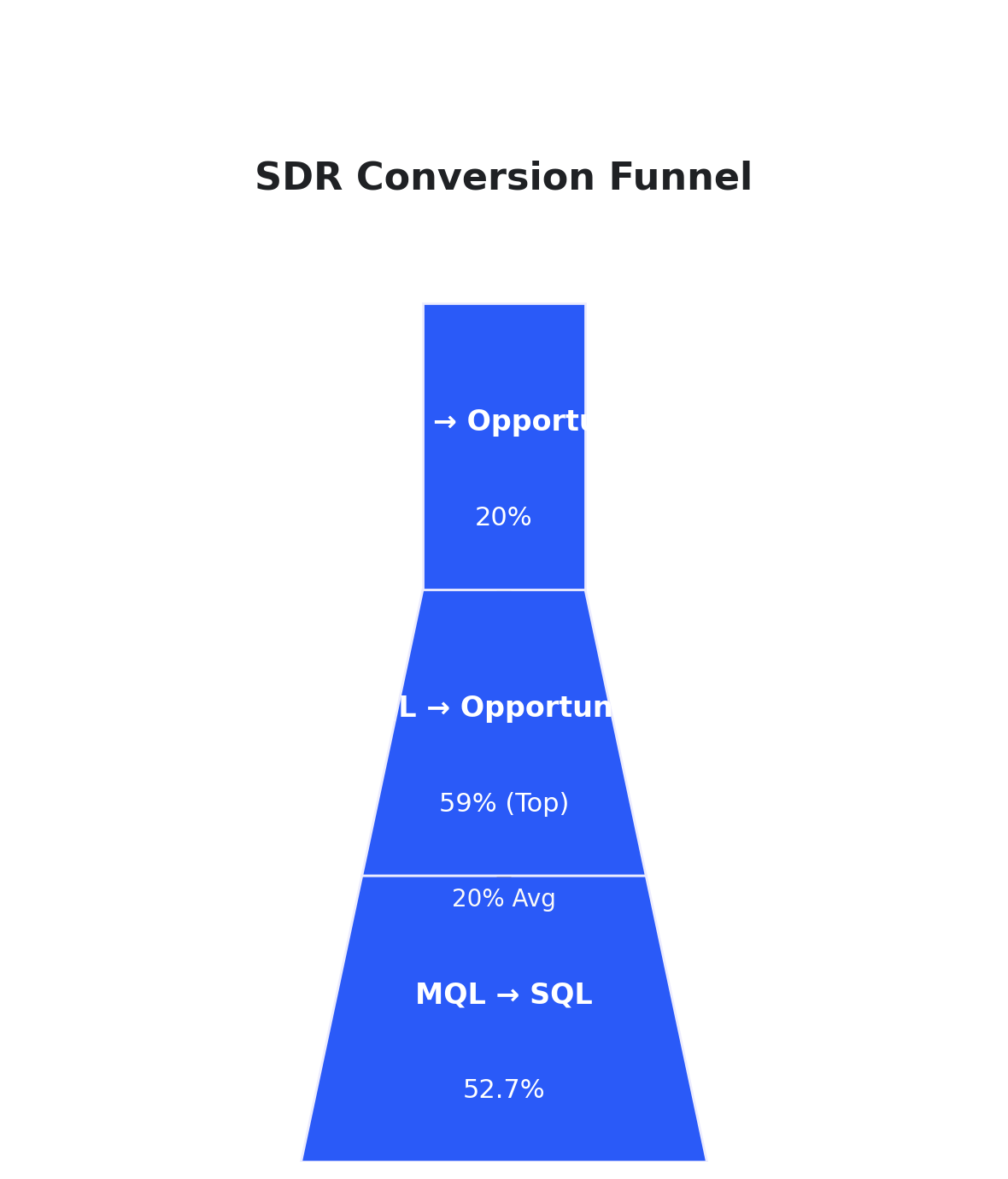
The average MQL to SQL conversion rate sits at 52.7%, according to Operatix’s latest research. That means roughly half of your marketing-qualified leads should be making it through qualification. If you’re significantly below this, your qualification criteria might be too strict (or your marketing might be sending you junk).
But here’s where things get interesting. Top-performing SDR teams convert 59% of SQLs into opportunities, based on Gartner’s research. The average? Only about 20%. That gap between mediocre and excellent is massive—and it’s where you’ll find your biggest opportunity for improvement.
When it comes to booking meetings, outbound teams typically book 15 meetings per month, with an 80% show rate. That means 12 actual held meetings per month per rep. The Bridge Group found slightly higher numbers at 21 bookings with a 62% conversion rate. Either way, if you’re booking fewer than 12 meetings monthly, you’ve got work to do.
And the ultimate conversion? Your lead-to-opportunity conversion rate should hover around 20%. That’s your North Star metric. For every 100 prospects you engage, 20 should become real opportunities. Anything less means your targeting, messaging, or follow-up process needs attention.
Email Performance: What Actually Gets Responses
Email is still the workhorse of B2B sales, but most teams are doing it wrong. Here’s what the data actually says.
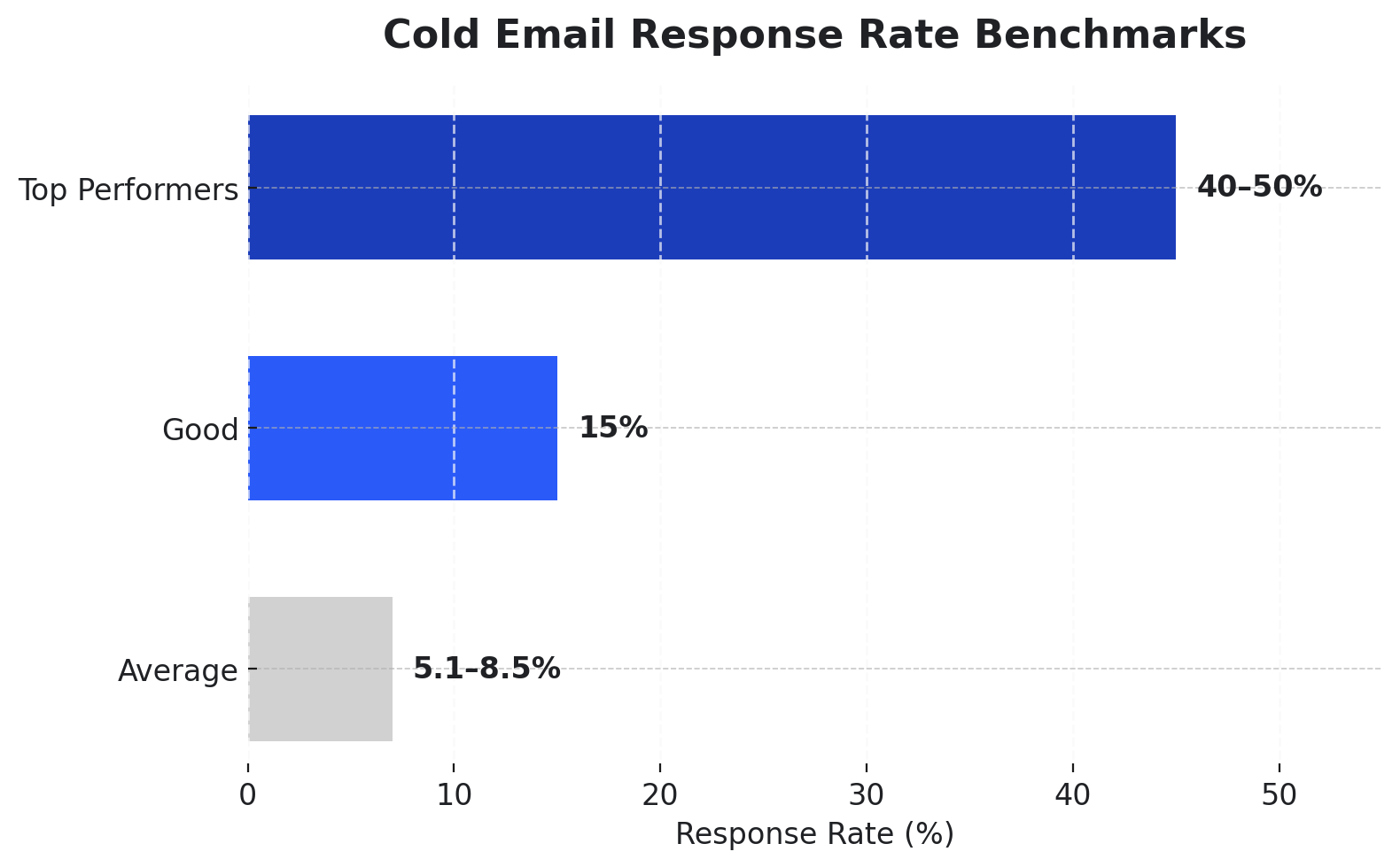
Cold email response rates range from 5.1% to 8.5% across industries, according to recent studies. But here’s the kicker: a “good” reply rate is 15% or higher, and top performers consistently hit 40-50%.
📊 Beat Average Email Performance
Our LinkedIn outbound engine combines targeting precision, personalized messaging, and multichannel sequences for 40%+ response rates.
What separates the best from the rest? Personalization. Highly personalized emails achieve 2-3x higher reply rates than generic templates. Yet only 5% of reps consistently personalize every message. That’s your competitive advantage right there.
The average cold email open rate sits between 20-40%. If you’re below 20%, your subject lines need work. If you’re above 40% but not getting replies, your email body isn’t delivering value.
Here’s something most people miss: email sequences with 4-7 messages generate 27% response rates—that’s three times better than using just 1-3 emails. And your first follow-up alone can boost responses by 50%.
Length matters too. Emails between 50-125 words get about 50% reply rates, but anything longer than 125 words and you’ll watch your response rate crater. Keep it tight.
Want to know the best day to send? Thursday pulls a 6.87% average reply rate—the highest of any weekday. Tuesday through Thursday mornings (9-11 AM in the prospect’s time zone) see 30-40% higher connect rates than other time periods.
Call Connect Rates: The Cold Reality
If you think email is tough, calls are even harder. But they’re still essential.
It takes 18 or more dials to connect with a prospect over the phone, according to Gartner. And when you do connect, call-back rates are less than 1%. Brutal, right?
A good connect rate falls between 25-35%. Anything below 20% suggests problems with your calling tools, data quality, or timing. The average SDR has about 3.6 quality conversations daily, which over a 20-day work month adds up to 72 connects.
Most reps see an average of 4.4 connects per 100 touches. That’s why you can’t rely on calls alone—you need a multichannel approach.
The Multichannel Advantage
This is where things get really interesting. When you combine email, phone, and social touches, magic happens.
Multichannel outreach increases engagement by 287% compared to single-channel approaches. And using three or more channels for campaigns results in a 494% higher order rate than single-channel campaigns.
🚀 Deploy True Multichannel Outbound
We design LinkedIn-led campaigns with email and phone integration—proven 494% higher order rates than single-channel.
Even simpler multichannel tactics work. Multi-channel follow-ups see 28% higher conversion rates than email-only sequences. The data is clear: prospects respond better when you reach them where they are, not just where you prefer to be.
Here’s the persistence factor: 80% of sales require 5 or more follow-ups. Yet 44% of sales reps stop after just one attempt. That’s like running a marathon and quitting at mile 3.
Sequences with 11 or more touches see up to 10% higher conversion rates than short cadences of six or fewer. But here’s the thing—you can’t just spam people. Each touch needs to add value.
Speed Wins: The Response Time Factor
This stat should be tattooed on every sales leader’s forehead: engaging with leads within 5 minutes of receiving a response increases conversion rates by 400%.
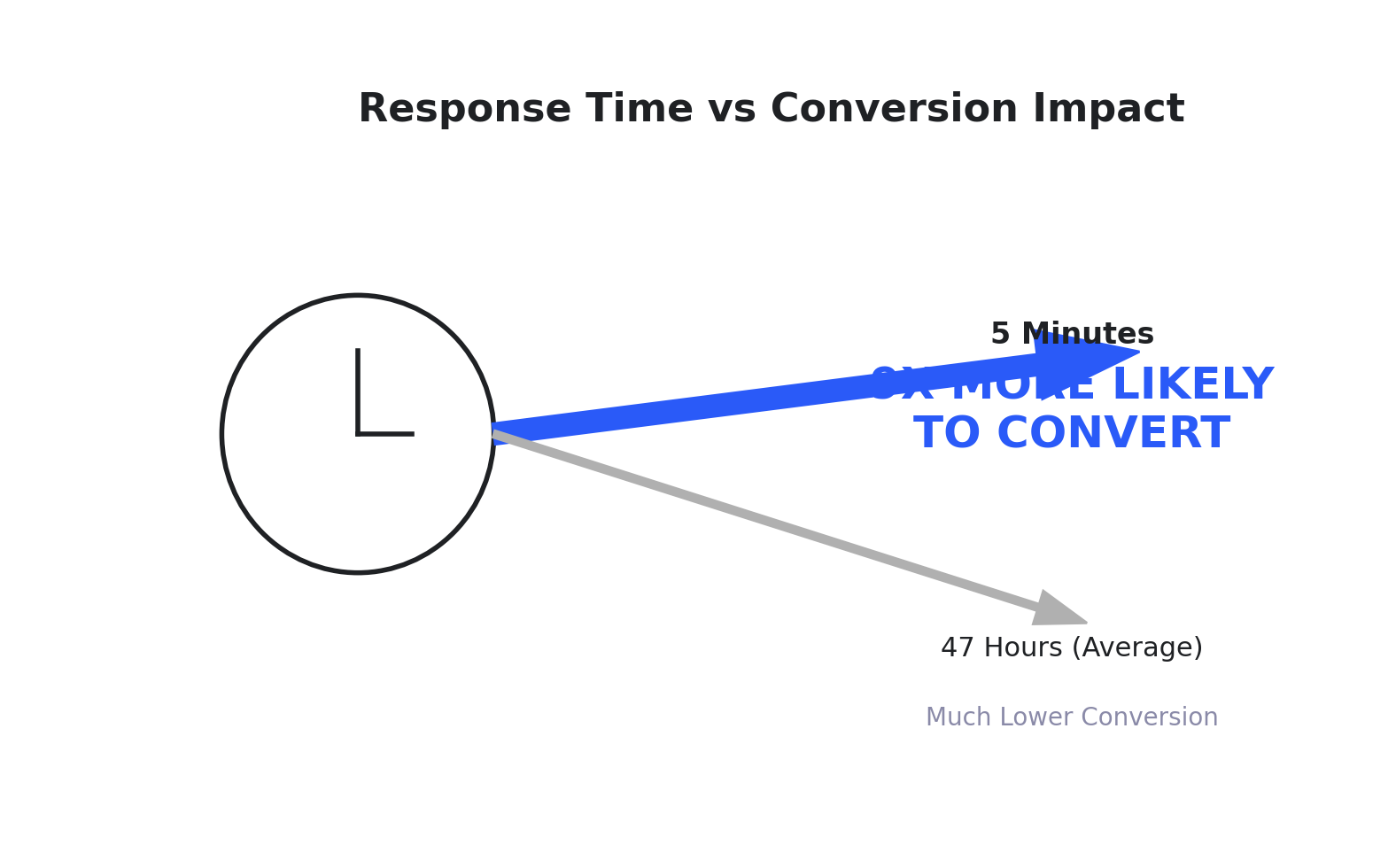
Yet the average lead response time is 47 hours. Forty-seven hours! By then, your prospect has already moved on, talked to a competitor, or decided they don’t need a solution after all.
Leads contacted within 5 minutes are 9x more likely to convert than those contacted later. Speed isn’t just a nice-to-have—it’s a competitive weapon.
Pipeline Generation: The Revenue Impact
Let’s talk about the real impact of sales development on your bottom line.
SDRs generate between 46% and 73% of pipeline, depending on your ACV and business model. TOPO’s research shows this consistently across B2B companies. Outbound SDRs are responsible for 53% of pipeline conversion specifically.
The median SDR-generated pipeline? $3 million annually, according to the Bridge Group. But this varies wildly by deal size.
For lower ACV companies (under $25k deals), SDRs generate $191k in pipeline monthly. For higher ACV companies, that number jumps to $600-700k per month per rep.
Here’s a reality check though: 71% of sales development teams deliver less than half the sales pipeline. That means most teams are underperforming. If your SDRs are generating less than half your pipeline, you’ve got significant room for improvement.
Lead Quality Matters: High-Intent vs Low-Intent
Not all leads are created equal, and your conversion rates will reflect that.
High-intent leads (demo requests, “contact sales” forms) convert at 75-80% from lead to meeting. These people are practically begging to talk to you.
Low-intent leads (content downloads, webinar attendees) convert at just 5-10%. That’s a 15x difference! This is why lead scoring and prioritization matter so much.
If you’re treating every lead the same, you’re leaving money on the table. Top performers segment their lists and adjust their approach based on intent signals.
What Top Performers Do Differently
The gap between average and exceptional isn’t about working harder—it’s about working smarter.
Top-performing teams maintain meeting hold rates of 85% or higher. Average teams? Closer to 62-80%. That difference compounds fast.
The best reps use structured cadences rather than random outreach. They plan 8-12 touchpoints over 2-4 weeks, mixing channels strategically. Random acts of prospecting don’t cut it anymore.
Personalization is non-negotiable for top performers. They spend more than 10 minutes per cold email when necessary, researching prospects deeply before reaching out. Generic templates get generic results.

🎯 Scale Personalization Without Sacrificing Quality
Our LinkedIn targeting and campaign design delivers deep personalization at scale—no generic templates, just results.
They respond to inbound leads within 5 minutes, not 5 hours or 5 days. They have alerts set up, calendars blocked, and systems in place to move fast.
They follow up consistently. While 44% of reps quit after one attempt, top performers plan 5-10 touches minimum. They know most deals happen in the follow-up.
Industry Context: Your Mileage May Vary
Before you compare your numbers to these benchmarks, remember that context matters.
B2B sales cycles are getting longer—the average has increased from 33 days in 2020 to 43 days by early 2025, a 30% increase. Longer cycles mean you need more patience and more persistent follow-up.
Companies using predictive analytics for lead scoring see a 16% boost in sales conversions. If you’re still qualifying leads manually without data-driven insights, you’re at a disadvantage.
Different industries see wildly different conversion rates based on deal complexity, price point, and buying processes. A $5k SaaS deal converts differently than a $500k enterprise contract.
The Technology Factor
Modern SDRs aren’t just hustlers with a phone—they’re power users of technology.
AI-powered personalization can increase email open rates by 50% compared to non-personalized emails. Tools that help you personalize at scale are no longer optional.
⚡ Get Complete Outbound Infrastructure
We handle targeting, campaign design, and scaling—giving you a LinkedIn outbound engine that converts while you focus on closing.
7-day Free Trial |No Credit Card Needed.
Sales engagement platforms that manage multichannel sequences are basically mandatory now. Manual processes don’t scale, and they definitely don’t keep up with the pace needed to capture modern buyers.
Having access to verified, accurate contact data dramatically improves connect rates and conversion rates. Bad data means wasted effort, lower conversions, and frustrated reps.
Conclusion
Here’s the bottom line: conversion rates aren’t just numbers on a dashboard—they’re a direct reflection of your process, your data quality, and your team’s execution.
The benchmarks are clear. 52.7% MQL to SQL. 59% SQL to opportunity for top performers. 15-21 meetings booked monthly. 5-8% cold email response rate as average, 15%+ as good.
But here’s what really matters: the gap between average and excellent is massive, and it’s where you’ll find your biggest opportunities. Most teams aren’t failing because they don’t work hard enough—they’re failing because they don’t know what “good” looks like.
Focus on three things: get your data quality right, build multichannel sequences with 5+ touches, and respond to inbound leads within 5 minutes. Do those three things consistently, and you’ll beat 80% of your competition.
The numbers don’t lie. Now go use them.
FAQs
What is a good SDR conversion rate?
How many meetings should an SDR book per month?
How does LinkedIn Premium help me stand out to recruiters?
How many follow-ups does it take to convert a lead?
What's the best channel for SDR outreach?
Transform Your SDR Conversions
LinkedIn outbound delivers 287% higher engagement than single-channel approaches—let us build your system.
Segmentation That Actually Converts
LinkedIn outbound targets precise demographics with strategic campaign design and scaling methods