
🎉Find Prospects and Send Cold Emails & LinkedIn Outbound | All in One Place

SDR Email Response Statistics That Actually Matter in 2025

Table of Contents

SDR Email Response Statistics

  • Average cold email reply rate has dropped to 5.1% from around 7% the previous year
  • Cold email open rates have dropped from roughly 36% down to 27.7% in 2025
  • First follow-up alone can increase replies by 49%, yet 48% of sales reps never send a single follow-up message
  • Campaigns with 4-7 follow-up emails achieve a 27% reply rate, triple the 9% rate of campaigns with 1-3 touches
  • Advanced personalization can achieve up to 18% reply rates—more than double the 7-9% rate for generic templates
  • Personalized subject lines boost reply rates by 35% compared to generic subject lines in cold emails
  • One follow-up email increases reply rates by 220%, making persistence critical for success
  • Highly personalized email bodies boost reply rates by 142% compared to non-personalized emails
  • Emails between 50-125 words can see 50% higher reply rates than longer messages
  • Emails containing 6-8 sentences deliver the highest reply rate at 6.9% and strong 42.67% open rate
  • Cold emails containing links have 27-35% higher spam rates than those without in initial outreach
  • Only 5% of senders actually take the time to personalize every message, creating massive opportunity
  • Campaigns targeting smaller lists of under 100 recipients achieve the best reply rates, averaging 5.5%
  • Targeting just 1-2 contacts per company delivers a 7.8% reply rate versus 3.8% when emailing 10+ people
  • Companies responding to leads within 5 minutes are 100 times more likely to connect compared to waiting 30 minutes

Picture this: You send 100 carefully crafted emails. Two people reply. Is that good? Bad? Without data, you’re just guessing—and in 2025, guessing costs you deals.

Here’s the reality check: Over 361 billion emails get sent every day. Your message is fighting for attention in an increasingly crowded inbox. Add stricter spam policies from Gmail and Outlook, and you’ve got a challenge that requires strategy, not just volume.

But here’s the good news: Email still works. 61-77% of B2B decision-makers prefer email as their initial contact channel. The people cutting through the noise aren’t sending more emails—they’re sending smarter ones.

This article breaks down the most critical email response statistics you need to know. We’re not talking vanity metrics here. We’re focused on what actually moves the needle: meaningful conversations that turn into pipeline.

Let’s dive into the numbers that matter.

Key SDR Email Response Statistics

Open Rates: The First Hurdle (But Not the Whole Story)

Open rates used to be the golden metric. Now? They’re more like a suggestion.

The benchmark: Cold emails see open rates between 23.9% and 27.7% across B2B industries. Some reports claim higher numbers around 42%, but that’s likely inflated by Apple’s Mail Privacy Protection, which automatically pre-loads emails whether the recipient actually reads them or not.

Here’s the thing: Open rates vary wildly by industry. Education hits 40.4%, while Financial Services hovers around 22.8%. So before you panic about your numbers, make sure you’re comparing apples to apples.

And honestly? Open rates are becoming less reliable. Many sales teams are ditching tracking pixels altogether because emails without them often land in the inbox more reliably and get better response rates. An artificially high open rate means nothing if nobody’s replying.

Bottom line for skimmers: Don’t obsess over opens. Focus on replies.

Response Rates: The Metric That Matters Most

This is where the rubber meets the road. A reply means genuine interest. It’s the first step toward an actual conversation.

The benchmark: Average cold email response rates fall between 5.1% and 8.5%. A “good” response rate is generally 5-10%, while top performers consistently break 10% and elite campaigns can hit 20%+ with hyper-personalization.
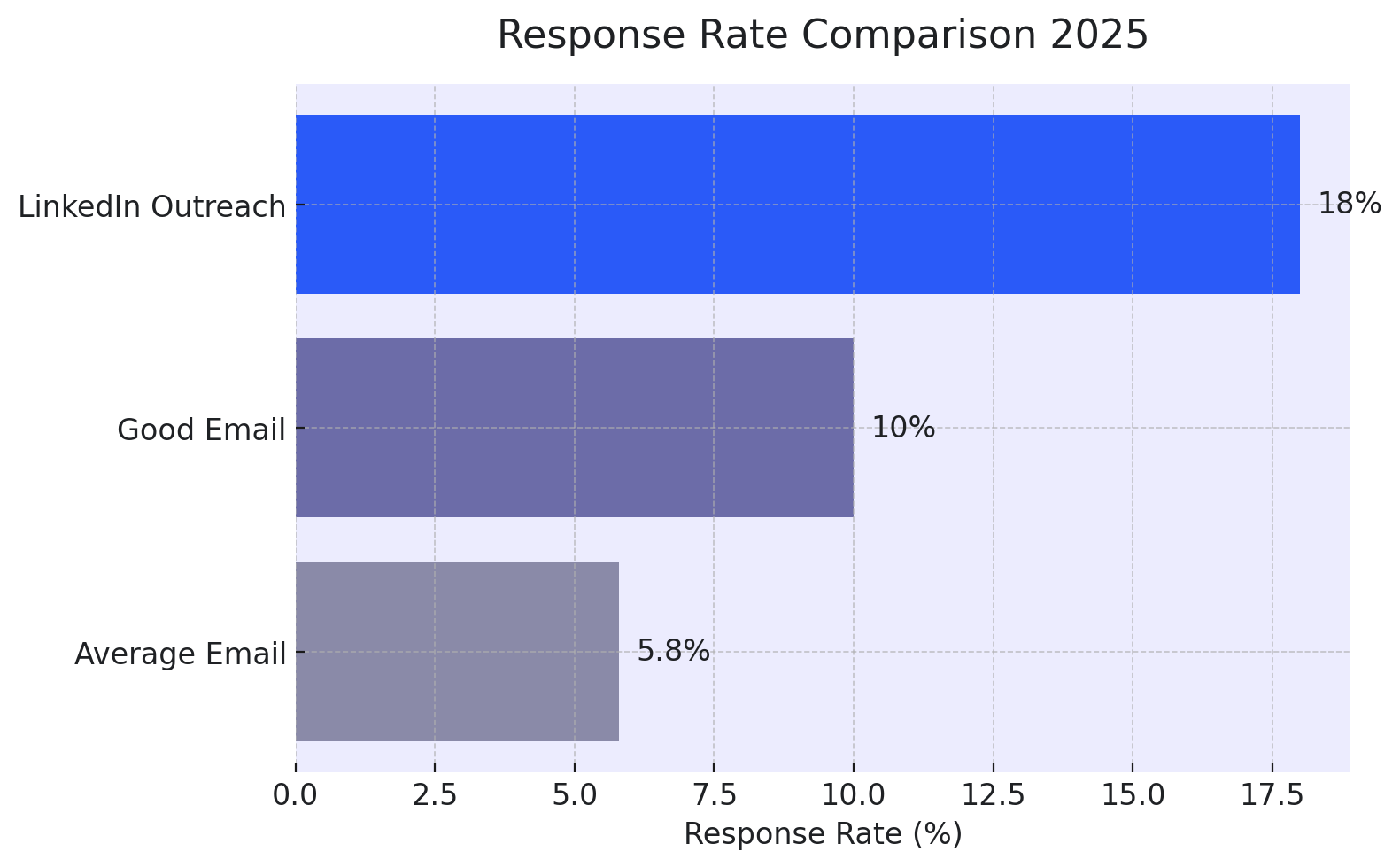


But here’s the trend you need to know: Response rates dropped 15% year-over-year, falling from 6.8% to 5.8%. Inbox fatigue is real. People are drowning in outreach, and generic messages get ignored faster than ever.

📉 Email Fatigue Killing Your Response?

LinkedIn outreach delivers 3x better engagement with native personalization and zero spam filters.

Use these as your starting point, not your ceiling. UnderstandiWant to calculate your response rate? It’s simple: (Unique Replies ÷ Delivered Emails) × 100.

If your response rate is below 5%, something needs to change. But if you’re above 10%? You’re doing something right.

Click-Through Rates: Handle With Care

Click-through rates measure how many people clicked a link in your email. Average CTR for B2B emails ranges from 1-3%.

But here’s the catch: Including links in cold emails is risky. While links might boost engagement by 15% in warmed-up campaigns, they can increase spam placement rates by 27-35% in cold outreach. Your email might never reach the inbox at all.

The trade-off: More clicks from fewer people, or better deliverability to everyone? Most pros choose deliverability and save the links for follow-ups.

From Email to Deal: The Full Funnel

Let’s talk about the entire journey from send to closed deal.

Email-to-Meeting: Most productive SDRs book around 15 meetings per month. It takes serious volume—sometimes 100 dials or equivalent emails—to secure a single meeting.

Lead-to-Opportunity: For SaaS companies, the average lead-to-opportunity conversion rate is about 12%. Top-tier teams with solid qualification processes? They convert 59% of qualified leads into opportunities.

Email-to-Deal: Here’s the sobering reality: The average cold email conversion rate to a closed deal is 0.2153%. That means you need roughly 464 cold emails for every closed deal.

Sounds brutal, right? But this is exactly why data-driven strategies matter. Small improvements in response rates compound into massive pipeline gains.

Industry Breakdown: Know Your Benchmarks

Different industries see wildly different performance. Here’s what you need to know:

Software/SaaS:

  • Open Rate: 47.1%
  • Reply Rate: 1.9%
  • Conversion to Deal: 0.03%

IT & Consulting:

  • Open Rate: 26.2%
  • Reply Rate: 3.5%
  • Conversion to Deal: 0.04%

Marketing & Advertising:

  • Open Rate: 35.7%
  • Reply Rate: 4.4%
  • Conversion to Deal: 0.09%

Financial Services:

  • Open Rate: 22.8%
  • Reply Rate: 3.3%
  • Conversion to Deal: 0.10%

ng where you stand helps you set realistic goals and identify improvement opportunities.

What Actually Drives Email Response Rates

Knowing the benchmarks is step one. Understanding what moves them is where you win.

Personalization: The 2x Performance Multiplier

Generic emails die in the inbox. Personalized ones start conversations.

The numbers: Emails with advanced personalization (beyond just name and company) see a 142% lift in reply rates—jumping from 7% to 17%. That’s more than double the performance.

But here’s what “advanced personalization” actually means:

  • Referencing a recent LinkedIn post they shared
  • Mentioning a specific company initiative you researched
  • Connecting your solution to a pain point they’ve publicly discussed
  • Showing you understand their role and challenges

Five minutes of research per prospect can double your results. That’s a trade worth making.

🎯 Personalization at LinkedIn Scale

Our targeting engine finds perfect prospects and automates personalized outreach that actually converts.

Email Length: Shorter Wins

Your prospects are busy. Respect that.

The sweet spot: Emails under 125 words consistently outperform longer ones. Some high-performing campaigns with ultra-focused messages hit 50% reply rates by keeping it incredibly concise.
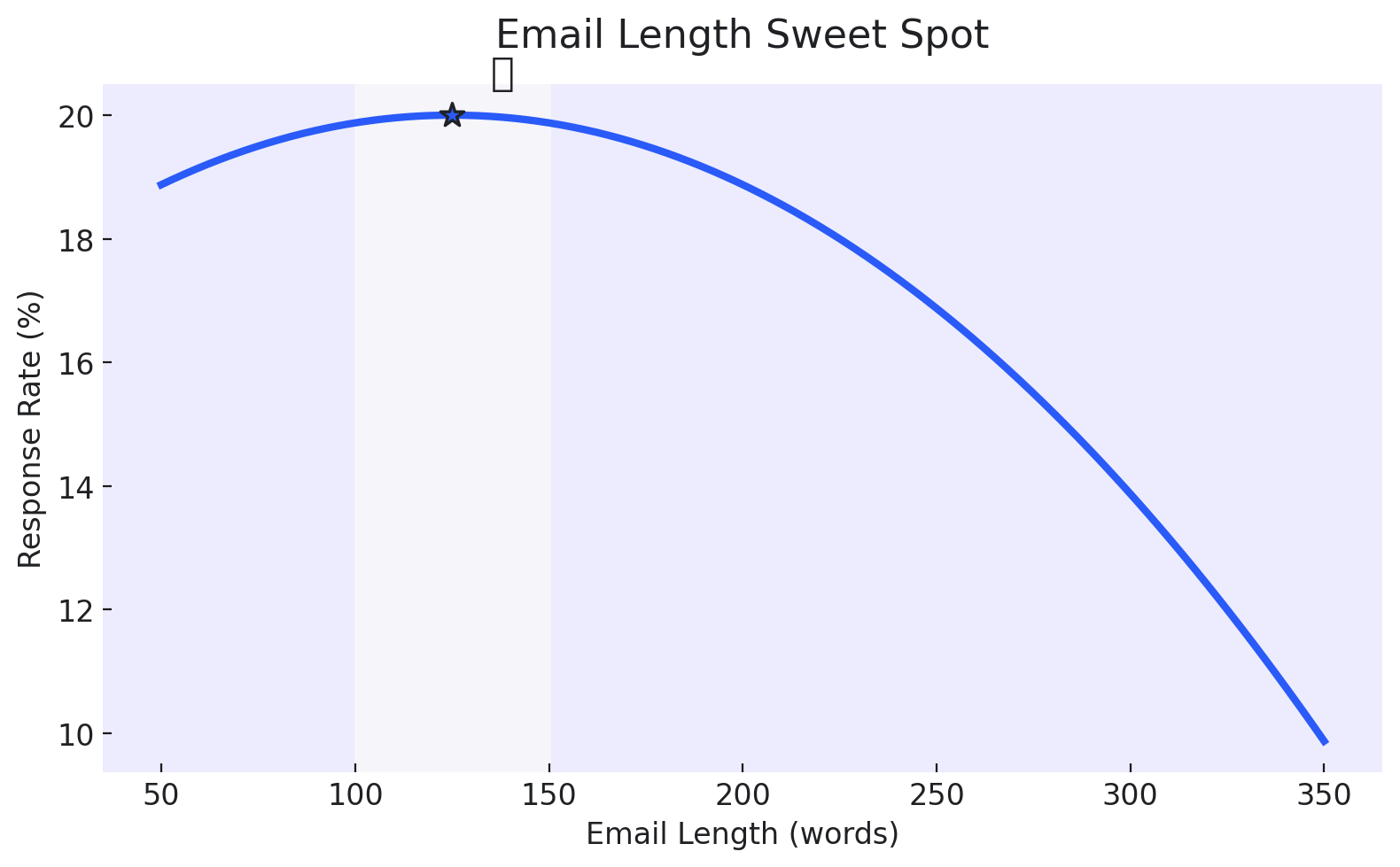


Think of it this way: Every extra sentence is a chance for them to lose interest. Cut the fluff. Get to the point. Make every word earn its place.

Follow-Ups: The Persistent (But Not Annoying) Approach

Most people don’t reply to your first email. That doesn’t mean they’re not interested—they’re just busy.

The data: Sequences with 4-7 emails see 200% higher response rates (jumping from 9% to 27%) compared to 1-3 email sequences.
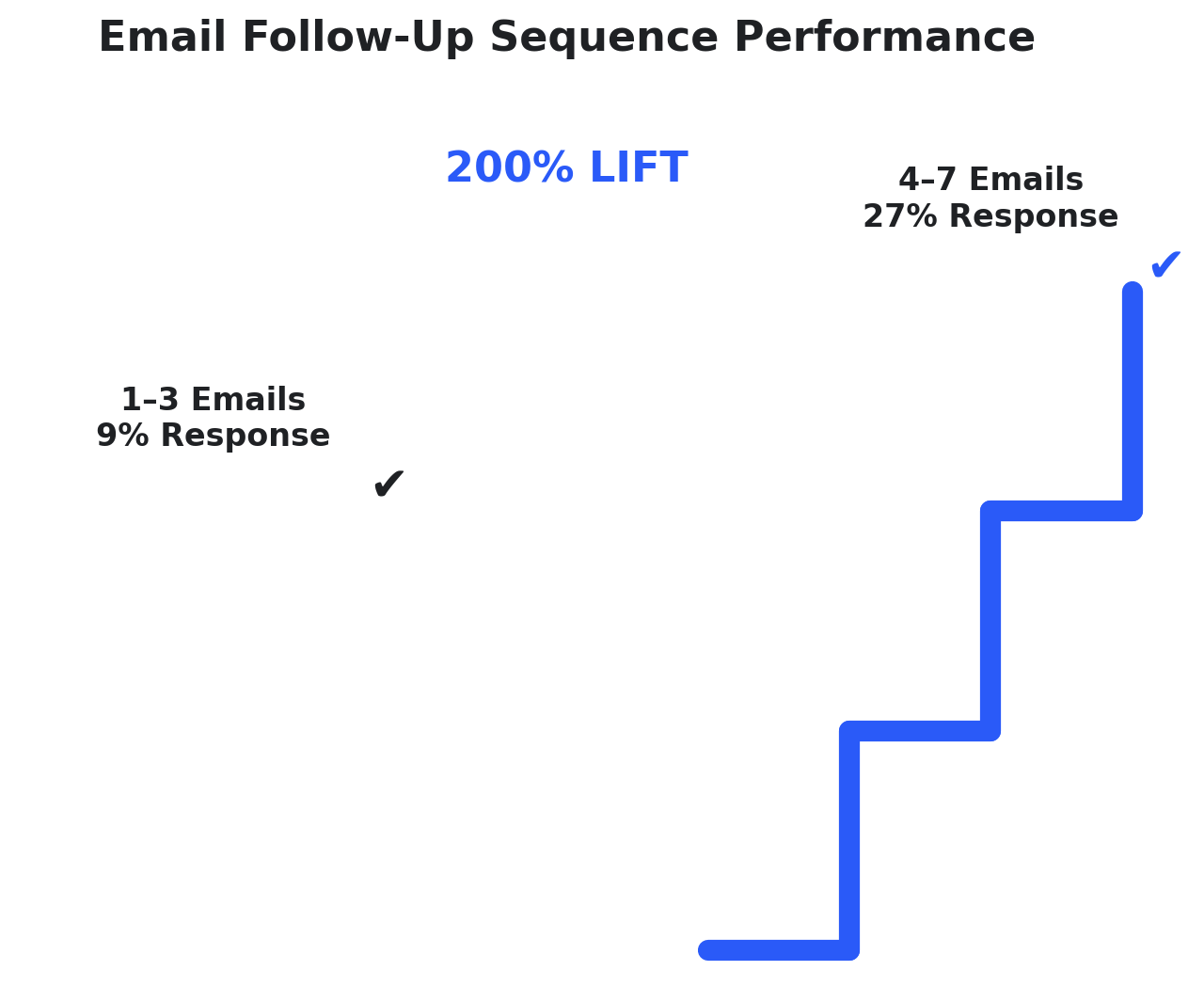


But here’s the nuance: After the third email, unsubscribe and spam complaint rates start climbing. You need to add value in every follow-up, not just say “bumping this up in your inbox.”

Each follow-up should:

  • Reference something new or relevant
  • Provide additional value or insight
  • Give them a reason to engage beyond “just checking in”

Timing: When You Send Matters

Not all sending times are created equal.

Best days: Tuesday, Wednesday, and Thursday consistently outperform Monday and Friday. Early morning (6-9 AM) sees the highest reply rates at 6.43%, when inboxes are freshest.

The surprise winner: Late evening (8-11 PM) shows remarkably high engagement at 6.52% reply rates. Why? Less competition. Your email isn’t buried under 50 others.

Afternoon options: The 1-3 PM window offers a secondary peak right after lunch.

Test different sending times for your specific audience. B2B tech buyers might check email different hours than healthcare executives.

Targeting: Quality Over Quantity Always Wins

This might be the most counterintuitive finding in all the data.

Campaign size matters: Small, focused campaigns targeting fewer than 100 recipients get 5.5% reply rates. Blast 1,000+ people? Your reply rate crashes to 2.1%.

Contacts per company: Target just 1-2 carefully selected contacts per company for 7.8% reply rates. Spray 10+ people at the same org? You’ll see 3.8% replies as you look untargeted and spammy.

Seniority sweet spot: Entry-level professionals reply at 8% rates, while C-level executives dip to 5% or lower. Sometimes a bottom-up approach (building an internal champion) beats going straight to the top.

The takeaway: Smaller, smarter lists crush large, generic blasts every single time.

🚀 Precision Targeting Without The Guesswork

LinkedIn’s 1 billion professional profiles let us build campaigns that hit exact buyer personas.

Building Your High-Performance Email Strategy

Data without action is just trivia. Here’s how to actually use these insights.

Audit Your Current Performance

Run through this quick checklist:

Response Rate Check: Compare your average against the 5.8% benchmark and your industry average. Where do you stand?

Personalization Test: What percentage of your emails go beyond name and company? Are you seeing the potential 2x lift between generic and personalized campaigns?

Length Analysis: Count the words in your templates. Are you under 125 words? If not, what can you cut?

Follow-Up Review: How many touchpoints are in your sequences? Are you tracking engagement past the third email?

Level Up Your Team’s Skills

The best tools in the world won’t save bad execution. Focus on these fundamentals:

The 5-Minute Research Rule: Train your team to find one meaningful personalization angle in five minutes or less. This might be a LinkedIn post, a podcast quote, or a news mention. Make it real, make it relevant.

Value-First Framework: Structure emails around solving problems, not pitching products. Your first email’s job is to earn a conversation by showing you understand their world.

Multi-Channel Approach: Email is powerful, but it’s even better when combined with other touchpoints. High-growth teams average 16 touchpoints across channels. A simple LinkedIn profile view before an email can boost reply rates to 11.87%.

💡 LinkedIn + Email = Unstoppable

We design complete multi-channel sequences with LinkedIn leading the conversation every time.

7-day Free Trial |No Credit Card Needed.

The Right Tools Make It Possible

You can’t execute a data-driven strategy without the right tech stack.

For finding and verifying quality contacts, you need accurate contact data. Bad data wastes 27.3% of a sales rep’s time—that’s over 500 hours per year down the drain.

For managing sequences and tracking performance, automation tools help you test, measure, and optimize systematically. You need visibility into what’s working so you can do more of it.

And if you want to improve your email deliverability, start with the basics: proper sending infrastructure, domain warmup, and list hygiene. No strategy works if your emails land in spam.

What Top Performers Do Differently

Let’s put it all together in one clear picture:

Personalization: Advanced vs generic = +142% reply rate improvement Email Length: Under 125 words vs 200+ words = Significant increase, up to 50% in some cases Follow-Ups: 4-7 email sequence vs 1-3 emails = +200% response rate Targeting: 1-2 contacts per company vs 10+ = +105% reply rate Campaign Size: Under 100 prospects vs 1,000+ = +162% reply rate

These aren’t marginal gains. These are business-changing improvements that come from being more strategic, not just more active.

Conclusion

The landscape of email outreach in 2025 is clear: Working harder doesn’t cut it anymore. Working smarter does.

Yes, average reply rates are declining. Yes, inboxes are more crowded than ever. And yes, spam filters are getting stricter. But here’s what the data proves beyond doubt: Smaller, smarter, and more personalized approaches consistently crush spray-and-pray tactics.

The teams winning aren’t sending more emails—they’re sending better ones. They’re doing the research. They’re keeping messages concise. They’re following up with value. They’re targeting precisely. And they’re seeing the results in their pipeline.

Every statistic in this article represents a lever you can pull to improve your performance. Pick one. Test it. Measure the results. Then pick another.

Success in sales outreach isn’t about magic bullets or secret hacks. It’s about mastering the fundamentals that data says work, then executing them consistently.

Your competition is still sending generic mass blasts. You now know better.

FAQs

What's a good response rate for cold emails in 2025?

A good response rate is 5-10%, with average rates hovering around 5.8%. If you're hitting above 10%, you're in top-performer territory. Elite campaigns with excellent personalization and targeting can reach 20%+.

Should I worry about my open rates?

Not as much as you used to. Open rates are becoming less reliable due to Apple's Mail Privacy Protection and other factors. Many emails show as "opened" when they weren't actually read. Focus on response rates instead—they're the metric that actually indicates engagement.

How many follow-up emails should I send?

Data shows that 4-7 email sequences perform best, delivering 200% higher response rates than shorter sequences. However, watch your unsubscribe and spam complaint rates after the third email. Each follow-up needs to add value, not just say "checking in."

Does email length really matter?

Absolutely. Emails under 125 words consistently outperform longer ones. Every extra sentence is another chance for your prospect to lose interest. Keep it concise, respect their time, and get to the point quickly.

When's the best time to send cold emails?

Early morning (6-9 AM) and surprisingly, late evening (8-11 PM) show the highest reply rates at around 6.4-6.52%. Tuesday, Wednesday, and Thursday tend to outperform Monday and Friday. But test what works for your specific audience—timing can vary by industry.

LinkedIn Outreach Beats Email Stats

Get 3x higher response rates with LinkedIn’s built-in personalization and targeting tools.

Segmentation That Actually Converts

LinkedIn outbound targets precise demographics with strategic campaign design and scaling methods

How to Build a High-Converting B2B Sales Funnel from Scratch on LinkedIn ​